How to Start a Metal Roofing Hail Claim
To start a metal roofing hail claim, photograph the roof and nearby metal surfaces, record the storm date, and review your policy for a cosmetic damage exclusion and wind or hail deductible. Have a qualified professional inspect the panels, seams, fasteners, and coating before repairs erase evidence. Then submit the inspection findings, photos, storm records, and repair estimate to your insurer.
A dent does not automatically mean a metal roof has stopped working. The key question is whether hail changed only its appearance or impaired its ability to protect the building. That distinction matters especially for commercial and multifamily roofs, where the repair scope can be substantial and coverage depends on the policy and documented damage.
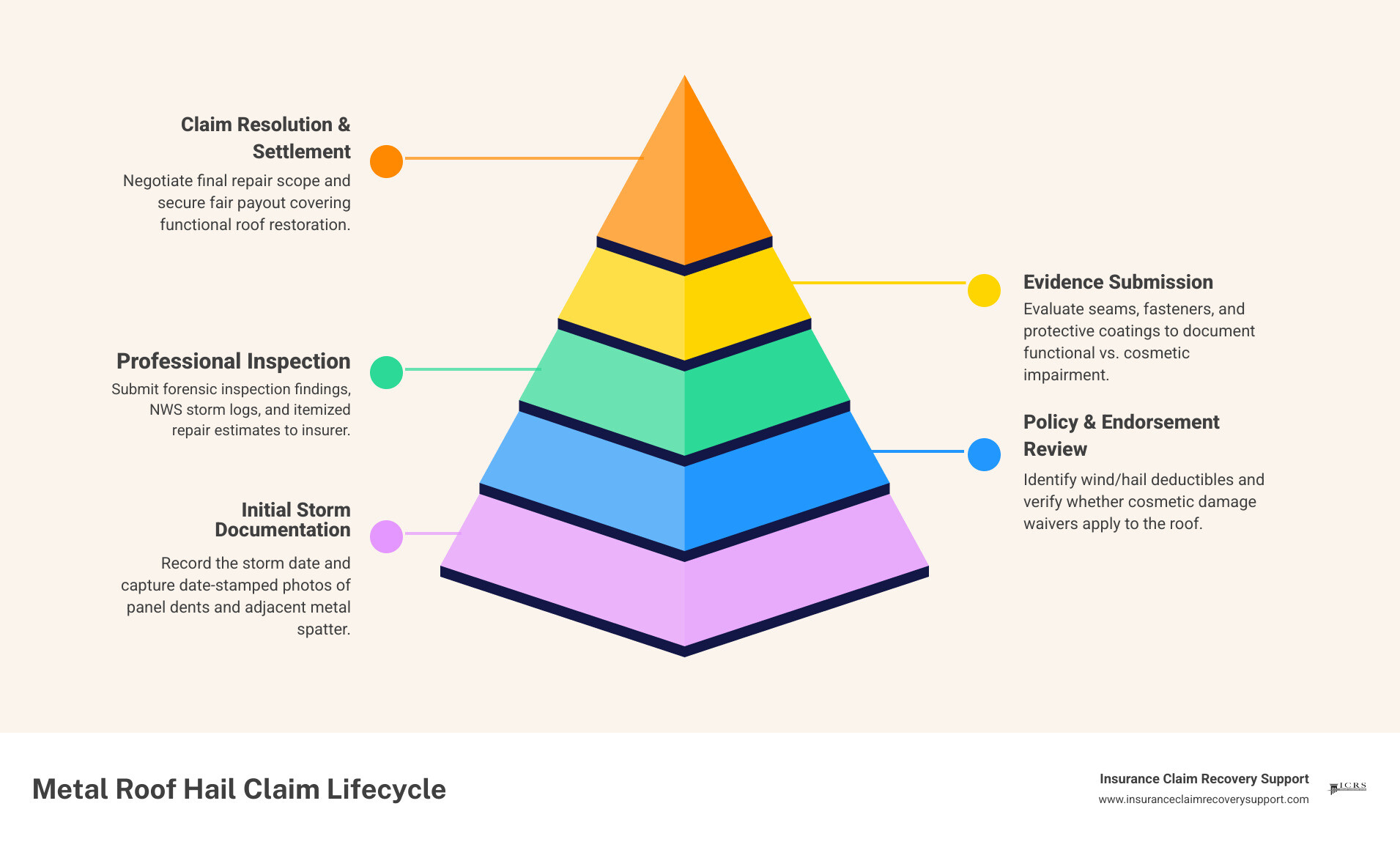
Terms related to metal roofing hail claim:
Understanding Cosmetic vs. Functional Damage in a Metal Roofing Hail Claim
When navigating a hail damage roof insurance claim, the core dispute between insurers and property owners almost always revolves around the difference between cosmetic and functional damage.
Cosmetic damage alters the visual aesthetics of the metal paneling—leaving small dimples, surface pitting, or minor indentations—without diminishing the system’s ability to act as a weather barrier. Functional damage, by contrast, impairs the physical performance, lifespan, or structural integrity of the roof system.
| Damage Type | Visual Indicators | System Impact | Standard Insurance Stance |
|---|---|---|---|
| Cosmetic Damage | Shallow indentations, minor panel dimpling, uniform surface marks | Purely aesthetic; water shedding remains intact | Often excluded under cosmetic waivers |
| Functional Damage | Cracked factory paint, torn seams, loose fasteners, metal punctures | Compromised water barrier, accelerated corrosion risk | Covered subject to standard policy terms |
Hail does not merely dimple metal; severe impacts can compromise panel overlaps, dislodge fasteners, or create micro-fractures in factory finishes. Once a factory coating fractures, the underlying steel is vulnerable to rust and moisture intrusion, turning what looked like a minor indentation into a genuine functional failure.
Assessing UL 2218 Class 4 Impact Ratings and Rupture Thresholds
Most commercial-grade steel and aluminum roofing profiles are tested under the Underwriters Laboratories (UL) 2218 standard. In this test, steel balls of varying sizes are dropped onto panels from heights up to 20 feet. A Class 4 rating—the highest available—indicates that the metal panel withstood the drop of a 2-inch steel ball without cracking, splitting, or showing structural rupture.
While Class 4 materials excel at resisting punctures, field conditions involve jagged, wind-driven hailstones. Haag Engineering studies have shown that the typical threshold size for hail necessary to rupture metal panels in fair-to-good condition is at least 2.5 inches. Punctures may be rare with smaller stones, but impact energy can still deform seams and loosen clips, creating legitimate hail damage claims.
The Impact of Cosmetic Damage Waivers and Policy Exclusions
Carriers often add cosmetic damage endorsements to reduce policyholder premiums on metal roofs. These endorsements state that the insurer will not pay for cosmetic denting caused by wind or hail unless the roof’s water-shedding performance is compromised.
Evaluating whether hail damage is covered by insurance requires examining policy endorsements carefully. Insurers frequently point to research presented at industry conferences—such as studies showing water in shallow hail divots can evaporate faster than water in structural panel flutes—to argue against functional impairment. However, if hail impacts cause paint delamination or dislodge clip assemblies, the exclusion should not apply because the roof’s baseline barrier integrity is lost.
How Roof Architecture and Material Specifications Affect Hail Severity
The physical design of a metal roof plays a massive role in how impact energy disperses across the surface.
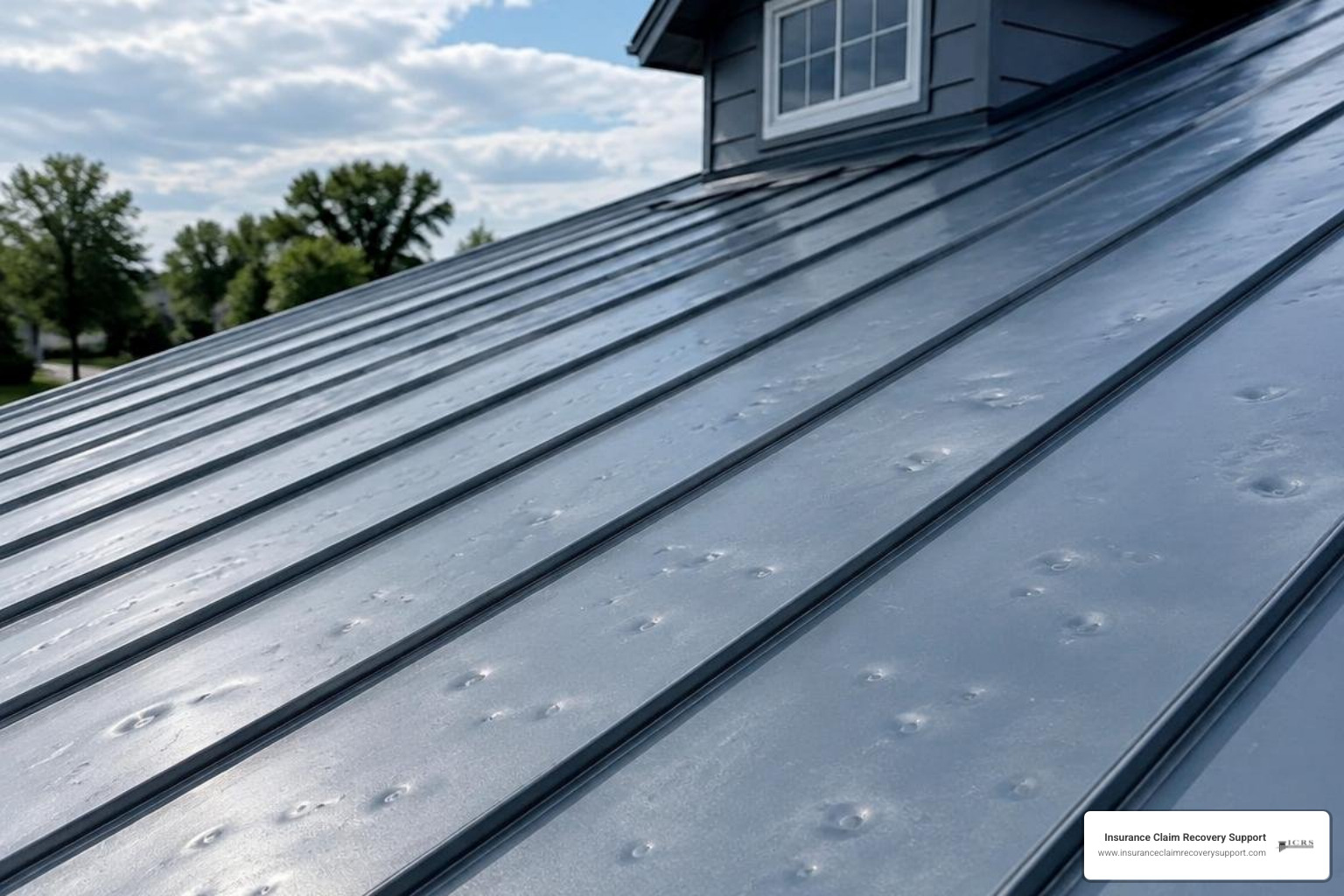
Roof pitch, panel profiles, and substrate backing all dictate whether an impact results in a faint scuff or severe structural displacement.
Metal Thickness, Gauge Selection, and Structural Profiles
Metal thickness is measured by gauge; counterintuitively, lower numbers indicate thicker metal.
- 22-Gauge to 24-Gauge Steel: Standard for commercial architectural systems and standing seam profiles. These thicker panels offer exceptional impact resistance and hold up well against severe hail.
- 26-Gauge to 29-Gauge Panels: Commonly found on light commercial or agricultural buildings. Thinner profiles show visible denting much more easily under moderate hail.
- Panel Profiles: Flat panel designs reveal dents immediately under changing sunlight, whereas corrugated, ribbed, or embossed profiles help mask aesthetic dimpling and offer greater rigidity during a roof storm damage insurance claim.
Comparing Metal Panels to Asphalt Shingles in Severe Hail Storms
Understanding how different roof assemblies respond to hail helps contextualize property risk. When managing roofing insurance claims for storm damage, policyholders frequently encounter different failure mechanics between materials:
Asphalt shingles rely on protective ceramic granules. Hail impacts dislodge these granules, leaving the underlying asphalt exposed to UV degradation and rapid deterioration. Metal roofing flexes and absorbs kinetic energy. While metal may display visible indentations, it rarely suffers immediate leaks unless seams separate or large hail ruptures the panel.
Step-by-Step Strategy to File and Document Hail Damage
Filing a successful metal roof claim requires an organized approach to preserve evidence and demonstrate covered loss under the hail damage insurance claim process.
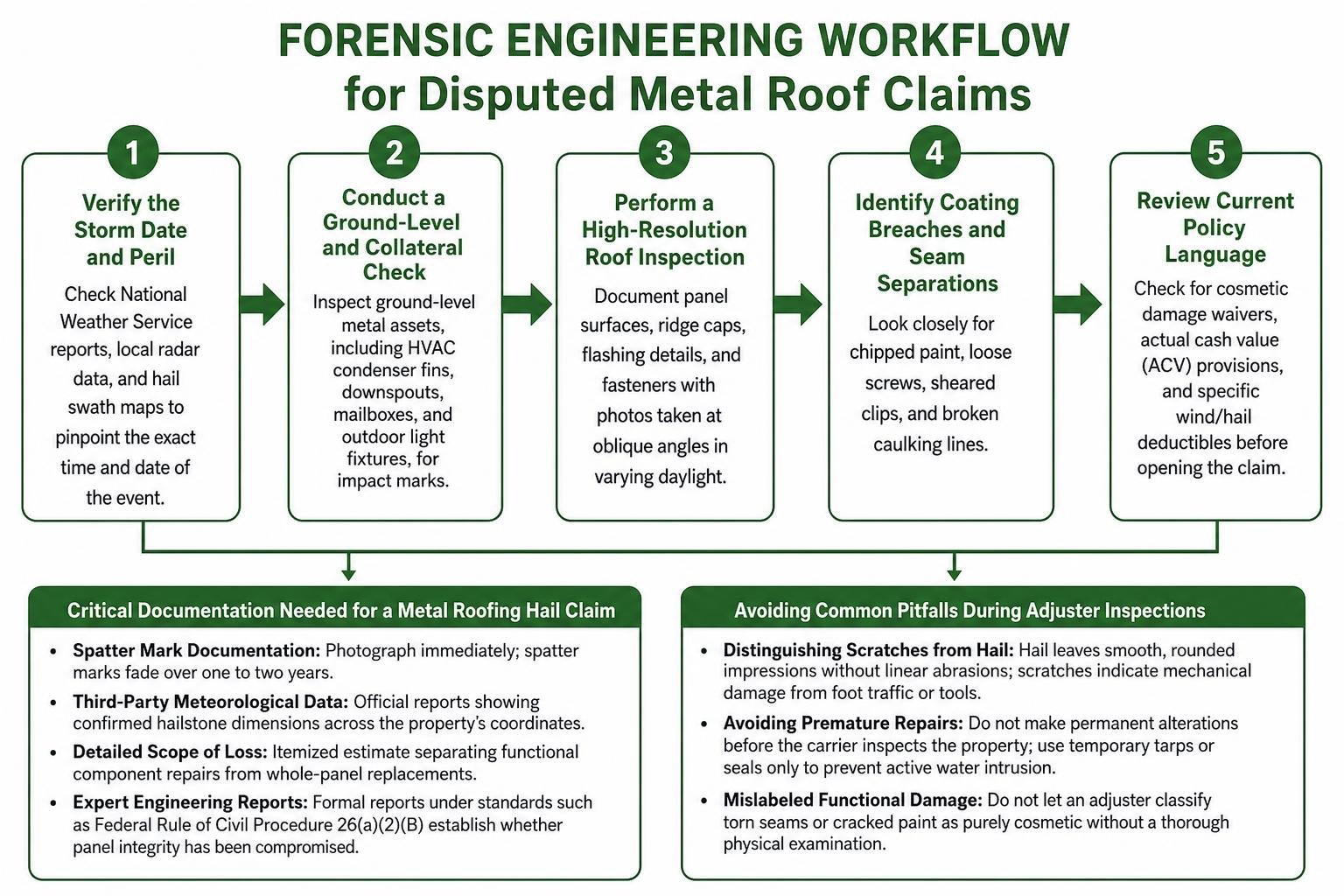
- Verify the Storm Date and Peril: Check National Weather Service reports, local radar data, and hail swath maps to pinpoint the exact time and date of the event.
- Conduct a Ground-Level and Collateral Check: Inspect ground-level metal assets, including HVAC condenser fins, downspouts, mailboxes, and outdoor light fixtures, for impact marks.
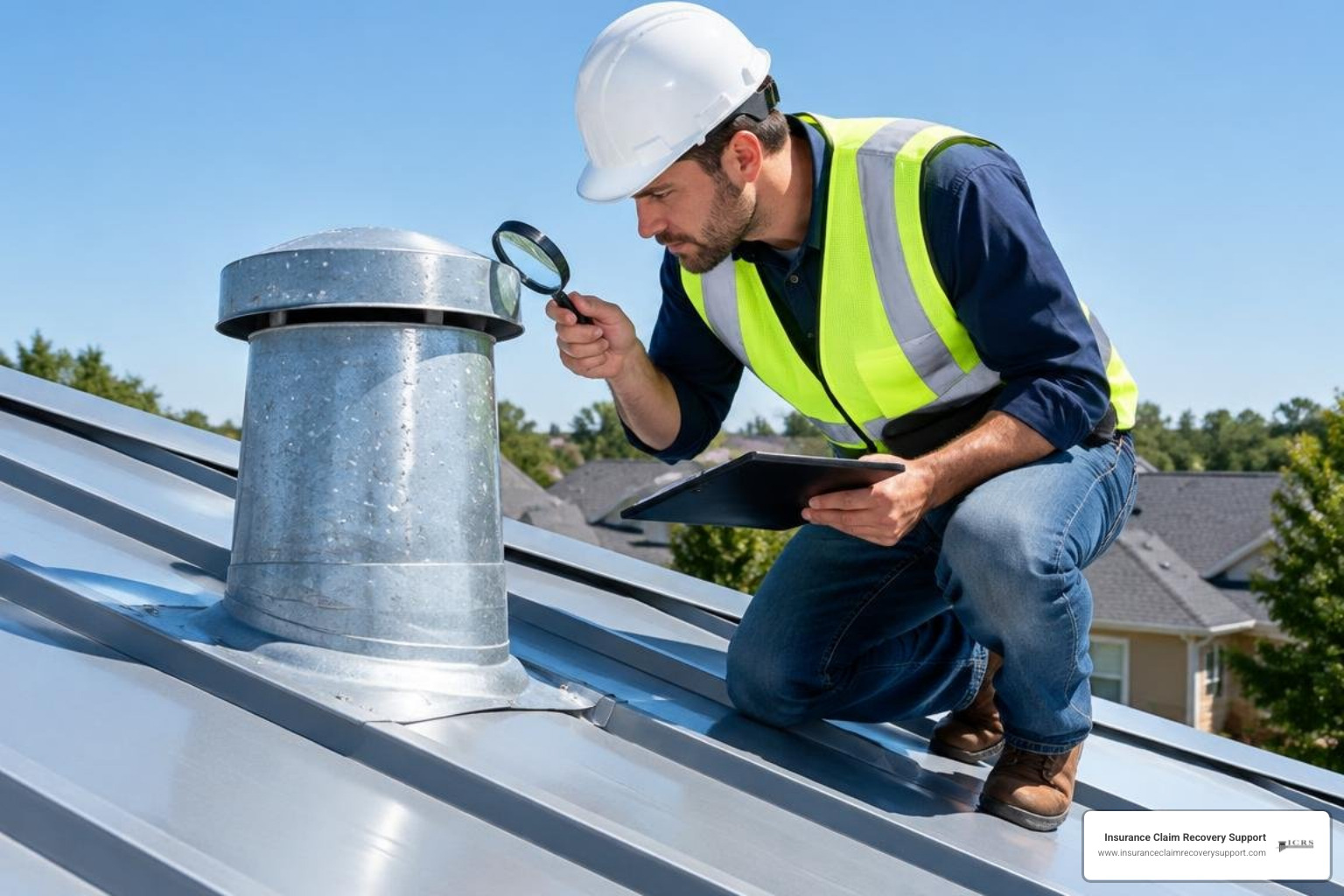
- Perform a High-Resolution Roof Inspection: Document panel surfaces, ridge caps, flashing details, and fasteners with photos taken at oblique angles in varying daylight.
- Identify Coating Breaches and Seam Separations: Look closely for chipped paint, loose screws, sheared clips, and broken caulking lines.
- Review Current Policy Language: Check for cosmetic damage waivers, actual cash value (ACV) provisions, and specific wind/hail deductibles before opening the claim.
Critical Documentation Needed for a Metal Roofing Hail Claim
A complete evidentiary package ensures your claim is supported by facts rather than assumptions. Utilizing resources like an ultimate checklist for large loss hail damage insurance claims helps organize the necessary paperwork:
- Spatter Mark Documentation: Oxidation and biological growth get knocked away by hail impacts, leaving clean “spatter marks.” Because spatter marks fade over one to two years, photographing them immediately provides objective proof of storm timing.
- Third-Party Meteorological Data: Official reports showing confirmed hailstone dimensions across the property’s coordinates.
- Detailed Scope of Loss: An itemized estimate separating functional component repairs from whole-panel replacements.
- Expert Engineering Reports: In complex commercial disputes, formal reports prepared under standards such as Federal Rule of Civil Procedure 26(a)(2)(B) establish whether panel integrity has been compromised.
Avoiding Common Pitfalls During Adjuster Inspections
Relying purely on lay testimony or visual walk-throughs often leads to underpaid claims. Property owners should keep these considerations in mind, as outlined in our roof claim adjuster guide:
- Distinguishing Scratches from Hail: Hailstones leave smooth, rounded impressions without linear abrasions. Scratches often indicate mechanical damage from foot traffic or maintenance tools.
- Avoiding Premature Repairs: Making permanent alterations before the carrier inspects the property can compromise your evidence. Implement temporary tarps or seals only where necessary to prevent active water intrusion.
- Mislabeled Functional Damage: Never let an adjuster classify torn seams or cracked paint as purely cosmetic without a thorough physical examination.
Overcoming Insurance Denials and Disputed Metal Roof Claims
When a carrier issues a partial payment or outright denial based on a cosmetic endorsement, commercial and multifamily policyholders can pursue a formal hail damage claim dispute to resolve the disagreement.
In many commercial property disputes, systemic underpayment and initial claim rejections are treated by carriers as a routine cost of doing business. Broad scrutiny across major property insurers—highlighted in reports by Insurance Journal, investigative coverage by NYT and The Guardian, reporting from CNN, and regulatory oversight detailed in the California Enforcement Action—demonstrates how aggressive adjusting practices routinely delay or minimize settlements unless policyholders push back with verifiable physical evidence.
Proving Functional Loss in a Disputed Metal Roofing Hail Claim
Proving functional loss requires connecting physical impacts to a reduction in the roof’s service life or water-shedding performance. A comprehensive presentation, as detailed in the definitive guide to large loss hail claims, focuses on tangible structural deficiencies:
- Loose or backed-out fasteners that break the seal of neoprene washers.
- Gaps created along interlocking standing seams that allow wind-driven rain penetration.
- Cracking in protective finishes (such as Galvalume or Kynar coatings) that accelerates substrate corrosion.
Utilizing Forensic Engineering and Metallurgical Evidence
For substantial commercial losses, forensic engineering provides conclusive evidence to resolve claim impasses. Independent structural engineers and metallurgists use specialized techniques when showing how to file large loss hail damage claims fast:
- Scanning Electron Microscopy with Energy Dispersive Spectroscopy (SEM-EDS): Analyzes the micro-structure of the metal coating to verify whether micro-fracturing has exposed the core steel.
- Coating Thickness Testing: Measures paint film depth around dent margins to identify localized thinning and future failure points.
- Comparative Control Testing: Compares damaged roof sections against undamaged control samples to rule out pre-existing manufacturing defects.
Frequently Asked Questions About Metal Roof Hail Claims
Will Insurance Pay for Hail Dents on a Metal Roof?
Coverage depends entirely on your specific policy language and whether you have a cosmetic damage waiver. If your policy covers cosmetic loss, standard denting is compensable. If a cosmetic exclusion is present, the damage must be proven to affect the roof’s functional ability to shed water, as explained in our guide on hail storm roof damage insurance claims.
Should Property Owners Sign a Cosmetic Damage Waiver?
While cosmetic waivers provide premium discounts, property owners should weigh the trade-offs carefully. On commercial and multifamily properties with thin-gauge, flat metal panels, signing a waiver can leave you responsible for tens of thousands of dollars in visible dent repairs following a storm.
How Can You Distinguish Hail Dents from Mechanical Damage?
Hail impacts leave rounded, indentations with consistent directional patterns across panel slopes, matching local storm trajectories. Mechanical damage from foot traffic or dropped equipment typically exhibits sharp edges, irregular scrape marks, and localized concentration around HVAC equipment.
Conclusion
Managing a complex metal roof hail claim requires objective technical evidence, a clear understanding of cosmetic endorsements, and accurate documentation. When substantial commercial and multifamily properties sustain storm damage, relying on qualified experts helps ensure that insurance carriers evaluate damage according to policy provisions and engineering facts.
For commercial building owners, apartment operators, and property managers facing complex damage evaluations or disputed scopes of loss, obtaining professional assistance for complex commercial roof claims ensures your interests are represented with thorough forensic documentation and professional claim adjustment.
Call anytime—our trained insurance claim AI assistant is available 24/7 to answer claim questions, share helpful resources, and collect information for our team. A team member will follow up during business hours.