Commercial and multifamily
Apartment complexes, offices, retail centers and industrial properties with building damage and potential operational disruption.

ICRS offers full public-adjusting representation for qualifying property claims of $250,000+ after deductible. For claims under $250,000, Claim Navigator provides paid strategic guidance, with the option for full representation when appropriate. Explore Claim Navigator.
When a fire or storm damages your building, the insurance claim can become a project of its own. ICRS helps property owners and managers document the loss and pursue a fair settlement.
Commercial properties · Apartments · Condominium & homeowner associations · Schools · Churches · High-value homes.
Request a Claim ReviewBased in Lakeway, Texas • Serving policyholders in Austin
A large property loss in Austin can involve occupied apartments, commercial tenants, association responsibilities or custom construction. Our licensed public insurance adjusters help owners and managers organize the damage, repair scope and insurer correspondence around the property involved.
Start with a building-by-building record: roof and exterior observations, affected interiors, emergency work and available estimates. For income-producing property, preserve records of disrupted operations separately from the physical repair documentation.
Understand what a public adjuster does →Meet ICRS and learn about our work with property insurance claims.
Apartment complexes, offices, retail centers and industrial properties with building damage and potential operational disruption.
Religious organizations, HOA and condominium associations, schools and historical buildings with complex repair needs.
Significant damage involving custom construction, specialized finishes and a repair scope that needs careful documentation.
A fire claim can involve more than visibly burned materials. Smoke, soot, water used during firefighting and disruption to the property’s use may also need evaluation.
Gather the policy, claim correspondence, available photographs and repair estimates for your review. Coverage and the appropriate next steps depend on the policy and circumstances.
Explore the Free Fire Claim Guide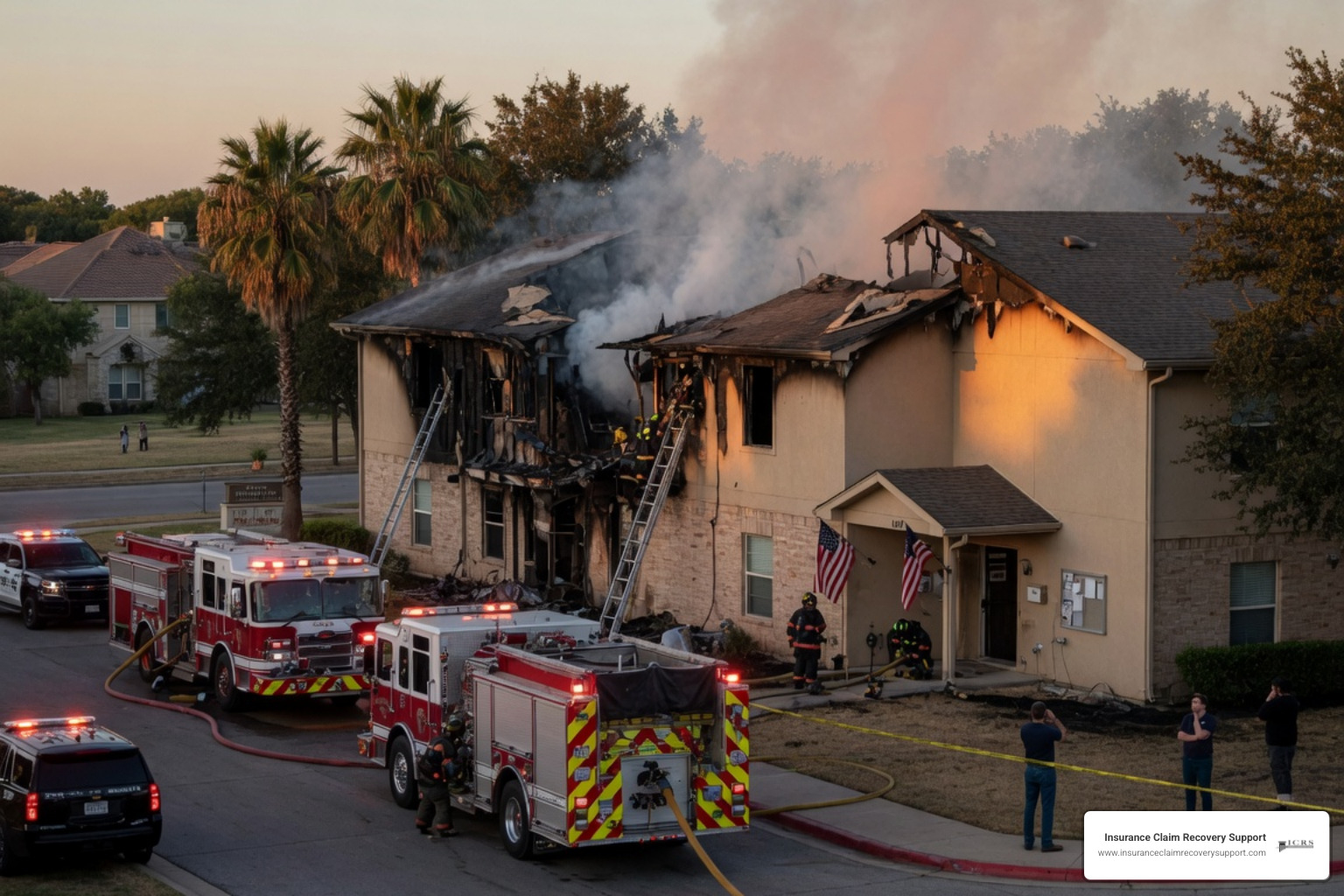
For an occupied Austin apartment community, commercial building, HOA, church, school or high-value home, organize the claim by building, room, roof area and affected system. Start with the loss category below and keep the property-specific evidence together.
Document affected rooms, contents and systems, including firefighting water and questions requiring qualified inspection. Fire and smoke claim support.
Preserve dated roof and exterior photographs, roof-system details, maintenance records and inspection findings. Match each proposed repair to an identified building or roof section. Hail claim support.
Document roof coverings, openings, exterior systems and related interior damage; keep observations tied to the loss date. Wind claim support · Tornado claims.
For a burst pipe or other water release, record the source, discovery time, affected floors and units, moisture readings and emergency work. Separate plumbing repair costs from resulting building damage. Water and burst-pipe claim support.
Retain available weather, heating, occupancy and plumbing records together with the damaged-component evidence. Review resulting water damage separately from the failed pipe or equipment. Winter-storm resources · Freeze and water claims.
Document the water source, entry points, water lines, affected building areas and cleanup records. Review the applicable flood policy separately; property coverage must be checked against its terms. Flood claim support.
Preserve incident records, equipment details, diagnostic findings and repair proposals. Qualified inspection can help distinguish direct damage from unrelated wear or failure. Lightning claim support.
Keep income, expense, tenant, shutdown and restoration-timeline records separate from building estimates. Business interruption is a potential consequence of a loss, not a separate cause of physical damage. Business-interruption claim documentation.
Coverage and recovery depend on the policy, exclusions, deductibles and documented facts. ICRS exclusively represents policyholders. Full representation is for qualifying claims of $250,000+ after deductible. For claims under $250,000, Claim Navigator provides paid strategic guidance, with the option for full representation when appropriate. Request a claim review.
Explore published examples from the ICRS portfolio: multifamily freeze and water damage and an apartment fire insurance claim. Review the documented scope, claim issues and outcome described in each case.
For your property, keep inspection findings, repair estimates, insurer payments and unresolved questions in one indexed file. Use the large-loss documentation checklist to prepare for a review.
These are portfolio examples; their locations are not asserted to be in this service area. Every claim depends on its policy, facts and evidence. Past results do not guarantee a similar outcome.


For apartment and commercial properties, identify the person authorized to coordinate the claim and the people holding inspection reports, photographs, invoices and correspondence. A shared document index makes it easier to see what has been provided and what is still missing.
ICRS represents owners of commercial properties, apartments, condominium and homeowner associations, schools, churches and high-value homes. For a substantial Austin-area loss, keep building repairs, common-area responsibilities and interruption records clearly identified.
Explore our Cedar Park and Leander resources. Use the large-loss documentation checklist, review our commercial claim services, or request an Austin property claim review.
Select the property’s location to explore regional claim resources.
Ready to discuss your loss? Request a claim review through our intake page.
Request a Claim ReviewReview a published ICRS portfolio example: a church hail claim involving roof and interior damage. This example from the ICRS portfolio shows why documenting the full damage scope matters. Explore ICRS claim results →
Every claim depends on its policy, facts and documentation. Past results do not guarantee a similar outcome.
Learn who represents you and what to expect from the role.
Read the explanation →Explore the claim process and questions to consider along the way.
Explore the resource →Find additional articles and resources for property owners and managers.
Browse ICRS articles →ICRS is based in Lakeway, Texas and serves property owners in Austin. This page describes a service area, not a separate Austin office.
Yes. Share your policy, available estimates and insurer correspondence so the team can review the situation and discuss whether ICRS is a fit.
Our condominium focus is association-level property claims, rather than individual unit-owner claims.
Tell us where the property is, what happened and where the claim stands.
Request a Claim Review
FREE ICRS COMMERCIAL CLAIM RESOURCES
Seven practical PDF guides for commercial and multifamily property owners: the full Resource Kit, the First 72 Hours field guide, four companion checklists, and the 52-jurisdiction source index.
Enter your details below for immediate access to the downloads.
Educational resources only. Requesting the guides does not create a public adjuster engagement or guarantee a claim result. We handle your information under our Privacy Policy.
