How to Maximize a Hail Storm Claim for a Large Property
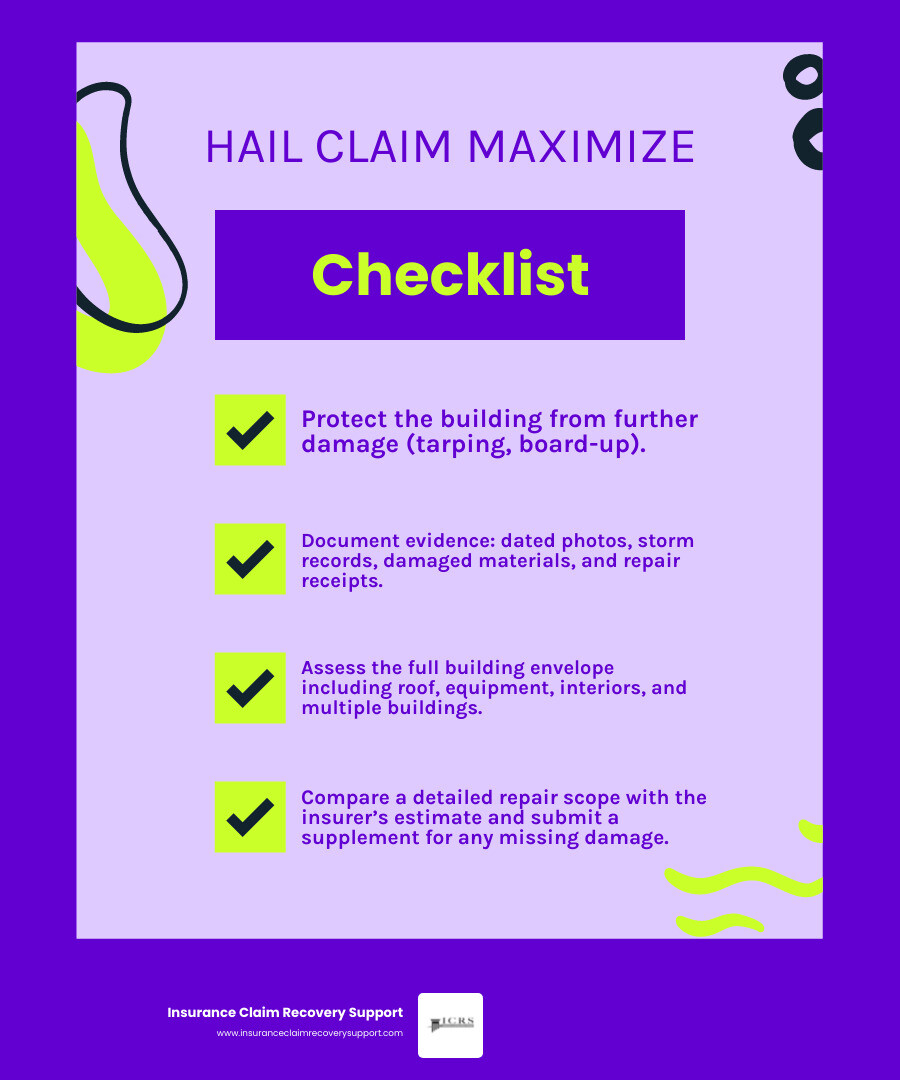
To maximize a hail storm claim, property owners should protect the building from further damage, report the loss promptly, and preserve dated photos, storm records, damaged materials, and receipts for temporary repairs. They should have the full building envelope assessed, then compare a detailed repair scope with the insurer’s estimate. Missing damage or repair costs can be submitted for review through a documented supplement.
For commercial buildings and multifamily properties, that assessment may extend beyond the roof to rooftop equipment, interiors, and multiple buildings. Business interruption or lost rental income may also need separate documentation if the policy covers those losses. The goal is a claim that reflects the documented damage and applicable policy terms, not simply the first estimate.
Relevant articles related to hail storm claim maximize:
Immediate Post-Storm Protocol and Evidence Preservation

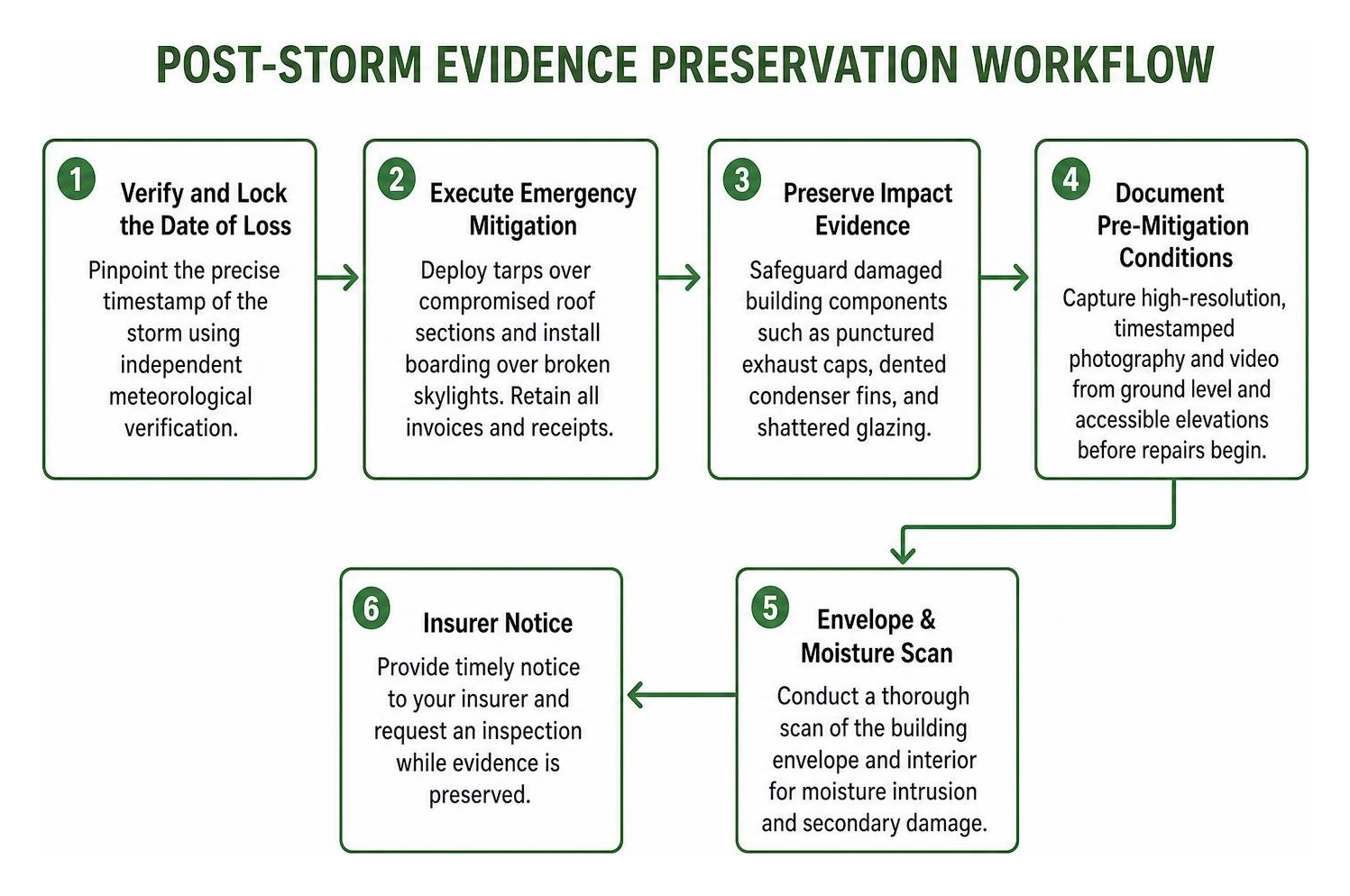
Following a severe convective weather event, policyholders must take systematic measures to establish an accurate record of loss. Standard commercial policies impose a contractual duty to mitigate damages while preserving physical evidence for insurer inspection.
- Verify and Lock the Date of Loss: Pinpoint the precise timestamp of the storm using independent meteorological verification.
- Execute Emergency Mitigation: Deploy shrink-wrap or industrial tarps over compromised roof sections and install boarding over broken skylights. Retain all invoices and receipts.
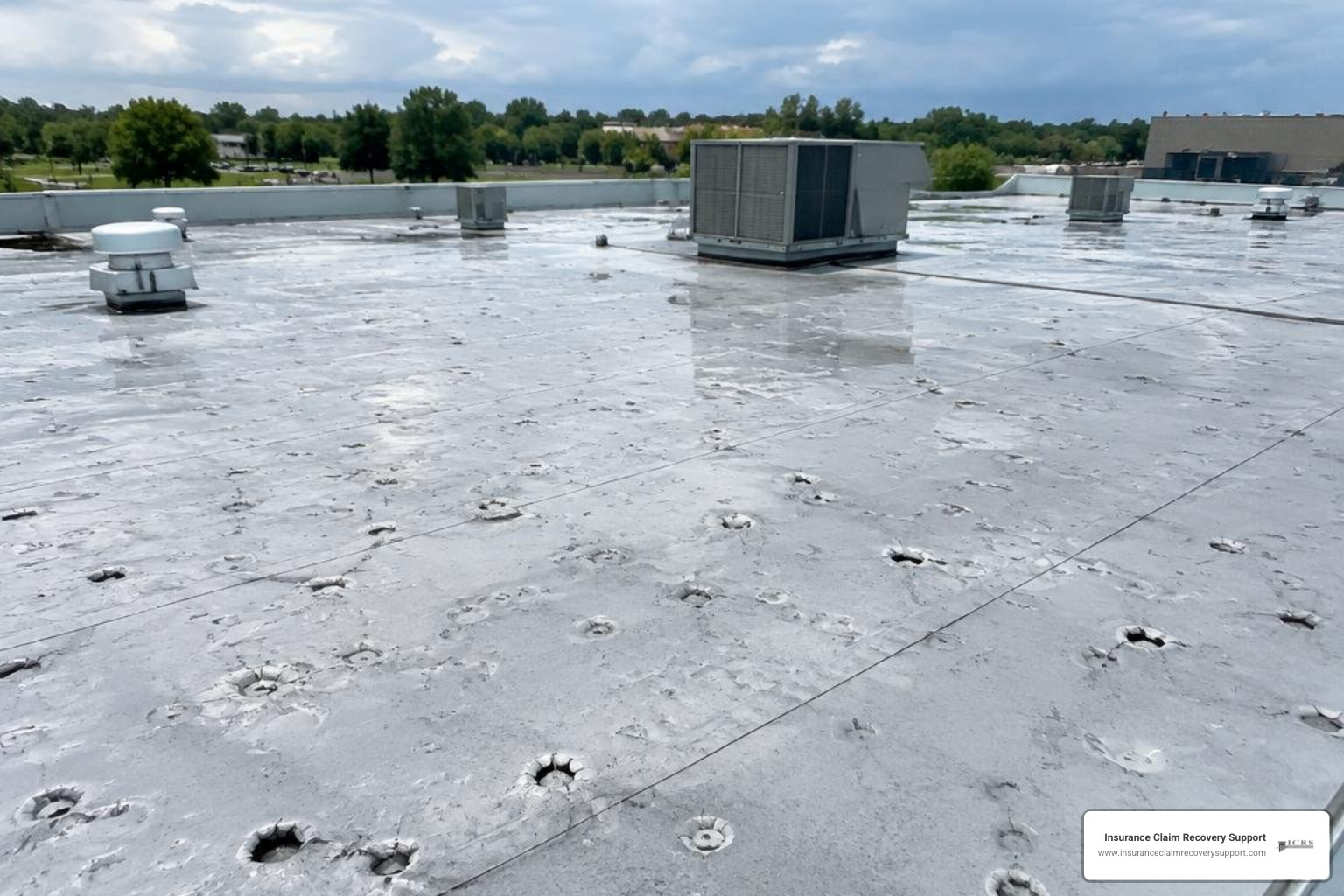
- Preserve Impact Evidence: Safeguard damaged building components such as punctured exhaust caps, dented condenser fins, and shattered glazing. Do not discard structural debris prior to carrier examination.
- Document Pre-Mitigation Conditions: Capture high-resolution, timestamped photography and video from ground level and accessible elevations before emergency repairs commence.
According to the IBHS claims analysis of severe hailstorms, hail impact dynamics produce variable damage thresholds across different materials. Granule loss, fractured scrims, and micro-tears often worsen rapidly under thermal expansion if mitigation is delayed.
Pinpointing Date of Loss with Meteorological Data
Insurers frequently challenge hail claims by attributing damage to pre-existing storms or unverified historical weather events. Establishing an indisputable loss date requires objective data:
- Dual-Polarization Radar Reports: High-resolution radar data identifying hydrometeor classification, hail core density, and terminal velocity.
- Hail Swath Mapping: Detailed mapping indicating the precise swath, azimuth, and stone dimensions (e.g., 1.75-inch to 3-inch impacts) across property coordinates.
- NOAA Storm Prediction Center Records: Official storm spotter logs and local severe weather warning bulletins confirming the storm event.
Securing these records before submitting the First Notice of Loss (FNOL) prevents coverage disputes surrounding policy effective dates.
Comprehensive Building-Envelope and Moisture Mapping
Hail strikes rarely affect only the primary roof covering. Complete envelope evaluation requires advanced diagnostic tools to trace hidden water intrusion. Policyholders managing low-slope roofs should reference established flat roof moisture intrusion protocols to uncover saturated substrates.
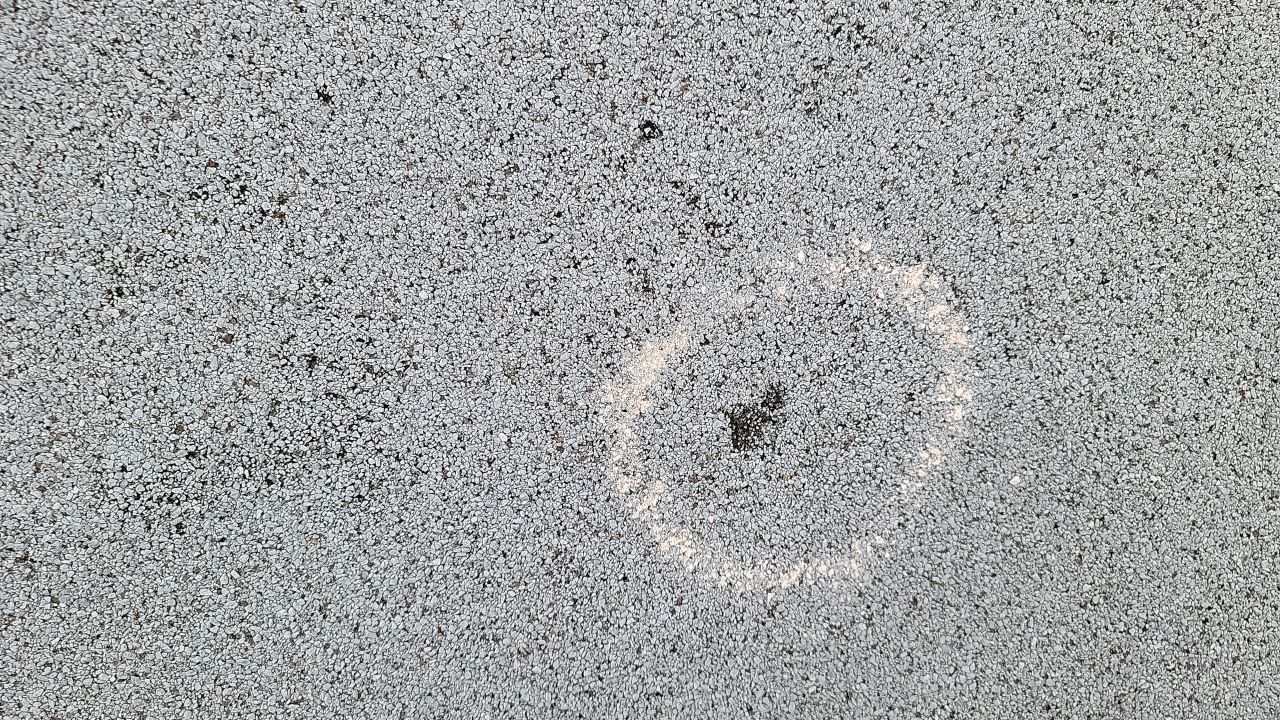
Inspectors execute standard test-square protocols (10-foot by 10-foot chalked grids on each directional roof slope) to quantify impacts per square. Simultaneously, certified technicians document directional collateral damage on metal copings, parapet caps, commercial HVAC coils, exhaust vents, and exterior cladding.
Policy Analysis: Deductibles, Valuations, and Coverage Endorsements
Securing full financial recovery requires an exact understanding of policy valuation provisions, deductible structures, and restrictive endorsements.
Under statutes such as the Texas Prompt Payment of Claims Act (Texas Insurance Code Chapter 542), carriers must adhere to strict operational timelines: acknowledging receipt of the claim within 15 days, commencing investigation, and accepting or rejecting the claim within 15 business days after receiving all requested documentation.
Navigating Percentage Wind and Hail Deductibles
Unlike standard fixed dollar deductibles, wind and hail deductibles across hurricane and convective storm regions are commonly structured as percentage-based obligations tied directly to total insured property values:
For large commercial facilities and multi-family portfolios, a 1% to 5% deductible represents substantial exposure. Identifying these figures immediately allows ownership to forecast reserve requirements accurately.
Cosmetic vs. Functional Damage Policy Exclusions
A common hurdle in property claims involves cosmetic wave endorsements. Carriers frequently attempt to dismiss severe impact dents as non-actionable aesthetic flaws. Understanding metal roofing hail damage coverage rules helps distinguish between surface blemishes and compromised structural performance.
- Functional Damage: Impact marks that fracture underlying fiberglass mats, compromise single-ply scrims, loosen fasteners, break interlocking panel seams, or crush condenser fins, reducing the operational lifespan or water-shedding integrity of the assembly.
- Cosmetic Exclusions: Policy provisions that exclude payout if the damage alters only visual appearance without degrading weatherproofing performance. Overcoming improper cosmetic denials requires engineering assessments proving water barrier impairment or accelerated coating degradation.
Essential Strategies to Maximize a Hail Storm Claim on Commercial Properties
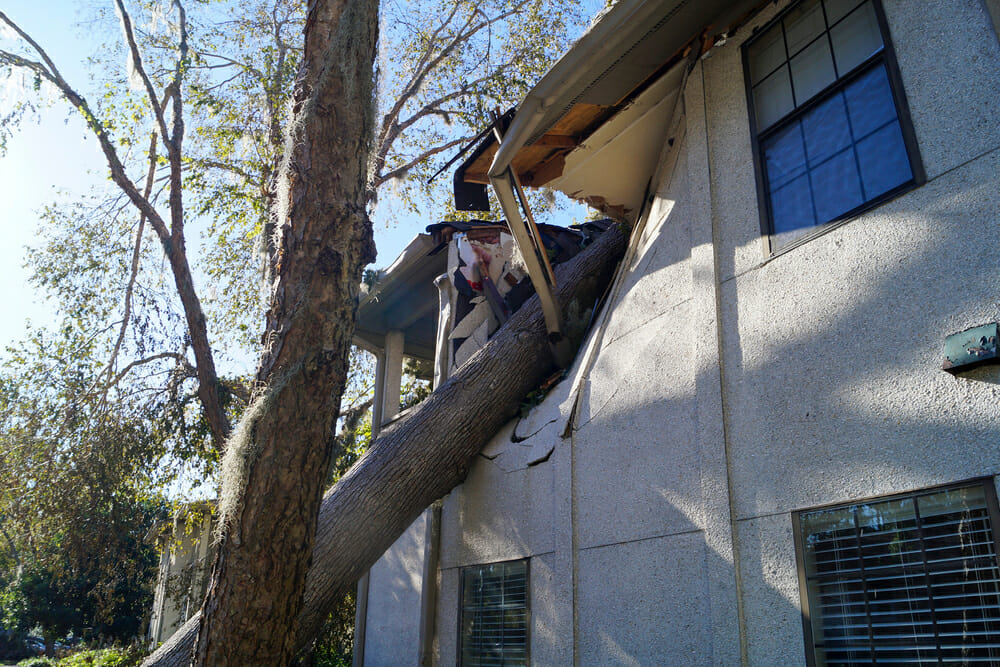
Commercial property claims involve extensive mechanical infrastructure, life-safety requirements, and financial liabilities that standard residential approaches fail to address. Following proven best practices for commercial hail policyholders protects the balance sheet against omitted repair costs.
Advanced Building-Envelope Assessments to Maximize a Hail Storm Claim
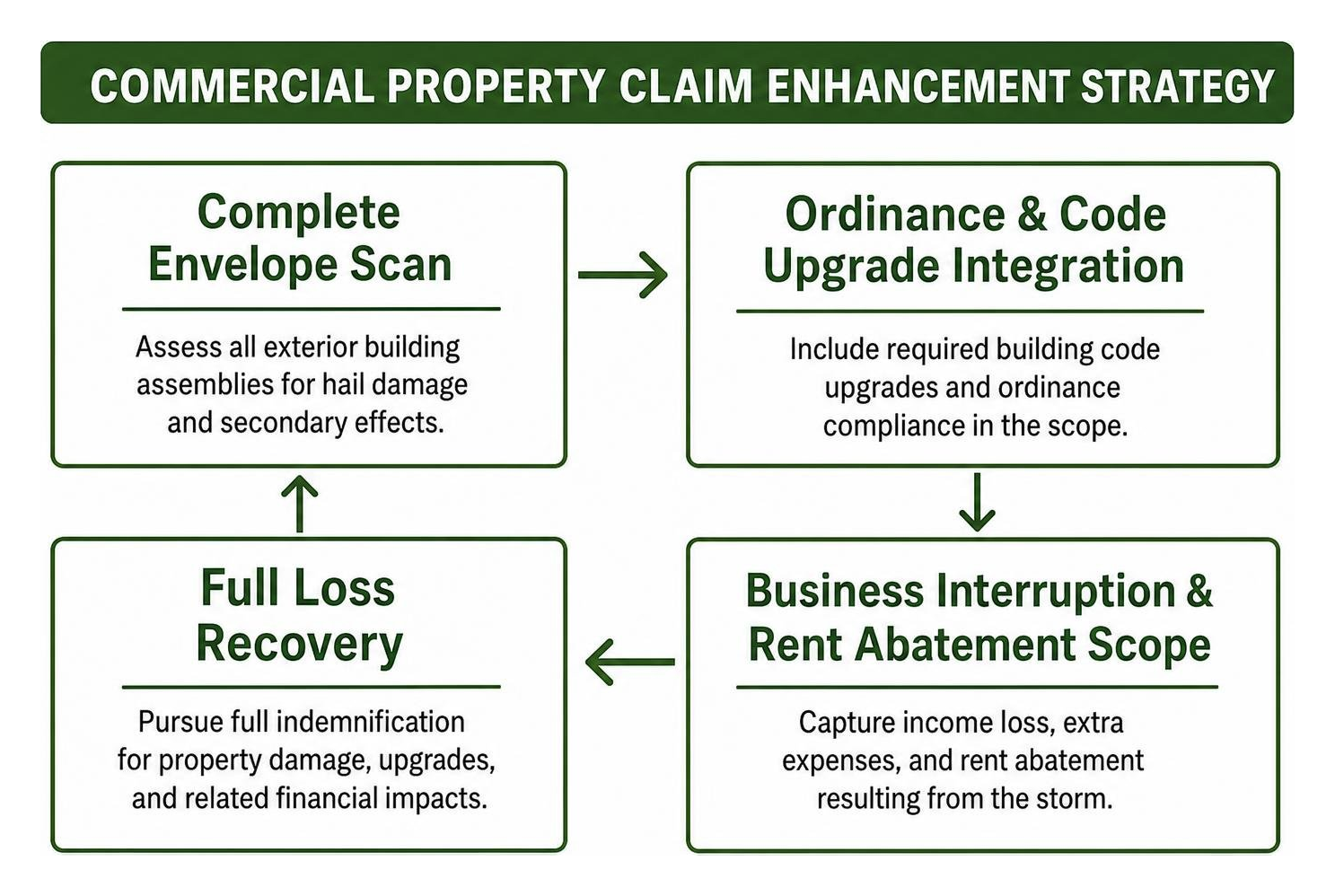
To properly maximize a hail storm claim across high-value real estate or commercial facilities, assessments must capture secondary structural effects across all assemblies:
- TPO and EPDM Single-Ply Membranes: Identifying micro-fractures, shattered insulation fasteners, and crushed polyisocyanurate (polyiso) substrate underneath intact-looking membranes.
- Built-Up and Modified Bitumen Systems: Pinpointing membrane de-bonding, granule displacement, and delamination across multi-ply assemblies.
- Standing Seam Architectural Metal: Assessing seam displacement, compromised clip fasteners, damaged thermal breaks, and crushed structural ribs.
- Parapet Walls and Terminations: Documenting bent counterflashings, compromised coping joints, and water migration paths behind exterior insulation and finish systems (EIFS).
- Ordinance or Law Coverage: Incorporating mandatory building code upgrades, including modern insulation continuous-R requirements, updated drip-edge flashings, and wind-uplift fasteners required by local municipal building authorities.
A detailed review of large-loss commercial hail valuation demonstrates how missing substrate damage often accounts for severe initial underpayments.
Documenting Business Interruption and Multifamily Rental Disruption
Hail events frequently cause immediate operational standstills or render apartment units unlivable due to interior water penetration. Securing complete settlement recovery demands careful documentation of secondary financial losses:
- Lost Rental Income: Rent rolls, vacancy reports, and tenant lease agreements proving revenue loss directly tied to storm-induced un tenantability.
- Tenant Rent Abatement: Contractual ledger credits granted to residents during building repairs or structural restoration.
- Extra Expense Coverage: Incurred costs for temporary office space, tenant relocation, mobile chiller units, or perimeter security.
- Period of Restoration: Establishing realistic project schedules accounting for lead times on commercial roofing materials, municipal permitting, and structural engineering approvals.
The Supplement Process and Dispute Resolution for Lowball Settlements
Initial insurer estimates are often prepared quickly by field adjusters managing high claim volumes, leading to omitted line items, underestimated material quantities, or inaccurate labor pricing. A careful supplement should focus on the documented scope of this loss, applicable policy terms, and support for each omitted or undervalued repair item.
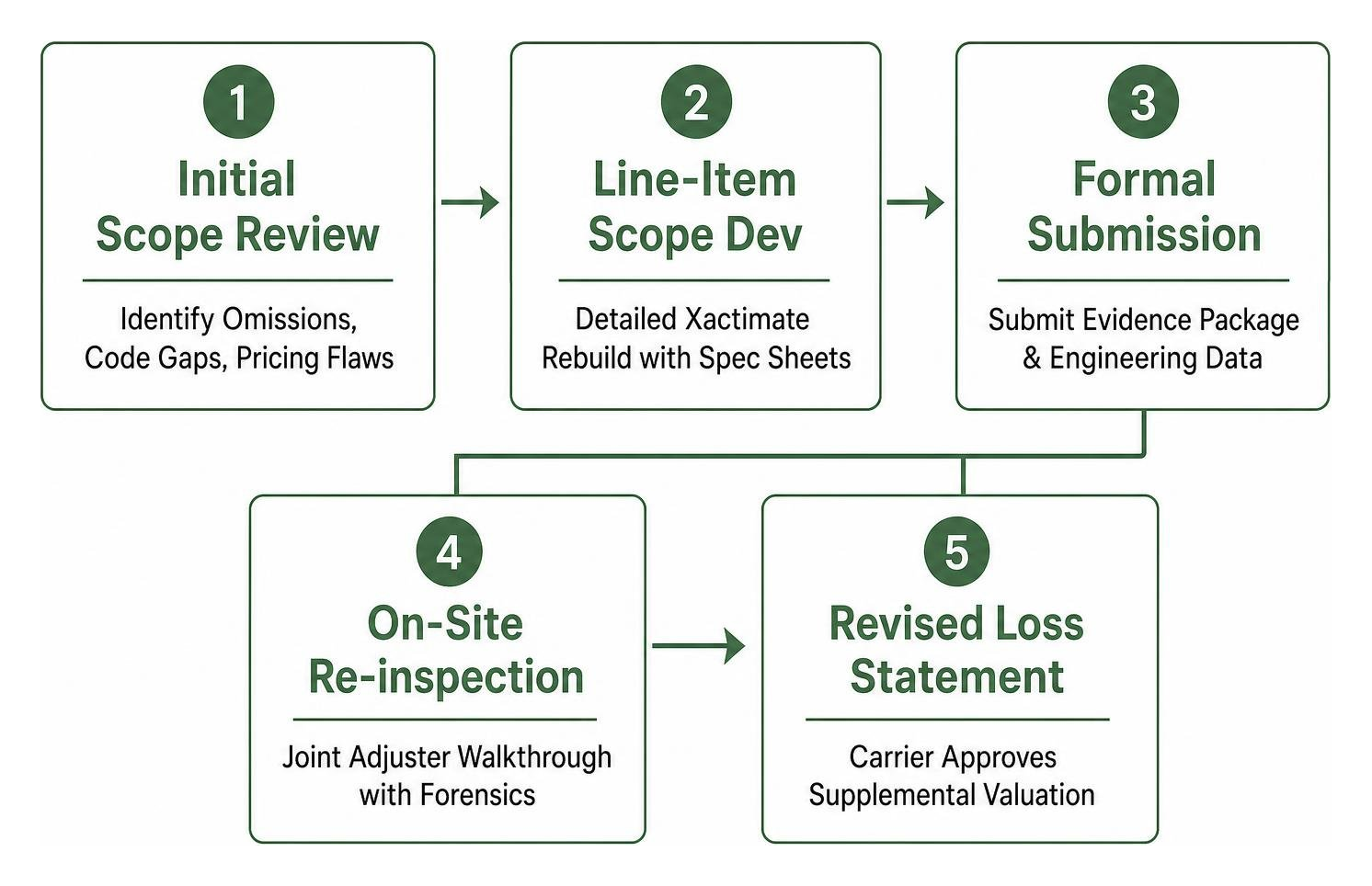
Property owners facing incomplete scopes must navigate standard hail damage roof insurance claim negotiation to realign estimates with actual construction costs.
Preparing Line-Item Estimates and Supplement Submissions
A supplement is a formal, documented request submitted to the insurer for additional funds to cover necessary repair items omitted from the initial statement of loss. Successful supplements require:
- Unit-Cost Line Items: Preparing transparent, unit-priced estimates using industry-standard platforms like Xactimate, reflecting current market labor rates and regional material prices.
- Manufacturer Installation Specifications: Attaching published requirements from manufacturers (such as Carlisle, GAF, or Johns Manville) showing that spot repairs void existing system warranties and necessitate slope or roof replacement.
- Local Municipal Code Requirements: Providing written documentation from local building code officials regarding ice-and-water barrier mandates, continuous insulation requirements, and deck re-nailing schedules.
- Photographic Evidence Logs: Categorizing indexed photographs showing concealed damages discovered during selective demolition, core cuts, or mechanical testing.
Negotiating Supplemental Scope to Maximize a Hail Storm Claim
When carriers present initial valuations that fail to cover necessary restorations, policyholders should reject informal verbal revisions. All supplemental scopes must be submitted with engineering reports, moisture scans, and written statutory deadlines. In cases of persistent valuation deadlocks, commercial policies include an appraisal clause—a binding contractual dispute mechanism where independent appraisers and an umpire resolve scope pricing discrepancies without immediate litigation.
Professional Large-Loss Representation for High-Stakes Hail Claims
Commercial complexes and multifamily properties face significant financial exposure following severe storms. Company staff adjusters and independent adjusters represent the financial interests of the insurance company. Policyholders managing large, complex claims often engage dedicated licensed hail damage public adjuster representation to level the technical playing field.
Overcoming Carrier Underpayments and Structural Omissions
Complex claims require thorough forensic investigations. Professional public adjusting firms perform comprehensive scope development, interpret obscure policy endorsements, manage carrier correspondence, and substantiate concealed structural damages to ensure claims accurately reflect actual physical losses.
HAAG Certified Commercial Roof Inspections
Scott and Misty are licensed public adjusters and HAAG Certified Commercial Roof Inspectors. Their specialized inspection credentials ensure that hail strike impacts, structural degradation, substrate fractures, and mechanical damage are documented using rigorous engineering standards that withstand insurer scrutiny.
Frequently Asked Questions about Commercial Hail Claims
How long do property owners have to file a hail damage claim in Texas?
Most standard commercial and multifamily policies require reporting damage promptly, with formal filing windows typically ranging from 90 days to one year from the date of loss. While policy terms dictate specific reporting deadlines, policyholders should notify carriers as soon as damage is detected to comply with contractual conditions and preserve critical physical evidence.
What is the difference between actual cash value and replacement cost value in a hail claim?
Actual Cash Value (ACV) represents the cost to replace the damaged property minus physical depreciation based on age and wear. Replacement Cost Value (RCV) represents the total modern cost required to repair or replace the property with materials of like kind and quality without deducting for depreciation. On RCV policies, the withheld depreciation is released after repairs are completed and properly invoiced.
How does the supplement process work if the insurance adjuster misses structural damage?
When an adjuster’s initial statement of loss omits damaged components, hidden moisture, or required code upgrades, the policyholder submits a supplemental claim. This package includes a detailed line-item estimate, photographic evidence, manufacturer specifications, and building code documentation. If needed, a joint re-inspection is scheduled on-site to review the missed damage and secure an adjusted claim payout.
Conclusion
Maximizing a complex commercial or multifamily hail claim requires disciplined evidence collection, comprehensive building envelope inspections, rigorous policy analysis, and persistent scope negotiation. When structural recovery and operational revenue are on the line, policyholders must rely on objective data and forensic documentation rather than an insurer’s preliminary assessment.
Insurance Claim Recovery Support LLC represents policyholders managing large-loss property claims across Texas—including Austin, Dallas-Fort Worth, San Antonio, Houston, Lubbock, San Angelo, Amarillo, Lakeway, Bee Caves, Georgetown, and Waco. For qualifying property losses exceeding $250,000 after deductible, property owners can contact a public adjuster to get the settlement you deserve. Call anytime—our trained insurance claim AI assistant is available 24/7 to answer claim questions, share helpful resources, and collect information for our team. A team member will follow up during business hours.