Large Loss Hail Damage Claims: Insurance Claim Recovery Support LLC
Large Loss Hail Damage Insurance Claims are among the most financially complex and fiercely contested disputes in commercial property insurance — and if you own or manage an office building, apartment complex, warehouse, retail center, or religious facility, knowing how to navigate one could be the difference between full recovery and a six-figure shortfall.
Here is a quick-reference snapshot so you can orient yourself immediately:
| Key Question | Quick Answer |
|---|---|
| What qualifies as a “large loss” hail claim? | Generally any commercial hail claim exceeding $250,000 in estimated damage |
| Who handles these claims? | A licensed public adjuster or attorney specializing in large-loss commercial property |
| What are the biggest insurer tactics? | “Cosmetic damage” exclusions, prior-damage reclassification, desk-adjuster underestimates |
| What documentation is critical? | Forensic roof inspections, meteorological date-of-loss reports, core cuts, thermal imaging |
| What legal protections exist in Texas? | Texas Insurance Code 541 (bad faith) and 542 (prompt payment) |
| What is the first step after a hailstorm? | Document everything, mitigate secondary loss, and engage a forensic expert before the insurer’s adjuster visits |
| Can a denied or underpaid claim be overturned? | ✅ Yes — independent engineering, appraisal, and public adjuster advocacy frequently reverse denials |
The numbers tell a stark story. In 2025 alone, the nation’s largest property insurers paid out more than $5.6 billion in hail-related claims nationally, with Texas accounting for $1.4 billion of that total — a 27% year-over-year jump. Across the border in Canada, a single August 2024 Calgary hailstorm generated nearly $2.8 billion in insured losses and 130,000 claims, making it the second-costliest insured event in Canadian history. These are not isolated outliers. They are the new baseline for a hail environment that is growing more severe, more frequent, and more expensive with every passing storm season.
🔑 Key Takeaway: The scale of hail losses is accelerating. For commercial and multifamily property owners, the question is no longer whether a major hailstorm will hit — it is whether your claim will be handled fairly when it does.
For property owners and managers, the challenge is not just surviving the storm. It is surviving the claims process that follows. Insurers operating at combined ratios above 100 — meaning they pay out more in claims than they collect in premiums — are under intense financial pressure to scrutinize, delay, and minimize large commercial hail settlements. The result is a landscape where even legitimate, well-documented claims routinely face pushback.
I’m Scott Friedson, CEO of Insurance Claim Recovery Support (ICRS) and a multi-state licensed public adjuster with more than 15 years of experience and 500+ Large Loss Hail Damage Insurance Claims successfully resolved, representing over $250 million in recovered settlements for commercial and multifamily property owners. In this guide, I’ll walk you through exactly what to do — and what to avoid — so you can protect your asset and recover every dollar your policy entitles you to.
Defining the $250,000 Threshold: What Qualifies as a Large Loss Hail Claim in 2026?
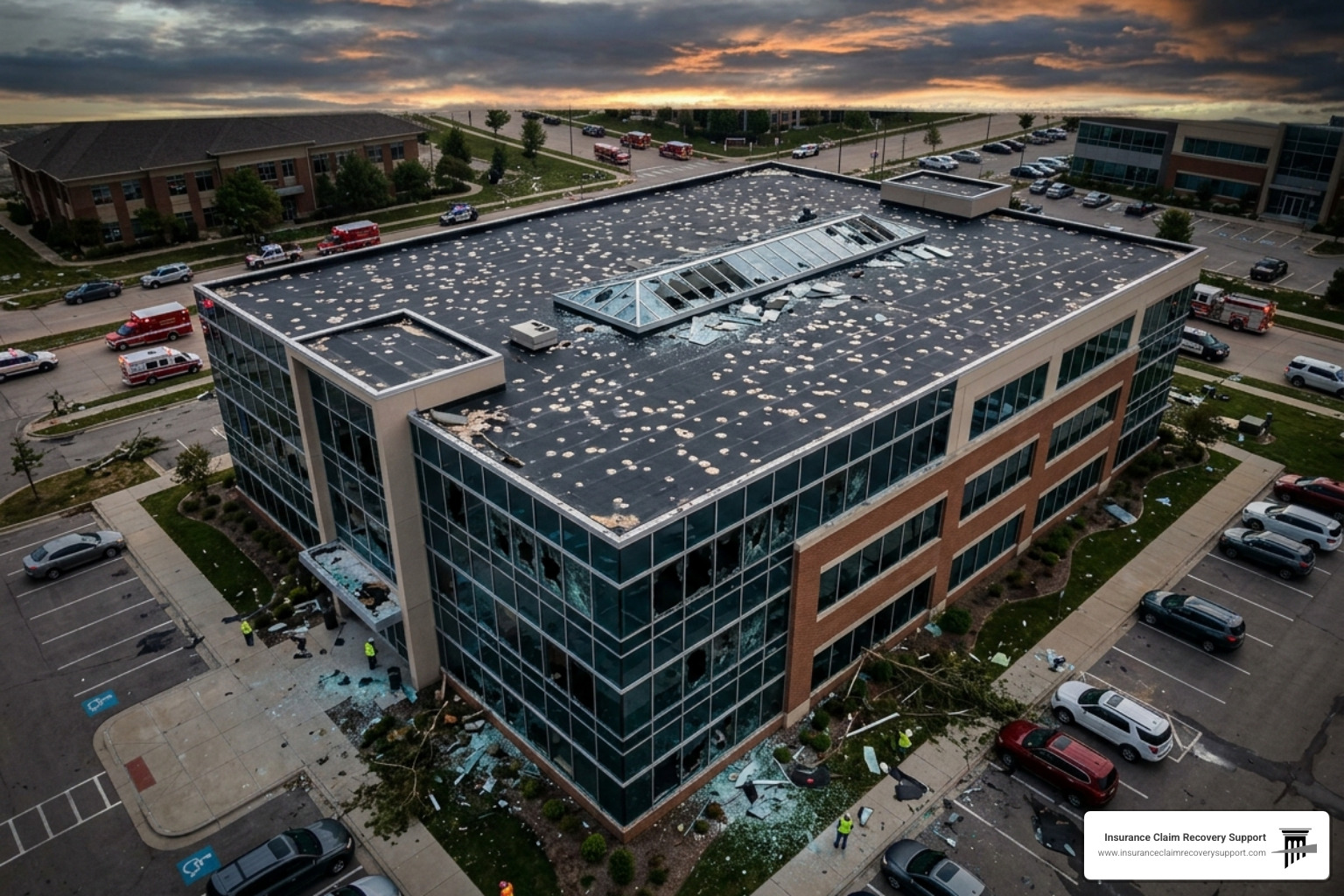
In the context of commercial property insurance, a “large loss” isn’t just about the size of the hailstones; it’s about the financial and operational impact on the asset. While a single-family home claim might involve a $20,000 roof replacement, Large Loss Hail Damage Insurance Claims for commercial entities often involve complex systems, massive square footage, and significant business interruption.
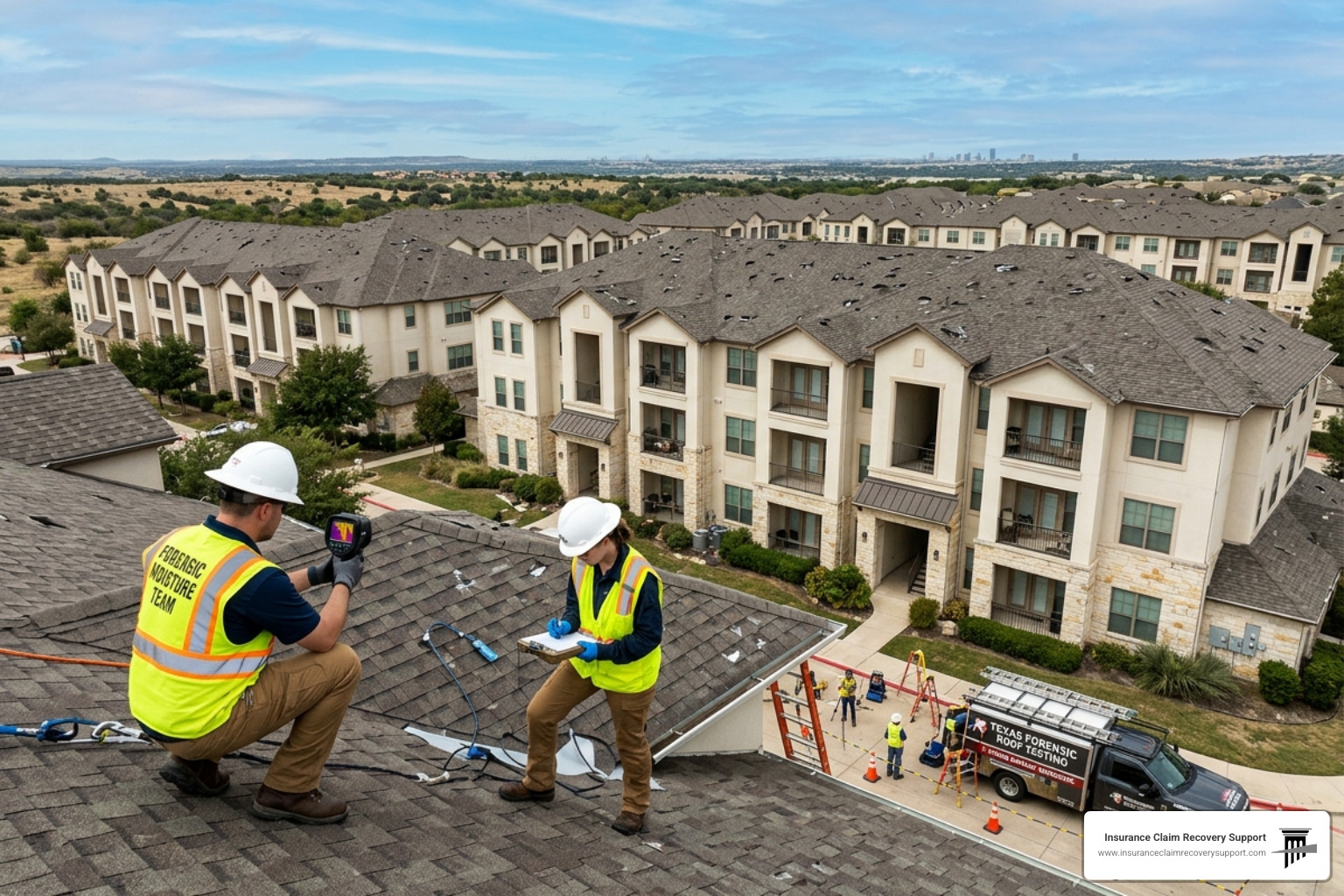
Generally, the industry recognizes a $250,000 threshold as the entry point for large loss status. However, for a 300-unit multifamily complex or a sprawling industrial warehouse, the numbers can quickly climb into the millions. These claims are not handled by your local neighborhood agent; they are assigned to specialized “Large Loss” units within the insurance company, staffed by adjusters whose primary goal is to mitigate the carrier’s financial exposure.
Understanding what is a large loss claim is the first step in realizing that you are no longer in a “standard” claims environment. You are in a high-stakes negotiation where every detail—from the type of roofing membrane to the specific date of the storm—will be scrutinized. Proper large loss claims handling requires a team that understands the nuances of commercial multi-peril policies and the specific vulnerabilities of industrial and retail facilities.
Identifying Large Loss Thresholds for Commercial Assets
When we evaluate a commercial hail loss, we look at several factors beyond the visible dents. We must consider:
- Asset Valuation vs. Actual Cash Value (ACV): Is your policy a Replacement Cost Value (RCV) policy, or will the insurer attempt to depreciate your roof based on its age?
- Business Interruption (BI): If hail shatters skylights in a manufacturing plant, the resulting water damage might halt production. The lost revenue is often a massive component of the large loss claim.
- RCV Triggers: Many policies require you to actually complete the repairs before they release the withheld depreciation. For a $1 million roof, coming up with that capital upfront can be a major hurdle.
For a deeper dive into these complexities, our Public Adjuster Large Loss Claims Guide provides a roadmap for navigating these high-value settlements.
Commercial vs. Residential: Why Complexity Demands Advocacy
Commercial claims are exponentially more difficult to resolve than residential ones. We aren’t just dealing with asphalt shingles; we are dealing with TPO, EPDM, modified bitumen, and complex HVAC systems.
- Modern Building Codes: If a hailstorm damages 25% of your roof, local codes in cities like Austin or Dallas may require you to replace the entire roof to meet current insulation or wind-uplift standards.
- Ordinance and Law Coverage: Does your policy pay for these mandatory code upgrades? Without an advocate to point this out, insurers often conveniently leave these costs out of their estimate.
- Structural Engineering: Flat roofs on retail centers can suffer “bruising” that isn’t visible to the naked eye but compromises the structural integrity of the substrate.
To understand the full scope of commercial roof systems, see our Public Adjuster Roofing Complete Guide.
Navigating Systemic Insurer Scrutiny and 2026 Market Volatility
As of May 2026, the insurance market is in a state of high alert. Following the record-breaking $5.6 billion payout in 2025, carriers are pulling back. A May 2025 Senate hearing on insurance insolvency highlighted the “unprecedented” strain on the industry, leading to what many call a “War on Hail.”
We are seeing systemic efforts to reduce payouts. The Oklahoma Attorney General’s ‘Hail Focus Initiative’ was launched specifically to investigate carriers that were found to be using “corporate secret” reports to systematically underpay claims. Even President Trump, in early 2026, criticized the “skyrocketing” cost of commercial insurance premiums, calling for more transparency in how large losses are adjusted.
For the latest on these market shifts, check our Industry Report: 2025 National Hail Payout Trends.
The “Cosmetic Damage” Exclusion Trap
The most common tactic we see in Large Loss Hail Damage Insurance Claims is the “cosmetic damage” exclusion. Insurers will argue that if the hail only caused “aesthetic” dents in a metal roof or siding without causing an immediate leak, it isn’t a covered loss.
Fact vs. Myth:
- Myth: If the roof isn’t leaking, the hail damage is only “cosmetic.”
- Fact: Impact-related fractures to the bitumen or substrate constitute functional impairment because they significantly shorten the roof’s service life and void manufacturer warranties.
- Translation: Insurers use “cosmetic” language as a legal shield to avoid replacing million-dollar waterproofing membranes. If the hail hit hard enough to dent metal, it hit hard enough to compromise the underlying system.
For more on what you should expect, see the average insurance payout for hail damage roof.
Regulatory Investigations and Bad Faith Schemes
Insurers in California and Illinois are currently under investigation for “bad faith” practices related to large-scale weather events. In Texas, we rely heavily on Texas Insurance Code 541, which prohibits unfair settlement practices. When an insurer misrepresents the damage or fails to conduct a reasonable investigation, they are in violation of the law.
We’ve seen cases where insurers ignored their own underwriting inspections—which showed the roof was in good condition—only to claim “prior unreported damage” once a hail claim was filed. This is why we documented events like when a Texas City was slammed with tennis ball sized hail, providing the meteorological proof needed to counter carrier denials.
Strategic Roadmap: Step-by-Step Guide to the Large Loss Hail Claim Process
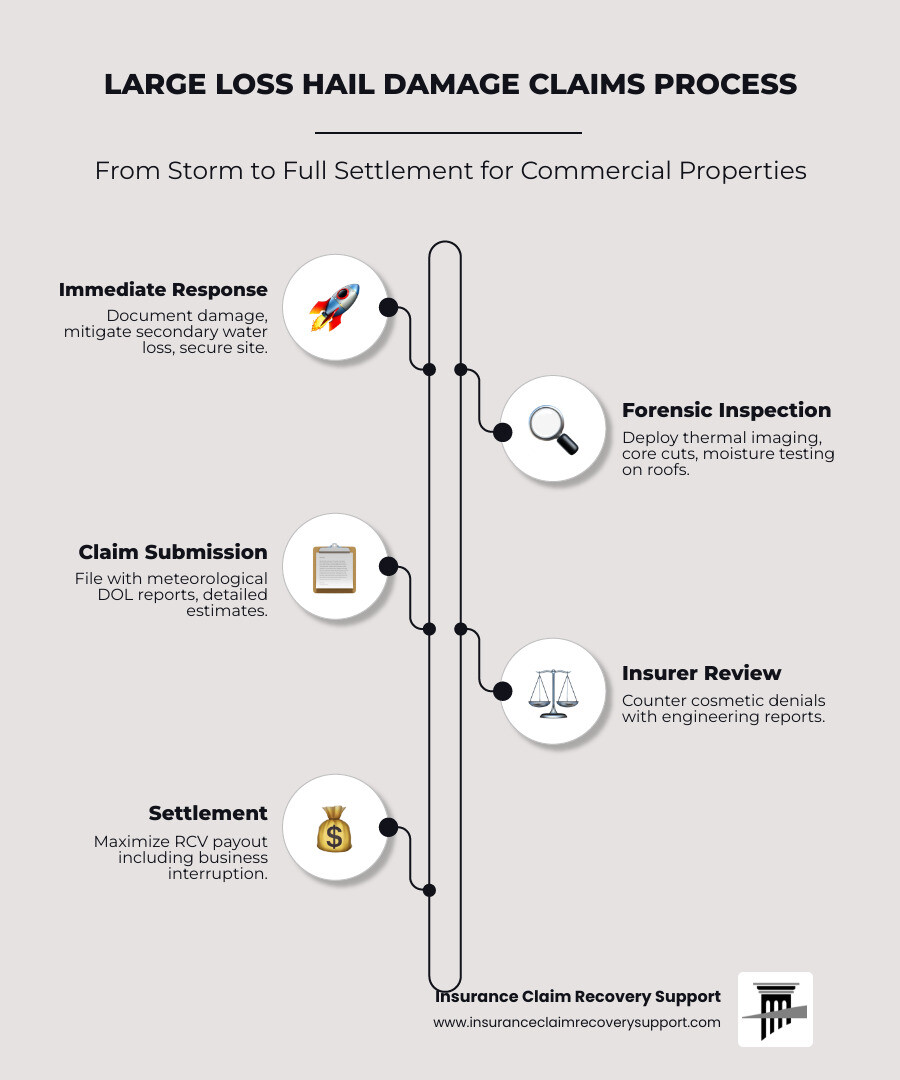
When the sky turns green and the sirens go off, your actions in the first 48 hours will dictate the success of your claim.
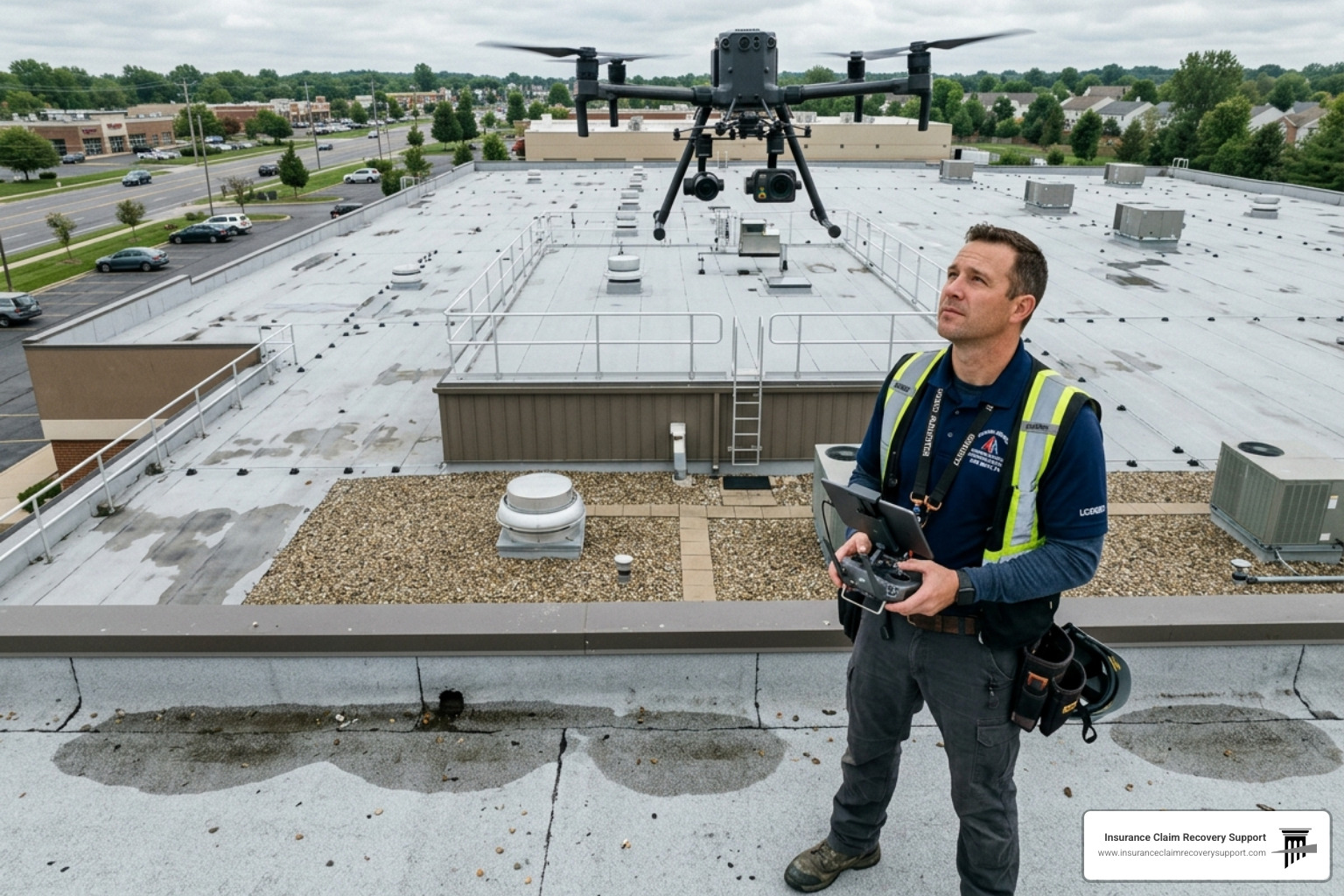
- Comprehensive Documentation: Take high-resolution photos and video of the entire property—not just the roof. Document HVAC fins, window seals, and even the “spatter” marks on the ground.
- Evidence Preservation: Do not let a contractor “tear off” the roof before the insurer sees it. If you must make emergency repairs to prevent leaks, save every receipt and photograph the “before” and “after.”
- Date of Loss (DOL) Verification: Insurers will often claim the damage happened during a different storm outside your policy period. We use forensic meteorological reports to pin down the exact minute the hail hit your address.
The hail insurance claim process for a large loss is a marathon, not a sprint. Follow our detailed hail damage claim process to ensure you don’t miss a single step.
Immediate Post-Storm Action Items for Property Managers
Property managers are on the front lines. Your first priority is mitigation. If you don’t take steps to stop a leak, the insurer may deny the resulting “ensuing loss” (like mold or interior damage).
- Professional Forensic Inspections: Don’t rely on a “free inspection” from a door-to-door roofer. You need a forensic expert who can perform non-destructive testing.
- Review Your Policy: Look for separate hail deductibles. In high-risk areas like Dallas or San Antonio, these are often percentage-based (e.g., 2% of the building’s value), which can mean a massive out-of-pocket expense.
Our guide on Dos and Donts of Filing Hail Claim Damages for Policyholders is essential reading for any commercial property manager.
Overcoming Denials in Large Loss Claims
If your claim is denied, do not panic. Denials are often the insurer’s “opening offer.” We overcome these by using:
- Independent Structural Engineering: We bring in engineers who don’t work for insurance companies.
- Core Cuts: We physically remove small sections of the roof to inspect the substrate for damage that isn’t visible from the surface.
- Moisture Thermography: We use infrared cameras to find water trapped under the membrane.
For a deeper look at how we challenge adjusters, see our Roof Claim Adjuster Guide 2026.
Texas Statutes and Essential Legal Protections for Commercial Policyholders
Texas has some of the strongest policyholder protections in the country, but they only work if you know how to use them. Texas Insurance Code 542, also known as the Prompt Payment of Claims Act, requires insurers to meet strict deadlines for acknowledging, investigating, and paying claims. If they miss these deadlines, they may owe you 18% interest plus attorney fees.
When a carrier refuses to budge on the amount of the loss, we often trigger the Appraisal clause. This is a form of alternative dispute resolution that can bypass years of litigation and result in a binding “Appraisal Award.”
For more on regional specifics, see our guides on hail storm Texas and hail damage repair Texas.
The Role of Public Adjusters in High-Stakes Claims
A major issue in 2026 is the “licensing gap.” Many insurance companies are using “desk adjusters” located in other states who never actually set foot on your roof. They rely on low-resolution satellite imagery or photos taken by “ladder assists” who are paid to find no damage.
A licensed public adjuster from ICRS acts as your private advocate. We:
- Correct Desk Adjuster Errors: We provide the on-the-ground evidence they ignore.
- Maximize Settlements: Our goal is a 100% indemnification of your loss.
- Avoid the “Appraisal Trap”: We ensure that if we go to appraisal, the “umpire” is truly neutral.
Learn more about the public adjuster claim process.
Texas Regional Hail Hotspots: Local SEO Focus
We serve the entire state of Texas, with a heavy presence in the cities most battered by hail:
- Austin & Round Rock: Seeing a massive increase in multifamily hail claims.
- Dallas & Fort Worth: The “Hail Capital” of the U.S., where $2 billion storms are becoming common.
- San Antonio: Frequent supercell activity affecting historic and religious institutions.
- Houston: Dealing with the “double whammy” of hail and hurricane-force winds.
- Lubbock & San Angelo: High-frequency events hitting industrial and manufacturing hubs.
We even track specific events, like recent activity in Fannin County hail.
Expert FAQ: Navigating Large Loss Hail Damage Insurance Claims
Q: What constitutes a “Large Loss” for commercial properties? Translation: Any claim where the complexity of the damage and the value of the asset (typically >$250k) requires specialized forensic experts and public advocacy. It’s the point where “standard” adjusting ends and forensic investigation begins.
Q: How do Texas Statutes 541 and 542 protect policyholders? Translation: These laws are your “stick.” They penalize carriers for “bad faith” delays and ensure you are paid penalty interest on delayed settlements. They keep the insurer honest by making it expensive for them to be dishonest.
Q: Why is the “Cosmetic” vs “Functional” dispute so common in 2026? Translation: Carriers are tightening margins by redefining damage. They want to pay for a “patch” when you need a “replacement.” If the impact shortens the roof’s life or voids your warranty, it is functional damage, regardless of what the carrier’s adjuster claims.
Conclusion: Securing Your Commercial Asset’s Future
At Insurance Claim Recovery Support (ICRS), we know that a commercial property is more than just a building—it’s an investment, a workplace, and a community. When Large Loss Hail Damage Insurance Claims are handled poorly, the financial ripple effects can last for a decade.
We specialize in maximizing settlements and reducing the delays that keep your business in limbo. With a 90% settlement success rate for commercial assets, we help our clients avoid the “litigation trap” and get the funds they need to restore their properties to pre-loss condition.
Don’t let an insurance company’s “desk adjuster” decide the fate of your asset. If you’ve been hit by a storm in Austin, Dallas, Fort Worth, San Antonio, Houston, or anywhere in between, contact a public adjuster for property damage claims in Texas today. We represent you—never the insurance company.