Why Houston Wind Claims Can Make or Break Your Commercial Property Recovery
Houston wind claims are among the most complex and high-stakes insurance challenges facing commercial property owners, multifamily operators, and facility managers in Texas today.
For a broader wind-loss documentation checklist, explore the ICRS Hail & Wind Claim Guide. Coverage and next steps depend on the facts and policy terms.
If you need a quick answer, here’s what you should know right now:
How Houston Wind Claims Work — Quick Overview
- Storm hits — Straight-line winds, tropical storms, or hurricanes cause damage to your roof, siding, windows, or structure.
- Document immediately — Photograph everything before any repairs begin; pull NOAA weather data to establish the date and intensity of the event.
- Report promptly — Texas law requires insurers to acknowledge your claim within 15 business days and accept or deny it within approximately 45 days.
- Get an independent inspection — Hidden damage (lifted flashing, compromised underlayment, water intrusion paths) is routinely missed by carrier-appointed adjusters.
- Know your deductible — Coastal and near-coastal properties often carry a separate wind/hail deductible of 1–2% of the insured building value, not a flat dollar amount.
- Dispute underpayments before they become lawsuits — A public adjuster can negotiate a fair settlement and trigger the appraisal process without the cost and delay of litigation.
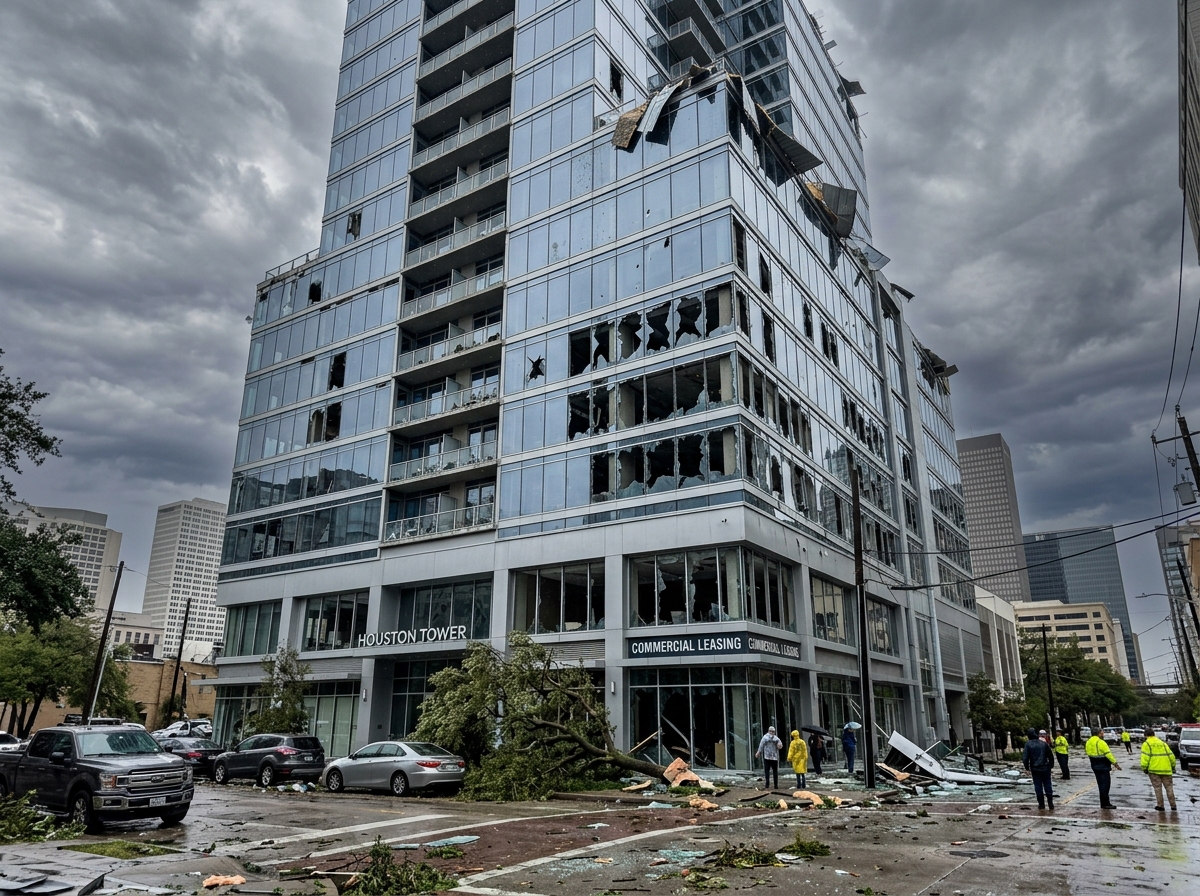
Houston sits squarely in one of the most wind-exposed corridors in the United States. The city regularly sees straight-line thunderstorm winds of 50–70 mph multiple times per year, and when a named storm like Hurricane Beryl makes landfall, those gusts escalate to hurricane force at 74 mph or higher. Wind and hail together account for nearly half of all property damage claims nationwide — and in Houston’s commercial and multifamily market, a single storm event can generate losses that run well into six or seven figures.
The problem isn’t just the wind itself. It’s what happens after the storm, when property owners submit claims and discover that insurers dispute the cause, undervalue the scope, or deny coverage outright by pointing to wear-and-tear, deferred maintenance, or policy exclusions. For a commercial building owner managing tenant relationships and revenue continuity, or a multifamily operator facing lender scrutiny and code-upgrade costs, a delayed or underpaid claim isn’t a minor inconvenience — it’s a direct threat to your bottom line.
I’m Scott Friedson, a multi-state licensed public adjuster and CEO of Insurance Claim Recovery Support (ICRS), and over the course of 500+ large-loss claims worth more than $250 million — including hundreds of houston wind claims — I’ve seen exactly how these disputes unfold and how to resolve them efficiently, without unnecessary litigation.
Houston wind claims glossary:
- Public Adjusters for Commercial Properties Tornado and Windstorm Property Damage Claims
- commercial wind insurance claims
- how to submit a wind damage insurance claim
Navigating the Complexities of Houston Wind Claims
When we talk about houston wind claims, we aren’t just talking about a few missing shingles. We are talking about the structural integrity of multi-million dollar assets. Houston’s unique geography creates a “perfect storm” of meteorological threats. From the Gulf of Mexico, we face What is a Hurricane threats that bring sustained, high-velocity winds. Inland, we frequently encounter severe thunderstorms producing straight-line winds of 50-70 mph.
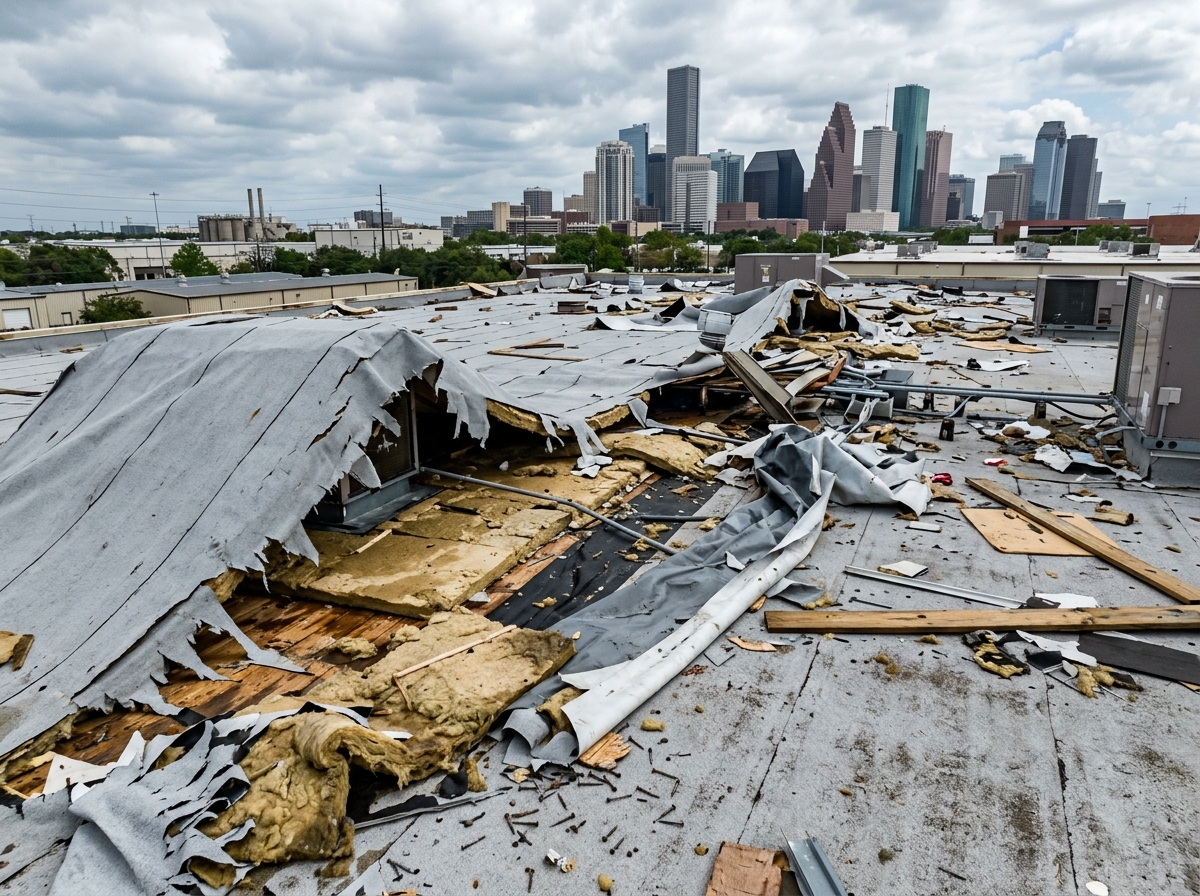
At these speeds, the physics of wind uplift come into play. Wind doesn’t just “hit” a building; it creates pressure differentials. As wind flows over a flat commercial roof, it creates suction—similar to an airplane wing—that can lift roof membranes, tear perimeter flashing, and compromise the adhesive bonds of asphalt shingles. Even if a roof looks “fine” from the ground, the internal structure may have been significantly weakened. Understanding Texas Wind Damage requires looking beyond the surface.
Identifying Claimable Damage in Houston Wind Claims
Commercial roofing systems are engineered to withstand specific thresholds, but those ratings assume a perfect installation and no prior degradation. Standard asphalt shingles may be rated for 60-110 mph, but damage often begins at much lower speeds—sometimes as low as 35-50 mph if the roof has age or previous unrecorded stress.
Key signs of wind damage that qualify for a claim include:
- Creased Shingles: High winds lift the shingle, creating a permanent horizontal fold or “crease” across the top. This breaks the fiberglass matting and ruins the shingle’s ability to shed water.
- Granule Loss: Excessive wind scouring removes the protective granules, exposing the underlying bitumen to UV degradation.
- Lifted Edges and Perimeter Flashing: The edges of a commercial roof are the most vulnerable. Once the seal is broken, subsequent wind events can peel back large sections of the roof like a sardine can.
- Secondary Water Leaks: Wind damage rarely stays on the exterior. If a wind event creates a breach, rain—often driven horizontally during a storm—infiltrates the building envelope. This leads to mold, damaged drywall, and compromised insulation.
As Public Adjusters in Houston TX, we often find that insurance adjusters ignore “chatter” or slight lifting, claiming it doesn’t constitute “functional damage.” However, scientific research shows that once a seal is broken, the roof’s wind resistance is permanently compromised.
Common Obstacles to Successful Houston Wind Claims
Filing houston wind claims is often an uphill battle because insurance companies have a vested interest in minimizing their exposure. We see four common tactics used to deny or underpay claims:
- Wear-and-Tear Exclusions: The insurer claims the damage was inevitable due to the age of the roof, rather than the specific wind event.
- Pre-existing Conditions: Carriers may argue that the damage existed prior to the policy period or was caused by a previous storm that wasn’t reported.
- Maintenance Issues: If gutters were clogged or minor repairs were deferred, the insurer may attempt to shift the blame to the property owner.
- Delayed Reporting: Texas policies have strict timelines. Waiting too long to report a claim can give the insurer a “late notice” defense, especially if the damage worsened over time.
| Feature | Public Adjuster (ICRS) | Litigation (Lawyers) |
|---|---|---|
| Primary Goal | Maximize settlement through evidence | Win a legal judgment/settlement |
| Speed | Faster (usually months) | Slower (usually years) |
| Cost | Percentage of settlement | Higher fees + court costs |
| Approach | Collaborative/Appraisal-based | Adversarial/Court-based |
| Success Rate | High (90% for ICRS) | Varies significantly |
Managing these obstacles requires a strategic approach to Tag Wind Damage Claim documentation and a deep understanding of policy language.
The Role of TWIA and Coastal Policy Requirements
For properties located in Tier 1 coastal counties, the Texas Windstorm Insurance Association (TWIA) acts as the insurer of last resort. TWIA is a not-for-profit entity that provides coverage when private carriers won’t. The TWIA Board recently set a $4.3 Billion Probable Maximum Loss (PML) for the upcoming storm seasons, highlighting the massive financial risk in the region.
If you carry a TWIA policy, you must be aware of specific requirements:
- WPI-8 Certificates: Any structural repair or roof replacement must be inspected and certified to meet windstorm building codes. Without this certificate, you may be ineligible for future coverage.
- Strict Deductibles: Coastal policies almost always use percentage-based deductibles (1%, 2%, or even 5% of the total building value). For a $5 million commercial asset, a 2% deductible means you are responsible for the first $100,000 of the loss.
- Reporting Deadlines: TWIA generally allows one year from the date of the storm to report a claim, but sooner is always better.
Navigating these requirements is essential for Public Adjusters for Commercial Properties Tornado and Windstorm Property Damage Claims to ensure no money is left on the table.
Strategic Recovery and Dispute Resolution for Property Managers
For property managers and commercial owners, the recovery process is a race against time. Every day a building remains damaged is a day of potential tenant complaints, lost revenue, and further structural decay. Documentation is your most powerful weapon.
We recommend using NOAA weather data for storm verification to pin down the exact wind speeds recorded at the nearest weather station on your date of loss. This objective data makes it much harder for an insurer to claim “there wasn’t enough wind to cause damage.”
Fact vs. Myth: Managing Windstorm Expectations
There is a lot of misinformation circulating after major storms. Let’s clear up a few common misconceptions:
- Myth: My contractor said they can “waive” my deductible.
- Fact: In Texas, it is illegal for a contractor to waive an insurance deductible. Both the contractor and the policyholder can face legal consequences for this, and insurers can demand proof of payment before releasing final funds.
- Myth: If I make temporary repairs, the insurance company won’t pay for the full replacement.
- Fact: You have a policy obligation to mitigate further damage. Making temporary repairs (like tarping) is required. Keep all receipts; these costs are generally reimbursable as part of the claim.
- Myth: The insurance company’s adjuster is there to help me.
- Fact: The staff adjuster works for the insurance company. Their job is to find reasons to limit the payout. A public adjuster is the only professional licensed to represent your interests.
Whether you are dealing with Hail Storm Insurance or complex wind claims, having an independent expert is vital.
Avoiding Litigation through the Appraisal Process
Many policyholders believe their only options are to accept a lowball offer or sue the insurance company. This is a false choice. Most Texas policies contain an “Appraisal Clause”—a powerful dispute resolution mechanism.
The appraisal process works like this:
- You hire an appraiser (often your public adjuster).
- The insurance company hires an appraiser.
- The two appraisers select an “Umpire.”
- If the appraisers agree on the value of the loss, the award is binding. If they don’t, the Umpire makes the final call.
This process is significantly faster and less expensive than a lawsuit. It focuses purely on the amount of the loss, avoiding the years of depositions and legal posturing associated with “bad faith” litigation. We use this to resolve Winter Storm Damage and Your Insurance Claim and wind disputes alike, ensuring our clients get paid what they are owed without the courtroom drama.
Expert Advocacy for Commercial Property Owners
At Insurance Claim Recovery Support (ICRS), we specialize in the heavy lifting of houston wind claims. We don’t represent homeowners for small residential losses; our focus is exclusively on large-loss commercial assets, multifamily complexes, and industrial facilities.
Our team manages the entire roadmap:
- Initial Assessment: We conduct a forensic-level inspection to find hidden wind uplift and structural breaches.
- Policy Analysis: We identify every applicable coverage, including business interruption, code upgrades, and debris removal.
- Documentation: We compile NOAA data, engineering reports, and line-item estimates that leave no room for carrier “interpretation.”
- Negotiation: We go toe-to-toe with the insurance company’s experts to secure a fair settlement.
If you own or manage commercial or multifamily property in Houston or elsewhere in a state where we are licensed, our team can help document the damage and pursue a claim supported by the facts and policy terms.
Whether you’ve suffered from Tornado Damage Claims, hurricanes, or straight-line winds, we are here to ensure your property—and your business—recovers fully. Contact us today for a no-cost, no-obligation consultation to review your policy and your damage. We only get paid when you get paid, aligning our success directly with yours.
Texas Wind Damage is a reality of doing business in the Gulf Coast region. Winning the battle against insurance companies requires the right strategy, the right data, and the right advocate. Let us help you navigate the storm.