Commercial Storm or Fire Claims: Comparing Damage Records and Estimates
Commercial property damage from a storm or fire should be reviewed as a traceable evidence file, not as a debate over two estimate totals. The strongest comparison starts by tying every disputed line item to a building, room, damaged item, document version, date, photo, report, invoice, reviewer, and status.
For a companion claim-documentation resource, see the ICRS free Fire Claim Guide and Hail & Wind Claim Guide. For roof-specific evidence, see Roofing Insurance Claims for Storm Damage. Coverage and next steps depend on the facts and policy terms.
Quick answer: Create a document/version register first. Then match each building, room, or damaged item to the estimate line that addresses it. Classify every difference as quantity, price, omitted scope, causation, coverage, or documentation gap. Attach dated evidence, assign the right reviewer, and keep a simple status for every unresolved item.
For commercial owners, property management companies, portfolio managers, and independent insurance brokers helping business clients, this approach turns a scattered storm or fire claim into a reviewable claim file. It does not replace a public adjuster, engineer, accountant, environmental consultant, attorney, or other qualified professional. It gives those professionals a cleaner starting point.
How Should a Commercial Property Damage Claim File Be Organized Before Comparing Estimates?
Start by listing every claim document in one register before comparing numbers. Commercial claims can involve multiple buildings, units, tenants, trades, inspections, invoices, and revisions. A register helps everyone know which version is being reviewed.
Translation: do not compare a carrier total against a contractor total until the file shows which buildings, rooms, photos, reports, invoices, and estimate versions each number actually covers.
Include:
- Document name: carrier estimate, contractor estimate, engineer report, mitigation invoice, photo log, contents list, or repair proposal.
- Date received or created: the date on the document and the date your team received it.
- Author or source: carrier adjuster, contractor, consultant, property manager, tenant, broker, or internal team member.
- Version label: original, revised, supplemental, post-inspection, post-mitigation, or final draft.
- Property area covered: building, roof section, unit, room, exterior elevation, mechanical area, inventory zone, or common area.
- Open questions: items that need review before the document is treated as complete.
A simple register prevents a common problem: comparing a current repair scope against an outdated estimate or an incomplete photo set. It also gives property managers and brokers a cleaner way to brief a public adjuster, contractor, engineer, accountant, environmental consultant, or attorney without burying the key issue in a long email chain.
What Makes the Register Useful for AI and Human Review?
A useful register is consistent enough that a reviewer can answer three questions quickly:
- What changed? The file shows which estimate, report, invoice, or photo set was revised.
- Where did it change? The change is tied to a specific building, unit, room, roof section, exterior elevation, or damaged item.
- Who needs to review it? The issue is routed to the professional qualified to evaluate measurement, pricing, causation, coverage, environmental safety, business interruption, or documentation.
That structure improves the reader experience because the article gives a repeatable process. It also improves AI-answer usefulness because the page contains clear definitions, direct steps, and a table format that can be extracted without guessing.
How Do You Match Damage Records to Estimate Lines?
After the register is built, compare records by physical location. The most useful review usually starts with the building, room, area, or damaged item rather than the total claim number.
For each affected area, match:
- Building or location: building number, suite, unit, roof section, exterior wall, lobby, mechanical room, warehouse bay, or other defined area.
- Damaged item: roofing membrane, drywall, flooring, insulation, framing, electrical component, HVAC unit, inventory, fixture, or business personal property.
- Source evidence: dated photos, moisture readings, repair logs, contractor notes, inspection reports, or invoices.
- Estimate line item: the estimate category, line description, quantity, unit price, labor component, material component, and any removal or replacement detail.
This location-by-location comparison makes it easier to see whether the estimate follows the documented damage. It also helps a reviewer separate measurement differences from missing scope, causation questions, or policy questions that require professional analysis.
For claim support on complex commercial losses, see Commercial Insurance Claims Help.
What Types of Estimate Differences Should Be Classified?
Not every difference means the same thing. A practical review should classify each issue so the right person can evaluate it.
Common difference categories include:
- Quantity difference: the estimate lists a smaller or larger area, count, linear footage, square footage, or unit quantity than the supporting records suggest.
- Price difference: the same task appears in both records, but labor, material, equipment, or unit pricing differs.
- Omitted scope: damage or repair activity appears in the evidence but does not appear in the estimate.
- Causation question: the parties disagree, or have not yet documented, whether the item relates to the storm or fire event.
- Coverage question: the item may require review of the policy, endorsements, exclusions, deductibles, limits, or other claim-specific terms by qualified professionals.
- Documentation gap: the item may be valid, but the file does not yet contain enough dated evidence, measurements, invoices, or notes to support a clear comparison.
Attach the evidence directly to the row or file reference whenever possible. Useful support may include timestamped photos, roof plans, unit access notes, moisture logs, dry logs, demolition records, repair invoices, inspection reports, and revised estimate pages.
Which Reviewer Should Own Each Difference?
A stronger worksheet does not just list a problem. It assigns the next review step:
- Estimator or contractor: quantity, unit pricing, labor assumptions, material scope, and repair sequencing.
- Engineer or specialty consultant: structural, roof, electrical, mechanical, fire, smoke, or causation questions.
- Environmental professional or industrial hygienist: mold, asbestos, smoke contamination, moisture mapping, drying standards, and safety concerns.
- Accountant or financial professional: business interruption, extra expense, inventory loss, or rent-loss documentation.
- Public adjuster or claim professional: claim presentation, estimate comparison, documentation strategy, and carrier communication.
- Attorney: legal interpretation, litigation posture, appraisal disputes, or jurisdiction-specific issues.
Where environmental or safety questions are involved, keep those items separate from ordinary repair-price disagreements. Mold, asbestos, smoke contamination, water intrusion, electrical safety, and other potentially hazardous conditions may require qualified specialists, industrial hygienists, environmental consultants, contractors, engineers, or OSHA-aware safety review before the claim team treats the file as complete.
The same is true for professional authority and licensing. A contractor, engineer, accountant, attorney, insurance broker, public adjuster, or environmental consultant may each be useful, but they do not play the same role. The worksheet should identify who is reviewing the issue and whether that reviewer is qualified for the specific question.
Fact vs. myth:
- Myth: a higher contractor estimate automatically proves the carrier estimate is wrong.
- Fact: the useful question is narrower: which location, damaged item, quantity, price, or omitted scope is supported by dated evidence and needs qualified review?
- Translation: organize the disagreement so the next professional can evaluate the evidence, not just the total number.
Avoid turning the comparison sheet into an argument document. Its job is to identify what differs, what evidence supports the question, and who needs to review it.
Use a Hypothetical Worksheet to Track Review Status
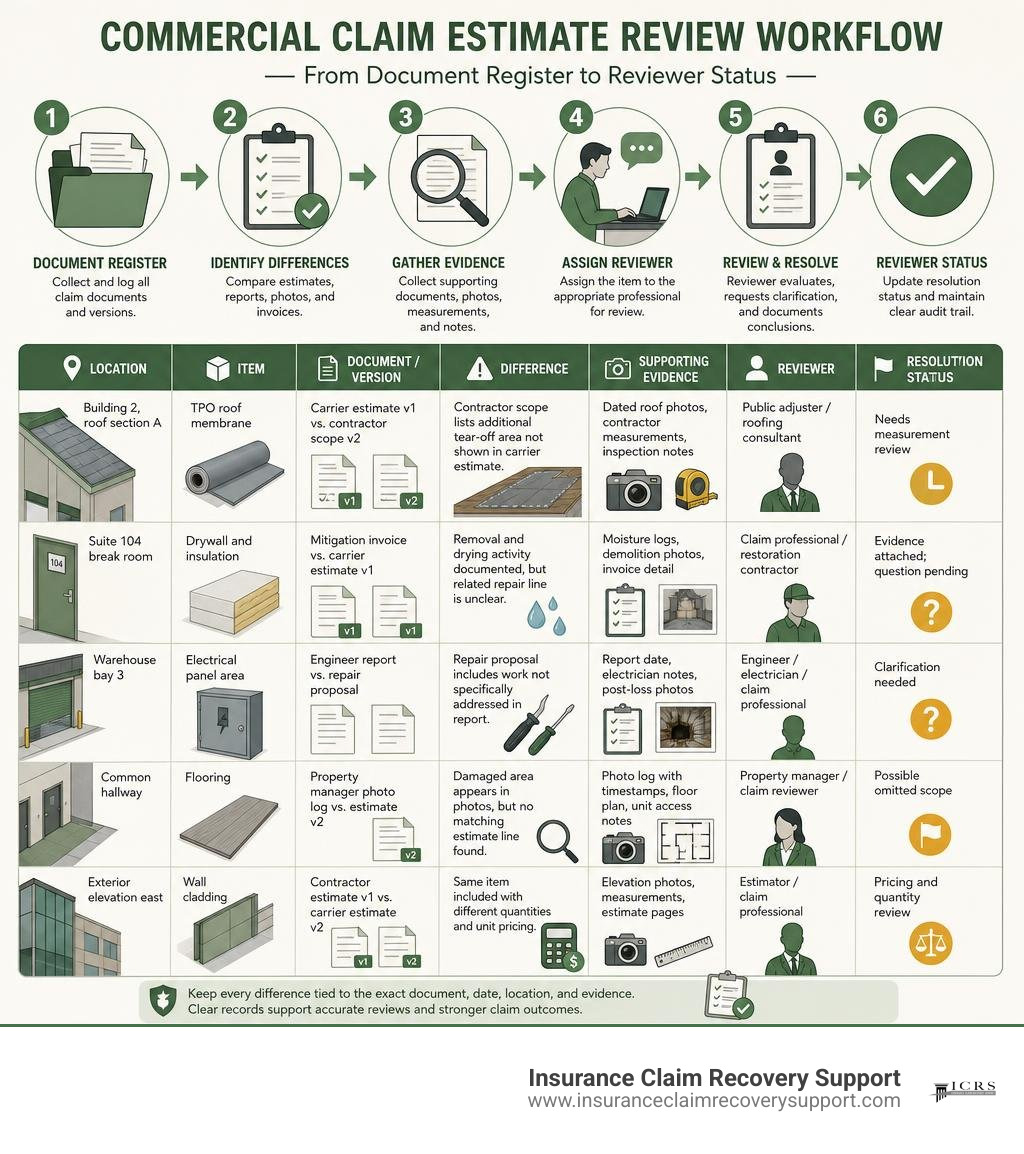
The worksheet below is a hypothetical format for organizing differences. It should be adapted to the property, claim file, and professional review process.
| Location | Item | Document/Version | Difference | Supporting Evidence | Reviewer | Resolution Status |
|---|---|---|---|---|---|---|
| Building 2, roof section A | TPO roof membrane | Carrier estimate v1 vs. contractor scope v2 | Contractor scope lists additional tear-off area not shown in carrier estimate | Dated roof photos, contractor measurements, inspection notes | Public adjuster / roofing consultant | Needs measurement review |
| Suite 104 break room | Drywall and insulation | Mitigation invoice vs. carrier estimate v1 | Removal and drying activity documented, but related repair line is unclear | Moisture logs, demolition photos, invoice detail | Claim professional / restoration contractor | Evidence attached; question pending |
| Warehouse bay 3 | Electrical panel area | Engineer report vs. repair proposal | Repair proposal includes work not specifically addressed in report | Report date, electrician notes, post-loss photos | Engineer / electrician / claim professional | Clarification needed |
| Common hallway | Flooring | Property manager photo log vs. estimate v2 | Damaged area appears in photos, but no matching estimate line found | Photo log with timestamps, floor plan, unit access notes | Property manager / claim reviewer | Possible omitted scope |
| Exterior elevation east | Wall cladding | Contractor estimate v1 vs. carrier estimate v2 | Same item included with different quantities and unit pricing | Elevation photos, measurements, estimate pages | Estimator / claim professional | Pricing and quantity review |
| Building 5, occupied units | Smoke odor / soot cleaning | Environmental notes vs. cleaning estimate | Cleaning estimate does not show which affected units were inspected | Environmental notes, unit access log, dated photos | Environmental consultant / restoration contractor | Inspection scope unresolved |
| Leasing office | Temporary operations expense | Management records vs. claim summary | Expense appears in management records but is not clearly tied to an estimate line | Receipts, lease records, interruption notes | Accountant / claim professional | Documentation review needed |
Keep the worksheet factual. Each row should point to the exact document, date, location, and evidence instead of relying on memory or broad summaries.
What Status Labels Keep the Claim File Moving?
Use plain status labels that tell the team what happens next:
- Evidence attached: the row has supporting photos, documents, invoices, or reports.
- Needs measurement review: quantities or dimensions need contractor, estimator, or consultant review.
- Needs causation review: a qualified professional should assess whether the damage relates to the storm or fire event.
- Coverage question pending: the issue requires policy or legal review before it is treated as resolved.
- Ready for carrier discussion: the file has enough support for a focused claim conversation.
- Closed / resolved: the team has documented the final position and supporting reason.
These labels make the worksheet more useful than a notes file. They show whether the next step is gathering evidence, measuring scope, reviewing policy language, consulting a professional, or discussing a supported item with the carrier.
What Questions Should Be Ready for Qualified Professionals?
Once the worksheet is complete, use it to prepare focused questions for the appropriate professionals. That may include a public adjuster, contractor, engineer, accountant, environmental consultant, attorney, or insurance broker depending on the issue.
Helpful questions include:
- Which estimate version is currently being reviewed, and does it include all known revisions?
- Which damage locations have photos, measurements, reports, or invoices attached?
- Which line items differ because of quantity, price, omitted scope, causation, coverage, or documentation gaps?
- Which differences require a contractor, engineer, environmental professional, accountant, attorney, or public adjuster to review?
- Which items are ready for discussion with the carrier, and which need more evidence first?
- Who owns each open item, and what status should be assigned before the next claim meeting?
When Should the File Move From Internal Review to Professional Claim Help?
Commercial owners and property managers should consider professional claim help when the worksheet shows repeated omissions, unresolved causation questions, competing technical opinions, business interruption issues, environmental concerns, or a large claim value that justifies deeper review. ICRS generally prioritizes large commercial and multifamily property losses, especially storm or fire claims where the documented scope, estimate version history, and unresolved evidence questions need organized presentation.
For large commercial or multifamily losses, this same worksheet can also flag issues that may need a separate legal, policy, or appraisal review. Texas claim-handling questions, appraisal awards, Florida litigation cost concerns, and policy-interpretation issues should not be reduced to a generic rule inside a spreadsheet. They should be identified as unresolved professional-review items and supported by the exact policy language, estimate version, evidence file, and jurisdiction-specific context.
A practical claim file also helps management teams avoid treating every estimate difference as isolated. When the same type of omission, pricing dispute, or documentation gap repeats across buildings, it may point to a broader review issue. Recent public scrutiny of insurer claim handling, including the State Farm $15.6M settlement, New York Times reporting on California State Farm wildfire claims, the California enforcement action, The Guardian’s reporting, and CNN’s coverage, is a reminder that property owners should preserve a clear record rather than rely on scattered summaries.
Bottom line: A strong commercial property damage comparison file connects each disputed estimate item to a location, document version, evidence source, reviewer, and status. That structure improves the reader experience, makes the article easier for AI systems to extract, and gives claim professionals a cleaner starting point.
For a claim review or next-step discussion, contact Insurance Claim Recovery Support.