Causes, Categories, and Early Detection of Commercial Water Damage
Commercial and multifamily properties are complex ecosystems. A commercial facility houses intricate HVAC infrastructure, multi-story plumbing stacks, high-pressure fire suppression lines, and massive roof spans. When liquid chaos strikes, commercial water damage spreads fast and deep.
For a companion resource on first response, drying records, and insurance documentation, explore the ICRS Ultimate Water Damage Insurance Claim Survival Guide. Coverage and next steps depend on the facts and policy terms.
To manage a water disaster effectively, facility managers and building owners need to understand the root physical causes, the specific hazard category of the incoming water, and how to spot hidden moisture before it triggers catastrophic structural failure.
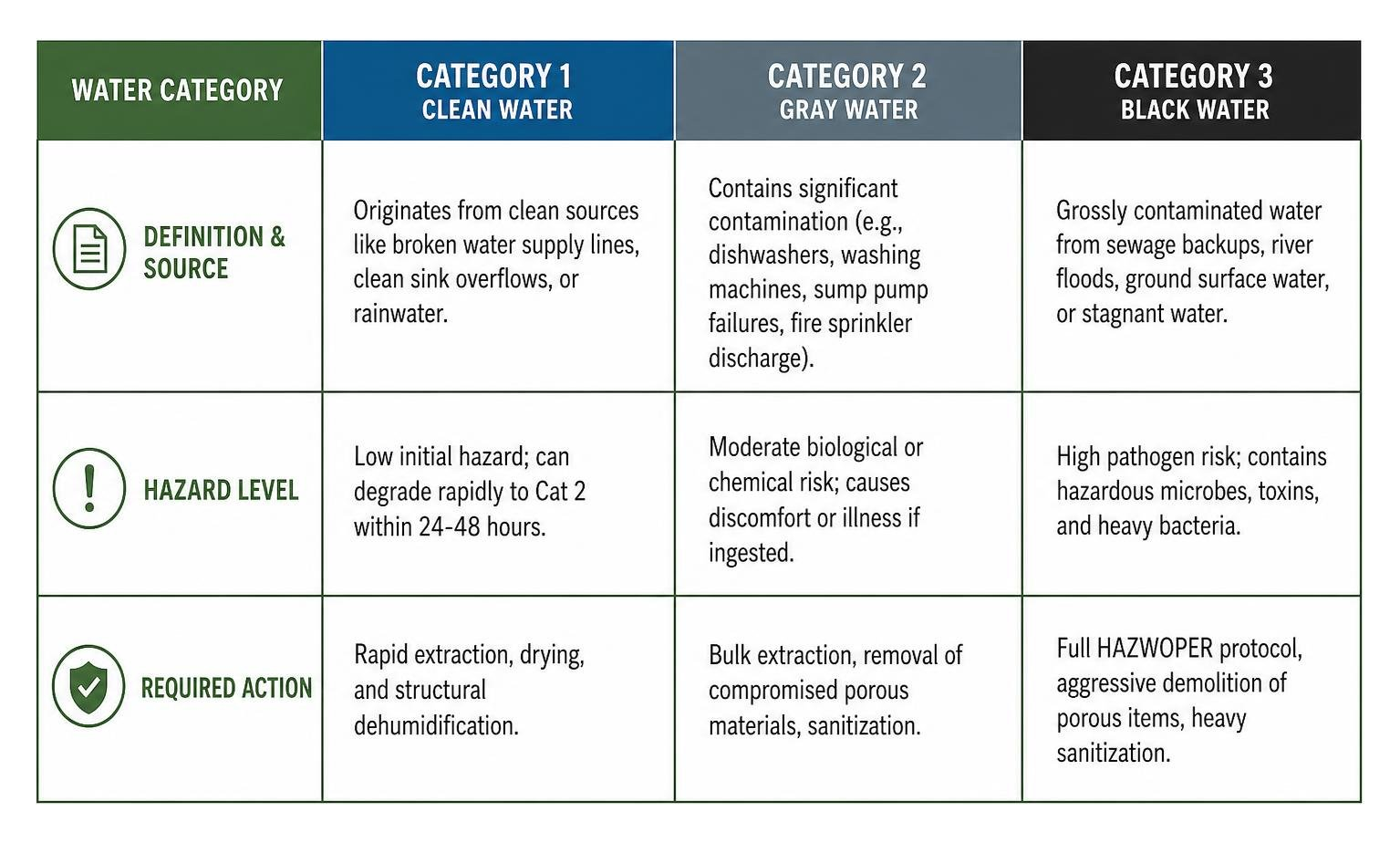
| Water Category | Definition & Source | Hazard Level | Required Action |
|---|---|---|---|
| Category 1 (Clean Water) | Originates from clean sources like broken water supply lines, clean sink overflows, or rainwater. | Low initial hazard; can degrade rapidly to Cat 2 within 24-48 hours. | Rapid extraction, drying, and structural dehumidification. |
| Category 2 (Gray Water) | Contains significant contamination (e.g., dishwashers, washing machines, sump pump failures, fire sprinkler discharge). | Moderate biological or chemical risk; causes discomfort or illness if ingested. | Bulk extraction, removal of compromised porous materials, sanitization. |
| Category 3 (Black Water) | Grossly contaminated water from sewage backups, river floods, ground surface water, or stagnant water. | High pathogen risk; contains hazardous microbes, toxins, and heavy bacteria. | Full HAZWOPER protocol, aggressive demolition of porous items, heavy sanitization. |
Primary Physical Causes and Industry Risk Profile
Every commercial sector faces distinct vulnerabilities. In multifamily properties and high-rise commercial office plazas, a single pipe burst on an upper floor can cause water to cascade downward through dozens of tenant suites, saturating drywall, elevator shafts, and ceiling assemblies along the way.
In industrial warehouses and retail centers, severe weather, storm surge, or HVAC condensate line clogs are frequent offenders. During winter freeze events, unheated utility spaces or exposed exterior fire lines can freeze and burst, pouring thousands of gallons of water into a facility in minutes. Routine failure points include:
- Plumbing and Pipe Bursts: High municipal water pressure or sudden freezes rupture supply mains and branch lines.
- HVAC System Condensate Failures: Clogged drain pans and frozen evaporator coils overflow above suspended ceiling grids, causing sudden ceiling collapses.
- Sprinkler System Malfunctions: Accidental head discharges, mechanical damage, or freeze-bursts dump massive volumes of high-volume water into commercial units.
- Roof and Flashing Failures: Storm winds, aging membranes, or clogged roof drains create standing water that breaches structural decks.
Categorization of Water Intrusion and Health Hazards
Restoration protocols are governed by guidelines from the Institute of Inspection, Cleaning and Restoration Certification (IICRC) and federal OSHA safety protocols. The industry classifies water loss into three categories:
- Category 1 (Clean Water): Originates from clean plumbing pipes or drinking fountains. If not dried within 24 to 48 hours, it quickly absorbs environmental pollutants and transitions into Category 2.
- Category 2 (Gray Water): Contains physical, chemical, or biological contaminants. Discharges from cooling towers, condensate drain pans, or commercial dishwashers fall under this category.
- Category 3 (Black Water): Highly toxic water containing raw sewage, ground floodwaters, or long-standing stagnant water. Black water carries dangerous pathogens and hazardous microbes. Materials saturated by Category 3 water must be safely stripped out under strict HAZWOPER environmental safety compliance.
Warning Signs of Hidden Commercial Water Damage
Water frequently migrates behind structural framing, under raised computer flooring, and into utility chases without leaving visible puddles on the surface. Facility managers should watch for these subtle indicators:
- Persistent Musty Odors: An unpleasant, damp smell almost always signals active microbial growth behind walls or beneath subfloors.
- Drywall Discoloration and Blistering: Brown ring stains, bubbling paint, or softening drywall indicate water traveling from above or behind.
- Subfloor Warping and Tile Delamination: Buckling commercial vinyl, cupping hardwood, or loose carpet tiles point to deep slab moisture intrusion.
- Elevated Relative Humidity: Unexplained spikes in interior building humidity indicate hidden reservoirs of evaporating water inside mechanical spaces.
When hidden moisture is suspected, restoration professionals deploy non-destructive moisture meters and thermal imaging tools (infrared cameras) to map unseen water plumes across concrete slabs and drywall assemblies.
The Commercial Water Damage Restoration Process and Advanced Technologies
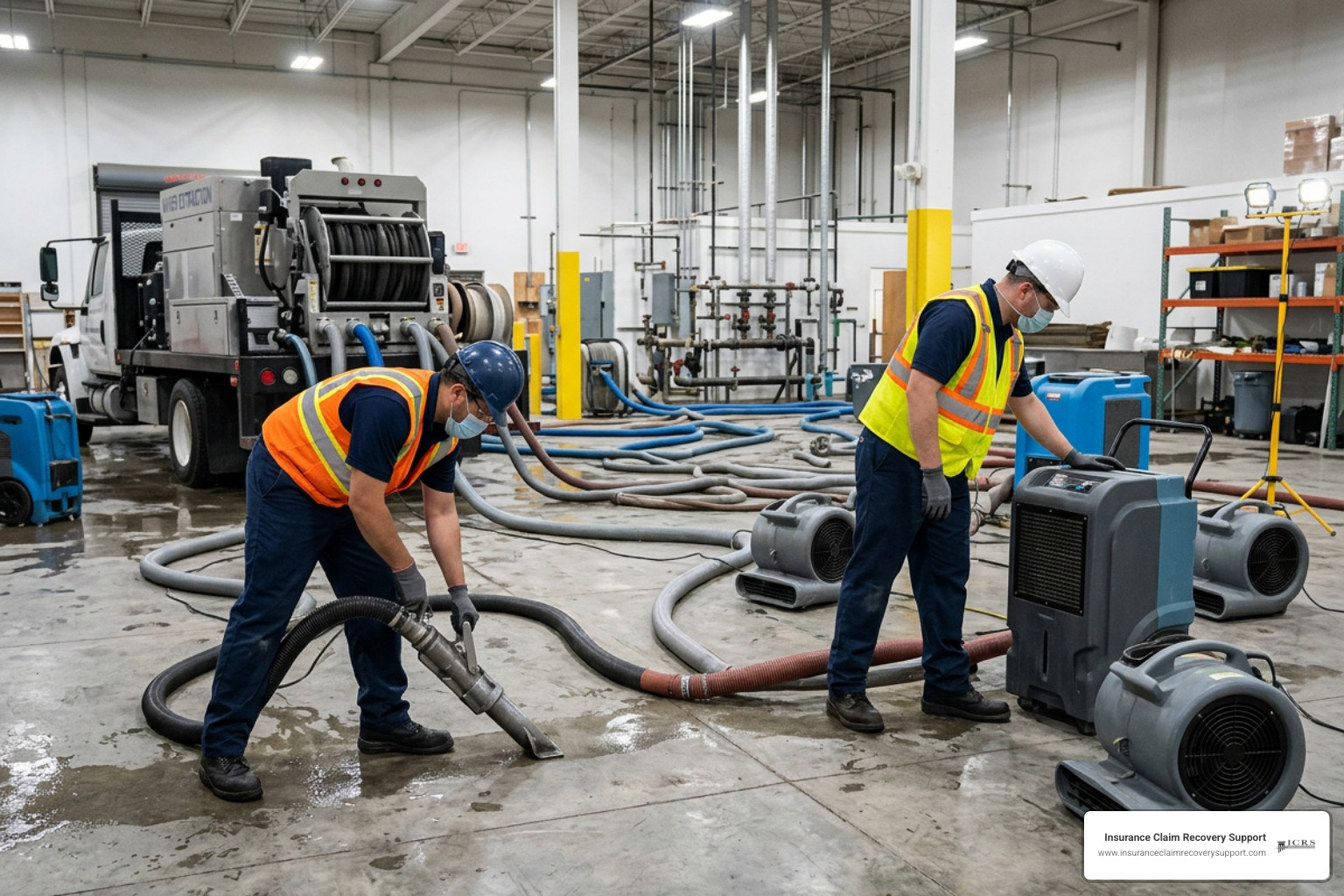
When an emergency occurs, standard residential drying methods fail. Restoring a commercial asset requires specialized heavy equipment, certified technicians, and strict scientific monitoring to return the structure to pre-loss condition while protecting building occupants.
Step-by-Step Commercial Water Damage Mitigation and Extraction Protocol
To limit long-term losses and comply with policy obligations, building owners must take immediate action. Understanding the Water Damage Insurance Claim Process ensures you select certified contractors while preserving your rights under your insurance contract.
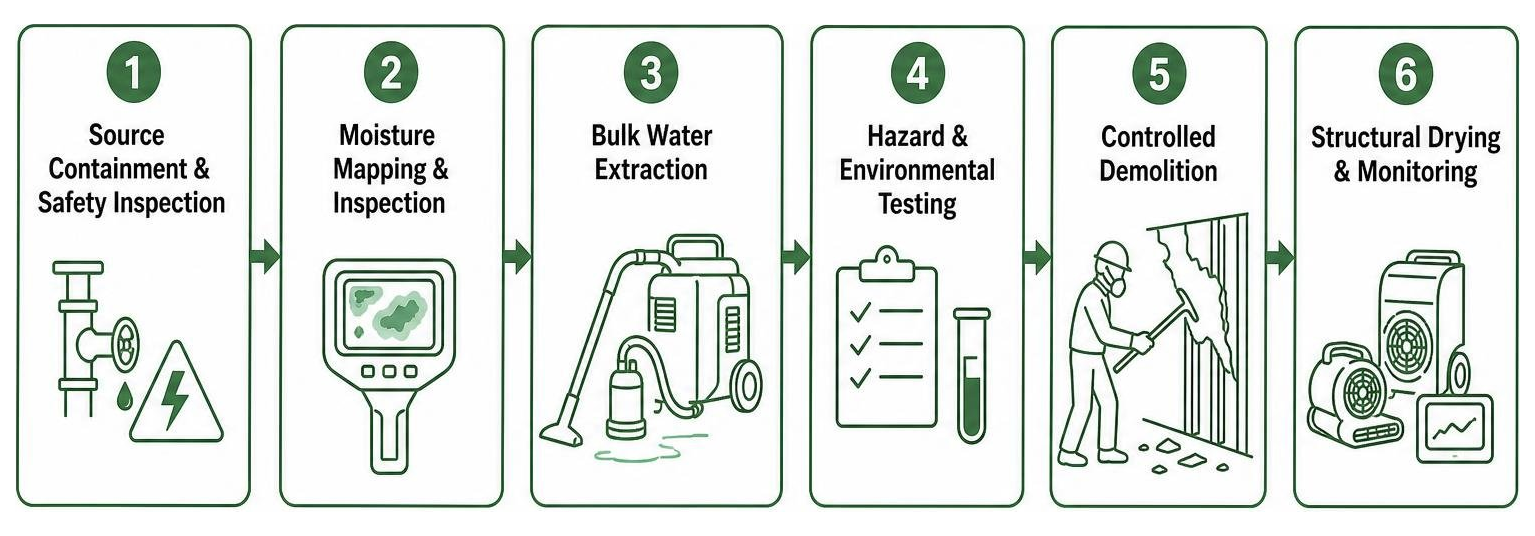
- Source Containment & Safety Inspection: Shut off water mains, isolate electrical circuits near standing water, and assess structural safety.
- Moisture Mapping & Inspection: Certified technicians build a digital “wet map” using thermal imaging and depth-penetrating meters to define exact loss boundaries.
- Bulk Water Extraction: High-capacity truck-mounted vacuum systems and submersible pumps extract thousands of gallons of standing water quickly.
- Hazard & Environmental Testing: In older commercial structures, local regulations and OSHA safety rules require an asbestos survey before removing wet building materials like ceiling tiles, drywall, or floor mastics.
- Controlled Demolition: Saturated non-salvageable materials (porous ceiling tiles, carpet padding, wet insulation) are removed to facilitate structural drying.
- Structural Drying Window: Industrial air movers and desiccant dehumidifiers run continuously over a standard 3 to 5 day structural drying window to achieve dry-standard equilibrium.
Advanced Drying Technologies and Environmental Compliance
Modern commercial drying relies on psychrometrics—the science of air, moisture, and temperature interaction. Professionals do not simply blow air around; they carefully calculate relative humidity, vapor pressure, and dew points.
- Desiccant Dehumidifiers: These heavy-duty units draw in damp air and pass it over a silica gel rotor, discharging ultra-dry air ideal for dense concrete slabs and complex commercial framing.
- High-Velocity Air Movers: Positioned strategically to push moist boundary layer air away from surfaces, accelerating evaporation.
- Document and Content Recovery: Sensitive business records, medical files, or historic books saturated by clean water undergo vacuum freeze-drying and desiccant air-drying to salvage vital data.
- Certified Industrial Hygienists (CIH): On large commercial losses, third-party industrial hygienists conduct environmental mold sampling and write strict remediation protocols. Because mold spores can colonize damp porous building materials within a tight 24 to 48 hour mold growth window, rapid structural drying is the first line of defense against toxic microbial blooms.
DIY vs. Professional Restoration and Preventive Maintenance
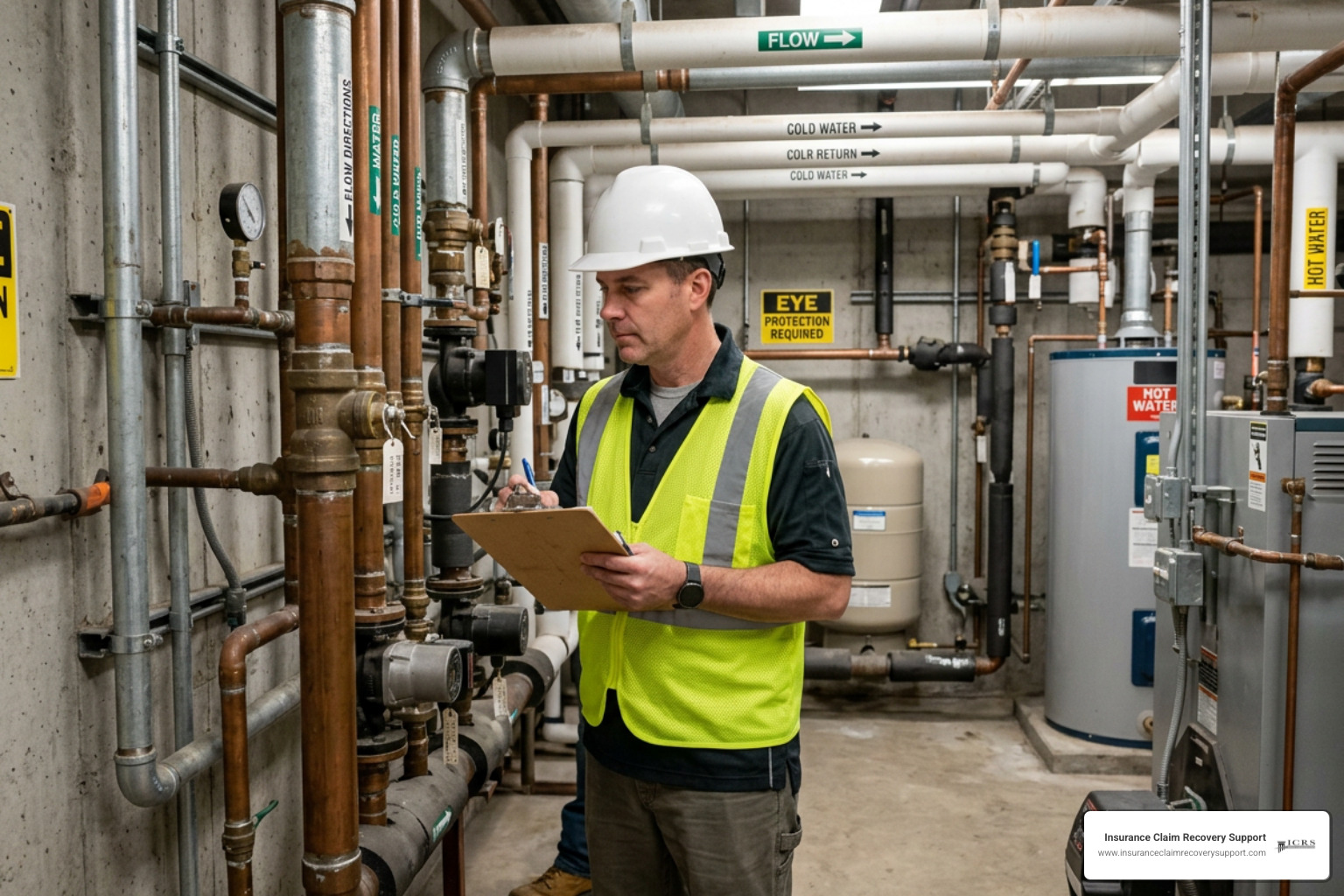
Commercial real estate represents millions of dollars in capital. Attempting to handle a significant water intrusion with internal janitorial staff often leads to hidden structural decay, persistent mold, and claim denials down the line.
DIY Limits versus Professional Restoration Standards
While janitorial crews can safely clean up a minor localized leak—such as a small clean-water sink spill on a vinyl floor—anything beyond a trivial puddle requires professional-grade equipment and technical credentials.
Fact vs. Myth: Commercial Drying
- Myth: “Setting up standard box fans and carpet dryers will dry out a commercial floor after a pipe break.”
- Fact: “Standard fans only dry surface layer materials. Deep moisture remains trapped in subfloors, concrete slabs, and wall cavities, fostering dark mold growth within 48 hours.”
Certified professionals hold credentials from the IICRC, including Water Damage Restoration Technician (WRT), Applied Structural Drying (ASD), and Applied Microbial Remediation Technician (AMRT). Large commercial losses also demand HAZWOPER (Hazardous Waste Operations and Emergency Response) compliance to handle sewage or hazardous wastewater safely. Failing to meet professional restoration standards can void your commercial property coverage or create severe health liability with commercial tenants. Proper guidance on managing these financial risks can be found in our overview of Commercial Property Insurance Claims.
Preventive Maintenance Strategies for Commercial Real Estate
The most cost-effective water loss is the one that never happens. Implementing proactive facility risk management protects building infrastructure and helps maintain lower insurance premiums:
- Annual Roof and Flashing Inspections: Inspect roof membranes, scuppers, and clear storm drains bi-annually, especially before storm seasons.
- HVAC Condensate Drain Flushing: Schedule bi-annual servicing to flush condensate lines, inspect secondary drain pans, and replace worn float switches.
- Backflow Preventer and Valve Servicing: Test backflow preventers annually and inspect fire sprinkler control valves to ensure rapid shutoff access during emergencies.
- Plumbing and Pipe Insulation: Insulate exposed supply lines in unheated attic spaces, mechanical rooms, and exterior walls to guard against sudden winter freezes.
- Smart Leak Detection Systems: Install automated flow-monitoring sensors and auto-shutoff valves in high-risk zones like boiler rooms, server suites, and kitchen breakrooms.
Managing Commercial Insurance Claims, Coverage Limits, and Insurer Scrutiny
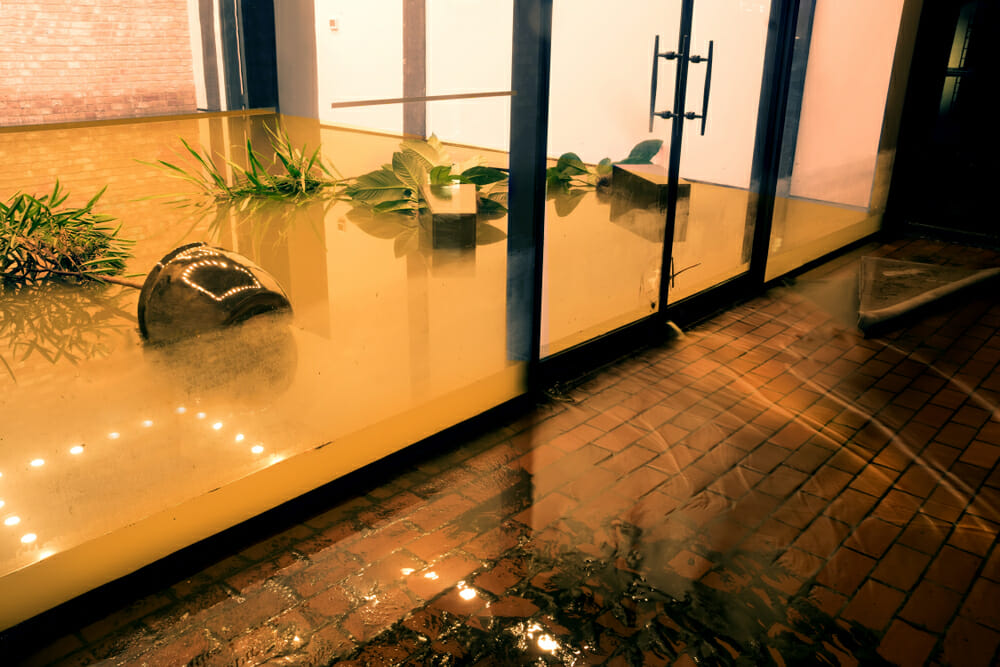
When commercial water damage strikes, managing the physical restoration is only half the battle. Navigating the commercial property insurance claim presents its own massive set of challenges. Commercial policies are written with complex endorsements, high deductibles, co-insurance clauses, and strict notice provisions.
Navigating High-Dollar Commercial Water Damage Claims and Insurance Scrutiny
Insurance carriers are corporations focused on controlling loss ratios, frequently treating systemic underpayment as a standard “cost of doing business.” In recent years, major carriers have increased scrutiny on high-dollar commercial and multifamily losses, relying on internal guidelines and claim denial tactics designed to reduce payouts. For building owners, this often means delayed claim processing, aggressive scope reduction, or improper classification of water losses as “pre-existing wear and tear.”
Property managers facing extensive losses should review our specialized guide on Commercial Water Damage Claims to understand how insurers evaluate water losses.
Systemic carrier scrutiny is widespread across the commercial property insurance industry. Regulators and courts have repeatedly cited major insurers for deceptive claims practices and unfair delays. For instance, in a landmark ruling, State Farm agreed to a State Farm $15.6M settlement following allegations of bad-faith claim handling. Similar operational patterns are documented in major legal actions across the country, as detailed in coverage by the NYT California article, the official California Enforcement Action, reporting from The Guardian, and analysis by CNN.
In Texas, policyholders are protected by robust legal frameworks, including Texas Insurance Code Chapter 541 (Unfair Competition and Unfair Practices) and Chapter 542 (Prompt Payment of Claims). These statutes set strict deadlines for insurers to acknowledge, investigate, accept, or deny claims, imposing mandatory statutory interest penalties on insurance companies that unreasonably delay indemnifying policyholders. Similar statutory protections exist across other states, countering the “cost of doing business” strategy some carriers use to stall valid payouts and underpay claims.
Translation Callout: Policy Language vs. Carrier Action
- Policy Clause: “The insurer will indemnify the insured for direct physical loss caused by sudden and accidental discharge of water.”
- Carrier Adjuster Interpretation: “We acknowledge the pipe broke suddenly, but we contend the underlying pipe rust indicates continuous seepage over months, so we are denying structural drying costs.”
- Policyholder Action: Secure immediate independent engineering and public adjusting representation to prove the physical loss was direct, sudden, and fully covered under the policy terms.
Documenting Damage and Overcoming Denial Strategies
To overcome aggressive carrier denials, commercial policyholders must build an unassailable evidentiary record. You cannot rely on the insurance carrier’s adjuster to accurately document your loss. Independent field adjusters hired by insurance companies often face heavy caseloads or work with limited licensing requirements, leading to broad oversights in structural scope.
To protect your investment, maintain complete operational records:
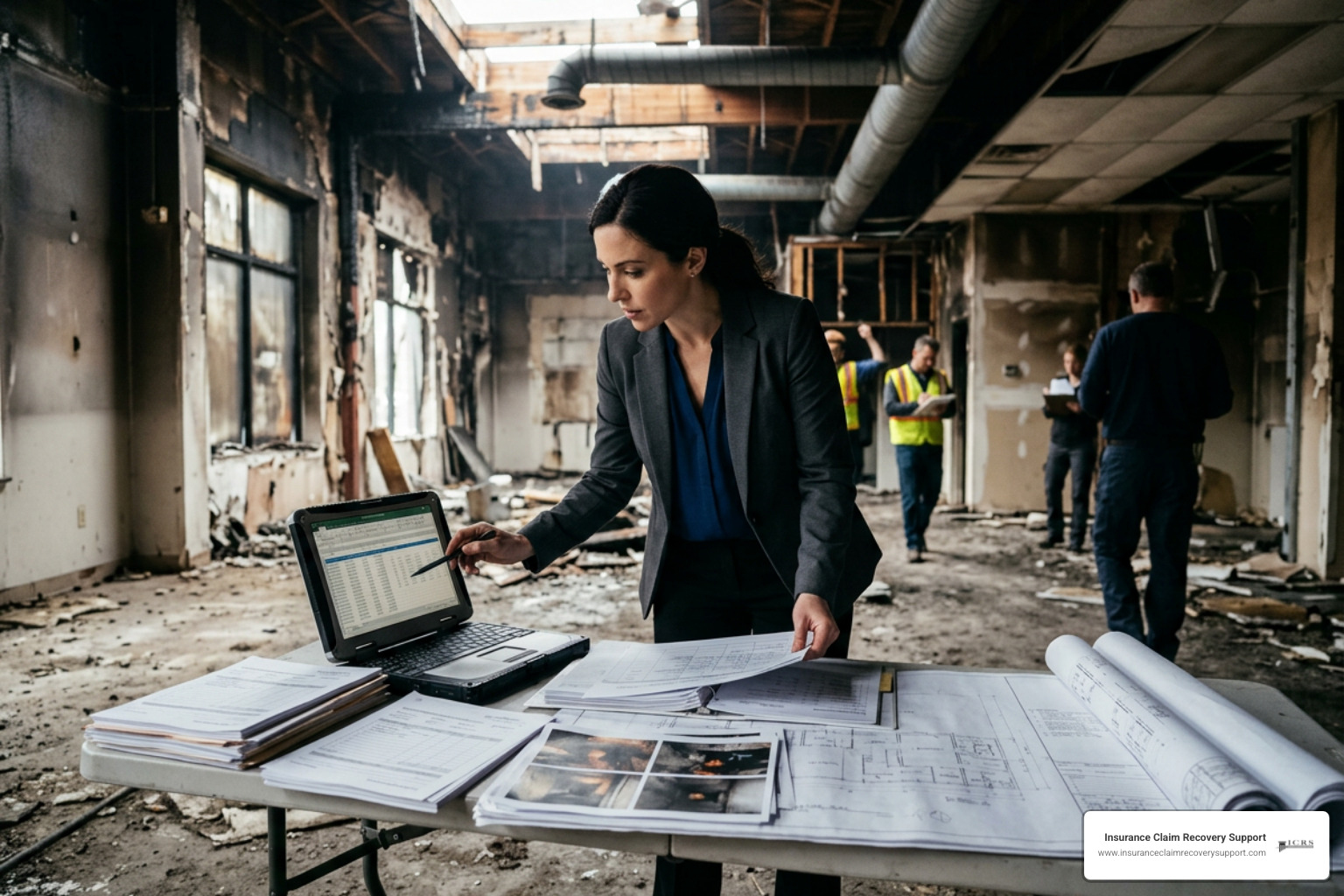
- Daily Dry Log Records: Demand that your restoration contractor provide daily moisture logs recording grain-per-pound (GPP) moisture readings, relative humidity, and dry-standard progress across all affected building materials.
- Psychrometric Charts: Modern drying logs must include psychrometric calculations demonstrating that drying equipment was necessary and properly operated.
- Photographic and Video Proof: Capture comprehensive high-resolution photo and video evidence of the water source, point of origin, visible standing water, saturated building components, and damaged tenant personal property prior to demolition.
- Detailed Scope Summaries: Track all line-item emergency repair costs, equipment runtime hours, contractor invoices, and environmental survey results.
When carriers refuse to negotiate fairly, policyholders can invoke policy dispute mechanisms like appraisal awards or pursue legal remedies to recover actual cash value or replacement cost settlements. In high-litigation environments like Florida, where litigation costs can escalate rapidly, policyholders benefit from retaining independent advocates early to resolve claims amicably before formal legal battles become necessary. To explore strategies for managing major losses, consult our breakdown of Large Loss Insurance Claims.
Immediate Building Owner Protocol and Business Interruption
When water floods a commercial facility, immediate administrative and physical steps must be executed simultaneously:
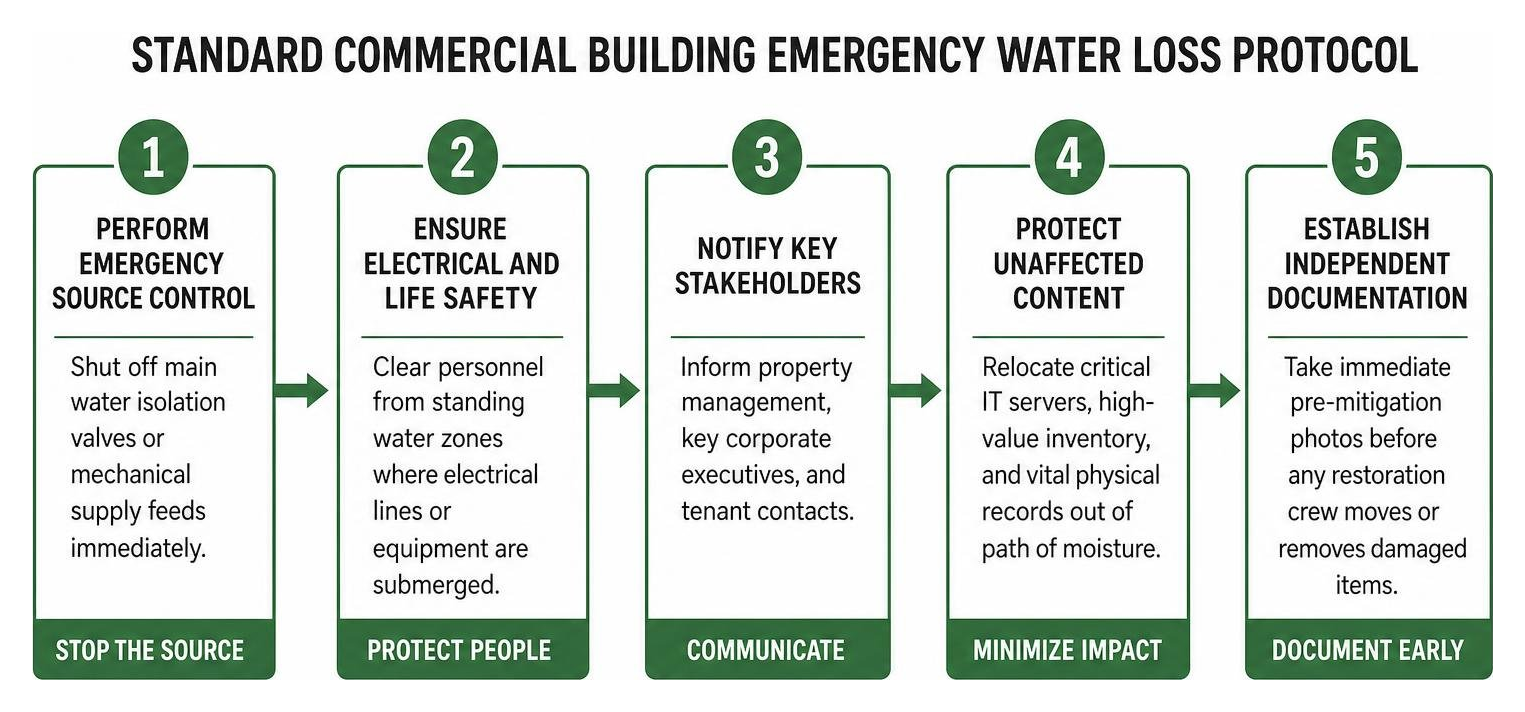
- Perform Emergency Source Control: Shut off main water isolation valves or mechanical supply feeds immediately.
- Ensure Electrical and Life Safety: Clear personnel from standing water zones where electrical lines or equipment are submerged.
- Notify Key Stakeholders: Inform property management, key corporate executives, and tenant contacts.
- Protect Unaffected Content: Relocate critical IT servers, high-value inventory, and vital physical records out of path of moisture.
- Establish Independent Documentation: Take immediate pre-mitigation photos before any restoration crew moves or removes damaged items.
- Track Business Interruption Losses: Document all lost operational income, extra expenses incurred to maintain temporary operations, and tenant rent abatements.
Commercial insurance policies frequently include Business Interruption (BI) and Extra Expense coverage. To learn more about calculating lost revenue and operational overhead during structural recovery, refer to our comprehensive guide on Business Insurance Claims and specialized regional resources like our guide to Property Insurance Claims Help.
Frequently Asked Questions About Commercial Water Losses
Should a building owner contact the insurance company or restoration contractor first?
When active water is running through a commercial building, your first phone call should always be to a qualified emergency water damage restoration contractor to shut off the source, extract standing water, and stabilize the property.
Most commercial property policies explicitly require the insured to take all reasonable steps to protect the property from further harm (known as the policyholder’s duty to mitigate). Waiting for an insurance company adjuster to travel to your site before starting water extraction can lead to secondary mold damage and structural decay—damage the insurer may later refuse to cover, citing your failure to mitigate.
However, you must notify your insurance carrier promptly after emergency containment begins. For a detailed roadmap on managing carrier communications alongside initial mitigation efforts, review our complete Insurance Claim Process Guide.
How long does structural drying take and how much does commercial restoration cost?
The structural drying phase for a commercial water loss typically takes 3 to 5 days, depending on the building materials involved, total water volume, and water category. Saturated lightweight concrete, multi-layer drywall, or dense subflooring may require longer drying cycles under desiccant dehumidification.
Commercial restoration costs vary based on the scope and complexity of the loss:
| Restoration Scope | Estimated Cost Range | Primary Cost Drivers |
|---|---|---|
| Basic Emergency Extraction | $500 – $2,500 | Bulk water pumping, surface vacuuming, minor containment |
| Standard Commercial Drying | $1,000 – $5,000 | Air mover setup, desiccant dehumidifiers, daily monitoring |
| Mold Remediation & Sanitization | $1,500 – $4,000+ | Containment buildouts, HEPA filtration, antimicrobial wash |
| Large-Loss Commercial Water Event | $5,000 – $20,000+ | Multi-floor extraction, structural teardown, high-capacity equipment |
Beyond physical restoration, large commercial losses frequently trigger secondary business interruption costs, tenant displacement expenses, and structural rebuild expenses that reach hundreds of thousands of dollars.
How can public adjusters transform high-dollar commercial water claims exceeding $250K?
On complex commercial water damage claims exceeding $250,000, relying exclusively on the insurance company’s internal adjuster often leaves significant settlement money on the table. Insurance company adjusters work for the insurer—not for you. Their job is to evaluate loss within strict carrier guidelines.
A licensed public insurance adjuster works exclusively as a policyholder advocate. Public adjusters perform detailed independent inspections, analyze complex policy language, audit restoration dry logs, write line-item construction estimates using industry-standard software (Xactimate), and negotiate directly with the carrier’s claims management team.
To understand how professional advocacy protects your asset during major losses, read our detailed article on How Public Adjusters Can Transform Your Commercial Claim.
Conclusion
Commercial water damage is an inevitable operational risk for real estate owners, but an unfair insurance settlement doesn’t have to be. When water compromises your commercial office building, apartment community, industrial facility, or retail plaza, rapid mitigation stops physical destruction—and expert claim advocacy protects your financial recovery.
At Insurance Claim Recovery Support LLC (ICRS), we represent policyholders exclusively. We never work for insurance companies. Our sole mission is to level the playing field, advocate for your policy rights, eliminate delays, and secure the maximum settlement you are rightfully owed under your policy contract.
Our team helps commercial and multifamily owners investigate and document water losses, review claim estimates, and pursue a resolution supported by the evidence and policy terms. We seek to avoid unnecessary litigation when possible.
If your commercial property has suffered major water loss exceeding $250,000, don’t face the insurance carrier alone. Contact our experienced commercial claim advocates today through our expert team at Public Insurance Adjuster Texas or visit our main Commercial Property Insurance Claims Pillar Page to schedule a comprehensive claim evaluation.