What to Look for in Commercial Water Damage Repair Companies
When a pipe bursts in a Dallas office tower or a flash flood hits a San Antonio retail center, the clock starts ticking. You aren’t just looking for a “guy with a van and a fan.” You need commercial water damage repair companies that understand the high-stakes environment of a business or multifamily property. Unlike residential work, commercial restoration involves massive square footage, complex HVAC systems, and the constant pressure of business interruption.
For a companion claim-documentation resource, see the ICRS Ultimate Water Damage Insurance Claim Survival Guide. Coverage and next steps depend on the facts and policy terms.
The first thing we look for is a company that adheres to the IICRC S500 standards. This is the “bible” of the restoration industry. It outlines the specific procedures for professional water damage restoration based on the category of water (clean vs. contaminated) and the class of intrusion (how much of the area is wet).
Top-tier commercial water damage repair companies should offer:
- 24/7 Emergency Response: Water damage is a “Category 3” emergency if left alone. Leading companies typically respond within minutes and are on-site within hours.
- Industrial-Grade Extraction: We aren’t talking about shop-vacs. These teams use truck-mounted extraction units and powerful submersible pumps capable of moving thousands of gallons per hour.
- Moisture Mapping and Infrared Imaging: You can’t fix what you can’t see. Professionals use thermal cameras to find “hidden” water behind drywall or under subfloors that would otherwise lead to rot.
- Business Continuity Focus: They should have a plan to isolate damaged areas so your tenants can keep working or your residents can stay in their units whenever possible.
According to scientific research on mold remediation in commercial buildings, moisture control is the only way to prevent mold. If the drying isn’t documented with daily moisture logs, your insurance company might try to deny a secondary mold claim later.
Essential Certifications for Commercial Water Damage Repair Companies
In the commercial world, “experience” needs to be backed by paper. When we represent policyholders in places like Houston or Austin, we check that the restoration contractor has the right credentials. This isn’t just about quality; it’s about liability.
- IICRC Certification: The Institute of Inspection Cleaning and Restoration Certification is the gold standard. Look for “Water Restoration Technician” (WRT) and “Applied Structural Drying” (ASD) designations.
- OSHA Compliance: Commercial sites are subject to strict safety regulations. If a worker gets hurt on your property and the company isn’t OSHA-compliant, that headache lands on you.
- HAZWOPER Training: This is critical if you are dealing with “Black Water” (sewage or floodwater). Handling biohazards requires specific Hazardous Waste Operations and Emergency Response training.
- Licensed Plumbers and Electricians: Many water events involve Dallas Flood Damage or internal mechanical failures. The company should have licensed tradespeople to handle the “source” of the leak safely.
Specialized Equipment Used by Commercial Water Damage Repair Companies
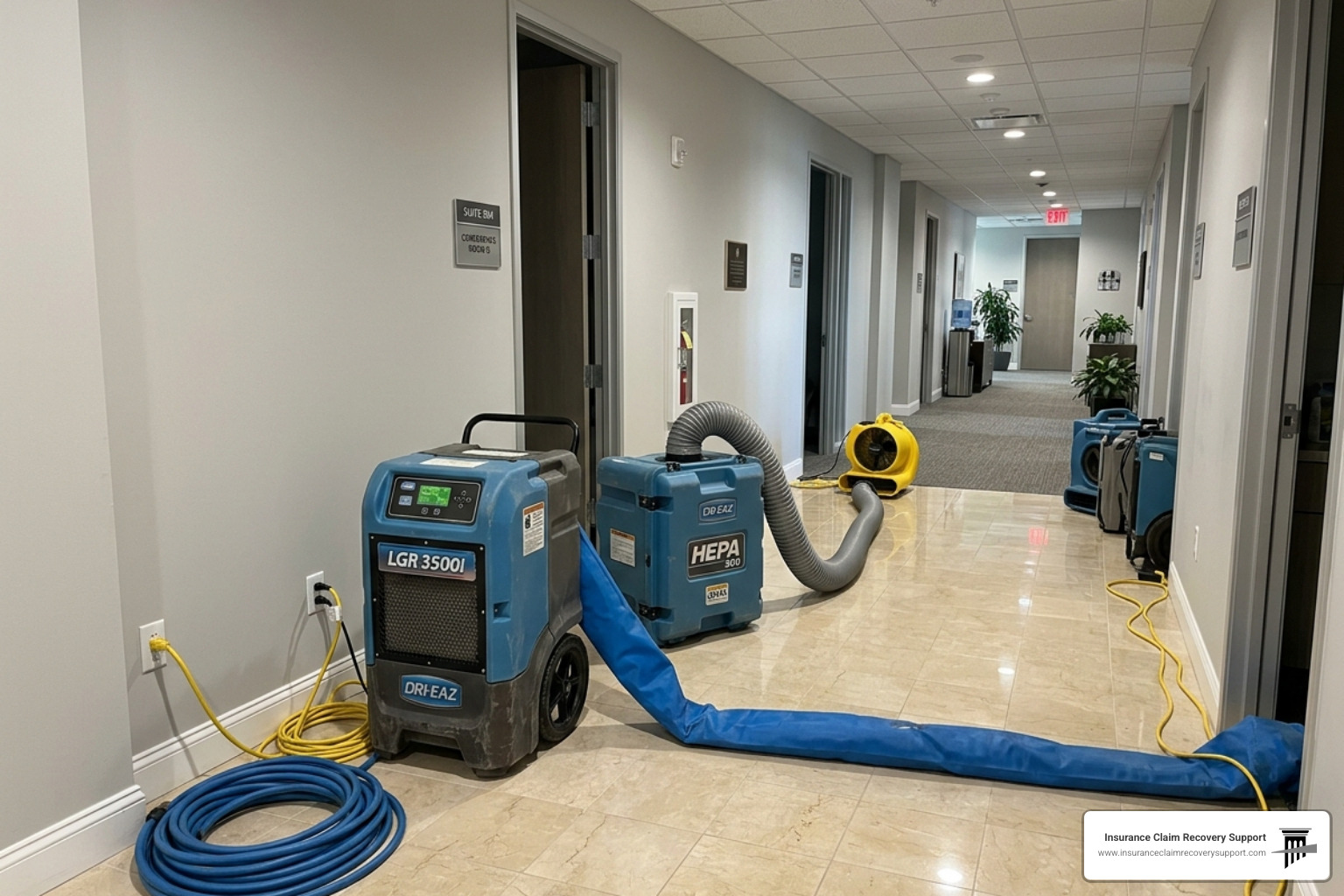
To dry out a 50,000-square-foot warehouse or a mid-rise apartment complex in Fort Worth, you need serious hardware. Leading commercial water damage repair companies invest heavily in technology to speed up the process.
- LGR (Low Grain Refrigerant) Dehumidifiers: These are high-performance machines that can pull moisture out of the air even in very low humidity, which is essential for deep-drying structural wood and dense materials.
- HEPA Air Scrubbers: These filter out 99.97% of airborne particles, including mold spores and dust, keeping the air safe for your employees and customers.
- Desiccant Drying: For large-scale losses, companies may bring in trailer-mounted desiccant dehumidifiers. These use chemical adsorbents to create extremely dry air, often used for sensitive documents or large open spaces.
- Subsurface Extractors: Tools like “weighted extractors” allow technicians to pull water directly out of carpet padding without removing the carpet, saving time and replacement costs.
- Psychrometric Monitoring: This is the science of drying. Technicians monitor temperature and relative humidity to ensure the “drying envelope” is working efficiently.
Understanding the Category Flood Damage is vital here. If the water is Category 3 (black water), much of the porous material like drywall and insulation cannot be “dried”—it must be removed and replaced.
Navigating the Restoration Process and Insurance Claims
The physical cleanup is only half the battle. The other half is the paperwork. As public adjusters, we often see a disconnect between what commercial water damage repair companies want to do and what the insurance company wants to pay for.
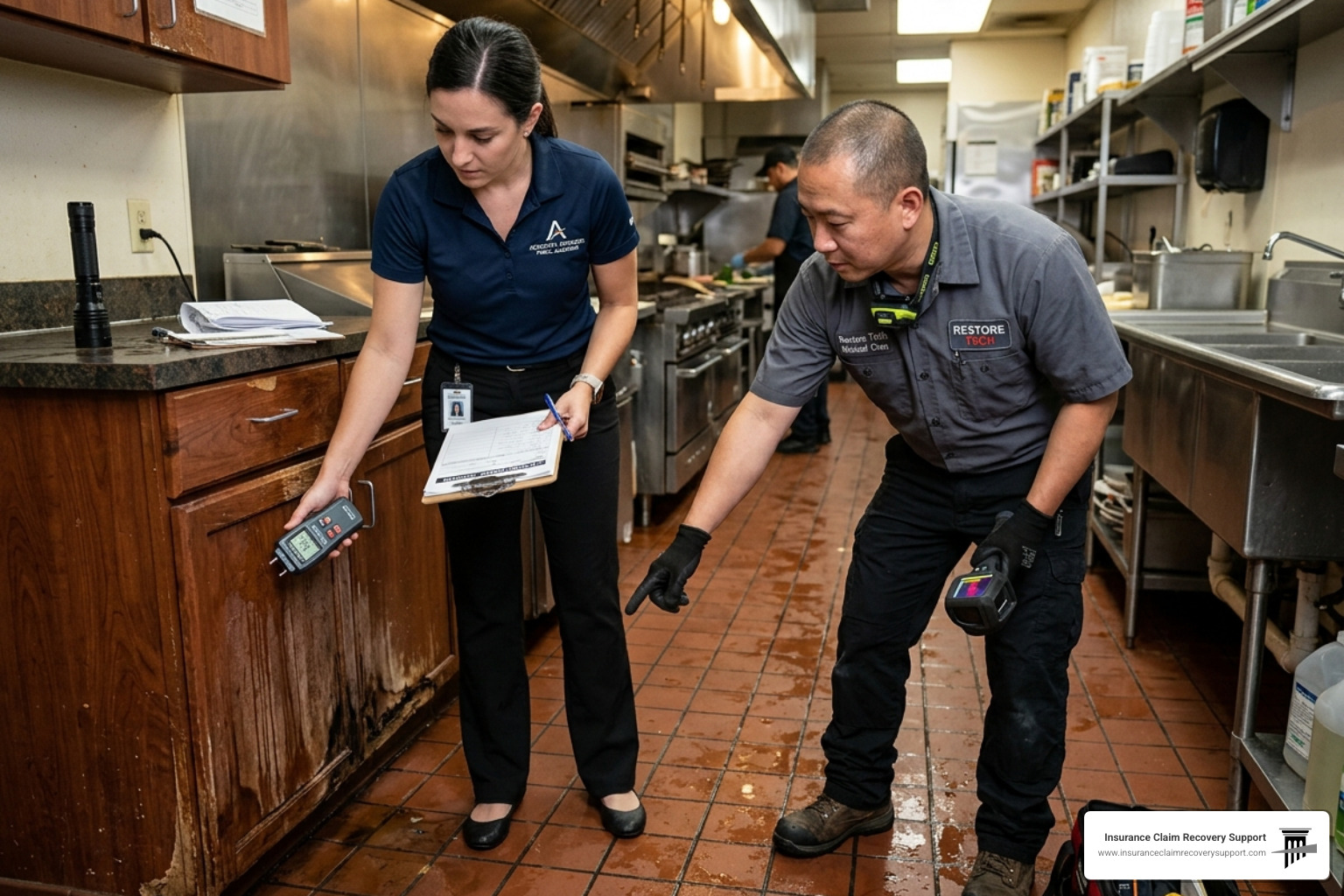
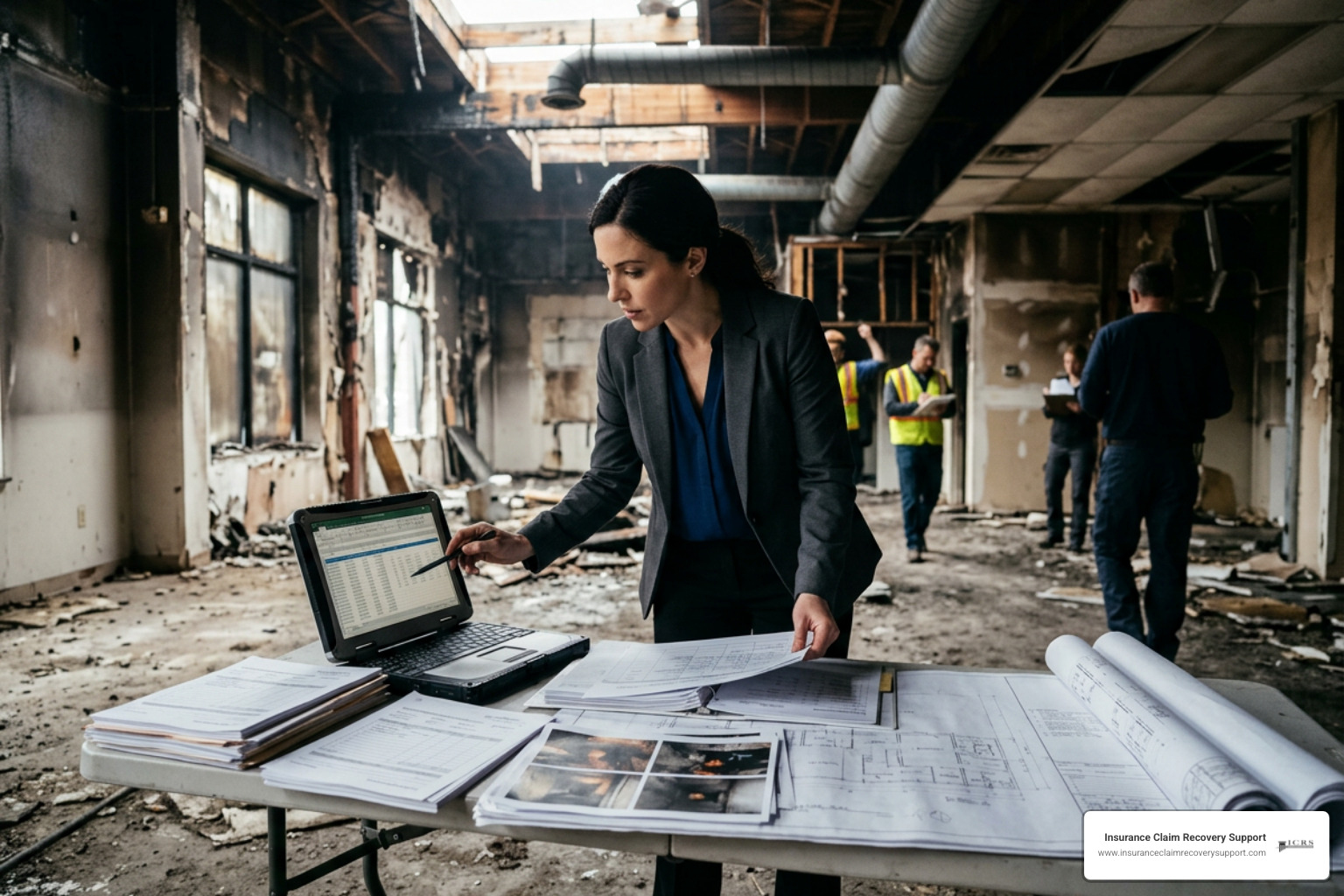
Documentation is your best friend. Before a single piece of baseboard is ripped out, the damage must be documented. This includes:
- Photos and Video: A visual record of every room, including the water line on the walls.
- Moisture Logs: Daily readings showing that the equipment is actually working.
- Proof of Loss: A formal statement to the insurance company regarding the amount of money being claimed.
One major hurdle is the “Preferred Vendor” trap. Insurance companies often have a list of commercial water damage repair companies they recommend. While these companies are often competent, they have a financial relationship with the insurer. This can sometimes lead to “corner-cutting” to keep costs down for the insurance carrier. We always advocate for hiring an independent restoration expert who works for you, not the insurance company.
Public Adjuster vs. Litigation: A Comparison
When the insurance company offers a settlement that doesn’t cover the actual cost of repairs, many owners think they have to sue. But litigation is slow and expensive.
| Feature | Public Adjuster (ICRS) | Insurance Litigation |
|---|---|---|
| Speed | Usually settled in weeks or months | Can take 2–5 years |
| Cost | Percentage of the increased settlement | High hourly legal fees + court costs |
| Approach | Expert negotiation and policy analysis | Adversarial and confrontational |
| Success Rate | ICRS has a 90% settlement success rate | Uncertain; depends on a jury or judge |
| Business Impact | Focuses on getting you back to work | Can tie up management for years in depositions |
By working with us at Insurance Claim Recovery Support, you can often avoid the courtroom entirely. We specialize in Flood Damage Insurance Claims and know how to present the evidence so the carrier pays up fairly.
The Standard Step-by-Step Restoration Workflow
While every job is different, most commercial water damage repair companies follow a structured 6-step process:
- Emergency Contact & Inspection: The team arrives, identifies the water source, and categorizes the water (Category 1, 2, or 3).
- Water Extraction: Using heavy-duty pumps to remove standing water. This is the most critical step to prevent the water from “wicking” further up the walls.
- Material Removal (Triage): Removing “non-salvageable” items like saturated ceiling tiles or wet insulation. In Texas, an asbestos survey may be required before demolition in older commercial buildings.
- Drying and Dehumidification: Deploying air movers and dehumidifiers. This typically takes 3 to 5 days.
- Cleaning and Sanitizing: Treating the area with antimicrobial agents to prevent mold and eliminate odors.
- Restoration & Build-Back: Replacing the drywall, flooring, and paint to return the building to its pre-loss condition.
For a deeper dive into the specifics of filing, see our guide on the Flood Claim process.
Commercial vs. Residential Restoration Differences
If you try to use a residential plumber for a commercial flood, you’re going to have a bad time. The scale is simply different.
- Multi-Unit Coordination: In an apartment complex in Waco or Lubbock, a leak on the 4th floor affects four different tenants below. You need a company that can manage logistics for multiple stakeholders simultaneously.
- Complex HVAC and Mechanicals: Commercial buildings have chillers, boilers, and complex ductwork. Water in these systems can spread contaminants throughout the entire building if not handled correctly.
- Large-Loss Logistics: A commercial loss might require 100+ dehumidifiers. Most residential companies don’t even own that many.
- Regulatory Hurdles: Commercial properties have stricter codes regarding fire suppression systems and ADA compliance during the “build-back” phase.
Knowing How to Survive a San Antonio Flood involves understanding these commercial complexities before the storm hits.
Fact vs. Myth: Commercial Water Damage Claims
Myth: My insurance company’s “preferred contractor” is the best choice for the job. Fact: They are often the best choice for the insurance company’s bottom line. You have the right to hire any qualified company you choose.
Myth: If I have water damage, it’s automatically covered. Fact: Most policies cover “sudden and accidental” leaks (like a burst pipe) but exclude “gradual” leaks that have been happening for weeks. This is why documentation of the “event” is so important.
Myth: Flood insurance and water damage insurance are the same thing. Fact: Standard commercial policies usually exclude “flood” (rising surface water from outside). You need a separate NFIP or private flood policy for that.
Myth: I have to wait for the insurance adjuster to show up before I start cleaning. Fact: You have a “duty to mitigate.” This means you must start the drying process immediately to prevent further damage (like mold). If you wait and mold grows, the insurance company might deny the claim because you didn’t act fast enough.
Maximizing Your Recovery Without Litigation
At Insurance Claim Recovery Support, our goal is to get your business back to normal without the “soaking” that comes from a lowball insurance settlement. Whether you are dealing with a frozen pipe in Amarillo or a hurricane-related intrusion in Houston, the process is the same: document everything, mitigate immediately, and bring in an advocate.
We represent property managers, HOA boards, and industrial owners across Texas and beyond. We understand the local laws and the specific tactics insurance carriers use to delay or underpay claims. Our USP is simple: we maximize your settlement and reduce delays, often resolving claims that others would have walked away from or sent to a lawyer.
If you’re currently staring at a wet floor and a mounting pile of bills, don’t go it alone. More info about commercial property insurance claims is available on our site, or you can contact us directly for a complimentary claim review. We serve Austin, Dallas, Fort Worth, San Antonio, Houston, and many other cities, ensuring that when disaster strikes, you have an expert in your corner.
Don’t let the insurance company leave you high and dry—or in this case, wet and underpaid. Pick the right commercial water damage repair companies, then pick the right public adjuster to make sure they get paid what they’re worth, and you get the building you deserve.