When a Storm Hits Your Commercial Property, Every Hour Counts
Commercial storm damage can bring a thriving business to a complete standstill — and the clock starts ticking the moment the weather clears.
For a companion claim-documentation resource, see the ICRS Hail & Wind Claim Guide. Coverage and next steps depend on the facts and policy terms.
Quick Answer: What Should You Do After Commercial Storm Damage?
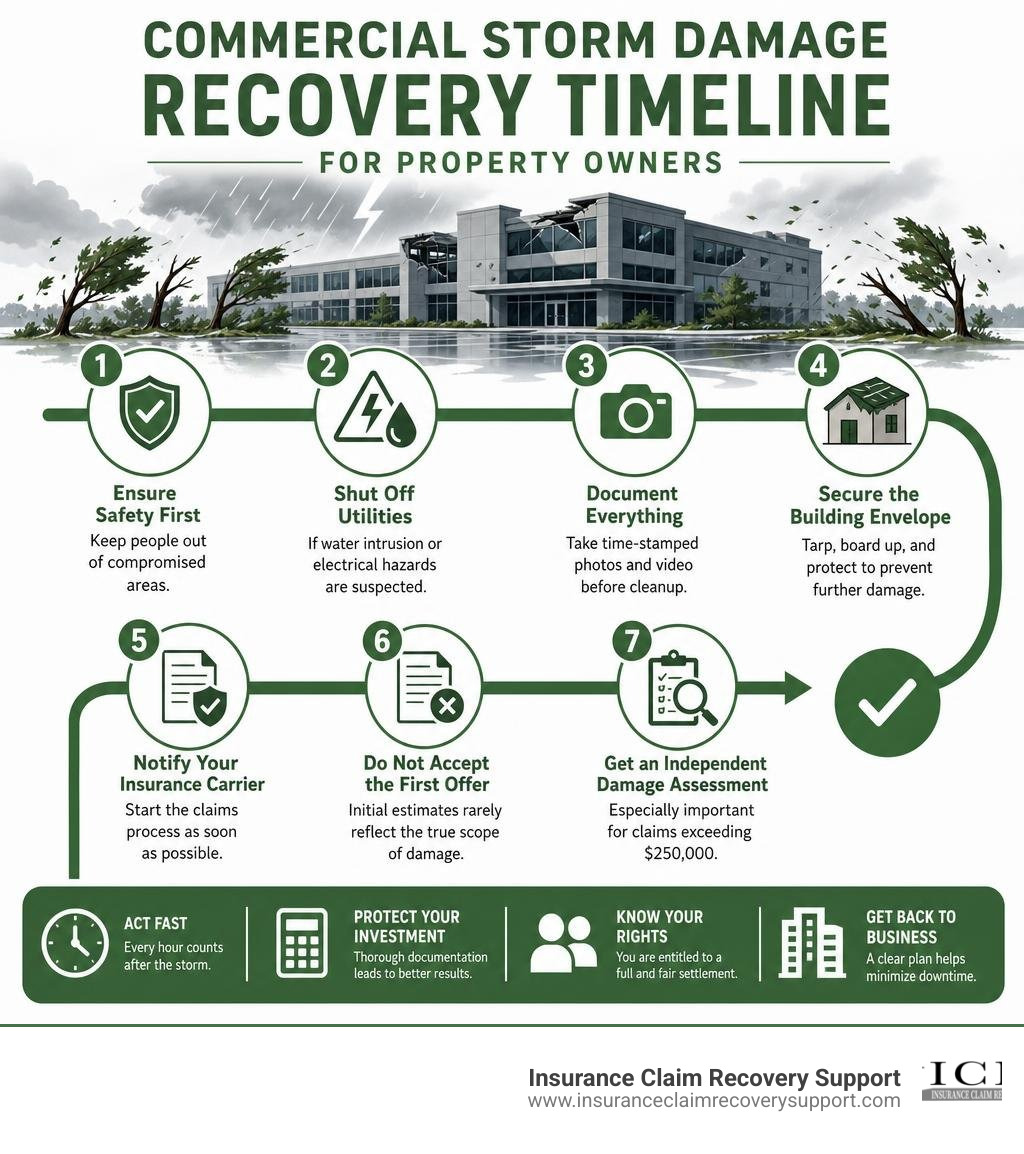
- Ensure safety first — keep employees, tenants, and customers out of structurally compromised areas
- Shut off utilities if water intrusion or electrical hazards are suspected
- Document everything immediately — time-stamped photos and video of all interior and exterior damage before any cleanup begins
- Secure the building envelope — emergency tarping, board-up, and shrink-wrap roofing to prevent further weather exposure
- Notify your insurance carrier — start the claims process as quickly as possible; delays can reduce your settlement
- Do not accept the first offer — initial insurance estimates rarely reflect the true, full scope of commercial losses
- Get an independent damage assessment — especially for claims exceeding $250,000, where underpayment risk is highest
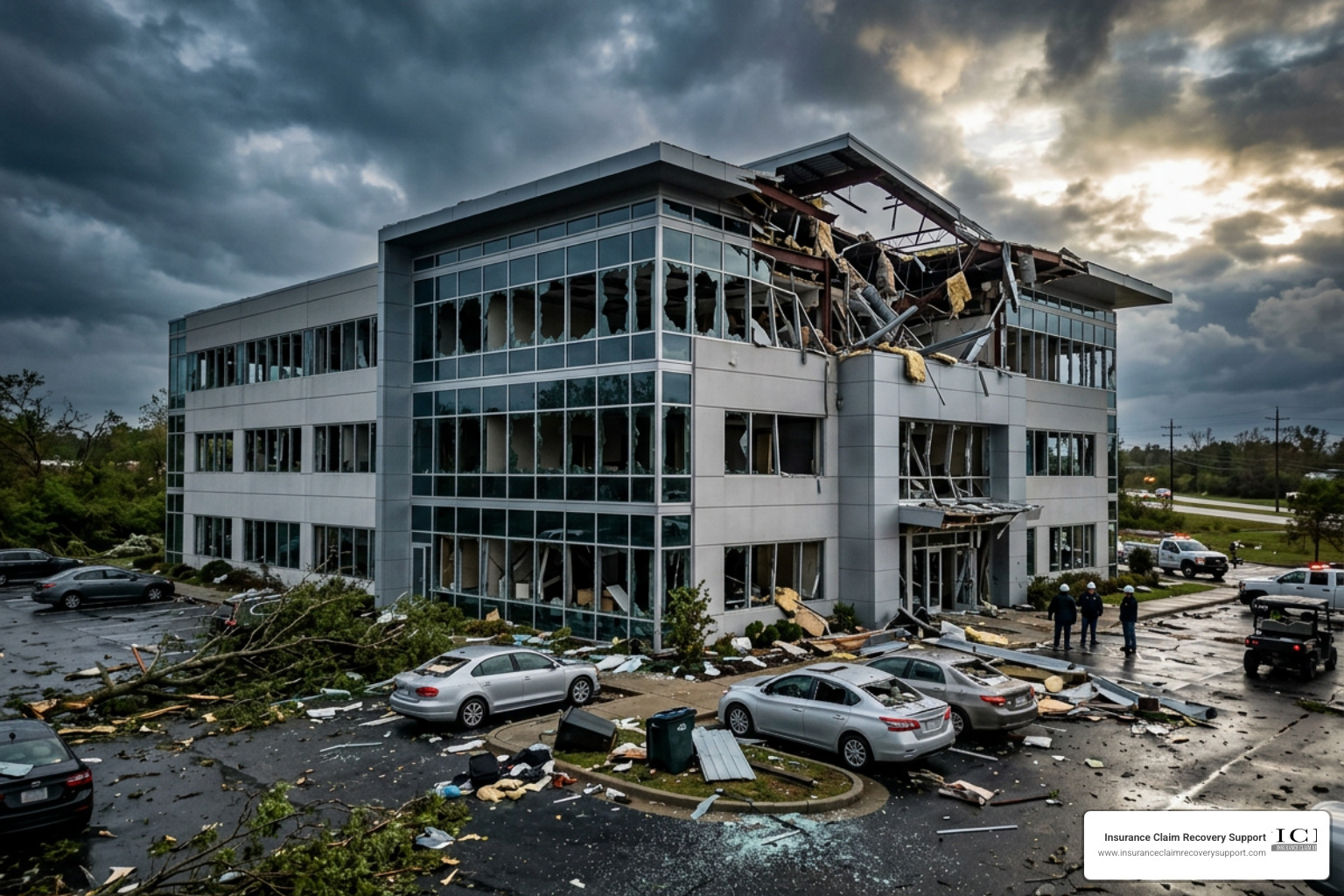
The reality facing commercial property owners, multifamily operators, and facility managers in July 2026 is stark: storms are becoming more intense, insurance claims are growing more complex, and carriers are under increasing financial pressure to minimize what they pay out. A Category 5 hurricane alone can disrupt more than half of the country’s economic productivity. Even a localized hailstorm or a straight-line wind event can compromise a commercial roof, trigger water intrusion across multiple tenant spaces, and generate a claims process that drags on for months — costing far more in business interruption losses than the physical damage itself.
What makes commercial storm recovery uniquely challenging is not the storm. It is everything that comes after it.
Property damage doesn’t just create a repair problem — it creates a business problem. Tenants are pushing for answers. Lenders are watching. Revenue stops, but expenses don’t. And somewhere in the middle of all that pressure, you are expected to navigate a complex insurance claim process against a carrier whose financial interests are not aligned with yours.
This guide is built to walk you through every stage of that process: from the first hours after a storm through final settlement — with clarity, without the runaround.
My name is Scott Friedson, and I am a Multi-State Licensed Public Adjuster and CEO of Insurance Claim Recovery Support (ICRS) LLC, a large-loss public adjusting firm with over 15 years of experience exclusively in commercial storm damage and complex property insurance claims. Across more than 500 large-loss claims totaling over $250 million in settled losses, I have helped commercial and multifamily property owners recover what they were rightfully owed — including cases where initial carrier offers were increased by 30% to more than 3,800%. The sections that follow are built on that real-world experience.
Commercial storm damage terms simplified:
Understanding Commercial Storm Damage and Structural Vulnerabilities

Commercial structures are fundamentally different from residential properties. They feature expansive footprints, complex mechanical systems, and engineering designed to withstand specific structural loads. When severe weather hits, these systems are put to the ultimate test. Whether you manage multifamily apartments, sprawling retail centers, multi-tenant office buildings, industrial facilities, or high-density HOAs, understanding where your building is vulnerable is the first step toward a successful recovery.
Wind Uplift and Roof Membrane Failures
Flat roof systems and low-slope membranes are highly susceptible to wind uplift forces. During a severe windstorm, tornado, or hurricane, wind moving rapidly across a flat roof creates a pressure differential. This differential acts like airplane wing lift, pulling upward on the roof membrane.
If there is any weakness in the perimeter flashing or coping caps, the wind will find it. Once the perimeter is breached, wind peels back TPO membranes, EPDM rubber, or PVC roofing, exposing the underlying insulation and decking to immediate structural compromise.
This is why a professional roof storm damage insurance claim must evaluate not just the visible tears, but the integrity of the entire building envelope. When wind uplift breaks the mechanical fasteners or adhesive bonds holding a membrane down, the roof’s structural capacity is permanently degraded, opening the door for massive water intrusion during the next rainfall.
Hail Impacts and Hidden Microfractures
Hail is one of the most deceptive sources of commercial storm damage. Unlike wind, which leaves obvious visual markers, hail damage on low-slope roofing systems is often invisible from the ground.
When hail strikes a TPO or EPDM membrane, it creates “bruising.” These impacts fracture the underlying reinforcement scrim or create microscopic cracks in the protective finish. Over time, these hidden microfractures degrade under UV exposure, allowing moisture to seep into the insulation board below.
On metal roofing systems, hail causes cosmetic denting that can lead to protective finish degradation, accelerating rust and corrosion years down the line. Furthermore, hail frequently destroys the delicate aluminum fins on HVAC condenser coils, restricting airflow, causing compressor failure, and triggering massive operational downtime.
Because many insurance policies contain cosmetic damage exclusions, carriers often try to dismiss hail dents as “non-functional.” Proper policy interpretation is crucial to prove that what looks like cosmetic damage actually compromises the mechanical lifespan and structural integrity of your building envelope.
Immediate Post-Storm Action Protocol for Commercial Properties
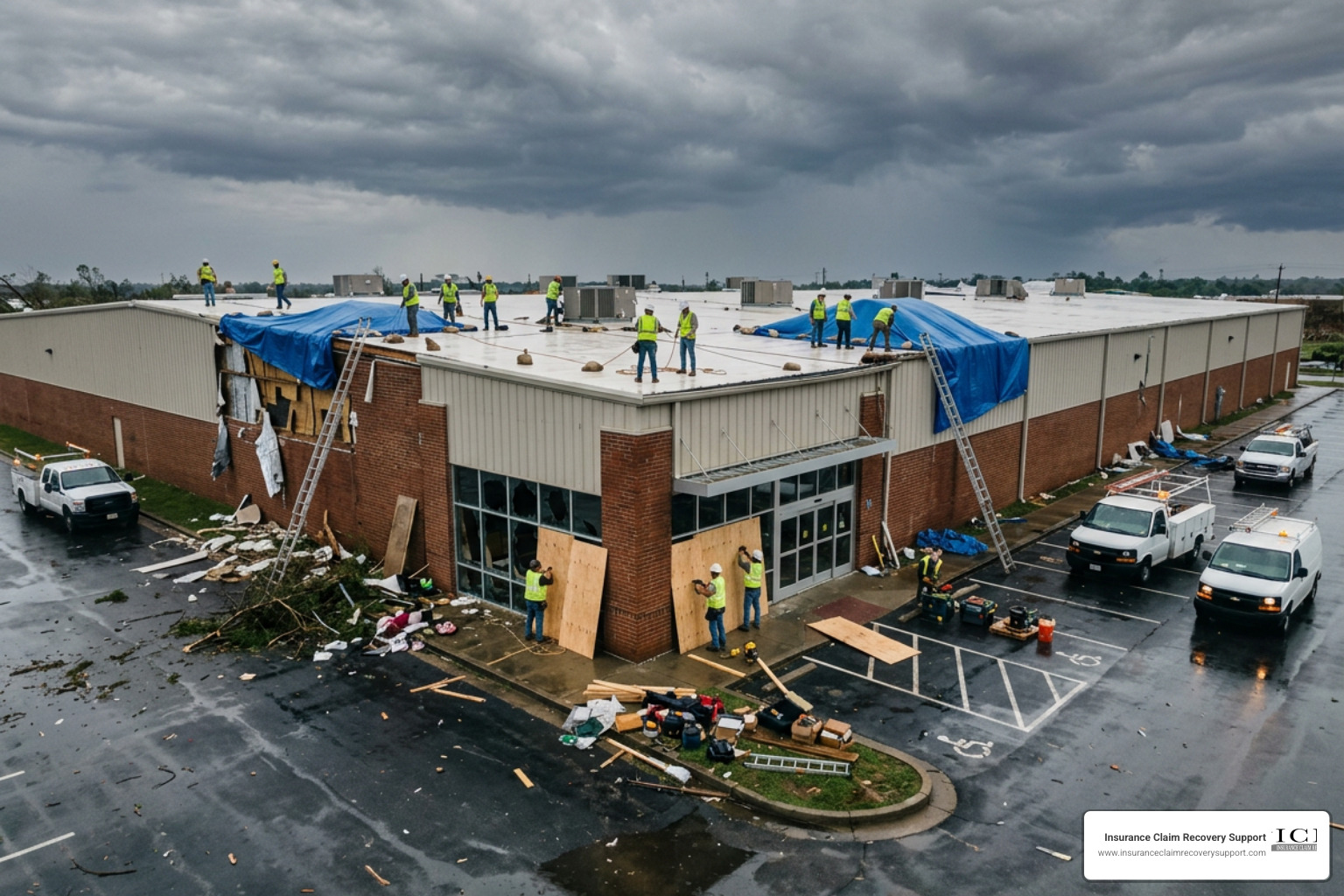
When the storm passes, your immediate actions dictate both the physical survival of your property and the financial viability of your insurance claim. Commercial property managers and owners have a legal and contractual duty to mitigate further loss. Failing to act quickly is one of the top mistakes in commercial property damage claims, often giving carriers a loophole to deny coverage for secondary damage.
Safety, Stabilization, and Emergency Mitigation
Before anyone steps onto the property, structural integrity must be verified. Restrict access to damaged areas and coordinate immediate utility shutoffs if gas leaks, compromised structural framing, or electrical hazards are suspected.
Once the site is deemed safe, emergency mitigation must begin:
- Secure the Building Envelope: Deploy temporary repairs, including professional board-up services for shattered windows, high-durability tarping, or shrink-wrap roofing for compromised membranes.
- Water Extraction & Structural Drying: If water intrusion has occurred, standing water must be extracted immediately.
- Maintain Dry Log Records: Do not let a restoration contractor dry your building without keeping daily dry log records. These records, compiled using moisture mapping and infrared cameras, document the atmospheric conditions (relative humidity, temperature, and grains per pound) to prove the building was dried to industry standards.
Environmental Hazards and OSHA Compliance
Commercial storm cleanup is heavily regulated by OSHA and state environmental agencies. Disturbing wet drywall, insulation, or flooring without proper testing can expose occupants to hazardous materials like asbestos and lead.
If water intrusion is left unaddressed for more than 24 to 48 hours, mold growth is virtually guaranteed. To remain compliant and protect your tenants, you must:
- Establish strict containment zones and deploy industrial air scrubbers equipped with HEPA filtration.
- Engage independent environmental hygienists to perform moisture testing and write mold remediation protocols before reconstruction begins.
- Be aware of adjuster licensing gaps; insurance company adjusters are rarely certified in environmental hazard assessment and frequently overlook the cost of compliance with local environmental laws.
Navigating Commercial Storm Damage Insurance Claims
Filing commercial property insurance claims is not a simple administrative task; it is a complex negotiation. The policyholder must submit a comprehensive proof of loss that details every damaged component, from structural steel down to the last ceiling tile.
| Claim Element | Actual Cash Value (ACV) | Replacement Cost Value (RCV) |
|---|---|---|
| Definition | Cost to repair/replace minus depreciation | Cost to repair/replace with materials of like kind and quality |
| Payout Basis | Based on the age and pre-storm condition of the property | Based on current market costs for labor and materials |
| Deductible Impact | Deductibles are subtracted from the depreciated value | Deductibles are subtracted from the total replacement cost |
| Upfront Funding | Lower initial payout, often insufficient to start repairs | Higher total payout, though depreciation is held back until repairs are completed |
Systemic Insurer Scrutiny and the Cost of Doing Business Model
In today’s commercial and multifamily insurance landscape, policyholders face unprecedented systemic insurer scrutiny. Major carriers have increasingly adopted a “cost of doing business” model designed to delay, deny, and underpay complex commercial claims to protect their corporate balance sheets. This systemic underpayment strategy treats delayed settlements as a financial strategy rather than a good-faith obligation.
For instance, the massive State Farm $15.6M settlement highlighted how carriers handle claims under heavy scrutiny. Furthermore, widespread issues with carrier practices have drawn national media attention, as seen in the NYT California article detailing the insurance crisis, and the subsequent California Enforcement Action targeting carrier violations. Reports from The Guardian and CNN have shed light on how systemic underpayment leaves commercial and multifamily property owners holding the bag.
When you file a large-loss commercial claim, the carrier’s roadmap is often designed to wear you down. They may send multiple rotating adjusters, demand redundant documentation, or offer an initial settlement that covers a fraction of the actual damage.
Documenting Commercial Storm Damage for Maximum Indemnification
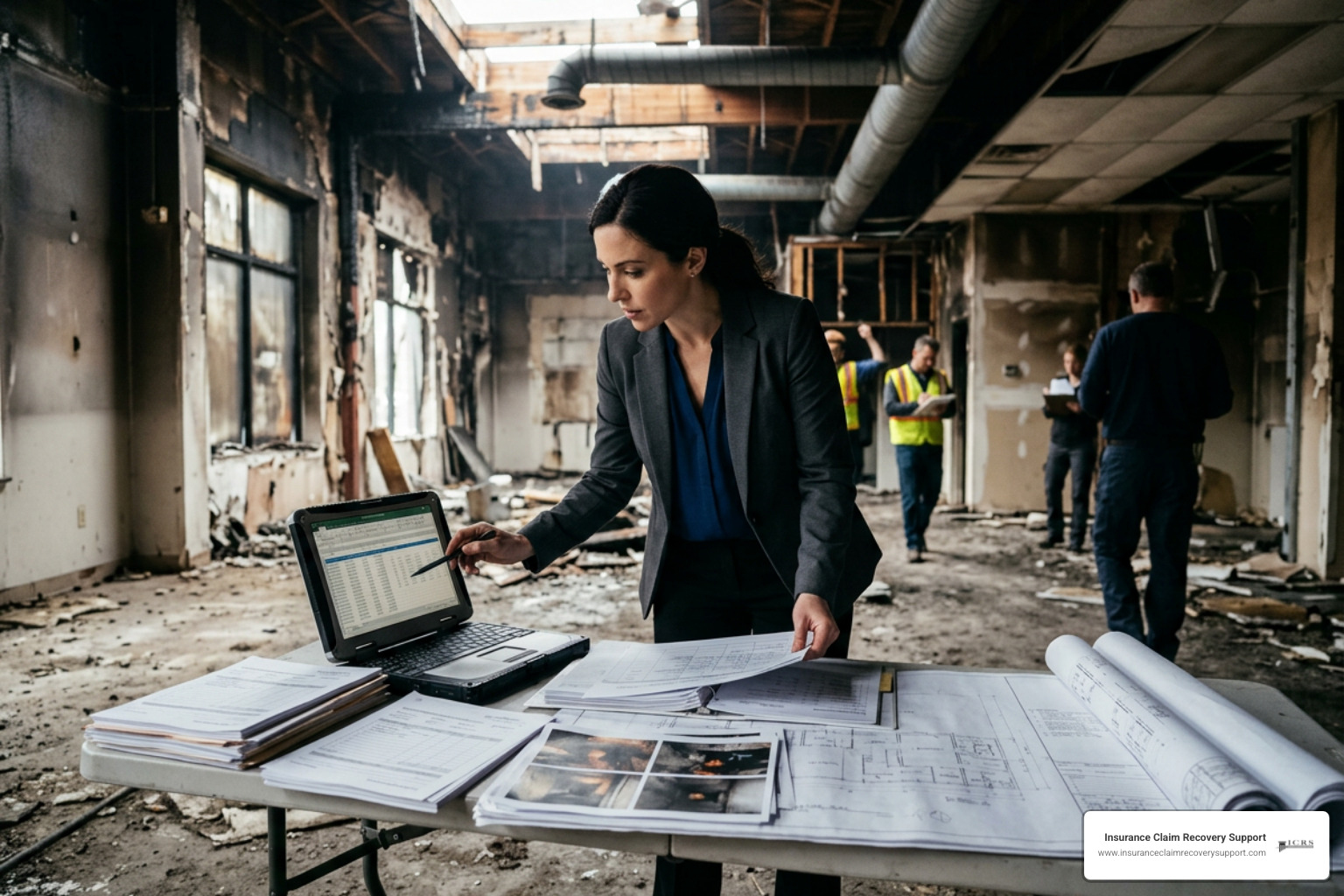
To counter systemic underpayment, your claim documentation must be bulletproof. Do not rely on the insurance adjuster’s visual inspection. Instead, build a comprehensive evidence package:
- Visual Evidence: Use time-stamped photos, drone aerial mapping, and thermal imaging to document structural and moisture anomalies.
- Professional Estimates: Secure detailed repair estimates using industry-standard estimating software that reflects local, real-time subcontractor pricing in markets like Austin, Dallas, Houston, or San Antonio.
- Business Interruption & Extra Expenses: A major storm damage insurance claim must account for business interruption losses. Document your lost revenue, ongoing fixed expenses, and the extra expenses required to maintain temporary operations.
Legal Frameworks, Policy Interpretation, and Dispute Resolution
Commercial insurance policies are highly customized contracts filled with endorsements, exclusions, and complex legal language. How these policies are interpreted directly dictates your financial recovery. For example, if your building must be brought up to modern building codes during reconstruction, you must navigate the nuances of ordinance or law coverage to ensure these expensive code upgrades are fully indemnified.
Texas Statutes 541 and 542 Prompt Payment Act
For commercial properties in Texas — including our local markets in Austin, Dallas, Fort Worth, San Antonio, Houston, Lubbock, San Angelo, Waco, Round Rock, Georgetown, and Lakeway — policyholders are protected by powerful statutory frameworks.
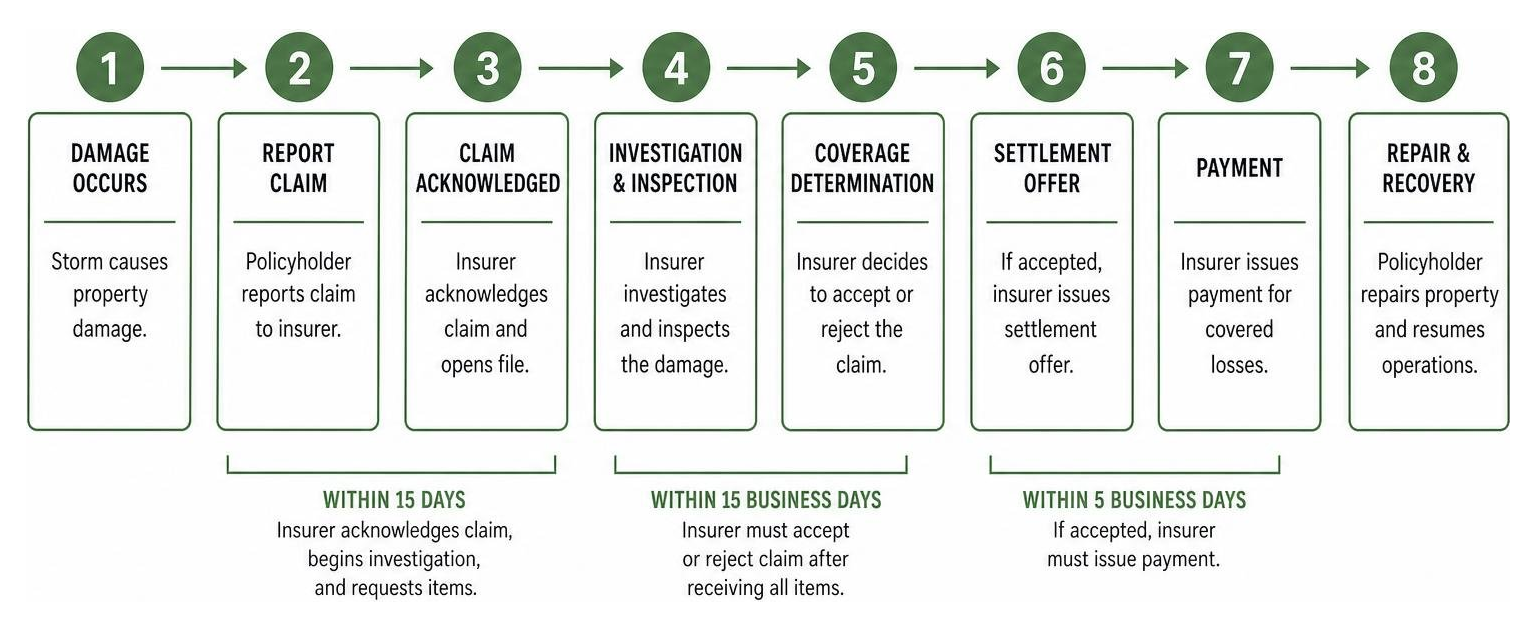
Under Texas Insurance Code Chapter 542 (the Prompt Payment of Claims Act), carriers must meet strict deadlines:
- They have 15 days to acknowledge your claim, begin an investigation, and request necessary items.
- Once they receive all requested documentation, they have 15 business days to accept or reject the claim.
- If they agree to pay, they must issue the check within 5 business days.
If a carrier misses these deadlines or violates the fair claim handling practices outlined in Texas Insurance Code Chapter 541, they can be held liable for statutory interest (currently up to 18% depending on the filing date) plus reasonable attorney fees. Utilizing these bad faith remedies is often the only way to force a stalling carrier to negotiate in good faith.
The Role of Appraisal Awards and Florida Litigation Costs
When a carrier refuses to agree on the scope or value of the damage, policyholders have several dispute resolution paths. Many commercial policies contain an appraisal clause. Appraisal is a contractual process where each party selects an independent appraiser, and these two select a neutral umpire. An agreement between any two of these three parties sets the binding amount of the loss.
While appraisal awards can resolve valuation disputes without the expense of a lawsuit, they do not resolve coverage disputes (i.e., whether the damage is covered under the policy). In states like Florida, escalating litigation costs and shifting regulations have made avoiding litigation a top priority for property owners. An independent damage assessment conducted early by a public adjuster can help you resolve disputes through appraisal or negotiation, saving hundreds of thousands of dollars in legal fees.
See how public adjusters can transform your commercial claim to understand how professional representation shifts the balance of power back to the policyholder.
Frequently Asked Questions About Commercial Storm Damage
What is the difference between windstorm and flood deductibles for commercial properties?
Translation: “Why is my insurance company telling me my $100,000 deductible is actually $500,000, and that they won’t pay for the water on my first floor?”
Commercial policies handle wind and water very differently:
- Windstorm Deductibles: Unlike flat-rate deductibles, windstorm and named storm deductibles are often percentage deductibles based on the total insured value (TIV) of the property. If your building is insured for $10 million and you have a 5% wind deductible, you must absorb the first $500,000 of repairs out of pocket.
- Flood Exclusions: Standard commercial property policies almost always exclude surface water damage (water rising from the ground up). If a storm surge or local river runoff floods your retail plaza, you must coordinate with a separate flood policy (often through FEMA) rather than your standard commercial carrier. However, if wind blows off a roof membrane and allows rain to pour in from above, that water intrusion is covered under your windstorm claim. For complex wind/water disputes, see our guide on tornado and windstorm property damage claims.
How does a public adjuster resolve complex commercial storm damage claims over $250,000?
Translation: “Why shouldn’t I just let my general contractor or my broker handle the claim?”
On large-loss claims exceeding $250,000, the stakes are too high for amateur representation:
- Contractors are not claim experts: While a good contractor knows how to rebuild, they cannot legally interpret policy language, negotiate coverage disputes, or argue overhead and profit allocations. In most states, a contractor negotiating a claim on your behalf is committing the Unauthorized Practice of Public Adjusting (UPPA).
- Public adjusters work exclusively for you: A licensed public adjuster conducts an exhaustive, independent damage assessment, reviews your policy for hidden coverages, compiles the complex proof of loss, and represents your interests in all meetings with the carrier. We handle the administrative and legal heavy lifting, reducing carrier delays and maximizing your final settlement.
How do dry log records and environmental hygienists protect my property from secondary damage?
Translation: “The restoration guy has some big fans running, isn’t that enough?”
No, it is not. Without scientific verification, you are exposing your property to massive long-term liabilities:
- Dry Log Records: These records prove that structural materials (studs, concrete, subfloors) have reached their dry standard. Without this documentation, an insurance carrier can argue that any subsequent mold or rot was caused by “owner negligence” rather than the storm itself.
- Environmental Hygienists: These independent experts use thermal imaging and moisture meters to verify that structural drying is complete and that the indoor air quality is safe for building occupants. This documentation is your shield against future tenant lawsuits and ensures complete compliance with OSHA and local health codes.
Conclusion
Recovering from commercial storm damage is not just about rebuilding physical walls; it is about protecting your financial future. When a storm compromises your multifamily asset, retail center, or office building, you are thrust into a high-stakes financial battle against an insurance carrier that has an army of adjusters, engineers, and attorneys working to limit their liability.
You do not have to fight this battle alone.
At Insurance Claim Recovery Support LLC (ICRS), we are licensed public insurance adjusters who represent policyholders only — never insurance companies. We specialize in large-loss commercial, multifamily, and specialty property claims involving wind, hail, hurricanes, tornadoes, and winter freezes.
Our mission is simple: maximize your settlement, reduce carrier delays, and resolve your claim without unnecessary litigation. With our 90% settlement success rate, we ensure you receive every dollar required to restore your property to pre-loss condition.
If your property has suffered storm damage, do not wait for the carrier to underpay your claim. Contact us today for a professional, independent consultation.
- Find public adjusters near me
- Get immediate claim help
- Read the latest property insurance news