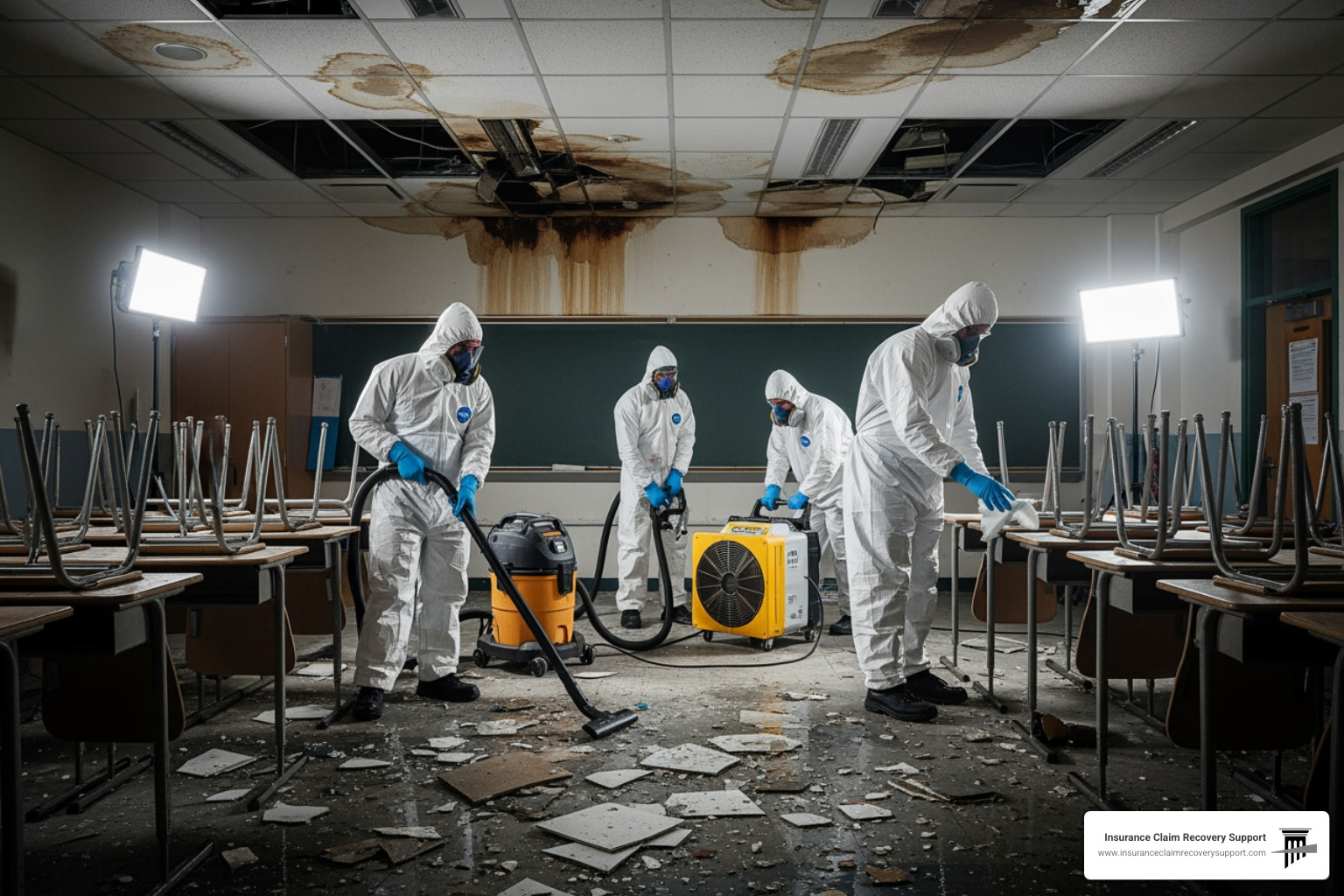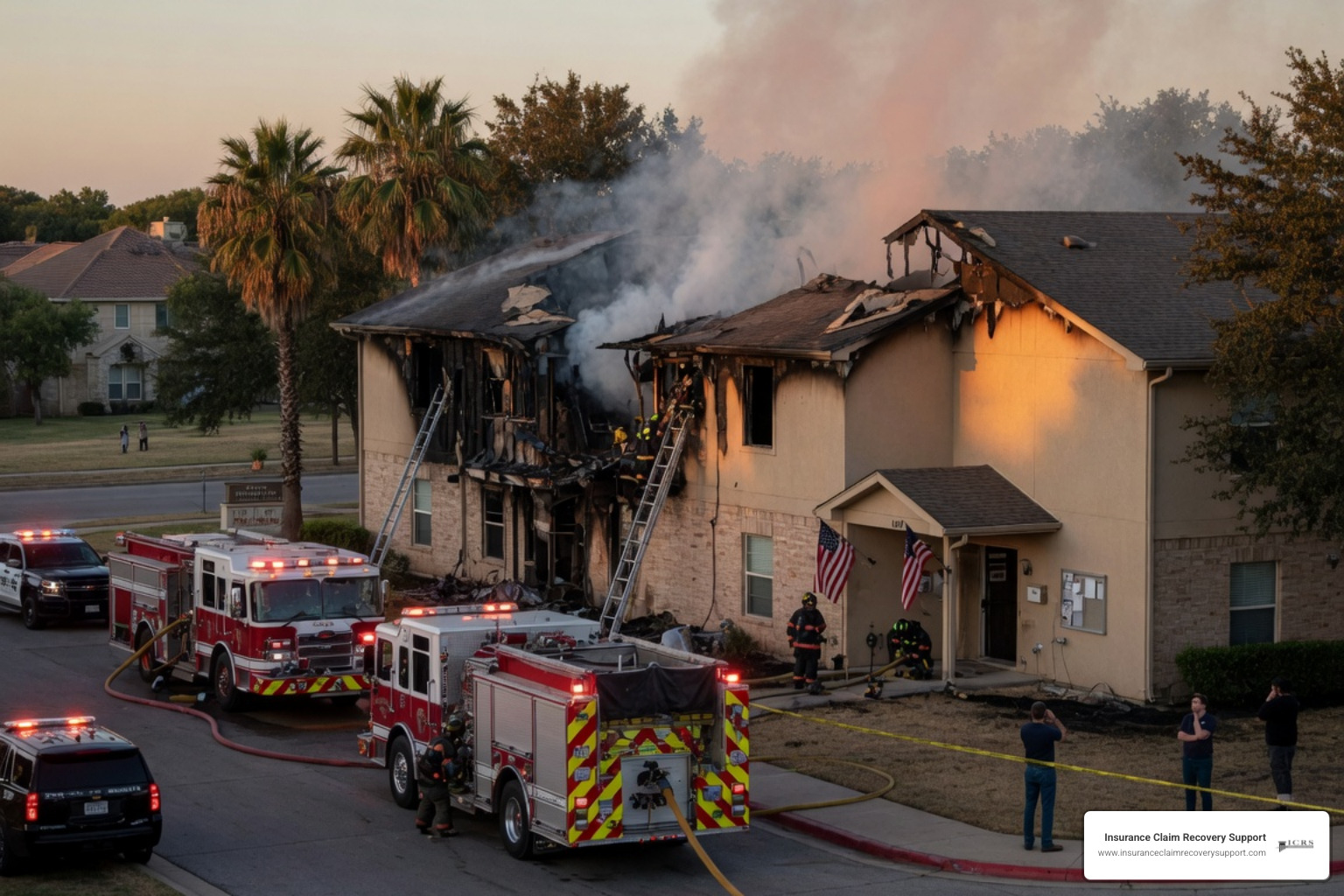
Why School Damage Cleanup Tarrant County Requires Specialized Expertise
School damage cleanup in Tarrant County demands immediate action and specialized expertise far beyond standard commercial restoration. When disaster strikes an educational facility, the stakes are uniquely high: students need safe learning environments, academic calendars can’t wait, and community trust depends on a swift, effective recovery.
For a companion claim-documentation resource, see the ICRS Hail & Wind Claim Guide. Coverage and next steps depend on the facts and policy terms.
From a urinal flood at Lake Worth High School to a direct tornado hit at Irving ISD’s Zavala Middle School, recent events show the vulnerability of Tarrant County schools to severe weather and infrastructure failures. Unlike other properties, schools can’t simply close and wait. They must continue educating students, assure parents, and provide safe working conditions for staff, all while navigating complex insurance claims.
This is what a proper response requires:
- Immediate Action: 24/7 emergency response for water extraction, board-up, and site security.
- Safety & Compliance: Protocols to protect students and staff, including air quality testing and adherence to Tarrant County Public Health regulations.
- Continuity Planning: Phased restoration and after-hours work to minimize disruption.
- Specialized Services: Expertise in restoring libraries, labs, and gym floors.
- Financial Recovery: Comprehensive insurance claim support to maximize your settlement.
Asking the right questions before hiring a restoration company—and knowing when to engage a public adjuster—can prevent months of disruption and financial loss.
I’m Scott Friedson, CEO of Insurance Claim Recovery Support (ICRS). For over 15 years, I’ve helped schools and other commercial property owners steer large-loss claims. I’ve seen how expert coordination and insurance advocacy protect both educational continuity and financial stability.
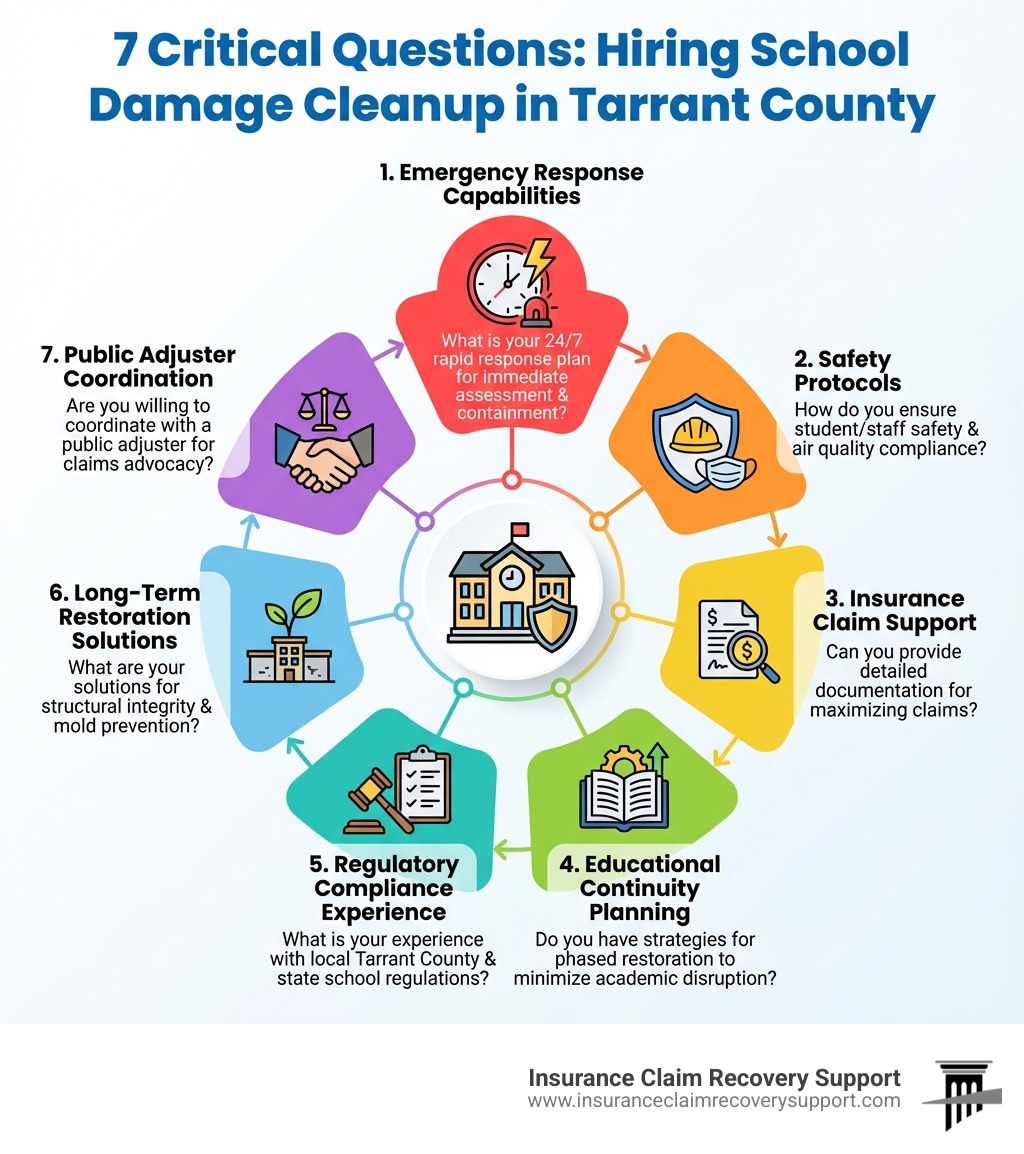
Key Questions for Your School Damage Cleanup Tarrant County Partner
When your Tarrant County school faces damage, the choices you make in the aftermath are critical. Asking a potential school damage cleanup Tarrant County partner these seven questions will help you assess their capabilities, ensure safety, protect academic continuity, and secure a fair insurance settlement.
1. What Is Your Emergency Response Plan and Experience with Different Types of School Damage?
Disasters don’t wait for business hours. A critical first step for any school damage cleanup Tarrant County provider is their ability to respond immediately. Every hour of delay increases costs, risks, and disruption. Immediate water extraction is crucial to prevent mold, while severe storm damage requires prompt board-up and site security.
Your cleanup partner should demonstrate clear, 24/7 capabilities and experience with:
- Rapid Response: A 24-hour call center and technicians who can be dispatched quickly.
- Water Extraction and Drying: Commercial-grade equipment for rapid water removal and structural drying to prevent secondary damage.
- Site Security: Board-up and temporary fencing services to secure the facility and prevent unauthorized access.
- Thorough Assessment: Initial assessments to identify all affected areas, including hidden damage.
- Diverse Damage Types: Proven experience with storm, water, fire, and mold damage common in the Dallas-Fort Worth area.
- Educational Facilities: Specific experience working in K-12 schools and universities, which have unique layouts and regulatory needs.
A swift, professional response minimizes the overall impact. You need a partner with a robust emergency plan and the expertise to handle the unexpected. For guidance on building resilience, we refer to resources like the FEMA guide for schools.
2. How Does Your Process Address the Unique Needs of Schools Compared to Other Properties?
Restoring a school is not like cleaning up an office building. The presence of students, rigid academic schedules, and specialized materials demand a custom approach. A school damage cleanup Tarrant County provider must adapt their process for educational environments.
Your partner should address these key areas:
- Student and Staff Safety: This is the top priority. The process must include containment barriers, HEPA air filtration, and air quality testing before re-occupancy to minimize exposure to hazards.
- Minimizing Disruption: Since education must continue, a good partner will use phased restoration, securing damaged sections while keeping safe areas operational. After-hours scheduling is also key.
- Academic Calendar Coordination: The provider must understand the urgency of getting students back into classrooms and coordinate their work to align with your academic calendar.
- Regulatory Compliance: Schools have specific health and safety regulations. A partner should be familiar with Tarrant County Public Health requirements, especially for areas like cafeterias.
- Specialized Contents and Areas: The cleanup plan must account for unique assets and spaces, including:
- Library/Document Restoration: Specialized drying for water-damaged books.
- Gym Floor Repair: Expert assessment for large, specialized surfaces.
- Science Lab Cleanup: Protocols for sensitive equipment and materials.
- IT Infrastructure: Protection for servers, computers, and networks.
A specialized company recognizes these nuances and prioritizes the educational mission.
3. What Are the Long-Term Solutions for Restoring Our Facilities and Mitigating Future Risk?
Effective school damage cleanup Tarrant County goes beyond the immediate fix. It’s about full restoration and preventing future damage. Ask potential partners about their long-term solutions.
- Hidden Damage Detection: Property owners often miss 30-50% of their actual damage. A good partner uses tools like thermal imaging to find hidden moisture in walls and compromised roofing materials, preventing future leaks and mold.
- Structural Integrity Assessment: After a severe event like a tornado, a comprehensive structural assessment is non-negotiable to ensure the building is safe for re-occupancy.
- Mold Prevention: In Texas’s humid climate, mold grows fast. The cleanup process must include aggressive drying and EPA-registered antimicrobial treatments to protect student and staff health.
- Seamless Reconstruction: A company that offers both mitigation and reconstruction services can expedite the entire recovery process.
- Risk Mitigation Advice: A valuable partner can also advise on preventative measures, such as roof maintenance plans and upgrading to more resilient building materials.
Addressing these long-term factors means you’re not just fixing a problem—you’re investing in the future resilience of your facility.
4. How Do You Ensure Student and Staff Safety During School Damage Cleanup Tarrant County?
Student and staff safety is the paramount concern during cleanup. A school damage cleanup Tarrant County partner must have rigorous protocols to guarantee a safe environment throughout the restoration.
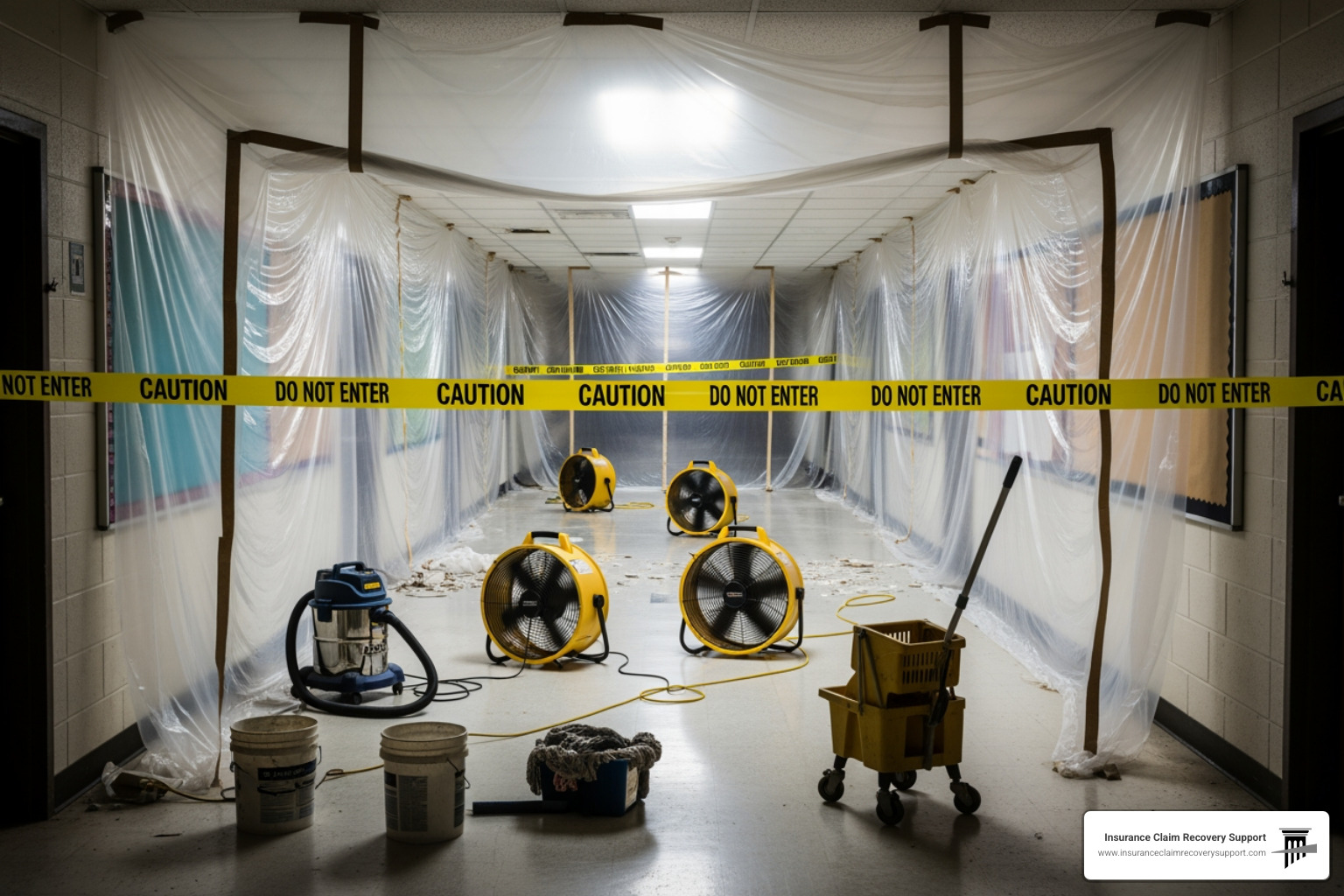
Key safety protocols should include:
- Site Security: Damaged areas must be immediately secured with containment barriers to prevent unauthorized access and cross-contamination.
- Air Quality Management: Use of HEPA air filtration systems and thorough air quality testing before reopening any area is essential to manage dust, mold spores, and other contaminants.
- Clear Communication: The partner should support the school’s communication with parents regarding safety measures and timelines.
- After-Hours Scheduling: Disruptive work should be scheduled after school hours or on weekends to minimize exposure.
- Certified and Vetted Crew: All technicians should be IICRC-certified and have passed thorough background checks to work on school grounds.
Safeguarding the school community is non-negotiable, and your cleanup partner must share this commitment.
5. How Will You Support Our Insurance Claim to Ensure a Full and Fair Recovery?
Navigating a complex insurance claim is a major challenge for schools. While restoration companies handle the physical cleanup, their role isn’t to advocate for your settlement. This is where a public adjuster is essential. Your insurer has experts protecting their financial interests; you need your own representation to ensure a fair outcome.
As public adjusters, we at Insurance Claim Recovery Support exclusively represent you, the policyholder. We help schools secure a full recovery by:

- Thoroughly Reviewing Your Policy: We identify all applicable coverages, including business interruption for extra expenses incurred during closures.
- Documenting All Damage: We carefully document all damage—including hidden issues—with photos, moisture mapping, and detailed inventories. Most property owners miss 30-50% of their actual damage.
- Accurately Estimating Costs: We develop detailed repair and replacement cost estimates to ensure nothing is overlooked.
- Negotiating with Your Insurer: We manage all communications and negotiations to counter low offers and maximize your settlement.
TABLE: Public Adjuster Path vs. Insurance Lawsuit Path
| Feature | Public Adjuster Path | Insurance Lawsuit Path |
|---|---|---|
| Advocacy | Represents policyholder’s interests exclusively. | Often adversarial; policyholder hires an attorney. |
| Cost | Fee is a percentage of the settlement; no upfront costs. | High costs: attorney fees, court costs, expert witnesses. |
| Timeline | Resolves disputes in months through negotiation. | Can take 1-3+ years of extensive legal proceedings. |
| Control | Policyholder retains more control over the process. | Attorney largely controls the legal strategy. |
| Stress Level | Significantly reduces policyholder’s burden. | High stress due to legal battles and uncertainty. |
| Primary Goal | Maximize settlement via expert claim preparation. | Seek compensation through legal action. |
| Litigation | Leverages negotiation and appraisal to avoid lawsuits. | Is litigation itself; a last resort. |
Our goal is to maximize your settlement and avoid unnecessary litigation, allowing you to focus on educating students.
6. What Is Your Strategy for Managing Educational Continuity and Financial Impact?
Maintaining educational continuity is a top priority for schools. Your school damage cleanup Tarrant County partner and public adjuster must have a clear strategy to keep students learning while managing the financial impact.
This strategy should include:
- Temporary Learning Spaces: Coordinating the setup of temporary portable classrooms if needed.
- Phased Reopening: Allowing students to safely return to unaffected areas as soon as possible to minimize disruption.
- Protecting and Relocating Assets: Protecting undamaged areas from secondary damage and relocating essential materials and equipment.
- Documenting Extra Expenses: This is crucial for your financial recovery. As public adjusters, we document all business interruption losses, such as the cost of temporary facilities, staff overtime, and additional transportation.
- Securing Advance Payments: We can often negotiate advance payments from your insurer to cover immediate expenses and provide critical cash flow.
A comprehensive strategy, backed by an expertly managed insurance claim, safeguards both your students’ education and your district’s financial stability.
7. How Can a Public Adjuster Help Streamline Recovery and Avoid Unnecessary Litigation?
Without expert help, many school districts with disputed claims feel pushed toward costly and lengthy litigation. A public adjuster offers a better path. Here’s how we address common concerns:
Fact vs. Myth
Myth: “My insurance company will pay fairly without help.”
- Fact: Insurers use their own adjusters to protect their financial exposure. A public adjuster works only for you, the policyholder, to level the playing field and ensure your claim is handled fairly and thoroughly.
Myth: “Hiring a public adjuster means I’m going to sue my insurer.”
- Fact: The opposite is true. A public adjuster’s expertise in documentation and negotiation helps avoid litigation. We resolve disputes through professional negotiation and the appraisal process, a faster and less costly alternative to a lawsuit.
Myth: “Our school district can handle the claim ourselves.”
- Fact: Large property claims are incredibly complex. Most property owners miss 30-50% of their actual damage because they lack the expertise to find and document it. A public adjuster manages the entire process, allowing your team to focus on school operations.
For Tarrant County school districts, we act as your trusted advisor, coordinating all parties and streamlining the process from assessment to settlement. Our 90% success rate in settling claims without lawsuits demonstrates our ability to resolve claims efficiently, saving you time, money, and stress. We even advise schools to put a service agreement in place before a disaster strikes for maximum preparedness.
Get the Right Answers for Your Tarrant County School’s Recovery
The recovery journey for a school after property damage is complex, but you don’t have to steer it alone. Every step, from emergency response to the final insurance settlement, requires specialized expertise.
We, Insurance Claim Recovery Support (ICRS), are a licensed public adjusting firm representing policyholders only—never insurance companies. We specialize in large-loss claims for schools, universities, and other commercial properties. Our goal is to maximize your settlement, reduce delays, and avoid unnecessary litigation.
Our team has helped Texas schools and other commercial property owners secure fair settlements for decades. We understand the pressures educational institutions in the Dallas-Fort Worth area face and are dedicated to protecting your interests.
Don’t let a complex insurance claim disrupt your students’ education or strain your district’s finances. Empower your recovery with expert advocacy.