Rules on Are Public Adjuster Fees Tax Deductible for Property Owners
Understanding whether are public adjuster fees tax deductible requires looking at how the IRS categorizes expenses incurred during property recovery. When a severe freeze, hurricane, fire, or tornado strikes a commercial building or multifamily complex, hiring professional representation is critical. However, how you report those professional fees depends heavily on property classification and IRC guidelines.
For commercial policyholders navigating massive losses, understanding why you need a public adjuster for commercial claims goes hand-in-hand with financial planning. The primary rule to remember is that the IRS treats personal losses and business losses under completely different tax codes.
Many property owners confuse the direct physical damage to their building with the professional representation fees paid to adjust the claim. While direct property damage is calculated using the property’s adjusted basis and pre-loss fair market value, public adjuster fees represent a professional service cost.
How Are Public Adjuster Fees Tax Deductible on Commercial Properties?
For commercial real estate owners, professional property managers, and apartment investors, the answer to are public adjuster fees tax deductible is much more favorable. Under Internal Revenue Code (IRC) Section 162, expenses that are “ordinary and necessary” in carrying on a trade or business can be written off.
When an industrial facility, shopping center, or hotel suffers structural damage, securing an accurate claim settlement is essential to maintaining business operations and protecting rental income. The fees paid to a public insurance adjuster to negotiate with insurance company adjusters, document loss scope, and enforce policy terms qualify as ordinary and necessary expenses paid to manage, conserve, or maintain income-producing property.
Commercial claim adjustments also frequently involve business interruption losses. When calculating taxable income from business interruption insurance proceeds, public adjuster fees incurred to secure those funds can typically be subtracted directly as an administrative cost or business expense.
For a deeper look into handling complex commercial recoveries, consult our public adjuster large loss claims guide.
Are Public Adjuster Fees Tax Deductible After TCJA Law Changes?
The Tax Cuts and Jobs Act (TCJA) significantly modified how individuals write off casualty losses and administrative fees. Before the TCJA took effect, taxpayers could sometimes claim fees paid to determine tax liability or manage personal property losses as miscellaneous itemized deductions on Schedule A, subject to the 2% Adjusted Gross Income (AGI) floor.
However, TCJA suspended all miscellaneous itemized deductions subject to the 2% AGI floor for personal tax filings. Furthermore, personal casualty losses were restricted strictly to losses resulting from federally declared disasters.
What does this mean for personal property?
- Miscellaneous Itemized Deductions: You can no longer write off public adjuster fees as a 2% miscellaneous itemized deduction on personal Schedule A filings.
- Federally Declared Disasters: Even if your personal property loss occurred during a federally declared disaster, public adjuster fees are categorized as an expense to establish the claim rather than direct physical damage.
Understanding these statutory limits helps policyholders weigh what are the negatives for using a public adjuster against the substantial increases in settlement proceeds professional adjusters deliver.
Calculating Net Settlement and Form 4684 Casualty Loss Reporting

When filing IRS Form 4684 (Casualties and Thefts), accurate accounting is vital. Property owners must calculate their casualty loss by comparing the property’s pre-loss fair market value with its post-loss fair market value, limited by the property’s adjusted basis, and reducing that amount by any insurance reimbursements.
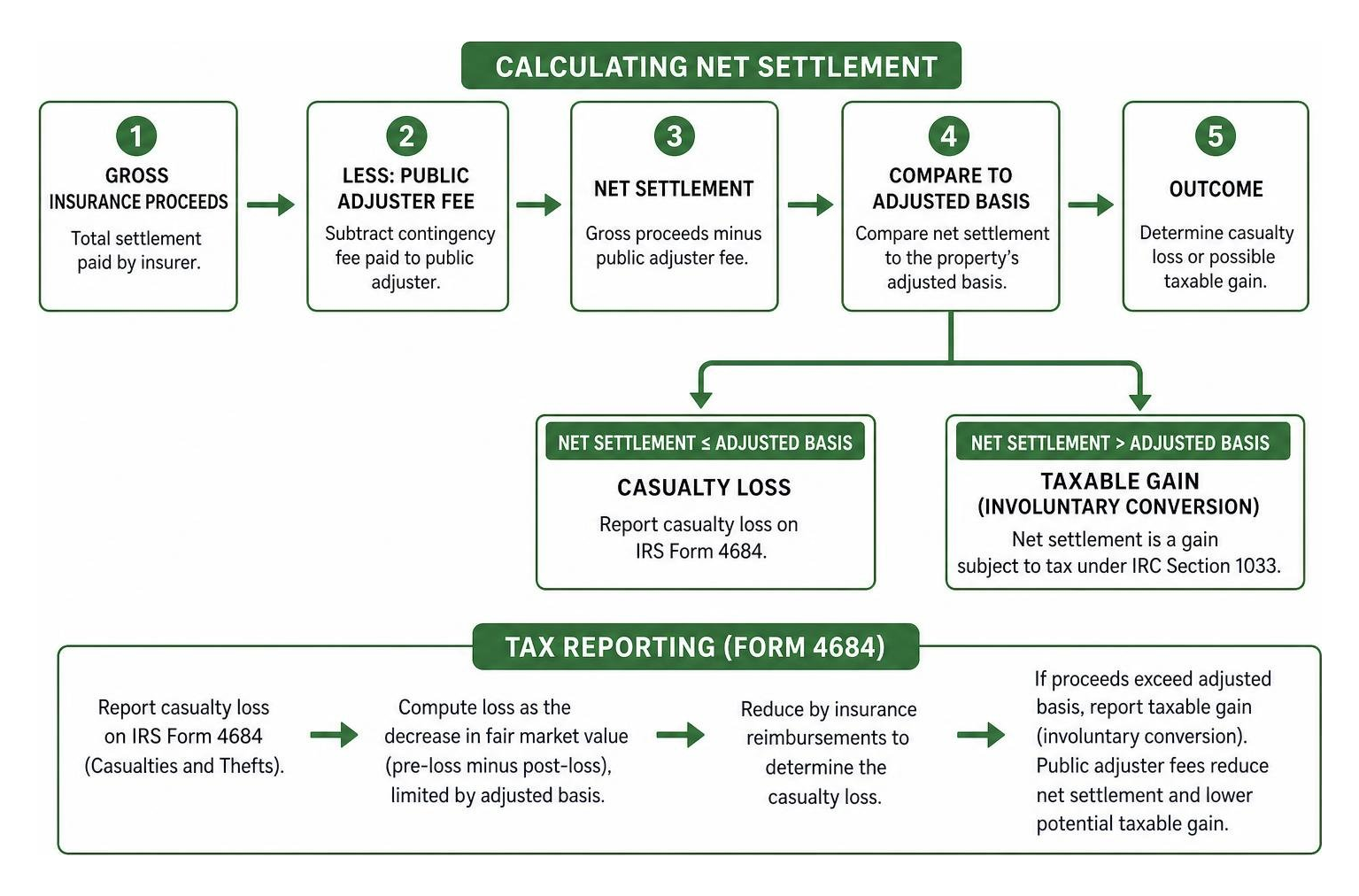
A critical nuance occurs when insurance proceeds exceed the property’s adjusted basis, creating a taxable gain (involuntary conversion). In these scenarios, public adjuster contingency fees act as a direct offset against gross insurance proceeds. By subtracting the public adjuster fee from the gross settlement, you lower the net recovery figure, which directly reduces your potential taxable gain under IRC Section 1033.
The timing of hiring experts is pivotal. Review the case for engaging public adjusters early in large loss claims to optimize both your claim recovery and tax reporting preparation.
Tax Treatment Comparison Matrix
| Property & Expense Category | Deductibility Standard | Primary Tax Form / Schedule | Key Statutory Authority |
|---|---|---|---|
| Commercial / Industrial Operating Property | Fully Deductible as Ordinary Business Expense | Schedule C, Form 1065, or Form 1120 | IRC Section 162 |
| Multifamily / Commercial Rental Real Estate | Fully Deductible as Property Management Expense | Schedule E (Form 1040) | IRC Section 212 |
| Non-Business / Personal Property | Non-Deductible as direct expense; lowers net proceeds | Form 4684 / Schedule A | IRC Section 165 / TCJA Rules |
| Business Interruption Claim Adjustment Fees | Subtracted from gross operational recovery | Schedule C or Corporate Returns | IRC Section 162 |
Business vs Personal Property Loss Deductions for Public Adjuster Fees
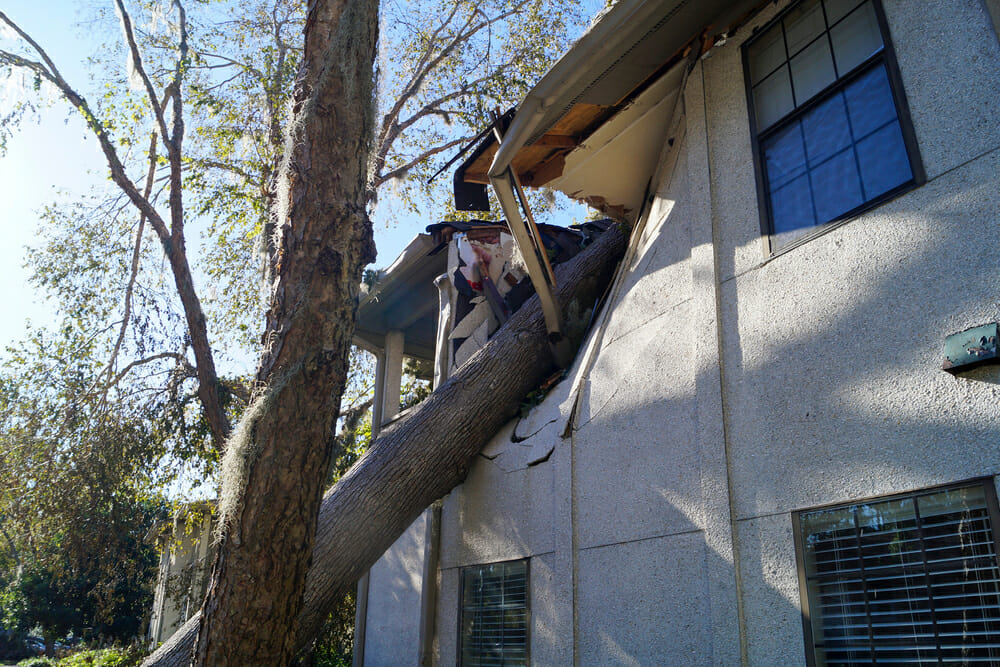
The tax code draws a sharp dividing line between business operations and personal assets. For commercial entities—such as HOAs, religious institutions, historical properties, retail centers, office parks, and industrial facilities—public adjuster fees represent a direct cost of doing business.
Commercial and Rental Property Deductions
If you own an apartment complex or commercial retail plaza, you report loss adjustments on Schedule E or corporate tax filings (Form 1120/1065). If an insurer attempts to underpay a $1 million hail or windstorm claim and a public adjuster negotiates a $1.8 million settlement charging a 10% contingency fee ($180,000), that fee is generally fully deductible as a professional expense necessary to preserve property value and business operations.
For a comprehensive breakdown of commercial claims strategies, explore our large loss insurance guide 2025.
Translation Callout: Insurance Industry Terminology vs Tax Reality
Translation: Insurers often treat claim adjustments as an administrative burden on the policyholder. However, from a tax accounting perspective, fees paid to level the playing field on commercial losses over $250,000 are essential business protection expenses.
Navigating Systemic Carrier Scrutiny
In recent years, systemic carrier delays and underpayments have become a standardized operational model across the industry. Major carriers frequently force policyholders into prolonged negotiations or appraisal processes.
Regulators have increasingly scrutinized carrier practices. For example, major carriers have faced massive regulatory oversight and legal enforcement actions regarding claims handling after major catastrophe events, as detailed in recent coverage by The Guardian and CNN. Similar enforcement actions highlight widespread systemic issues in disaster response, such as those documented in the official California Enforcement Action and reported by the New York Times.
Furthermore, historical carrier practices have resulted in substantial bad-faith settlements, such as the State Farm $15.6M settlement involving claim handling practices.
When carriers operate under a “cost of doing business” mentality that restricts initial payouts, commercial policyholders must retain public adjusters to compel fair indemnification. For commercial claims over $250,000, having expert representation is not just helpful—it is vital for financial survival.
Essential Documentation and Common Tax Mistakes to Avoid
To ensure public adjuster fees are properly recognized on commercial tax returns and withstand IRS audit scrutiny, policyholders must maintain strict recordkeeping.
Documenting Your Claim and Adjustment Expenses
- Adjuster Licensing Credentials: Ensure your public adjuster holds an active license with the state department of insurance. Be aware of adjuster licensing gaps across state lines.
- Representation Contract: Keep a copy of the executed public adjusting agreement clearly detailing the fee structure (contingency percentage, flat fee, or hourly rate).
- Itemized Settlement Breakdowns: Maintain all explanation of benefits (EOB) statements, adjuster fee invoices, and insurance settlement checks showing gross proceeds and fee disbursements.
- Environmental & Structural Inspection Reports: Document environmental hazards identified during the adjustment process, including OSHA compliance records, industrial hygienist protocols, mold testing, asbestos sampling, and structural dry-log records.
- Statutory Enforcement Records: In states like Texas, public adjuster work frequently involves navigating statutory protections under Texas Insurance Code Statutes 541 (Unfair Trade Practices) and 542 (Prompt Payment of Claims). Keep thorough records of demand letters, appraisal awards, and statutory interest calculations. In jurisdictions with heavy dispute activity like Florida, litigation costs and formal appraisal documentation must be meticulously separated from basic adjustment fees.
Fact vs. Myth: Tax Reporting of Public Adjuster Fees
- Myth: “I can deduct my public adjuster fee on Form 4684 and also write it off as an itemized business deduction.”
- Fact: Double-deducting is a severe error. The fee can either offset gross insurance recovery when calculating gain/loss or be deducted as a business expense, depending on property type—never both.
- Myth: “My insurance policy pays my public adjuster directly above my policy limits.”
- Fact: Standard commercial property policies explicitly exclude coverage for policyholder representation fees. Public adjuster fees are paid out-of-pocket or subtracted directly from the claim settlement.
- Myth: “Any licensing or prep course fee I pay as an adjuster can be written off immediately.”
- Fact: IRS Section 195 startup rules prohibit immediate write-offs for pre-licensing costs to enter a new trade; ongoing operating expenses are deductible only after active business operations commence.
Before executing a representation agreement, review our guidelines on hiring best public insurance adjuster.
Frequently Asked Questions About Public Adjuster Fees and Taxes
Can public adjuster fees be deducted if the insurance claim is only partially paid?
Yes, for commercial and rental properties. If an insurance company pays only a portion of a commercial property claim, the fee paid to your public adjuster remains a fully deductible ordinary business expense. If the unpaid portion of physical damage results in an unindemnified casualty loss, the public adjuster fee paid to recover the partial settlement still qualifies as a professional service expense on Schedule C, Schedule E, or corporate returns.
Are public adjuster fees covered directly by property insurance policies?
No. Insurance policies are written to indemnify direct physical loss to covered property and do not cover policyholder professional fees. The property owner pays the public adjuster out of the overall claim settlement proceeds. State regulations often establish percentage caps on adjuster fees—for example, Texas limits public adjuster fees to 10% of the total claim settlement, while states like Florida cap fees at 10% for declared disaster claims and 20% for non-disaster claims.
How do appraisal expenses differ from public adjuster fees on tax returns?
While both costs are incurred during claim disputes, the IRS historically categorized property appraisal fees paid to establish casualty loss amounts as expenses paid to determine tax liability. For commercial properties, both professional appraisal costs and public adjuster contingency fees are deductible operating expenses. However, for personal claims, appraisal costs can no longer be deducted as miscellaneous itemized deductions under post-TCJA rules.
Conclusion
Navigating complex commercial property insurance claims requires both expert policy interpretation and sound financial management. While the answer to are public adjuster fees tax deductible depends on property classification, commercial owners and property managers can generally claim these fees to protect their bottom line.
When a disaster threatens your commercial property, apartment building, or retail center in Texas or across our multi-state service area, getting expert representation ensures you receive every dollar you are owed under your policy.
At Insurance Claim Recovery Support LLC (ICRS), we represent policyholders exclusively—never insurance companies. Our team specializes in maximizing settlements, cutting through carrier delays, avoiding unnecessary litigation, and achieving an industry-leading 90% settlement success rate.
Whether your commercial property suffered fire damage in Houston, hail in Dallas, or severe storm destruction in San Antonio, Austin, Waco, Lubbock, or San Angelo, we are ready to advocate for your full indemnity.
Get expert claim recovery guidance from Insurance Claim Recovery Support today to protect your assets and streamline your claim recovery process.