How to Start a Church Hail Damage Claim
To start a church hail damage claim, keep people away from damaged areas, photograph visible damage from a safe location, and arrange temporary protection against water intrusion. Have a designated church representative notify the insurer promptly, save receipts for emergency work, and check the policy for notice requirements, deadlines, and the wind or hail deductible. Do not climb the roof or make permanent repairs before the damage has been documented, unless immediate work is needed for safety.
A hailstorm can affect more than the sanctuary roof. Steeples, gutters, windows, and rooftop HVAC equipment may also need inspection. If the insurer calls roof damage cosmetic, ask what evidence supports that conclusion before the board approves a repair plan; dents and damage that compromise the roof’s ability to keep water out may be treated differently under the policy.
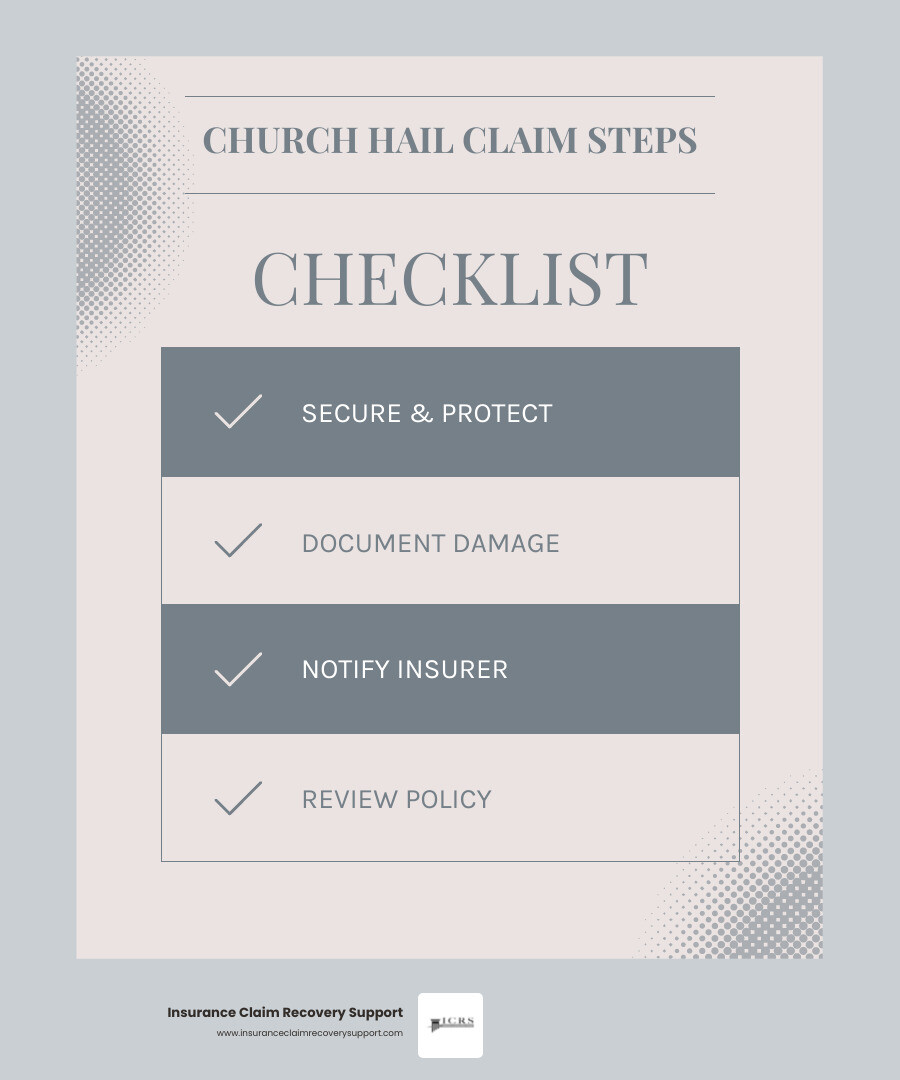
Quick look at church hail damage claim:
Step-by-Step Response: Managing a Church Hail Damage Claim After Severe Weather
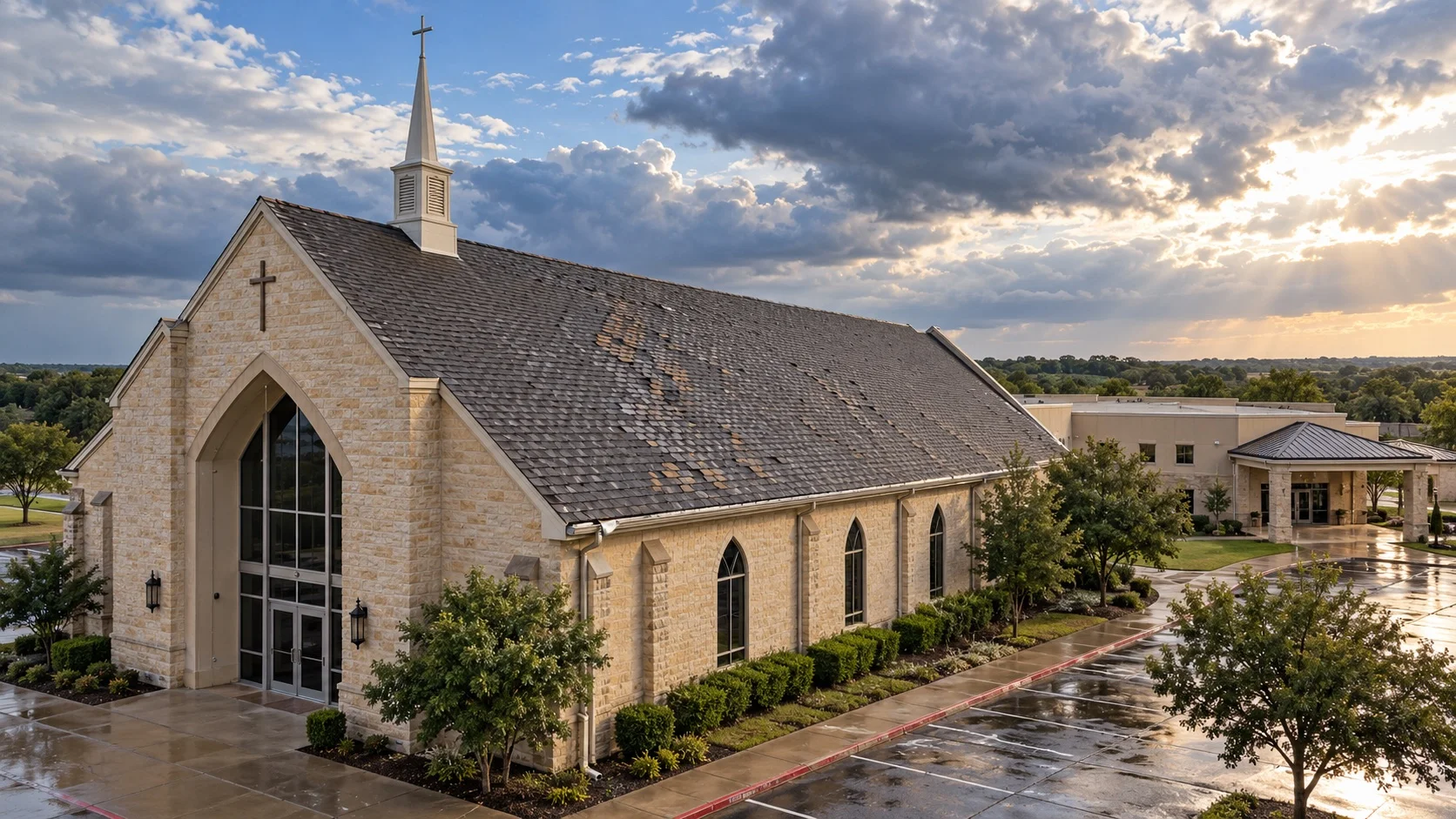
When severe weather impacts a commercial religious property, church leadership must balance community ministry with property preservation. Large hail events can create complex losses for houses of worship, schools, fellowship halls, offices, and other large property assets. Ministries feature complex architectural designs—including expansive sanctuaries, high steeples, decorative stained glass, and large flat-roof educational wings—that require an organized response protocol.
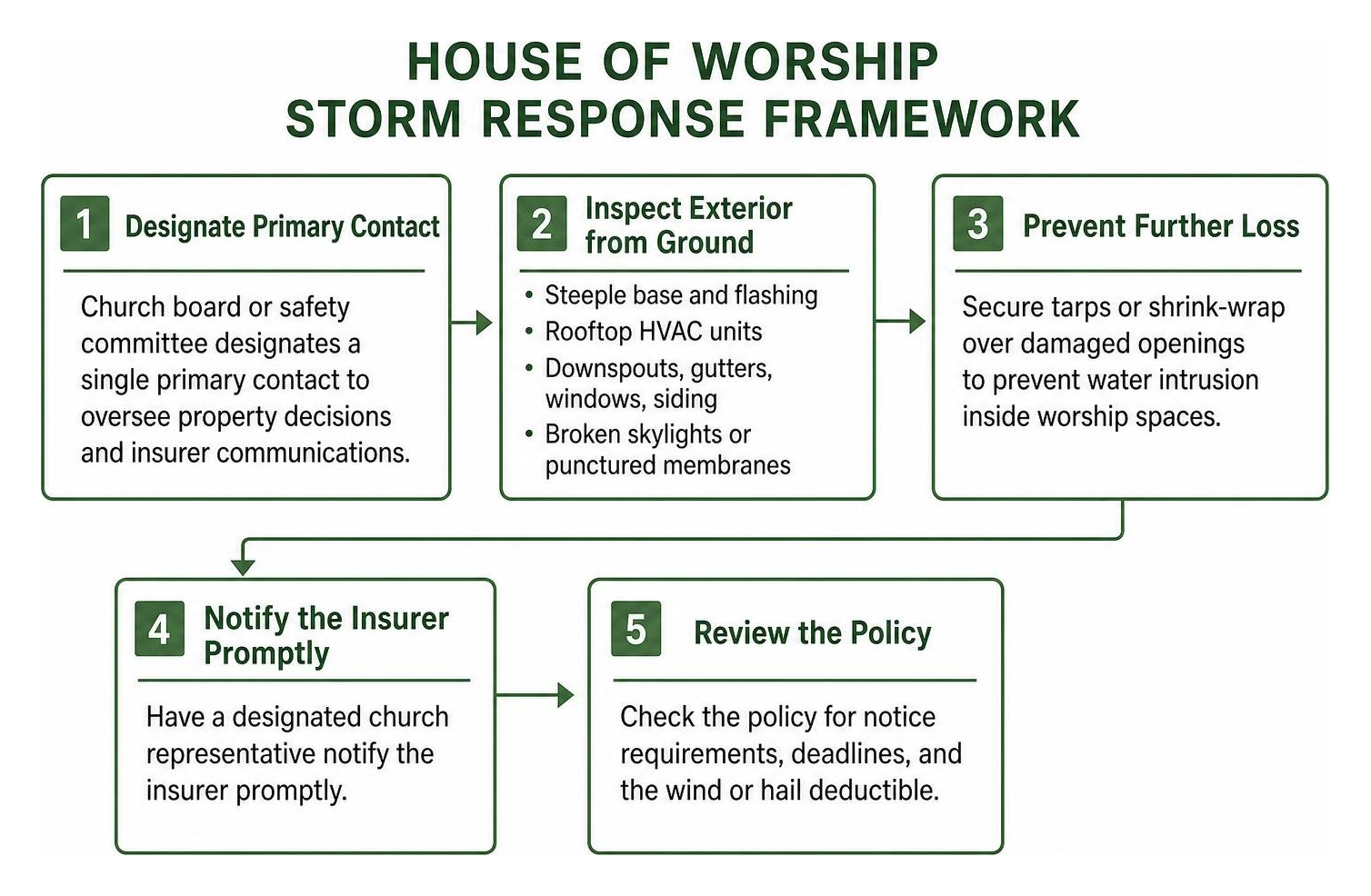
First, the church board or safety committee should designate a single primary contact to oversee property decisions and insurer communications. Immediately inspect the exterior perimeter from the ground:
- Examine the base and flashing around the sanctuary steeple for shifts or openings.
- Check rooftop HVAC condenser coils for crushed or bent cooling fins that restrict airflow.
- Inspect downspouts, gutters, window frames, and siding for heavy impact spatter.
- Secure tarps or shrink-wrap over broken skylights or punctured membranes to prevent church water damage inside worship spaces.
- Place collection basins and plastic sheeting beneath stained wood ceilings or organ lofts if interior leaks appear.
Prompt insurer notification is critical. Many commercial policies require immediate notice of loss and documentation of all emergency mitigation expenses.
Initial Evidence Gathering for a Church Hail Damage Claim
Thorough documentation forms the foundation of any successful property claim. Relying entirely on an insurer’s initial walk-through can leave hidden structural failures unaddressed.
Churches should assemble comprehensive objective evidence:
- Drone Aerial Photography: High-resolution imagery captures steep-slope steeples and broad sanctuary roofs safely without foot-traffic damage.
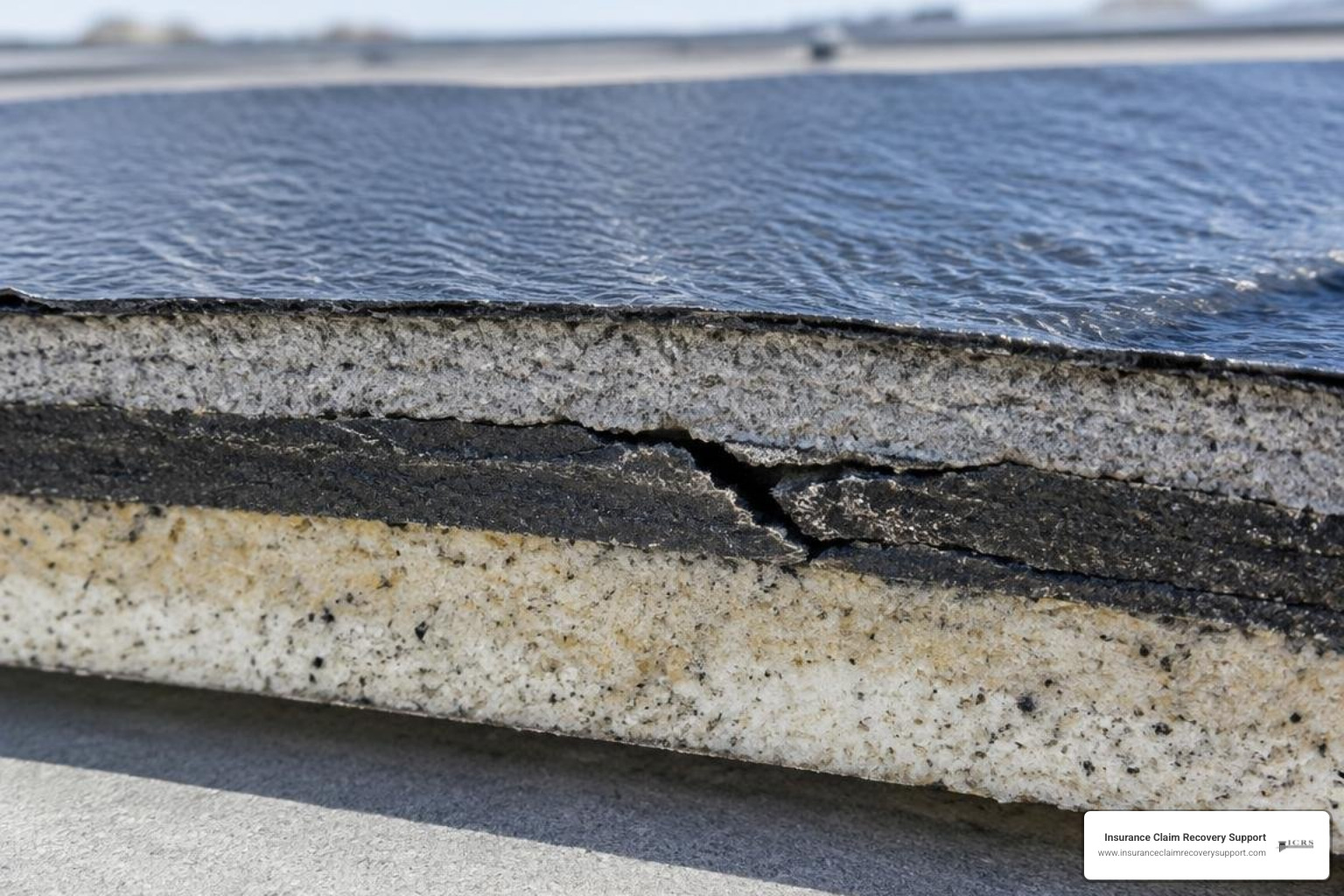
- Membrane and Underlayment Checks: Low-slope sections over fellowship halls require physical inspection for fractures, bruised insulation, or punctures.
- Metal Seam Verification: Standing-seam metal roofs must be inspected for displaced interlocking clips and seam gaps that allow wind-driven rain penetration.
- Soft Metal Spatter Mapping: Impact marks on aluminum vents, copper valleys, and air conditioning units establish storm direction and hailstone sizing.
- Non-Destructive Moisture Scans: Infrared thermography detects trapped water inside commercial roof assemblies before ceiling rot develops.
Capturing these items early ensures your roof hail insurance claim accurately reflects actual physical damage.
Evaluating Repair Costs Versus Policy Deductibles
Before submitting a claim, review your property policy declarations page. Many commercial church policies no longer carry simple flat-dollar deductibles; instead, they feature percentage-based wind and hail deductibles ranging from 1% to 5% of the total insured building value.
For a sanctuary insured at $5,000,000, a 2% hail deductible equals an out-of-pocket obligation of $100,000 before insurance proceeds apply. Ministry boards must evaluate whether total projected restoration costs exceed this threshold. If estimated repairs are near or below the deductible, paying out of church capital reserves avoids claim-frequency penalties. Conversely, when severe storms inflict deep structural loss across large properties, understanding how to maximize your commercial property damage claim helps preserve the ministry’s financial future. Some organizations mitigate this risk upfront by carrying wind/hail deductible buy-back policies.
Cosmetic vs. Functional Damage: Overcoming Structural Storm Denials
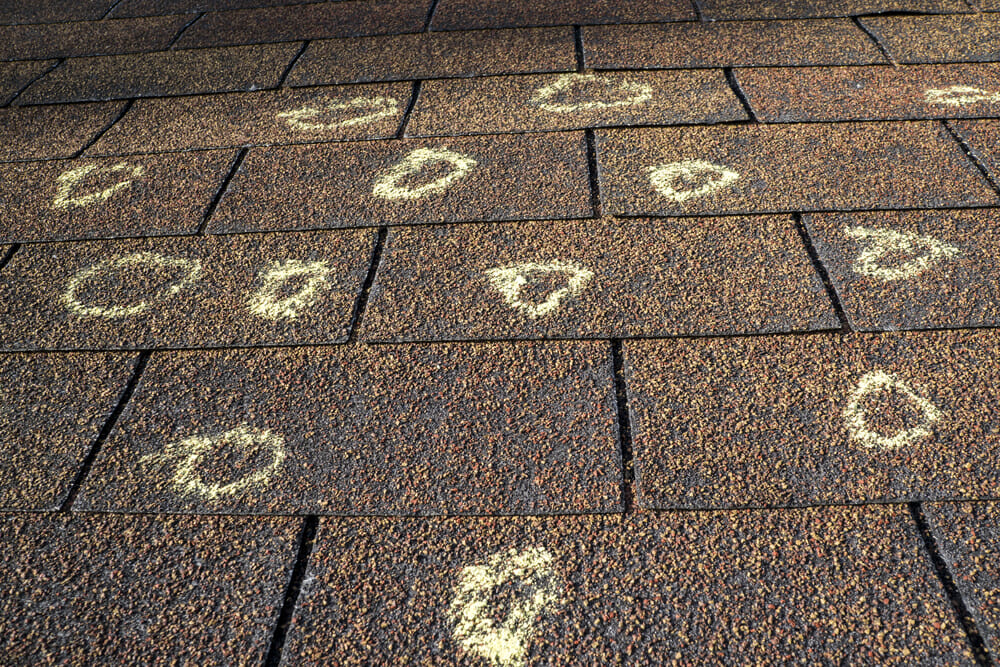
One of the most frequent hurdles in religious property claims is the “cosmetic damage” denial. Insurers often insert cosmetic exclusion endorsements that eliminate coverage for surface dents, marring, or scratches on exterior metal roofs and siding—provided the building envelope still prevents water entry.
Insurance adjusters and carrier-hired engineering firms may classify dented standing-seam panels or dimpled shingles as purely aesthetic. However, heavy hail impacts frequently cause micro-fractures in shingle asphalt, loosen protective granules, crack underlying roof decking, or warp metal seams so they fail under thermal expansion.
| Damage Type | Visual Characteristic | Long-Term Structural Consequence | Coverage Status Under Standard Policy |
|---|---|---|---|
| Cosmetic Denting | Minor shallow surface dimple without seam distortion | Aesthetic finish alteration only | Often excluded under specific cosmetic endorsements |
| Functional Seam Displacement | Warped panel interlocks or loose fasteners | Compromised water barrier, wind uplift failure | Covered physical damage |
| Membrane Bruising | Sub-surface fracture in commercial TPO/EPDM | Sub-layer degradation, latent interior leaks | Covered physical damage |
| Granule Depletion | Exposed fiberglass or asphalt shingle substrate | Accelerated UV deterioration and premature failure | Covered physical damage |
When an insurer issues a partial or total denial citing cosmetic exclusions, church leadership should seek independent engineering opinions and preserve the evidence needed for a denied claim review. Ministries may need to demonstrate that the roof system’s structural integrity and waterproof service life were genuinely compromised.
Lessons from Second Presbyterian Church: Policy Time Limits and Engineer Reports
The legal dispute in the Second Presbyterian Church of Albuquerque matter underscores the importance of strict policy compliance and independent structural evaluations. The church alleged that a severe hailstorm caused approximately $800,000 in functional damage requiring the complete removal and replacement of its metal roof system.
The insurer’s engineering assessment characterized the panel dents as cosmetic. Furthermore, the carrier asserted the policy’s contractual time-to-sue limitation provision barred breach of contract claims because legal action was not initiated within the period specified by the policy.
This case illustrates two lessons for church trustees:
- Never Rely Solely on Insurer Engineers: An insurer’s initial assessment may minimize functional seam displacement. Independent structural reviews are vital when hail alters the mechanical seal of metal roofs.
- Track Policy Deadlines Closely: Contractual limitation clauses can extinguish recovery rights regardless of damage severity. An insurance claim dispute guide can help boards track filing milestones and proof-of-loss requirements in a timely manner.
Spot Repairs vs. Full Roof Replacement on Aging Sanctuary Systems
Insurers frequently propose spot repairs—replacing only visibly shattered tiles or bruised sections—to minimize claim payouts. However, on historic or aging houses of worship, spot repairs are often technically impossible.
On older commercial religious properties, trustees should confirm whether matching materials are still available, whether surrounding brittle materials will be damaged during attempted patching, and whether the proposed repair will restore the building envelope to code-compliant functionality. When evaluating aging properties, review commercial property damage principles to confirm whether complete system replacement is necessary.
Legal Precedents and Pitfalls in Ministry Property Claims
Commercial insurance claims involving older houses of worship, apartment communities, condominium associations, schools, retail centers, offices, and other large property assets frequently intersect with complex legal doctrines, particularly when pre-existing wear and tear exists alongside fresh storm damage. Across commercial and multifamily real estate, systemic claim delays, lowball scopes, and wrongful cosmetic denials can function like a cost-of-doing-business strategy unless policyholders document the loss, request written explanations, and challenge unsupported assumptions.
When covered perils such as hail and non-covered conditions such as wear, tear, or latent defects combine to create a loss, many disputes turn on whether the policyholder can separate covered storm damage from excluded baseline deterioration. Church committees handling Texas matters should review Texas property damage claims standards with the understanding that results depend on the policy, damage, evidence, and governing law.
Avoiding Contractor Fraud and Unauthorized Adjusting in a Church Hail Damage Claim
Churches facing catastrophic hail losses are often approached by aggressive restoration contractors offering to “handle everything with the insurance company.” Surrendering complete control of a claim to an unlicensed third party introduces severe legal and financial liability.
To protect their congregation’s assets, trustees must remember:
- Contractors may be restricted from negotiating policy coverage or acting as adjusters unless properly licensed under applicable law.
- Retain control of all formal submissions to the carrier and require itemized sub-contractor invoicing.
- Rely on transparent commercial insurance claim appraisals and licensed professionals to preserve the integrity of the settlement process.
Proactive Risk Mitigation and Policy Upgrades for Ministries
Ministries can protect their capital and reduce future insurance costs by taking preventative physical and operational steps:
- Class 4 Impact-Resistant Materials: When re-roofing, select Underwriters Laboratories (UL) 2218 Class 4 impact-rated shingles or heavy-gauge metal panels. These materials withstand two-inch steel ball drops and may qualify for insurance premium discounts depending on the carrier and policy.
- HVAC Hail Guards: Install heavy-duty mesh screens or metal louver guards across rooftop condenser coils to shield delicate aluminum fins from impact.
- Steeple Flashing Reinforcement: Anchor flashing assemblies with heavy-duty fasteners to resist wind-driven hail uplift.
- Disaster Response Planning: Maintain a dedicated property committee with digital copies of insurance policies, building plans, and annual maintenance logs backed up offsite.
- Policy Endorsement Audits: Review coverage annually with your agent to clarify cosmetic damage endorsements, match replacement cost provisions, and manage deductible structures.
Coordinating Restoration Without Disrupting Ministry Operations
A well-coordinated claim and restoration plan can help congregations reduce disruption to worship services, school programs, and community events. Before approving a construction schedule, boards should confirm the scope of work, safety controls, material availability, warranty terms, and whether temporary protection is needed while the claim remains under review.
Frequently Asked Questions About House of Worship Storm Claims
What is the difference between functional and cosmetic hail damage on church roofs?
Cosmetic damage alters only the exterior aesthetic appearance (such as shallow dents in heavy metal panels) without affecting the roof’s lifespan or water-shedding capabilities. Functional damage involves broken waterproofing barriers, fractured asphalt cores, displaced standing seams, or compromised structural underlayments that permit water intrusion or accelerate decay.
How does the doctrine of concurrent causation impact a church roof claim?
Under the concurrent causation doctrine, if covered storm damage and non-covered wear and tear occur simultaneously, the policyholder must present clear, segregated evidence identifying the exact damages caused by the covered peril. Thorough photographic and engineering documentation is essential to preserve full replacement cost recovery.
Why should church trustees avoid letting roofing contractors negotiate insurance settlements?
Allowing contractors to manage insurance negotiations creates potential legal conflicts, appraisal disputes, and allegations of the unauthorized practice of public adjusting. Church boards maintain a fiduciary duty to safeguard ministry assets by retaining direct claim oversight and working with licensed claim advocates, such as a dedicated hail damage public adjuster, to represent their financial interests.
Conclusion
A destructive hailstorm can jeopardize a commercial house of worship’s physical facilities and financial stability. By organizing an immediate response, recognizing the difference between cosmetic and functional structural damage, adhering to policy deadlines, and avoiding contractor conflicts, church boards can protect their congregations.
When facing complex structural denials, delayed scopes, or extensive commercial hail losses, religious institutions benefit from experienced, independent claim representation. For qualifying commercial large losses of $250,000 or more after deductible, professional public adjusting levels the playing field against insurance company engineering teams. For claims under $250,000, property owners can utilize Claim Navigator for paid strategic guidance with the option for full representation when appropriate.
For dedicated assistance with your commercial house of worship property claim, explore professional support for a hail storm damage insurance claim. You can also request a comprehensive claim review directly at Insurance Claim Recovery Support Claim Help. Call anytime—our trained insurance claim AI assistant is available 24/7 to answer claim questions, share helpful resources, and collect information for our team. A team member will follow up during business hours.