Texas Floods 2025: When the Lone Star State Got a Little Too Much Water
Meteorological Dynamics and 2026 Recovery Lessons: Why Flash Flood Alley Overwhelmed Central Texas
As Central Texas property owners continue evaluating flood risk, claim documentation, and emergency planning in 2026, the July 2025 flood remains a critical case study for commercial and multifamily recovery. The catastrophic flood in Texas 2025 devastated Central Texas and the Hill Country when torrential tropical rainfall triggered unprecedented flash flooding along the Balcones Escarpment. Impacting Kerr County, Austin, San Antonio, Lakeway, Round Rock, and Georgetown, the disaster resulted in 136 confirmed fatalities, over $1.1 billion in structural damage, and widespread inundation of commercial and multifamily assets as the Guadalupe River surged 26 feet in 45 minutes.
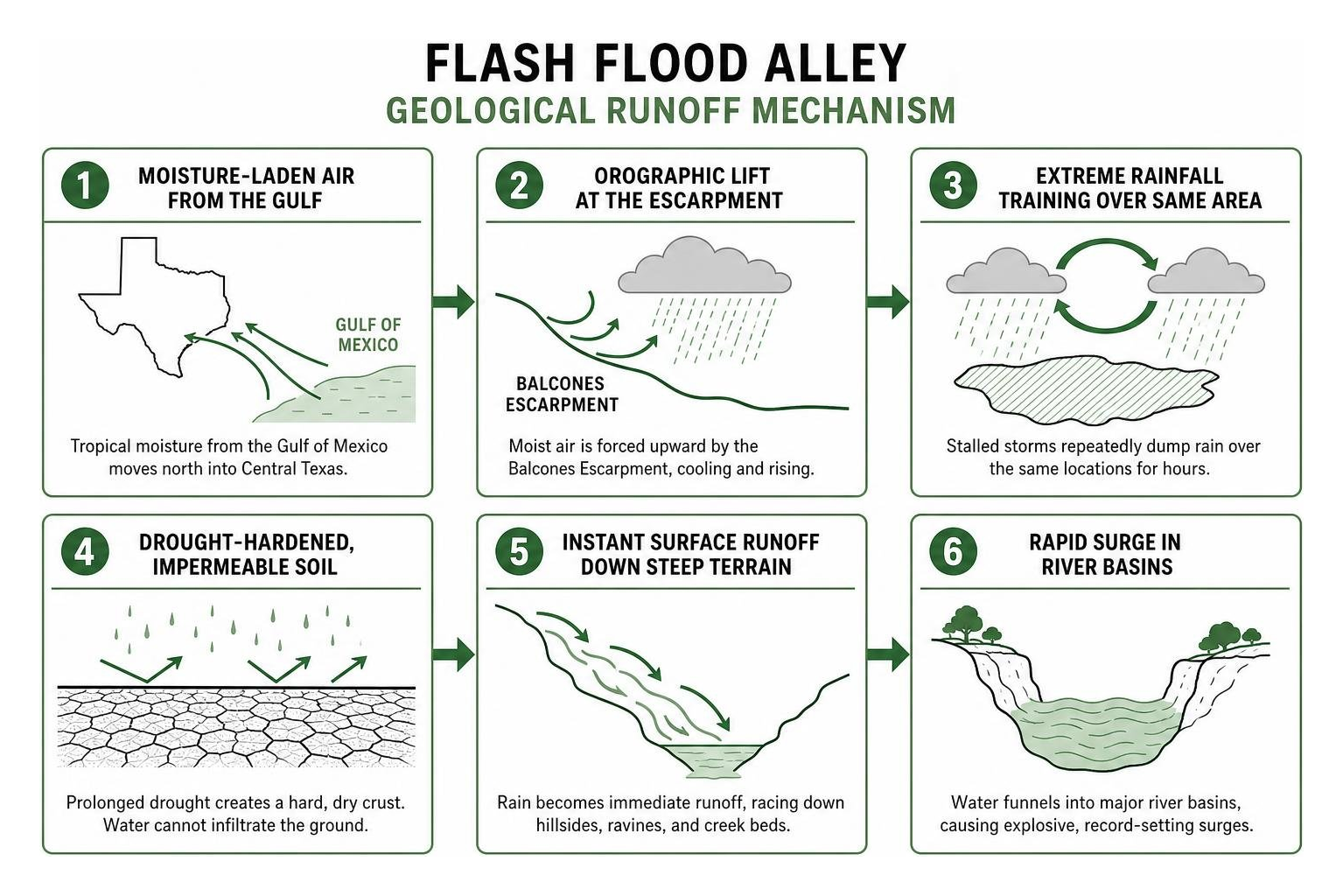
The geographic corridor tracing the Balcones Escarpment is widely known to hydrologists as “Flash Flood Alley.” Under normal conditions, the region’s steep limestone hills, thin topsoil, and deeply carved river channels create picturesque landscapes. However, when tropical atmospheric dynamics collide with this specific geology, the landscape functions like a massive concrete chute.
Prior to July 2025, Central Texas had experienced an extended period of severe drought. Rather than absorbing water, the drought-hardened ground formed an impermeable crust. When tropical moisture stalled overhead, the surface runoff was instantaneous. Water could not penetrate the earth, transforming dry ravines, creek beds, and tranquil riverbanks into violent conduits funneling millions of gallons directly into major river basins.
Meteorological Triggers Behind the Flood in Texas 2025
The extreme weather event was triggered by a stalled mesoscale convective vortex enriched by the moisture remnants of Tropical Storm Barry pulled northward from the Gulf of Mexico. Rather than moving steadily across the state, training thunderstorms aligned along the Balcones Escarpment, repeatedly dumping moisture over the exact same geographic footprints for hours.
A maximum rainfall total of 20.33 inches was recorded northwest of Streeter, near Mason. Rainfall intensities peaked at an astonishing 5.22 inches per hour along the Guadalupe River basin. Over 120 billion gallons of water were deposited onto Kerr County alone in a single night.
| Metric / Event | Historic 1987 Hill Country Flood | Historic 1998 Central Texas Flood | July 2025 Central Texas Flood |
|---|---|---|---|
| Peak Rainfall Total | 11.5 inches | 18.0 inches | 20.33 inches |
| Max Hourly Rainfall Rate | ~2.5 in/hr | ~3.8 in/hr | 5.22 in/hr |
| Guadalupe River Crest (Hunt) | 31.20 feet | 34.50 feet | 37.52 feet (New Record) |
| Surge Velocity | 10 ft in 2 hours | 15 ft in 1.5 hours | 26 ft in 45 minutes |
| Confirmed Fatalities | 10 | 31 | 136 |
Balcones Escarpment and Climate Change Intensification
The Balcones Escarpment acts as a topographic ramp. As low-level, moisture-laden air masses sweep inland from the Gulf, they encounter the sudden elevation change of the Texas Hill Country. This orographic lift forces air upward, triggering rapid condensation and atmospheric instability.
A warming atmosphere holds roughly 7% more moisture per degree Celsius of warming. When combined with prolonged drought periods that bake the soil into an impermeable glaze, extreme weather events become far more volatile. In July 2025, this thermal and topographic engine created unprecedented precipitation volume, transforming peaceful waterways into destructive walls of water that overwhelmed commercial developments, multifamily complexes, and civic infrastructure.
Chronological Timeline of the Catastrophic Flood in Texas 2025
The 2025 disaster unfolded overnight, catching thousands of sleeping residents, summer campers, and commercial facility operators off guard.
July 2–3: Atmospheric Setup and Early Warnings
On July 2, the Texas Division of Emergency Management (TDEM) placed state emergency resources on standby as weather models indicated potential heavy rainfall. By the afternoon of July 3, the National Weather Service (NWS) issued Flood Watches across Central Texas. However, widespread alert fatigue from previous uneventful forecasts, coupled with the holiday atmosphere of Independence Day weekend, led many property owners and facility managers to underestimate the looming threat.
July 4: Nocturnal River Surge and Peak Emergency Rescues
Between 1:00 AM and 4:00 AM on July 4, rainfall rates escalated rapidly into Flash Flood Emergencies. The Guadalupe River experienced an unprecedented rise, surging 26 feet in just 45 minutes near Hunt and Ingram before cresting at a record-shattering 37.52 feet. At youth summer camps such as Camp Mystic, floodwaters inundated low-lying cabins located in historical floodways.
More than 850 live water rescues were executed during the first 36 hours. Over 400 first responders—supported by US Coast Guard helicopters and municipal swift-water teams—conducted 167 rooftop extractions. By the end of July 4, 237 people had been pulled directly from raging waters, though Kerr County bore the brunt of the tragedy with 117 confirmed fatalities.
July 5–8: Search Operations and Multi-County Devastation
As waters began to recede, multi-agency search and recovery operations expanded across the region using advanced MQ-9 Reaper drones and K-9 units. Structural destruction spread beyond Kerr County:
- Travis County & Lakeway: Emergency personnel executed 66 lifesaving water rescues along 30 miles of waterways, recording over $28 million in damage across Leander, Jonestown, and Lago Vista.
- San Angelo & Tom Green County: Severe rainfall dumped 15 inches of rain, overwhelming municipal treatment infrastructure and causing a 1.6-million-gallon wastewater discharge into the Concho River.
- Williamson & Burnet Counties: Catastrophic runoff washed out roadways, bridges, and commercial infrastructure along tributary basins.
Over 1,000 first responders from across the country mobilized, supported by more than 2,000 local volunteers who assisted with search, recovery, and immediate relief efforts.
Structural Devastation, Early Warning Failures, and Institutional Reforms
The disaster inflicted an estimated $1.1 billion in structural and infrastructure damage, leaving commercial property owners, apartment complex operators, and municipal entities facing long-term physical and financial recovery challenges.
Institutional Fallout and Camp Safety After the Flood in Texas 2025
Following the tragedy, investigations revealed major vulnerabilities in commercial youth facility zoning and municipal alert infrastructure. Camp Mystic faced wrongful death lawsuits and filed for Chapter 11 bankruptcy reorganization, citing liabilities exceeding $10 million.
In response, the Texas Legislature enacted sweeping safety reforms:
- Senate Bill 1 (Heaven’s 27 Camp Safety Act): Mandates strict floodplain construction limits, redundant emergency notification systems, and certified evacuation protocols for youth camps operating in designated flood hazard zones.
- Senate Bill 3: Directs flood-prone Texas municipalities to install, maintain, and regularly test automated outdoor flood warning sirens.
When addressing significant structural impact to commercial assets, securing professional storm damage insurance claim assistance is vital to ensure all code upgrade mandates and hidden physical damages are accurately accounted for.
Fact vs. Myth: Floodway Mapping, Emergency Sirens, and 911 Bottlenecks
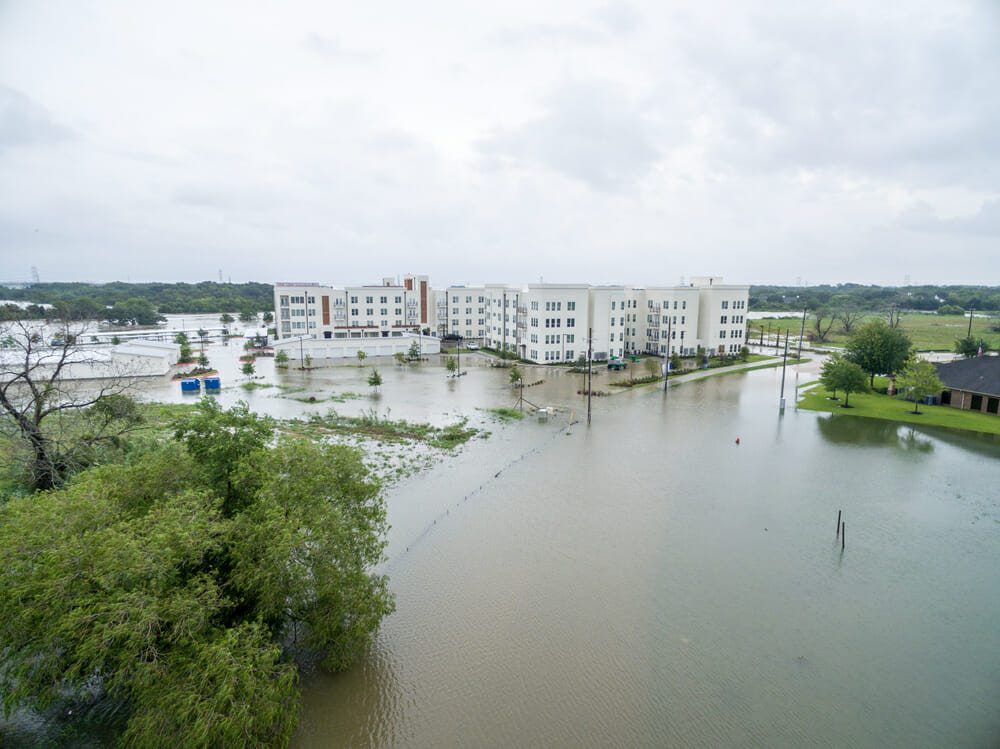
- Myth: If a commercial building is in FEMA Flood Zone X or has been removed from a Special Flood Hazard Area (SFHA), it is safe from catastrophic flood loss.
Fact: FEMA flood maps rely heavily on historical coastal surges and traditional river overflows, often overlooking severe, localized inland flash-flood events. Between 2011 and 2020, administrative appeals removed 55 buildings from high-risk flood designations near the river, yet many were still submerged when the river surged 26 feet in 45 minutes.
Myth: Local municipal 911 dispatch and wireless alerts are fully capable of handling catastrophic flash flood emergencies.
Fact: During the peak 6-hour disaster window in Kerr County, only two 911 dispatchers were on duty to manage 435 emergency calls, creating severe communication bottlenecks.
Myth: Standard commercial property insurance policies automatically indemnify all flood-related losses without dispute.
- Fact: Flood damage is strictly excluded under standard commercial property policies and requires specialized National Flood Insurance Program (NFIP) or private commercial flood endorsements.
Commercial Property Losses and Policy Recovery Challenges
For commercial building owners, apartment complex managers, hospitality operators, and HOAs in Austin, San Antonio, Dallas, Houston, Lubbock, San Angelo, Waco, and surrounding cities, recovering from commercial water inundation is heavily complicated by insurer tactics. Insurance carriers frequently treat delay and underpayment as a standard cost of doing business.
Catastrophic commercial water losses also reveal significant adjuster licensing gaps. Insurers frequently deploy temporary or out-of-state adjusters lacking specific Texas commercial adjusting licenses, leading to improper policy interpretation and missed structural scope. Furthermore, severe flooding introduces hazardous environmental conditions that must comply with OSHA worker safety standards. Commercial properties require certified industrial hygienists to enforce strict mold and asbestos remediation protocols, maintain psychrometric moisture maps, and preserve detailed dry log records to substantiate structural drying costs.
Under Texas Insurance Code Chapters 541 (Unfair Settlement Practices) and 542 (Prompt Payment of Claims), carriers face statutory interest and penalties if they fail to meet strict deadlines for acknowledging, investigating, and paying valid claims. When insurers stall, invoke arbitrary policy exclusions, or dispute legitimate structural drying logs, commercial policyholders have legal recourse through statutory bad-faith claims or appraisal awards.
National regulatory actions underscore widespread claim-handling misconduct. State Farm entered into a $15.6M settlement over systemic claim delays, while parallel regulatory reviews were detailed in the California Enforcement Action and reported by major media outlets including The New York Times, The Guardian, and CNN. Furthermore, lessons drawn from Florida property insurance litigation demonstrate how aggressive carrier underpayments force policyholders into costly disputes simply to secure the indemnification they paid for.
For commercial and multifamily claims exceeding $250,000, property managers should not rely on carrier-assigned adjusters who face inherent conflicts of interest. Engaging dedicated Texas public insurance adjusters ensures your business interruption, structural damage, and code-upgrade costs are thoroughly documented. If you are experiencing prolonged carrier resistance, explore how to resolve underpaid and delayed insurance claims before statutory deadlines expire.
Frequently Asked Questions About the 2025 Texas Floods
What caused the Guadalupe River to surge so rapidly in July 2025?
A stationary mesoscale convective vortex dropped up to 20.33 inches of rain over drought-hardened, impermeable limestone terrain along the Balcones Escarpment. With nowhere to percolate, an estimated 120 billion gallons of surface runoff rushed directly into the river basin, generating record hourly rainfall rates of 5.22 inches and driving a 26-foot surge in 45 minutes.
How did legislative changes like Senate Bills 1 and 3 alter Texas flood safety?
Translation: The state closed dangerous regulatory loopholes that previously allowed commercial camps and facilities to operate in flash-flood zones without adequate early warning systems.
Senate Bill 1 (Heaven’s 27 Camp Safety Act) instituted strict safety and building standards for youth camps situated in floodplains, mandating certified rapid-evacuation plans. Senate Bill 3 required flood-vulnerable municipalities across Texas to install automated, audible outdoor warning sirens to notify communities during nocturnal emergencies.
What should commercial property owners do when facing delayed or underpaid flood claims?
Commercial and multifamily property owners must immediately document all floodwater lines, preserve dry log records from remediation teams, retain industrial hygienists for Category 3 blackwater contamination, and track business interruption losses. If the insurer disputes scope or undervalues the loss, engaging licensed flood damage public adjuster services levels the playing field to negotiate a full, fair settlement.
Conclusion
In 2026, the historic flash floods of July 2025 remain a devastating reminder of Flash Flood Alley’s immense power and a current roadmap for flood preparedness, commercial property risk review, and claim recovery planning. Across Kerrville, San Angelo, Austin, Lakeway, Round Rock, and neighboring Central Texas communities, the disaster highlighted the vital necessity of modern emergency warning sirens, updated floodway mapping, and robust municipal 911 staffing.
For commercial building operators, apartment investors, HOAs, retail developers, and religious institutions, post-disaster recovery requires persistent vigilance. When carriers delay claims or undervalue severe structural losses, knowing your policy rights under Texas law is essential. At Insurance Claim Recovery Support, our public adjusters advocate exclusively for commercial policyholders, delivering the forensic documentation, policy interpretation, and settlement negotiation needed to properly indemnify your properties. Contact us today for professional guidance on Texas flood damage claims & support.
For policyholders reviewing flood-related property damage, see ICRS guidance on flood damage insurance claims. Flood and internal water losses may be handled under different policies and terms.