
Policyholder education

What Is a Public Adjuster?

A public adjuster is an insurance claims professional hired by the policyholder to document, prepare, present, and negotiate a first-party property insurance claim. The public adjuster represents the policyholder’s interests; the insurance company’s adjuster represents the insurer.

Understand who works for you, what they do, and what to ask before hiring one.

Watch the explainer, then get the free guide to keep.

By Scott Friedson, ICRS public adjuster · Updated October 27, 2026

What does a public adjuster do?

A public adjuster helps build and present the policyholder’s claim, rather than leaving the owner to manage every document and negotiation alone. Depending on the engagement and state requirements, the work may include:

  • Reviewing the policy and claim: identifying relevant coverage provisions, deductibles, documentation duties, and deadlines.
  • Documenting the damage: organizing inspections, photographs, measurements, repair scopes, estimates, and supporting professional reports.
  • Preparing the claim: presenting building, contents, extra-expense, and business-interruption documentation where applicable.
  • Evaluating the insurer’s estimate: comparing the scope, quantities, pricing, and supported claim items.
  • Negotiating for the policyholder: communicating with the insurer and supporting the claim with evidence.

ICRS focuses on complex property losses involving commercial buildings, multifamily properties, associations, churches, schools, and high-value homes.

Public adjuster vs. insurance company adjuster

Who each type of adjuster represents
AdjusterWho hires them?Whose claim interests do they represent?
Public adjusterThe policyholderThe policyholder
Staff / company adjusterThe insurance companyThe insurer
Independent adjuster hired by an insurerThe insurer or its claims administratorThe insurer on that assignment

“Independent” does not automatically mean “working for the policyholder.” Confirm who hired the professional and who they represent.

When should you consider hiring a public adjuster?

Consider a review when a property loss is substantial, the repair scope is disputed, the claim is delayed or underpaid, or documenting the loss is taking more time than you can give it. Commercial and multifamily claims can involve several buildings, shared systems, tenant impacts, and business-interruption records.

First address safety and urgent property protection. Notify your insurer and follow your policy’s duties and deadlines. An early review may help identify evidence to preserve before repairs or demolition change the site.

Explore documented ICRS claim examples to see the kinds of scope and documentation issues that can arise. Results are specific to each claim.

How much does a public adjuster cost?

Public adjusting is a paid service. Fees may be based on a percentage of the claim recovery or another agreed arrangement. The permitted fee, calculation, expenses, cancellation rights, and contract requirements vary by state and engagement.

Before signing, ask what the fee applies to, how the deductible and prior payments are treated, which expenses require approval, and what services are included. Read the written agreement rather than relying on a headline percentage.

ICRS provides paid consultation and contingency representation services. A free claim review is available for qualifying large-loss prospects; it does not make representation free. View the service options below.

What to check before hiring a public adjuster

  1. Verify the license. Check the individual and business with the insurance regulator for the state where the property is located.
  2. Ask about relevant experience. Look for experience with your property type, cause of damage, and claim complexity.
  3. Review the scope and written fee agreement. Understand services, costs, expenses, and cancellation terms.
  4. Ask who will handle your file. Confirm inspection, communication, documentation, and negotiation responsibilities.
  5. Look for evidence, not promises. Review documented examples and references. No professional can guarantee a specific recovery.

Read the Texas Department of Insurance’s hiring guidance.

Find the right ICRS claim support

Large-loss claims — $250,000+ after deductible: ICRS exclusively represents policyholders in qualifying property damage claims. Start with a free claim review to discuss fit.

Texas claims under $250,000: Claim Navigator provides paid strategic guidance, with the option for full representation when appropriate. Review the published service scope and money-back guarantee conditions before booking.

Free educational guides are available regardless of whether you hire ICRS. Browse the free claim guides and resources.

Common questions about public adjusters

Is a public adjuster the same as an insurance adjuster?

Public adjusters represent policyholders. Staff adjusters and independent adjusters hired by an insurance company handle claims for the insurer. Ask who hired the adjuster and whose interests they represent.

Do I have to hire a public adjuster?

No. You can handle your claim directly with your insurer. Consider professional help when the damage, documentation, time demands, or disagreement makes the claim difficult to manage.

Can a public adjuster help after an insurer makes an offer?

A public adjuster may be able to review an existing offer and help document disputed or overlooked damage. Eligibility depends on the claim’s status, policy terms, deadlines, prior agreements, and applicable state requirements. Seek a review promptly.

Does a public adjuster guarantee a larger settlement?

No. The policy, facts, documentation, and applicable requirements affect the outcome. Past claim results do not guarantee a settlement amount or timeline.

Does a public adjuster replace an attorney or contractor?

A public adjuster handles claim documentation and negotiation within the permitted scope of public adjusting. Contractors perform repairs; attorneys provide legal advice and representation. A claim may require more than one professional.

What should I have ready for a claim review?

Gather the policy and declarations, claim number, date and cause of loss, insurer estimates and letters, photographs, repair estimates, invoices, and any relevant business-interruption records. Avoid sharing sensitive documents through public comment forms.

Keep a free guide for your claim

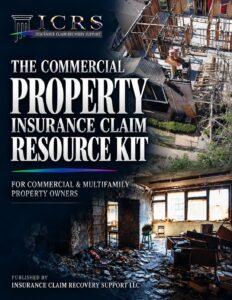
Get the What Is a Public Adjuster? guide for a practical explanation of representation, claim preparation, and questions to ask.

Sources: Texas Department of Insurance; Texas Office of Public Insurance Counsel; Maryland Insurance Administration. This page provides general education. Policy terms and state requirements vary.

ICRS logo with text "We Settle Big Claims" and details about commercial and multifamily public insurance adjusting, highlighting over $250 million in settlements, emphasizing "No Recovery, No Fee," against a dramatic stormy background.

Subscribe to Our Newsletter

Join our mailing list to get the latest updates, news and special offers delivered directly to your inbox.

7 Ways Commercial Building Owners Maximize Insurance Claims

Enter your email to receive this free ICRS guide, practical claim checklists, and ongoing ICRS educational emails, typically weekly. You can unsubscribe at any time.

Get the Free Guide

Looking for help with a specific loss? Explore the free Fire Claim Guide or Water Claim Guide.

Request a Free Large-Loss Claim Review ($250,000+ after deductible).

Request a Claim Review