What Are Property Damage Claims — and Why They Matter for Commercial and Multifamily Property Owners
Property damage claims are formal requests for compensation when physical damage occurs to your building, assets, or operations — whether from a hurricane, fire, freeze event, vandalism, or another covered peril.
If you own or manage a commercial or multifamily property and need a fast answer, here’s what you need to know:
- What it is: A property damage claim is a request submitted to your insurance carrier (or a responsible third party) seeking financial compensation for physical loss or damage to tangible property.
- Who pays: Typically your own insurer under your first-party property policy, though third-party liability claims against a responsible party are also possible.
- What you can recover: Repair or replacement costs, consequential losses like lost rental income or business interruption, and in some cases additional expenses tied directly to the damage.
- How long you have to file a lawsuit: Statutes of limitations vary by state — for example, Georgia allows 4 years under Georgia Code § 9-3-32, while California generally allows 3 years.
- Your biggest risk: Insurance adjusters work for the insurance company — not for you. Claims are routinely delayed, underpaid, or denied without proper advocacy on your side.
- Your best move: Engaging a licensed public adjuster early in the process can resolve most large-loss claims without litigation, saving you significant time, money, and stress.
Most commercial and multifamily property owners don’t realize how complex a large-loss claim can become until they’re in the middle of one. You’re managing tenant pressure, revenue loss, lender requirements, and a claims process that was designed by — and for — the insurance carrier. The gap between what insurers initially offer and what policyholders are actually owed can be staggering, sometimes reaching thousands or even millions of dollars on a single claim.
I’m Scott Friedson, CEO of Insurance Claim Recovery Support (ICRS) and a multi-state licensed public adjuster with over 15 years of experience handling property damage claims for commercial and multifamily property owners across the country. Over the course of 500+ large-loss claims valued at more than $250 million, I’ve helped property owners overturn wrongfully denied claims and recover settlements that far exceeded initial insurer offers — without unnecessary litigation. In this guide, I’ll walk you through everything you need to know to protect your rights and maximize your recovery.
Terms related to property damage claims:
- commercial property damage claims attorney
- denied fire insurance claim
- fire property damage attorney
Navigating the Complexities of Property Damage Claims

When we talk about property damage claims, we are referring to the physical harm done to tangible property. In high-stakes real estate, this isn’t just a broken window; it’s a structural failure, a collapsed roof, or a flooded mechanical room that threatens the viability of your entire investment.
Whether the damage stems from negligence (like a contractor’s mistake), willful destruction (vandalism), or acts of nature (the “Big Three”: wind, hail, and fire), the recovery process is rarely straightforward. We represent a wide array of policyholders, including:
- Commercial building owners and retail center operators.
- Apartment investors and multifamily operators facing tenant displacement.
- HOAs and condominium associations managing collective assets.
- Hospitality groups (hotels and motels) where every day of closure is lost revenue.
- Religious institutions, schools, and government buildings.
- Industrial and manufacturing facilities with specialized equipment.
In states like Texas, where Property Damage Claims in Texas are frequently driven by extreme weather, understanding the nuances of your policy is the difference between a full recovery and a financial disaster. For a deeper dive into the specific requirements for business assets, see our Commercial Property Insurance Claims Guide.
Understanding Different Types of Property Damage Claims
Not all property damage claims are created equal. The “peril”—the cause of the loss—dictates how the claim is adjusted and which experts need to be involved.
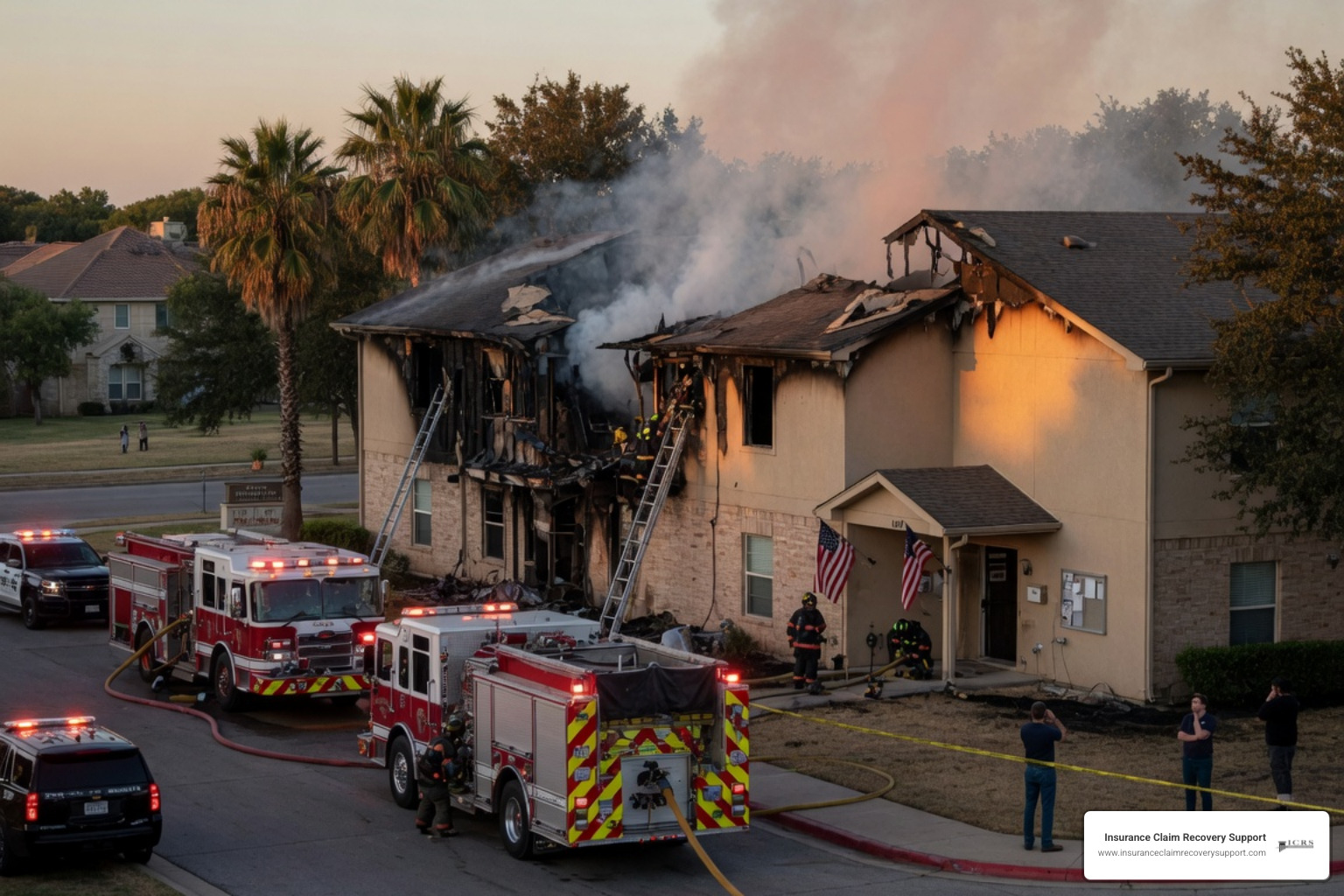
- Fire and Smoke: These are often the most devastating. Fire Property Damage Claims involve not just charred structures but pervasive smoke odor and water damage from firefighting efforts.
- Wind and Hail: In the South and Midwest, Hail Damage Insurance Claims are a leading cause of loss. Carriers often try to dismiss these as “cosmetic,” but we know they compromise the functional life of your roof and can hide structural issues that only a forensic eye will catch.
- Tornados and Hurricanes: These “catastrophe” events, like Tornado Damage Claims, often result in total losses or complex partial losses that require massive documentation.
- Water and Flood: Standard policies often cover “sudden and accidental” water discharge (like a burst pipe), but Flood Damage Insurance Claims usually require a separate policy through the NFIP or a private flood insurer.
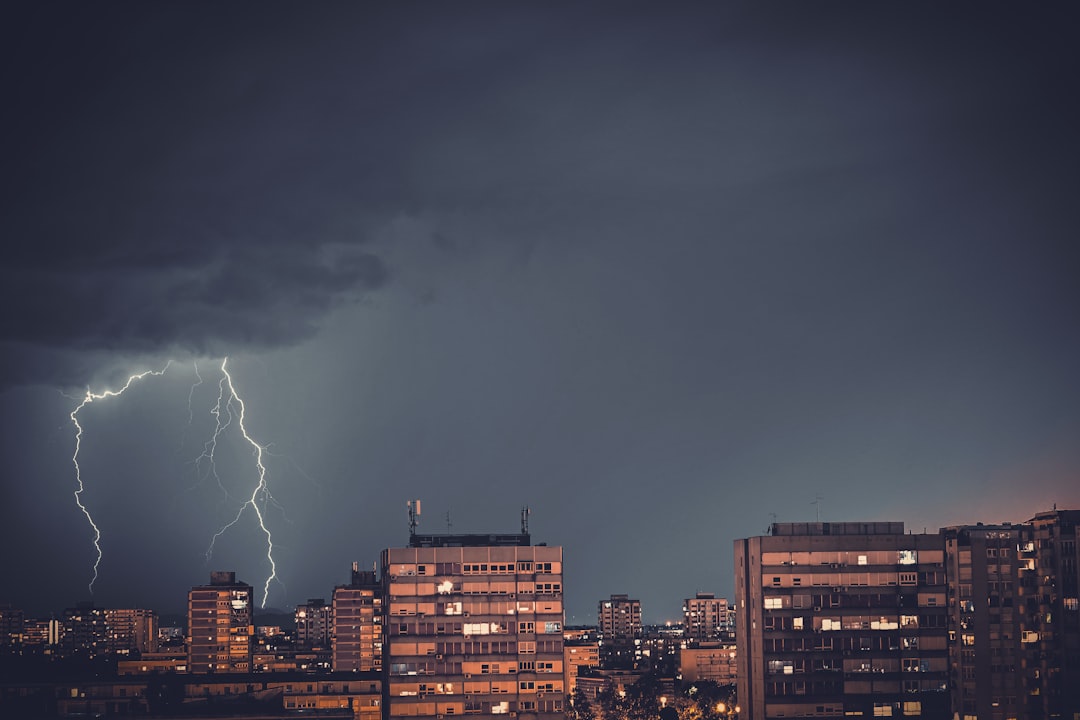
- Lightning and Freeze: Lightning Damage Insurance Claims can fry expensive HVAC and security systems, while winter freezes can lead to massive pipe bursts across multifamily complexes.
- Business Interruption: This is the “hidden” claim. If your building is damaged, you aren’t just losing bricks and mortar; you’re losing rent. Business interruption coverage compensates you for that lost income.
- Vandalism and Arson: Willful acts, such as graffiti, broken windows, or set fires, are generally covered, though vacant buildings often have strict exclusions (typically after 30-60 days of vacancy).
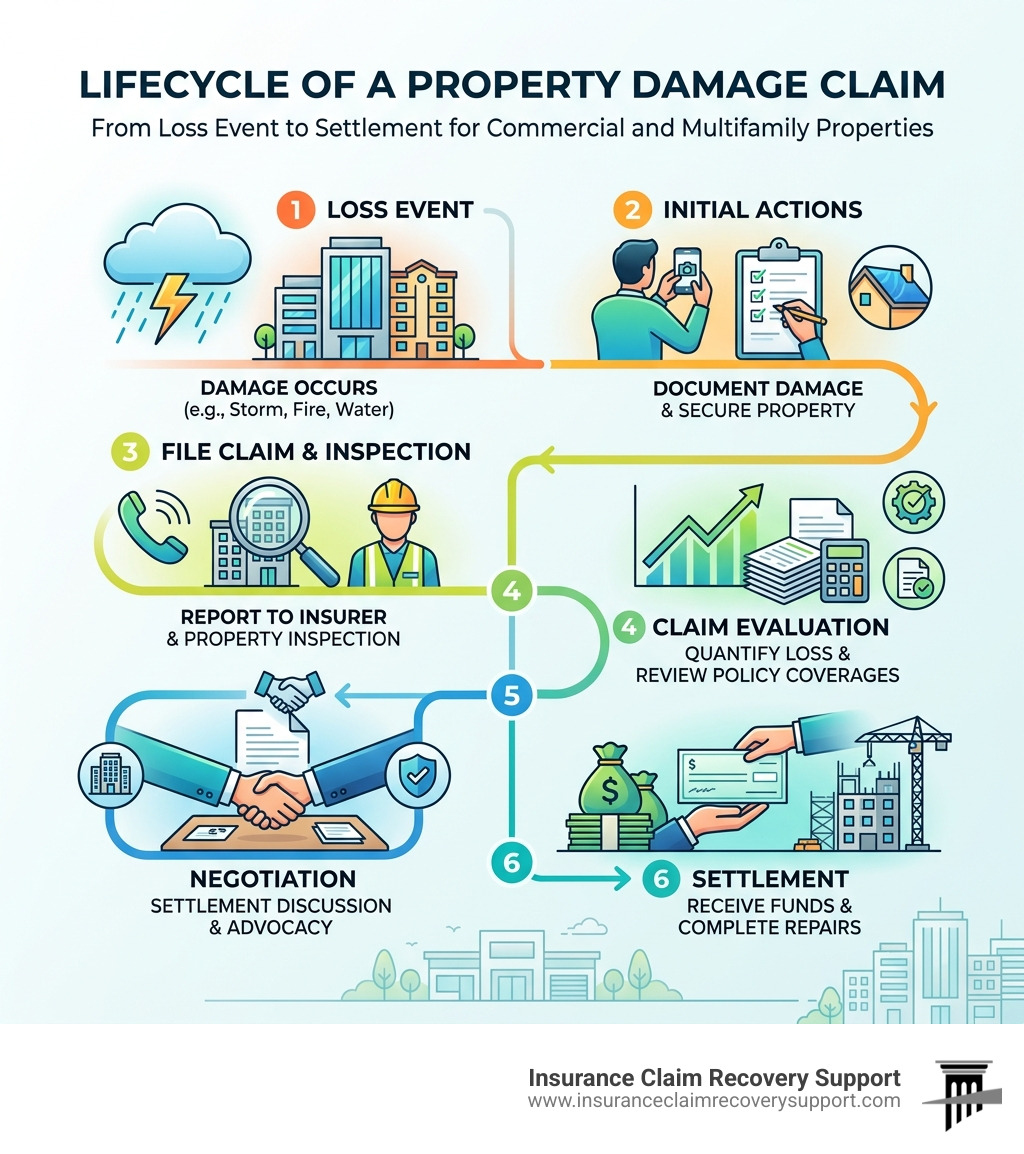
The Critical Steps After a Large-Loss Event
The hours and days following a loss are critical. Your actions here will either pave the way for a smooth settlement or give the insurance company “ammunition” to deny your claim.
- Protect the Property: You have a contractual “duty to mitigate” damages. This means you must take reasonable steps to prevent further harm—like tarping a roof or board-up services. If you don’t, the carrier may deny the additional damage that occurs after the initial event.
- Report to Authorities: For vandalism, theft, or fire, a police or fire report is essential evidence.
- Gather Evidence: Take hundreds of photos and videos. Do not throw anything away until the adjuster has seen it.
- Documentation: Collect repair estimates, but be careful. Don’t sign a “contingent” contract with a roofer or contractor before your claim is fully adjusted. You need an independent scope of loss.
- Professional Review: Knowing How to Negotiate with Insurance Adjuster for Property Damage is a skill. The carrier’s adjuster is looking for ways to save the company money; you need someone looking for ways to restore your property.
Replacement Cost vs. Actual Cash Value in Commercial Policies
One of the biggest “gotchas” in property damage claims is the valuation method.
| Feature | Actual Cash Value (ACV) | Replacement Cost Value (RCV) |
|---|---|---|
| Definition | Fair market value at time of loss | Cost to replace with new materials |
| Calculation | Replacement Cost minus Depreciation | Current market price for new items |
| Payout | Lower initial check | Higher total (after repairs are made) |
| Depreciation | Non-recoverable | Recoverable (usually) |
Most commercial policies are RCV, but carriers will initially pay out the ACV. You only get the “recoverable depreciation” check after you prove the work was completed.
Beyond the physical building, you may be entitled to compensatory damages (to put you back where you were), incidental expenses (like temporary fencing or security), and consequential losses (like lost profits). In rare cases of extreme carrier negligence, punitive damages may be awarded by a court, though these are typically capped at ten times the compensatory amount.
Maximizing Your Recovery: Public Adjuster vs. Litigation
When a claim goes sideways, policyholders often think their only choice is to sue. However, there is a massive difference between a claims dispute and a lawsuit.
Litigation is slow, expensive, and adversarial. In many states, the statute of limitations is ticking. For instance, Georgia’s limit for property damage is 4 years (Georgia Code § 9-3-32), while California’s is generally 3 years. If you miss these windows, your right to recover is gone forever.
However, before jumping into Disputing Damage Claims in a Lawsuit, consider the role of a Public Adjuster. We use the appraisal process—a contractual right in most policies—to resolve valuation disputes without setting foot in a courtroom.
Why Commercial Property Damage Claims Often Stall
Carriers have a “roadmap” for handling claims, and often, that roadmap includes detours designed to wear you down. Common tactics include:
- Adjuster Rotation: Switching your file between three different adjusters so you have to start from scratch every time.
- Underpayment: Offering a “lowball” estimate based on biased software data that doesn’t reflect local Texas or Georgia labor costs.
- Sovereign Immunity: If your damage was caused by a state entity (like a state-owned building in Tennessee), you face strict liability caps (often $300,000 per person/$1 million per occurrence) and specific filing portals like the Tennessee Claims Commission.
If you feel you are being treated unfairly, you may need to File a Complaint Against Your Insurance Company or consult our Bad Faith Insurance Complete Guide.
Fact vs. Myth: Common Misconceptions in Insurance Recovery
- Myth: My insurance agent will handle my claim.
- Fact: Agents sell policies; they don’t adjust large-loss commercial claims. Once a loss happens, you are handed off to a claims department whose goal is “loss mitigation” (for the company, not you).
- Myth: I have to use the insurance company’s “preferred” contractors.
- Fact: You have the right to hire your own licensed professionals. “Preferred” vendors often have pre-negotiated rates that may lead to cutting corners on your building.
- Myth: Lawsuits are the only way to get more money.
- Fact: At ICRS, we resolve 90% of our claims through expert negotiation and appraisal, avoiding the years of delay associated with the court system.
- Myth: Vandalism is always covered.
- Fact: If your commercial building has been vacant for a certain period (check your policy for the 30 or 60-day clause), vandalism, glass breakage, and water damage might be excluded entirely.
Conclusion: Securing Your Settlement with Expert Advocacy
Mastering your property damage claim isn’t about being aggressive; it’s about being prepared, documented, and professionally represented. Whether you are dealing with a fire in Houston, a major storm in Dallas, or a hurricane in Florida, the insurance company has a team of experts working to protect their bottom line. You deserve the same.
Insurance Claim Recovery Support (ICRS) is a leading Texas Public Adjuster and one of the premier Public Adjusting Firms Texas USA. We specialize in large-loss commercial and multifamily claims, with a 90% success rate in settling claims without litigation.
We serve policyholders across the United States, including:
- Texas: Austin, Dallas, Fort Worth, San Antonio, Houston, Lubbock, San Angelo, Waco, Round Rock, Georgetown, Lakeway, and Amarillo.
- Multiple States: Florida, Georgia, Colorado, North Carolina, South Carolina, Oklahoma, Pennsylvania, Ohio, Indiana, Kansas, Kentucky, Maryland, Utah, Nebraska, and Nevada.
Don’t let a carrier’s lowball offer become your final settlement. If you’re facing a complex claim, you can learn more info about property damage lawyer services or, better yet, contact us for a free claim consultation to see how we can maximize your recovery without the courtroom.