Why Every Commercial Property Owner in Key West Needs to Understand Their Insurance Rights
A Key West public adjuster could be the single most important professional you hire after a storm, fire, or major water loss damages your commercial property — and most property owners in Monroe County don’t know that until it’s too late.
Here’s the fast answer if you need it now:
What is a Key West public adjuster, and do you need one?
| Question | Quick Answer |
|---|---|
| What does a Key West public adjuster do? | Represents you — not the insurer — in documenting, filing, and negotiating your property damage claim |
| Who needs one? | Commercial property owners, multifamily operators, HOAs, hotels, and religious organizations with claims over $250K |
| When should you hire one? | As early as possible — but you can also hire one for underpaid or denied claims |
| How are they paid? | Contingency only — no upfront cost, no fee unless you recover settlement funds |
| Does it actually help? | A government study found using a public adjuster raises insurance claim payouts by an average of 747% |
| Are they licensed in Florida? | Yes — under Fla. Stat. 626.854, with regulated fee caps and strict conduct standards |
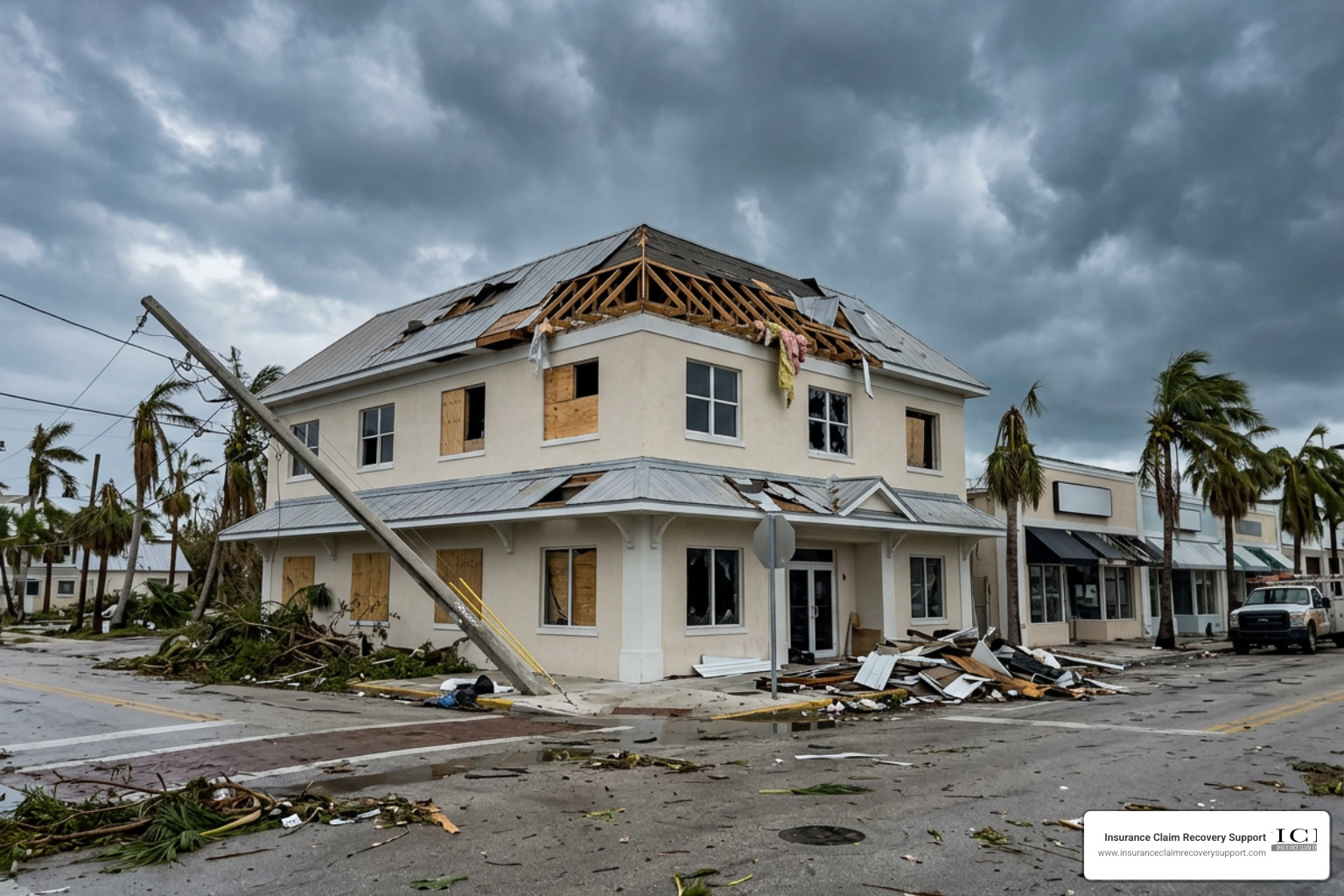
Key West sits at the southern tip of the continental United States, perched on a barrier island in Monroe County with direct exposure to Atlantic hurricanes, storm surge, and the full force of coastal weather events. That geography — combined with historic Conch-style architecture, sky-high material and labor costs driven by island logistics, and one of the most complex insurance markets in Florida — means that when a major loss hits a commercial property here, the claim process is rarely straightforward.
Insurance companies send their own adjusters to assess your damage. Those adjusters are trained by, paid by, and accountable to the carrier — not to you. Scope reductions, cause-of-loss disputes, and delayed payments are not accidents. For many insurers, underpaying claims is simply a cost-of-doing-business model baked into their operations.
That’s the real problem commercial property owners, multifamily operators, and hospitality businesses in Key West face: you’re navigating one of the most high-risk insurance environments in the country, often without anyone in your corner who actually works for you.
I’m Scott Friedson, a multi-state licensed public adjuster and CEO of Insurance Claim Recovery Support (ICRS) LLC, with over 15 years and 500+ large-loss claims totaling more than $250 million in settlements — including complex commercial and multifamily cases that required the exact kind of expertise a Key West public adjuster must bring to the table. In the sections that follow, I’ll walk you through everything you need to know to protect your property, your tenants, and your bottom line.
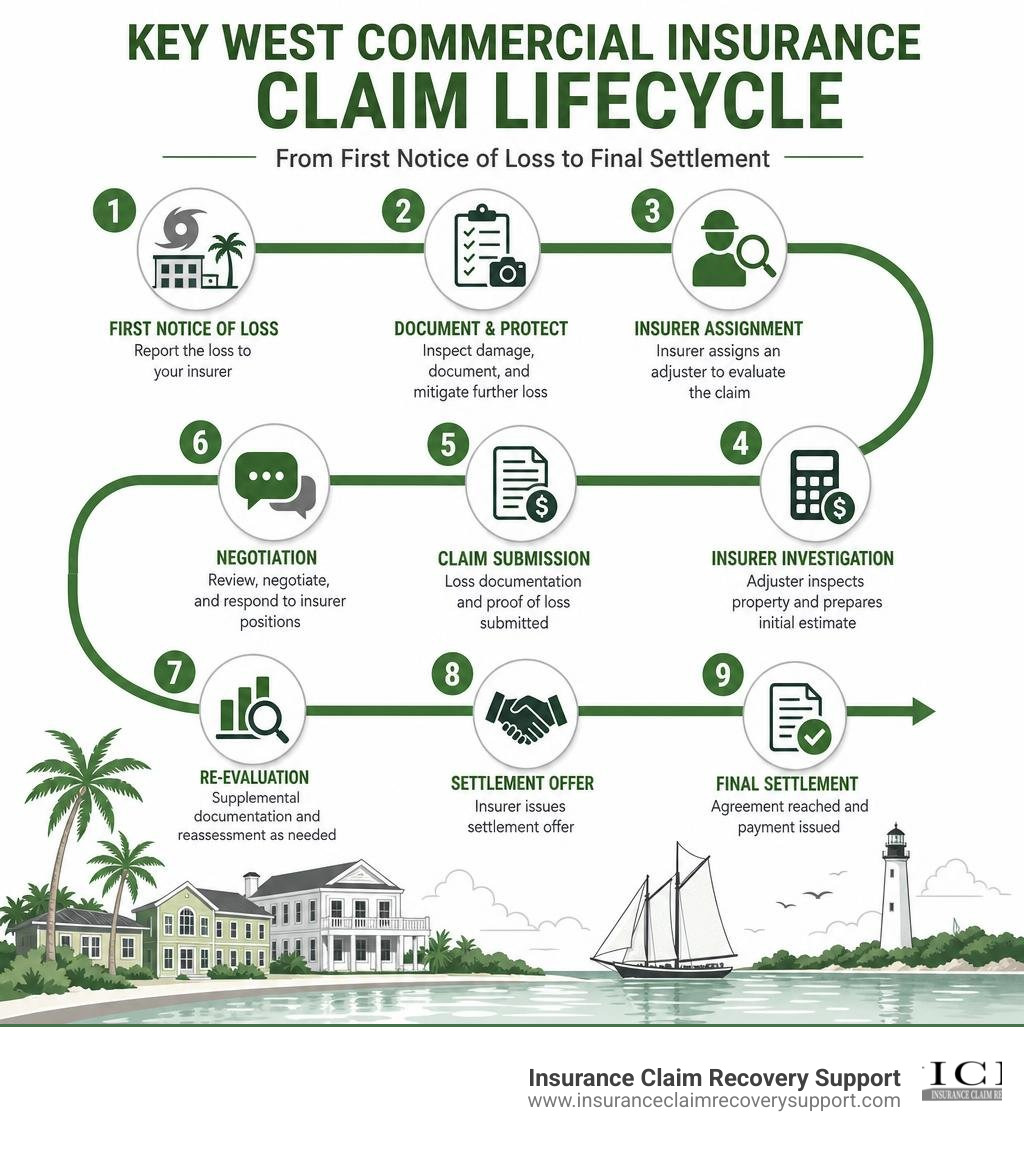
Relevant articles related to key west public adjuster:
Why Commercial Properties Need a Key West Public Adjuster
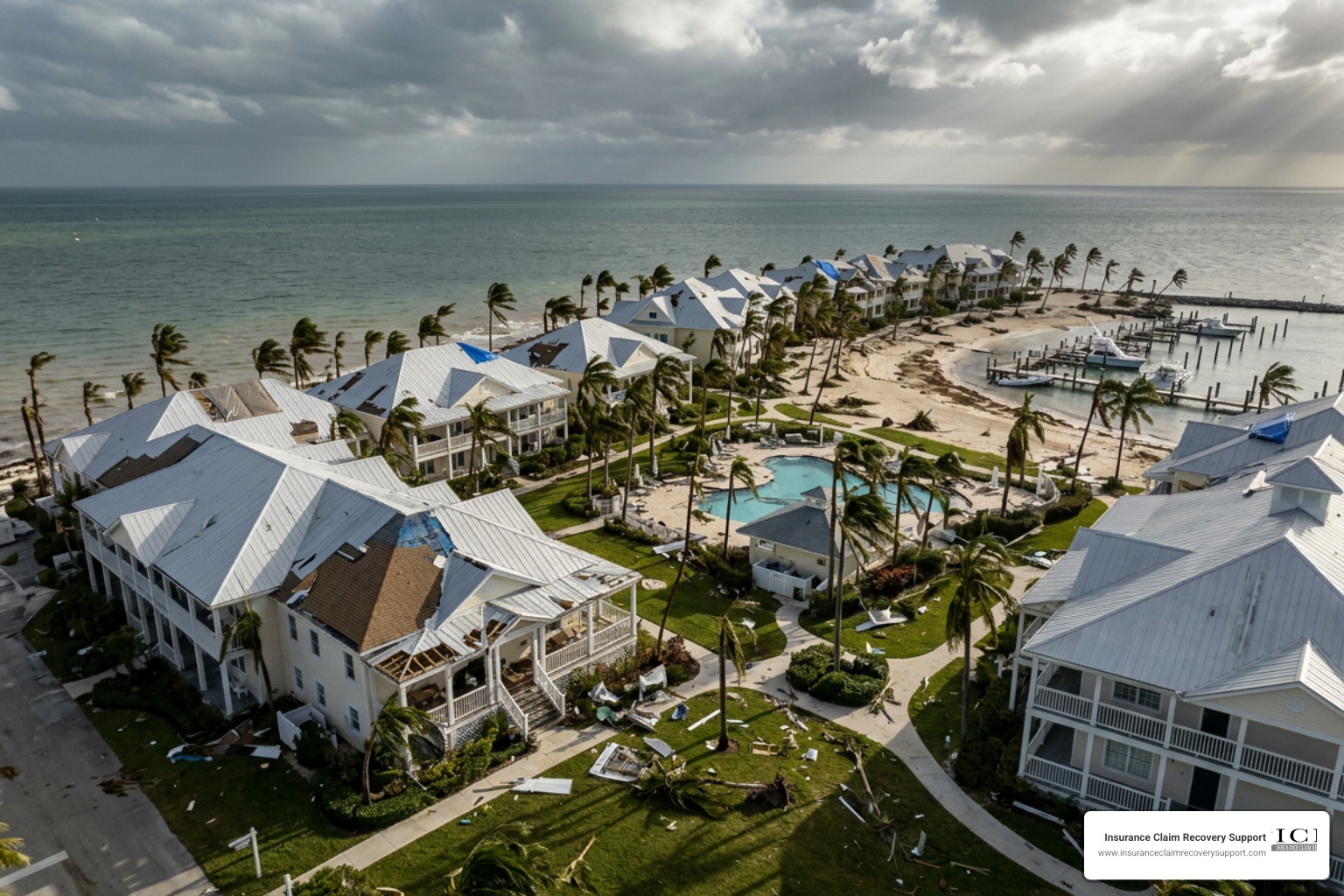
For a commercial real estate investor, professional property manager, or HOA board member in Key West, a property damage claim is not just an inconvenience—it is an existential threat to your business operations. When a claim exceeds $250,000, insurance carriers initiate an intense level of systemic scrutiny. They do not look at your commercial building or multifamily complex as a property to be restored; they look at it as a major liability to their quarterly balance sheets.
Unlike residential claims, commercial property losses involve massive complexities:
- Policy Interpretation: Commercial policies are rarely off-the-shelf products. They are often highly customized, manuscript policies with complex endorsements, co-insurance clauses, and strict mitigation requirements.
- Florida Litigation Costs: With recent legislative overhauls in Florida designed to curb insurance litigation, property owners face an uphill battle. Going to court is more expensive and difficult than ever. This makes settling your claim accurately during the administrative phase absolutely vital.
- Systemic Carrier Delays: Every day your resort, retail plaza, or apartment building sits damaged is a day of lost revenue. Carriers know that cash-flow pressure can force commercial policyholders to accept lowball settlements just to resume operations.
When you are dealing with a large-loss claim, you cannot afford to rely on the carrier’s goodwill. You need a dedicated advocate to ensure your property is fully indemnified. If you are wondering whether your claim warrants representation, you should read our guide on Should I hire a public adjuster for large-loss claims?
The Role of a Key West Public Adjuster in Large-Loss Claims
Large-loss claims require a level of forensic documentation that standard adjusters simply cannot provide. In the aftermath of a hurricane or major water loss, insurance companies often deploy “catastrophe adjusters.” There are major adjuster licensing gaps here; many of these field adjusters are fresh out of training, under-licensed, or flown in from states with entirely different building codes. They do not understand marine-grade building materials, coastal wind-borne debris region (WBDR) requirements, or the strict local building codes of Monroe County.
We step in to manage the entire scientific and structural documentation of your loss. This includes:
- Dry Log Records: In water and flood claims, carriers frequently argue that mold or rot was pre-existing. We monitor and compile detailed dry logs, infrared thermal imaging, and moisture mapping to prove the exact progression of structural drying.
- Environmental Hazards & OSHA Standards: Restoring a commercial property in Key West means complying with strict federal and state regulations. We coordinate with industrial hygienists to establish proper mold and asbestos protocols to ensure your repairs meet OSHA standards and do not expose you to future liability.
By managing these complex elements, we build an undeniable, evidence-backed claim package. For a deeper dive into how this role protects your interests, refer to our comprehensive Public adjuster definition and role in commercial claims.
Systemic Insurer Scrutiny and the Cost of Doing Business
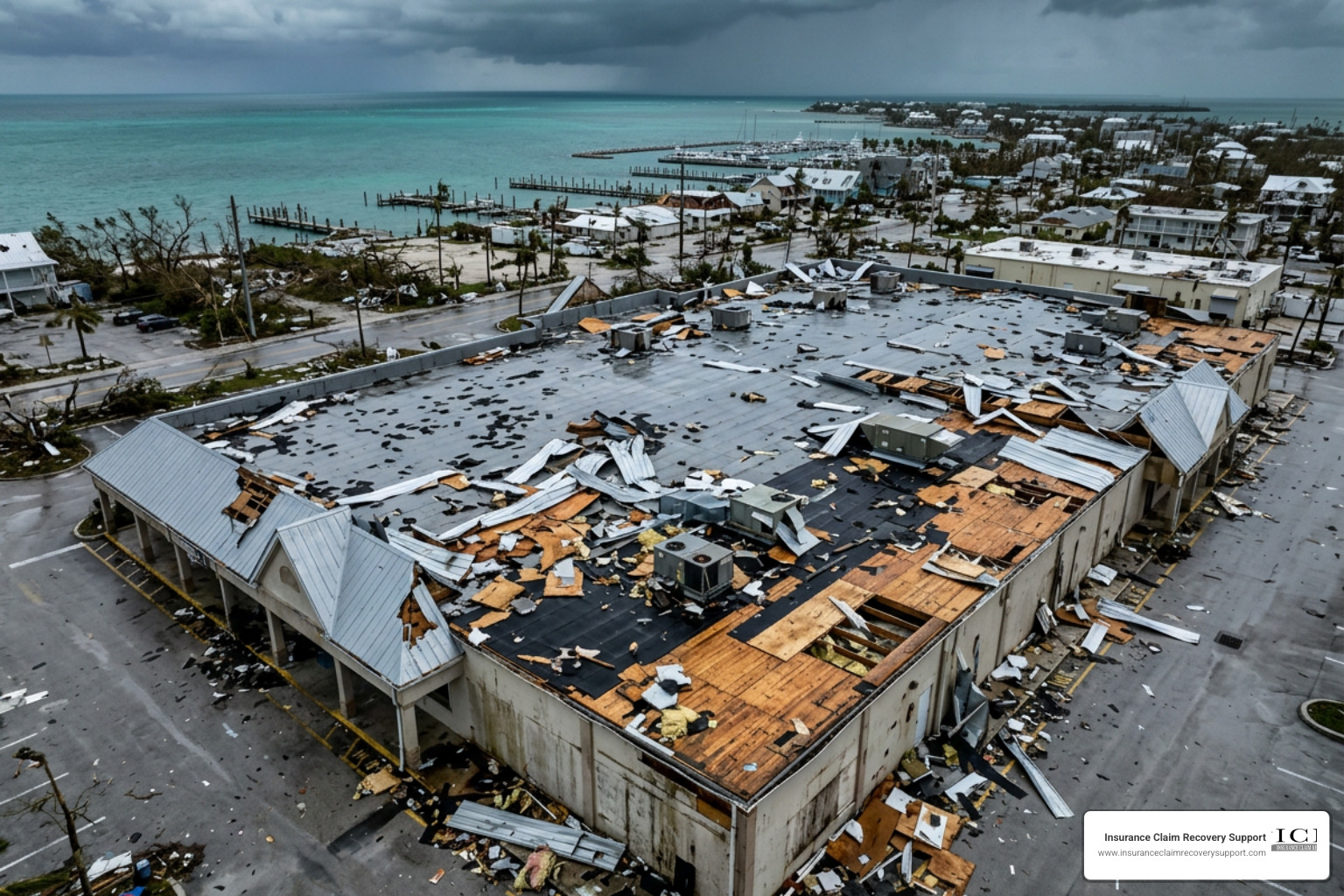
It is a common misconception that insurance companies exist to pay claims fully and promptly. In reality, major insurance corporations operate under a business model where denying, delaying, and underpaying claims is a calculated strategy to preserve capital. This “cost of doing business” model is particularly aggressive in high-risk zones like Key West, especially when dealing with high-value commercial and multifamily assets.
We have watched this play out nationwide. In early 2026, we saw systemic issues highlighted in the news, such as the State Farm $15.6M settlement over claim handling practices. This pattern of insurer scrutiny is not isolated to the Gulf Coast or Florida. For example, major media coverage including the NYT California wildfire insurance coverage has highlighted the growing national crisis of carriers pulling out of high-risk markets or severely limiting policyholder options.
Furthermore, the California Enforcement Action against State Farm and subsequent reports by The Guardian and CNN demonstrate how carriers systematically apply restrictive policy interpretations to avoid paying fair settlements after catastrophic events. When carriers apply these same high-pressure tactics to Key West commercial properties, the results can be financially devastating for property owners who try to negotiate alone.
Comparing Public Adjusters and Insurance Company Adjusters
To understand why you need an independent advocate, you must understand the inherent conflict of interest in the claims process:
Carrier-appointed adjusters are employees or independent contractors hired by your insurance provider. Their primary duty is to protect the insurance company’s financial interests. They accomplish this by looking for policy exclusions, reducing the scope of necessary repairs, and utilizing lowball estimating software.
Conversely, a licensed public adjuster has a fiduciary duty solely to you, the policyholder. We handle the policy interpretation, calculate the true cost of rebuilding to modern coastal codes, and negotiate directly with the carrier to secure a complete settlement.
To learn more about how these roles differ in practice, read our detailed breakdown on Public adjuster vs insurance company for property damage claim.
Navigating Florida Statutes and Key West Local Challenges
Key West commercial claims are governed by a complex web of Florida statutes, local building codes, and logistical realities that do not apply anywhere else. Navigating these rules requires a deeply experienced professional.
- Strict Timelines: Under Fla. Stat. 627.70131, insurance companies are held to specific response deadlines, including a 7-day acknowledgment of your claim, a 30-day window to conduct inspections, and a 60-day deadline to pay or deny the claim.
- Claim Filing Deadlines: Fla. Stat. 627.70132 establishes strict timelines for filing new, supplemental, or reopened claims. Missing these statutory deadlines can permanently forfeit your right to recover settlement funds.
- The Matching Statute: Fla. Stat. 626.9744 dictates that when undamaged portions of a property must be replaced to match repaired areas for aesthetic uniformity, the insurer must pay to replace the continuous run. This is a massive point of contention on commercial roofs and historic facades.
- Multi-State Expertise: While we are deeply integrated into Florida’s regulatory landscape, our multi-state footprint means we also bring advanced strategies from other strict jurisdictions. For example, we leverage our experience with Texas Statutes 541 and 542 (the Texas Prompt Payment of Claims Act) to hold carriers accountable to high standards of transparency and speed.
These statutory tools are vital when dealing with Key West’s unique local challenges. The historic Conch architecture in the Old Town historic district requires specialized, historic materials that must be approved by the Historic Architectural Review Commission (HARC).
Furthermore, because Key West is a remote barrier island, the high material and labor costs are compounded by the shipping logistics of trucking materials down the Overseas Highway. A standard mainland estimate will fall short of actual local construction costs every single time.
For a complete breakdown of Florida-specific insurance claim regulations, consult our Public adjuster Florida complete guide.
How to Choose the Right Key West Public Adjuster
Hiring the wrong adjuster can delay your claim and cost you thousands. When selecting a Key West public adjuster, ensure they meet the following professional criteria:
- Licensure Verification: Always verify their license with the Florida Department of Financial Services. For more details on licensing standards, see our Licensed public adjuster complete guide.
- Commercial Large-Loss Experience: Ask for case studies of commercial or multifamily claims they have successfully resolved that exceeded $250,000.
- Contingency Fee Structures: Reputable public adjusters work on a contingency basis, meaning there are zero upfront costs. Under Fla. Stat. 626.854, public adjuster fees are capped (typically at 10% during a declared state of emergency, and up to 20% for non-emergency claims). For a transparent look at how these fees work, read about Public adjuster fees and contingency structures.
Frequently Asked Questions about Key West Insurance Claims
Navigating a major commercial property claim in Monroe County is filled with legal and operational hurdles. To help you separate fact from carrier-driven fiction, we have compiled this guide to policyholder rights.
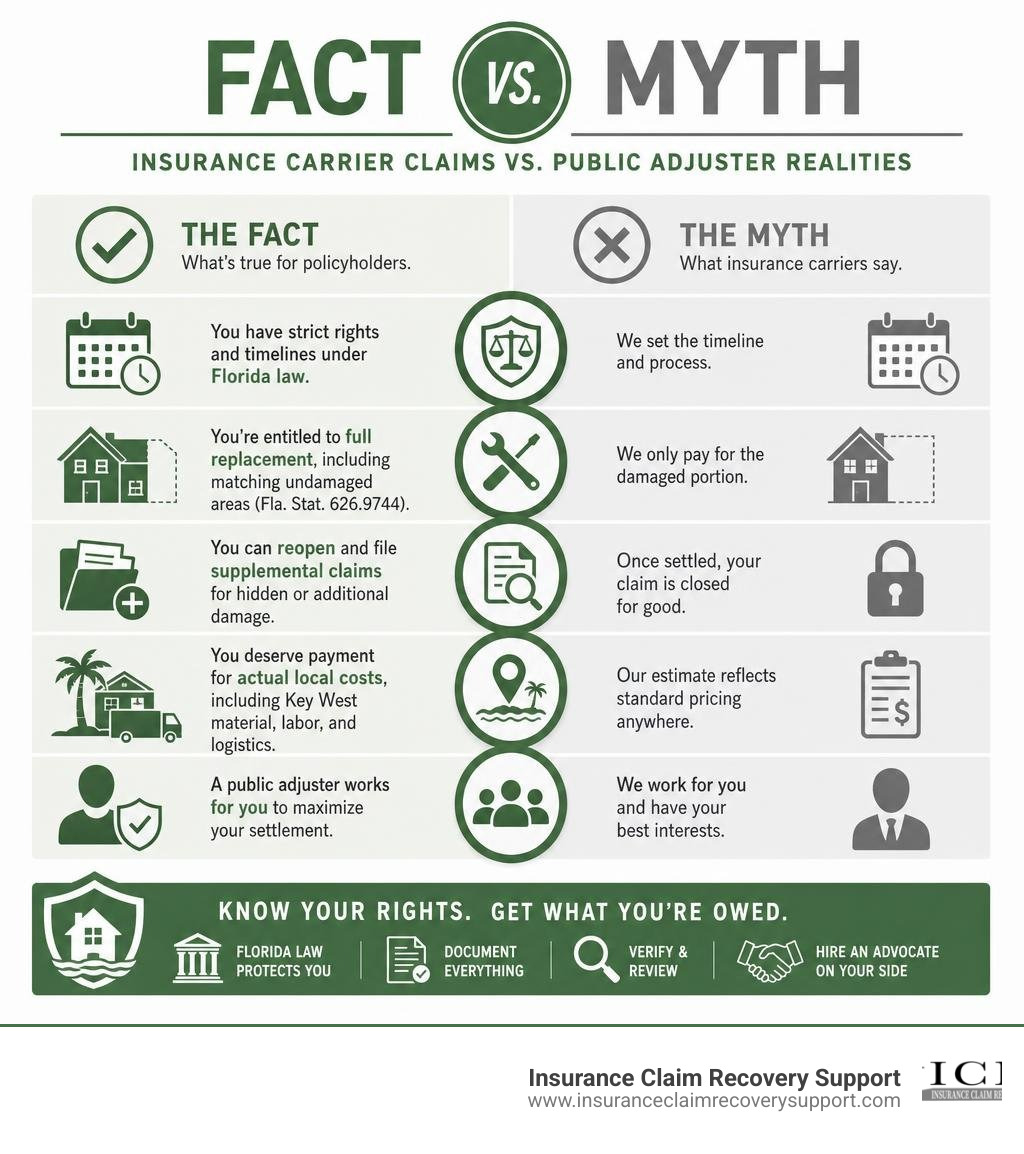
FAQ 1: Myth vs. Fact: Can I reopen a previously settled or underpaid commercial claim?
Myth: Once you accept and cash an initial settlement check from your insurance company, your claim is closed forever, and you cannot ask for more money.
Fact: You absolutely can reopen an underpaid or even a denied claim. Under Florida law, you can file a supplemental claim to recover the actual costs of repair if you discover hidden damage or if the initial settlement was insufficient to cover the work.
However, you must act within the strict statutory deadlines set by Fla. Stat. 627.70132. Our team specializes in reviewing closed files, identifying underpaid line items, and utilizing appraisal awards or strategic negotiations to secure the necessary funds to fully indemnify your business. To explore your options for reopening a claim, see our guide on More info about public adjuster services.
FAQ 2: Translation: What does the “Matching Statute” mean for historic Key West properties?
Translation Callout:
“When a loss requires replacement of items and the replaced items do not match in quality, color, or size, the insurer shall make reasonable repairs or replacement of undamaged items in adjoining areas to facilitate aesthetic uniformity.” — Fla. Stat. 626.9744
In plain English, if a hurricane damages 30% of your historic commercial building’s custom metal roof or unique siding, the insurance company cannot force you to patch it with mismatched, modern materials. Because Key West historic properties are highly regulated by local preservation boards, achieving aesthetic uniformity is a legal and structural necessity.
Under the matching statute, if matching historic materials are unavailable or if a patch would look mismatched, the carrier must settle the claim for the full replacement of the entire continuous area. We regularly hold carriers to this standard to protect the historic integrity and market value of Key West commercial assets.
FAQ 3: Myth vs. Fact: Will filing a major storm claim automatically cancel my commercial policy?
Myth: If my commercial property or HOA files a large-loss claim after a major hurricane, the carrier will immediately cancel our policy or raise our rates as a penalty.
Fact: Florida law strictly regulates when and how insurance carriers can non-renew or cancel policies. A carrier cannot cancel your policy mid-term simply because you filed a legitimate claim for storm damage.
While regional risk-pool pricing and overall market conditions in Monroe County do cause premiums to fluctuate across the board, trying to avoid a rate increase by hiding damage or under-claiming a major loss is a financial disaster. Your premium is already priced for the extreme risk of the Keys; if you suffer a loss, you must claim it to protect your investment.
Conclusion
Recovering from a catastrophic property loss in Key West requires more than just a contractor; it requires a sophisticated, legally grounded approach to your insurance claim. At Insurance Claim Recovery Support LLC (ICRS), we represent commercial property owners, multifamily operators, HOAs, and hospitality businesses with one single-minded goal: securing the full settlement you need to rebuild.
We specialize in maximizing settlements, reducing carrier-driven delays, and resolving complex claims with a 90% settlement success rate without resorting to unnecessary, expensive litigation. Our deep multi-state experience allows us to bring elite claim strategies directly to your Key West commercial property.
Do not let systemic carrier scrutiny dictate the future of your property. Schedule a free commercial claim consultation with our expert team today, and let us fight to protect your investment.