San Antonio Is One of the Most Flood-Prone Cities in North America — Here’s What Commercial Property Owners Need to Know
A flood in San Antonio can go from a clear sky to a catastrophic loss in a matter of minutes — and if you own or manage commercial or multifamily property here, that risk is not abstract. It is a recurring operational and financial reality.
Quick Answer: Key Facts About Flooding in San Antonio
| Question | Answer |
|---|---|
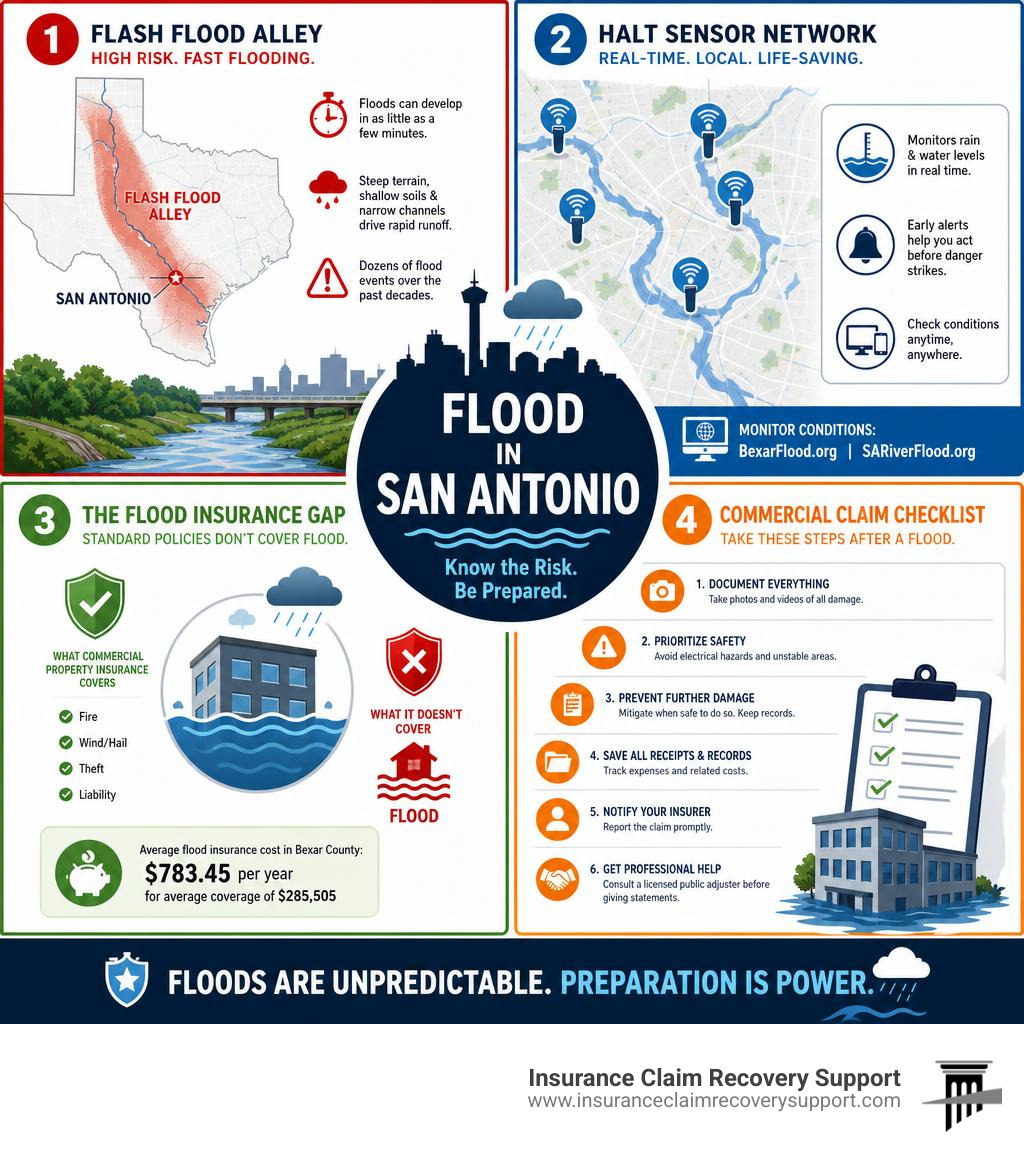
| Why does San Antonio flood so often? | Located in “Flash Flood Alley,” with steep terrain, shallow soils, and narrow river channels that produce rapid runoff |
| How fast can a flash flood develop? | In as little as a few minutes, even without visible rain nearby |
| Does standard commercial property insurance cover flooding? | ❌ No — flood damage requires a separate policy through the NFIP or private excess flood insurance |
| What is the average flood insurance cost in Bexar County? | $783.45 per year for average coverage of $285,505 |
| Where can I monitor flood conditions in real time? | BexarFlood.org, SARiverFlood.org, and the HALT sensor network |
| What should I do after my commercial property floods? | Document all damage immediately, avoid electrical hazards, and contact a licensed public adjuster before speaking with your carrier |
| Who oversees flood infrastructure in San Antonio? | The San Antonio River Authority, Bexar County, TxDOT, and the City of San Antonio |
San Antonio has recorded 129 flood events between 1993 and 2014 alone — resulting in 16 deaths, over 500 injuries, and nearly $15 million in property damage. And the threat has only grown more visible in recent years: the June 2025 Beitel Creek flood severely damaged commercial corridors and multifamily developments, accelerating a region-wide push to upgrade flood warning infrastructure. For commercial property owners, apartment operators, and institutional facilities managers, the question is not whether flooding will affect your property — it is whether you are financially and operationally prepared when it does.
I’m Scott Friedson, CEO of Insurance Claim Recovery Support (ICRS) and a multi-state licensed public adjuster with over 15 years of experience settling large-loss flood, wind, and business interruption claims for commercial and multifamily property owners across Texas — including properties directly impacted by a flood in San Antonio. Over 500+ claims exceeding $250 million in total value, I’ve seen how underprepared policyholders lose significant settlement value when they navigate the claims process alone.
Explore more about Flood in San Antonio:
Why Flash Flood Alley Makes a Flood in San Antonio a Constant Threat
San Antonio’s geography is a beautiful but dangerous paradox. The city sits directly on the edge of the Balcones Escarpment, a major geological transition zone where the flat Gulf Coastal Plains meet the rising rocky cliffs of the Edwards Plateau. This unique topography creates a perfect storm for extreme weather events.
When warm, moisture-laden air from the Gulf of Mexico travels inland, it collides with the elevated Balcones Escarpment. This triggers a process called orographic lifting, forcing the moist air rapidly upward into the cooler atmosphere. The result is sudden, concentrated, and torrential downpours directly over the San Antonio River Basin.
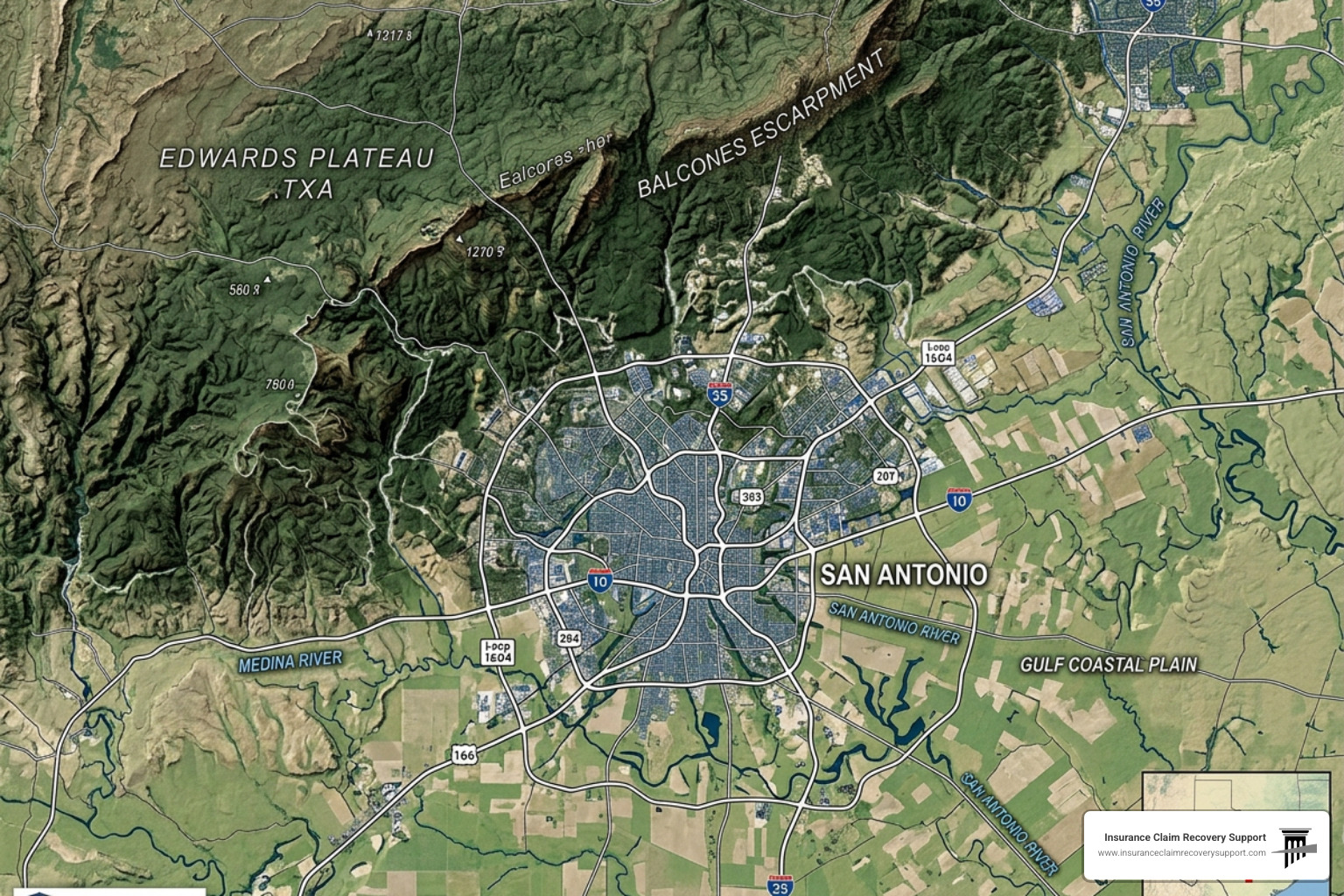
Compounding the problem are the region’s steep terrain and incredibly shallow soils. Unlike parts of the country with deep, sandy soil that absorbs rainfall like a sponge, the rocky terrain of the Texas Hill Country cannot absorb heavy rainfall. Instead, water immediately sheets off the hillsides and rushes into narrow, winding river channels and dry creek beds, transforming them into raging torrents within minutes.
Geography and History of the San Antonio River Basin
The history of San Antonio is defined by its relationship with water. While the San Antonio River fueled the city’s early economic rise, it has also repeatedly demonstrated its destructive potential:
- The September 1921 Flood: This remains the benchmark disaster for the region. The remnants of a Category 1 hurricane stalled over Texas, dumping historic amounts of rain. In Thrall, Texas, just northeast of Austin, an astonishing 38.2 inches of rain fell in 24 hours. In San Antonio, the river rose rapidly, drowning downtown in up to 12 feet of water. The catastrophe claimed 215 lives and caused $19 million in property damage—an amount equivalent to over $340 million today.
- The October 1998 Flood: Known as the wettest month in San Antonio’s climate history since 1885, October 17, 1998, saw a massive storm system dump 10 to 19 inches of rain across South Central Texas. The flood caused 11 deaths in Bexar County, forced 192 high-water rescues that saved 461 people, and generated over $115 million in public and private property damages. Municipal crews collected 480 tons of debris from 576 miles of local streets.
- The May 2013 Flood: A sudden, localized flash flood produced record rainfall of 9.87 inches at San Antonio International Airport, while some regional gauges recorded 17 inches in just 24 hours. The storm caused two fatalities, destroyed or severely damaged hundreds of homes, and cost millions in commercial structural repairs.
- The June 2025 Beitel Creek Flood: This recent disaster served as a stark reminder of our vulnerability, inundating commercial plazas and multifamily complexes, prompting local governments to rapidly overhaul warning systems.
Flash Flood in San Antonio vs. Overland Flooding
For commercial real estate owners, understanding the type of water threat you face is critical for risk mitigation and emergency response planning.
| Characteristic | Flash Floods | Overland Flooding |
|---|---|---|
| Speed of Onset | Rapid (minutes to hours) | Gradual (hours to days) |
| Primary Cause | Intense, heavy rainfall over a short duration | Sustained rainfall, rising river basins, or structural failures |
| Water Velocity | Extremely high, erosive, and violent | Low to moderate, slow-moving |
| Predictability | Low; can occur with little to no warning | High; tracked via river gauges and weather forecasting |
| Primary Structural Hazard | Hydrodynamic pressure, foundation scouring, debris impact | Hydrostatic pressure, prolonged saturation, mold growth |
In San Antonio, flash flooding is the dominant threat. Because flash floods develop so quickly, they catch property managers off guard. Just six inches of fast-moving water can compromise building envelopes, and 12 inches of water can easily inundate ground-floor commercial spaces and damage heavy mechanical equipment. When floodwaters rise, they don’t just wet the carpet—they exert immense hydrodynamic force that can collapse masonry walls, scour building foundations, and render commercial structures permanently unsafe.
Municipal Infrastructure and Real-Time Flood Warning Systems
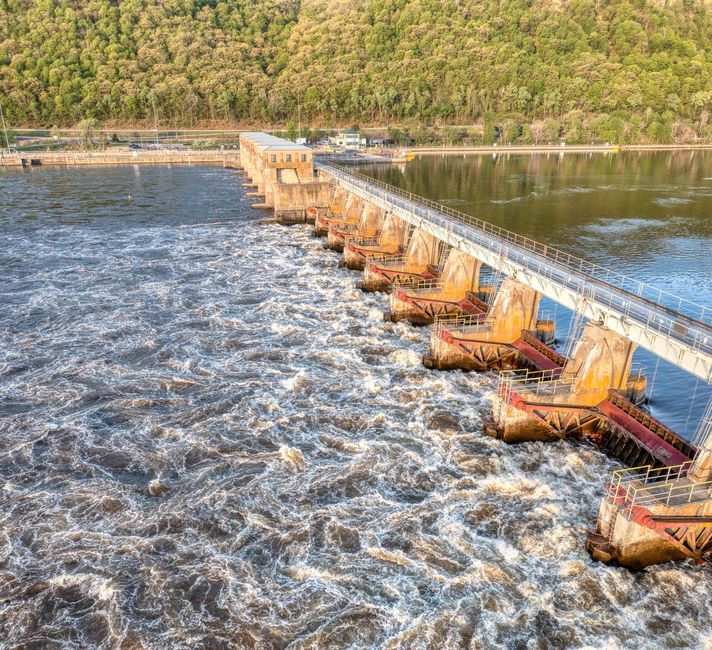
To combat this existential threat, San Antonio has spent over a century engineering massive flood control systems. Following the catastrophic 1921 disaster, the city constructed the Olmos Dam in 1927 to hold back water flowing toward downtown.
In 1997, the city completed an engineering marvel: the San Antonio River Flood Tunnel. This 24-foot-diameter, 3-mile-long underground bypass tunnel runs 150 feet beneath downtown. Working alongside the Olmos Dam, the tunnel acts as a giant drain, diverting massive volumes of floodwater safely underneath the city’s famous River Walk and discharging it further downstream. This system successfully saved downtown San Antonio from devastating inundation during the record-breaking 1998 storm.
The Role of the San Antonio River Authority and HALT Sensors
While major dams and tunnels protect the urban core, outlying commercial districts, retail plazas, and industrial parks rely heavily on active monitoring. The San Antonio River Authority (SARA) serves as a Cooperating Technical Partner with FEMA, continuously updating floodplain maps and maintaining regional drainage systems.
To keep drivers and property managers informed, Bexar County developed the HALT (High-Water Alert Lifesaving Technology) sensor network. Currently, there are 198 flood warning and gauge locations across Bexar County, with 170 active NextGen systems connected to real-time networks. By visiting BexarFlood.org or SARiverFlood.org, commercial operators can monitor rising water levels at critical low-water crossings in real time and subscribe to automated text alerts.
NextGen Flood Gates and Low-Water Crossings
Despite warning signs, drivers frequently bypass barricades. To eliminate human error, Bexar County has begun installing automated, railroad-style NextGen flood gates at high-risk crossings. These gates use upstream water sensors to automatically lower heavy barriers and activate flashing lights when water rises.
A prime example is the planned upgrade at Pinn Road near Leon Creek. This area, along with West Commerce Street, is a notorious hotspot for high-water rescues. During heavy rains, the San Antonio Fire Department (SAFD) routinely deploys to rescue stranded motorists here.
Even major thoroughfares are not immune. The lower level of I-35 in downtown San Antonio frequently floods during severe storms, disrupting critical commercial logistics and transport corridors. To manage this, TxDOT currently spends roughly $14,000 per month renting temporary pumps because the original 1990s drainage infrastructure cannot handle even a minor two-year storm event. Relief is on the horizon: TxDOT has allocated funding for a $22 million permanent pump replacement project, with construction scheduled to begin in early 2027 to protect this critical logistical corridor.
Commercial Property Safety and Emergency Protocols
For commercial, industrial, and multifamily property owners, preparing for a flood in San Antonio is a legal and financial necessity. Mitigating physical damage and ensuring tenant safety requires proactive planning before the clouds roll in.
Proactive Risk Assessment and Emergency Protocols
- Analyze Your True Risk: Do not rely solely on historical patterns. Review the draft floodplain maps on the River Authority’s Digital Data and Modeling Repository (D2MR) website. That when new maps are published, a 90-day appeal period allows property owners to challenge designations before they become federally binding.
- Protect Vulnerable Systems: Elevate mechanical, electrical, and plumbing (MEP) systems. Ensure that backup generators, HVAC units, and main electrical panels are elevated well above the local base flood elevation.
- Install Backflow Prevention: Install heavy-duty check valves in sewer lines to prevent contaminated municipal floodwater from backing up through drains and toilets into your ground-floor units.
- Draft a Business Continuity Plan: Ensure you have physical and digital off-site backups of all operational records. Standardize emergency evacuation routes and secure temporary staging areas for tenants.
Post-Flood Safety and Environmental Hazards
Once the water recedes, the immediate danger is not over. Entering a flooded commercial building requires extreme caution:
- De-energize Safely: Never enter a flooded space until you are 100% certain the electrical power has been shut off at the main breaker. Water conducts electricity, and standing in wet areas with active circuits can be fatal.
- Contaminated Water Hazards: Floodwaters in San Antonio often carry municipal sewage, chemical runoff from industrial parks, and animal waste. Ensure your maintenance crews wear heavy-duty work gloves, protective suits, and puncture-resistant boots.
- Secure the Building Envelope: Document the structural damage before starting any cleanup. Take high-resolution photos of standing water lines, buckled drywall, and warped flooring.
Navigating Commercial Property Damage Claims After a Flood
When a commercial or multifamily property sustains heavy water damage, the financial survival of your investment depends on how you navigate the insurance claim.
First, understand that standard commercial property insurance policies strictly exclude flood damage. To be indemnified for rising water, you must carry a separate policy through the National Flood Insurance Program (NFIP) or secure private excess flood insurance.
In Bexar County, the average annual NFIP premium is $783.45, providing an average of $285,505 in coverage for buildings and contents. For commercial properties worth millions, this basic coverage is a drop in the bucket. Commercial owners must secure private excess flood insurance to fully protect their physical assets and offset business interruption losses. Navigating these complex multi-layered policies is highly challenging, making it crucial to understand how property damage insurance claims in the insurance industry are actually evaluated.
Policy Interpretation and Texas Insurance Code Statutes 541 and 542
In Texas, commercial policyholders are protected by robust consumer laws, but you must know how to leverage them.
- Texas Insurance Code Chapter 541 (Bad Faith): This statute prohibits insurance companies from engaging in unfair claim settlement practices. If your carrier misrepresents policy provisions, fails to attempt a fair settlement in good faith, or unreasonably delays payment, they may be operating in bad faith. Learn more about your rights under a bad faith insurance claim Texas.
- Texas Insurance Code Chapter 542 (Prompt Payment of Claims Act): This law establishes strict timelines for carriers. Once you file a claim, the insurer has 15 days to acknowledge it, begin an investigation, and request necessary documentation. After receiving your proof of loss, they must accept or reject the claim within 15 business days. If they delay payment unreasonably, they face statutory interest penalties plus attorney fees. The property damage statute of limitations Texas when planning legal actions.
One of the most common battlegrounds in a San Antonio flood claim is the “Wind vs. Water” dispute. If a severe thunderstorm rips off a section of your commercial roof, allowing rain to pour in (windstorm damage), and simultaneously floods the ground floor from rising creek water (flood damage), your carrier will try to attribute all interior damage to the excluded flood policy. Disentangling these concurrent causes requires expert policy interpretation and forensic engineering.
Environmental Hazards, OSHA Protocols, and Dry Log Records
To ensure your commercial property is legally habitable and safe for tenants, you must strictly adhere to environmental safety standards:
- OSHA Compliance: Cleanup crews must operate under OSHA safety guidelines, particularly regarding hazardous materials and personal protective equipment (PPE).
- Industrial Hygienists: For claims exceeding $250,000, you should hire an independent industrial hygienist to test for mold, asbestos, and bacterial pathogens before tear-out begins.
- Moisture Surveys & Dry Logs: Insurance adjusters will try to minimize your water damage. You must counter their lowball estimates with comprehensive moisture surveys and daily “dry logs” recorded by certified mitigation contractors. These records prove how deep the moisture traveled into the building’s structural framing and drywall.
To successfully manage this mountain of evidence, you must learn property damage insurance claims and how to survive the paperwork tsunami to prevent your carrier from underpaying your claim.
Systemic Insurer Scrutiny and the Cost of Doing Business Model
In the commercial insurance sector, major carriers do not operate as charitable institutions. Increasingly, they view claim denials, delays, and underpayments as a viable “cost of doing business” model. By systematically disputing clear-cut damage on commercial and multifamily assets, insurers hold onto their capital longer, forcing commercial policyholders into accepting lowball settlements out of financial desperation. To understand the scale of this issue, read about why insurance companies delay deny and dispute claims on purpose.
This systemic scrutiny is a nationwide trend affecting large-loss commercial and multifamily property claims. For instance, State Farm recently agreed to a $15.6 million settlement in the South Central region over allegations of improper claim handling, as detailed in the Insurance Journal report.
Similar patterns of carrier pushback and widespread regulatory scrutiny have emerged across the country, as highlighted in the NYT article regarding wildfire coverage. This led to a formal California Enforcement Action addressing severe wildfire claim violations, a situation widely covered by national media outlets including The Guardian and CNN. While these Western cases involve wildfires, the underlying operational model remains identical for commercial and multifamily operators: when disaster strikes, carriers systematically scrutinize, delay, and attempt to underpay massive property claims to protect their bottom lines as part of their standard cost of doing business.
Adjuster Licensing Gaps and Under-Scoped Estimates
When a widespread flood in San Antonio occurs, local insurance adjusters are immediately overwhelmed. To cope, insurance companies flood the market with out-of-state “catastrophe adjusters.”
Many of these adjusters lack proper licensing in Texas, possess little understanding of local commercial construction costs, and are pressured by their employers to close claims as cheaply as possible. They frequently produce highly under-scoped repair estimates that fail to account for local labor rates, commercial building codes, or proper environmental remediation. Commercial policyholders must remain vigilant against these 8 sneaky tricks insurance companies use to underpay and delay your claim.
Resolving Disputes: Appraisal Awards vs. Litigation
If your carrier refuses to offer a fair settlement, you have two primary paths to resolve the dispute:
- The Appraisal Clause: Most commercial policies contain an appraisal clause designed to resolve disputes over the amount of loss (not coverage disputes). If invoked, you and your carrier each hire an independent appraiser, and an appraisal umpire is selected. An agreement between any two of these three parties results in a binding appraisal award. This process is generally faster than court, but it cannot resolve legal questions about what is actually covered.
- Litigation: If your carrier has acted in bad faith or denied coverage outright, you may need to file a lawsuit. However, litigation is costly and time-consuming. In states like Florida, skyrocketing litigation costs have reshaped the entire insurance landscape. Before heading to court, ask yourself: can you sue your insurance company and win?
Additionally, many commercial owners worry about the long-term consequences of fighting back. If you are concerned about being dropped or facing massive rate hikes, read our analysis on will your insurance company drop you or increase your premium after you file a property damage claim?
Frequently Asked Questions About San Antonio Flood Claims
Fact vs. Myth: Does Standard Commercial Property Insurance Cover Flood Damage?
Myth: “My commercial property policy covers water damage, so I’m protected if Leon Creek overflows into my ground-floor retail space.”
Fact: Standard commercial property policies explicitly exclude flood damage, defined as surface water, waves, tidal water, or the overflow of any body of water.
Translation: To protect your real estate assets from rising water, you must secure a dedicated NFIP or private excess flood policy. Be aware of coinsurance penalties—if you underinsure your building’s total value, the carrier can legally penalize you by paying only a fraction of your actual loss.
What is the Difference Between a Public Adjuster and an Insurance Company Adjuster?
The Difference: An insurance company adjuster is employed directly by your insurance carrier. Their primary fiduciary duty is to protect the insurer’s financial interests and minimize payout. A public adjuster is a licensed professional hired exclusively by you, the policyholder.
Translation: We work solely for you, conducting independent forensic damage assessments, calculating the true cost of repairs, and negotiating directly with the carrier to secure a fair settlement. For commercial and multifamily claims exceeding $250,000, having an experienced advocate manage the claim is essential to prevent severe underpayment.
Why Do Insurance Companies Delay, Deny, and Dispute a Flood in San Antonio?
The Reality: Insurers use delay tactics to exhaust your financial reserves, hoping you will accept a lowball settlement to get your business back up and running.
Translation: They will dispute whether water damage was caused by wind-driven rain or rising floodwaters, claim your building had “pre-existing wear and tear,” or drag out the claims process for months. If your carrier is acting unreasonably, you can take action and file a complaint against your insurance company with the Texas Department of Insurance.
Conclusion
Recovering from a major flood in San Antonio requires more than just a cleanup crew—it demands professional claim representation. When your commercial building, apartment complex, or industrial facility suffers catastrophic water damage, you cannot afford to rely on your insurance company’s adjuster to calculate your losses.
At Insurance Claim Recovery Support LLC (ICRS), we specialize in maximizing settlements, reducing delays, avoiding costly litigation, and resolving complex commercial property claims. We maintain a 90% settlement success rate without resorting to unnecessary lawsuits. As a Texas-based firm serving San Antonio, Austin, Houston, and Dallas-Fort Worth, we advocate exclusively for commercial building owners, professional property managers, and multifamily operators.
If your property has been affected by a storm or flood, don’t let the carrier underpay your claim. Schedule a consultation for Texas flood claims with our team of licensed public adjusters today, and let us protect your investment.