When a Storm Hits Your Commercial or Multifamily Property, the Claims Process Is Already Working Against You
A storm damage insurance adjuster is the professional who determines how much your insurer pays after severe weather strikes your property — and understanding who they work for, and how they work, could be the difference between a fair settlement and a shortfall that costs you hundreds of thousands of dollars.
For a companion claim-documentation resource, see the ICRS Hail & Wind Claim Guide. Coverage and next steps depend on the facts and policy terms.
Here’s what you need to know right now:
| Question | Quick Answer |
|---|---|
| What does a storm damage insurance adjuster do? | Inspects damage, interprets your policy, and recommends a settlement amount to your insurer |
| Who does the insurance company’s adjuster work for? | The insurance company — not you |
| What types of adjusters exist? | Company (staff) adjusters, independent adjusters, and public adjusters |
| Who works for you? | Only a licensed public adjuster represents your interests |
| When should you hire a public adjuster? | On any commercial or multifamily claim exceeding $250K |
| What’s the biggest risk without one? | Underpayment, missed coverages, and a settlement that doesn’t reflect your actual loss |
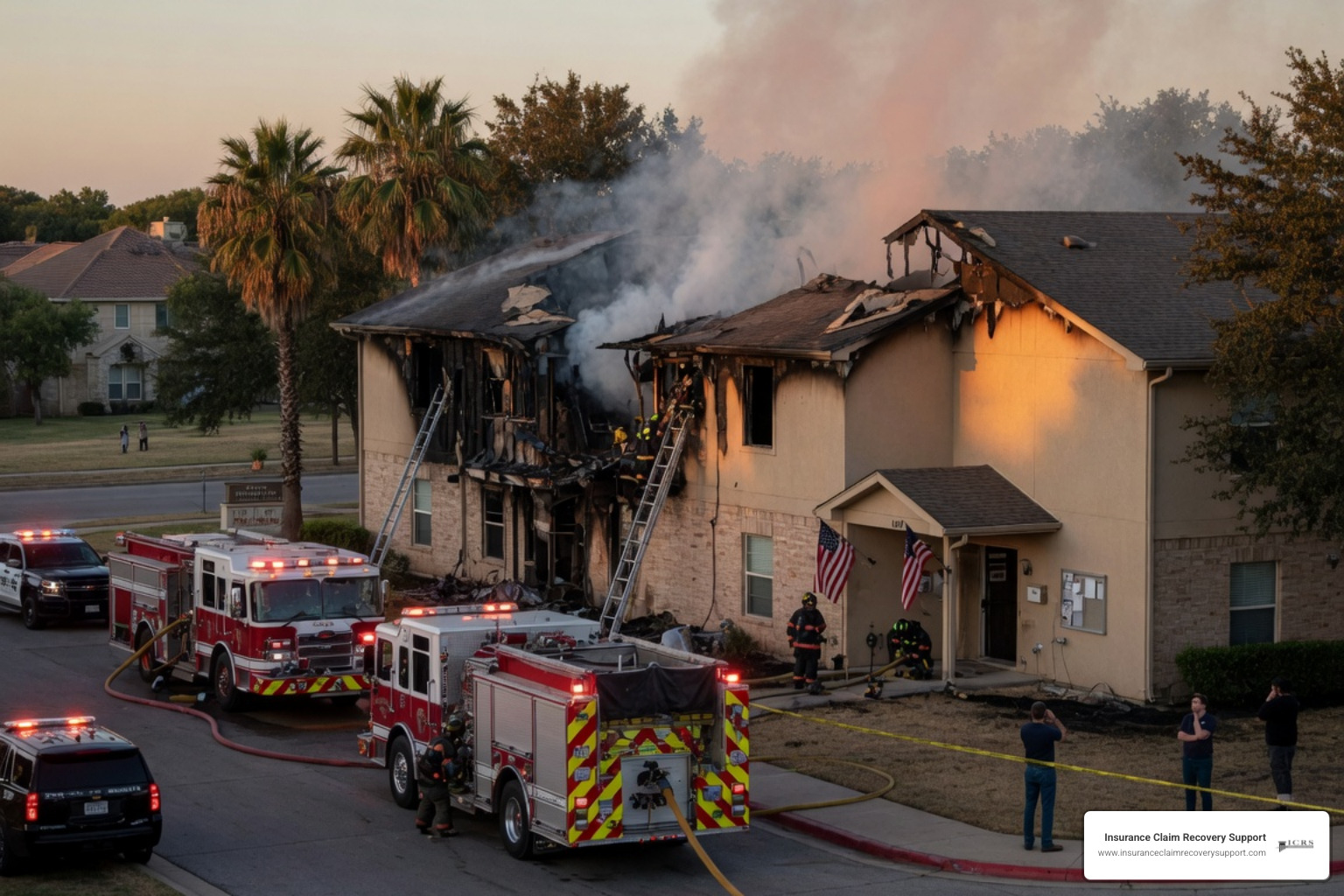
If you own or operate commercial real estate — apartment complexes, retail centers, office buildings, HOAs, hotels, churches, or industrial facilities — the stakes after a major storm are enormous. Severe convective storms caused more than $30 billion in insured losses in just the first six months of 2024 alone, generating 13 separate billion-dollar claim events from wind, hail, and tornado damage. Yet despite the scale of these losses, the number one consumer complaint reported to the National Association of Insurance Commissioners remains one consistent theme: insurance companies delaying claim payment.
The uncomfortable truth is that the claims process is not a neutral one. The adjuster who shows up at your property after a storm is typically working to protect the insurer’s bottom line — not yours. For commercial and multifamily property owners managing tenant pressure, lender requirements, and revenue disruption, an underpaid or delayed claim isn’t just an inconvenience. It’s a business crisis.
I’m Scott Friedson, a multi-state licensed public adjuster and CEO of Insurance Claim Recovery Support (ICRS), and over the course of more than 500 large-loss storm damage insurance adjuster claims totaling over $250 million, I’ve seen how quickly a legitimate commercial claim can be minimized, delayed, or wrongfully denied. This guide will walk you through exactly how the claims process works, where it typically breaks down for commercial and multifamily policyholders, and what you can do to protect your settlement from the moment the storm passes.
The Role of a Storm Damage Insurance Adjuster in Commercial Claims

When severe weather damages a commercial property or multifamily asset, the insurance company assigns an adjuster to evaluate the loss. While the title “adjuster” sounds objective, the reality is that different adjusters serve entirely different masters.
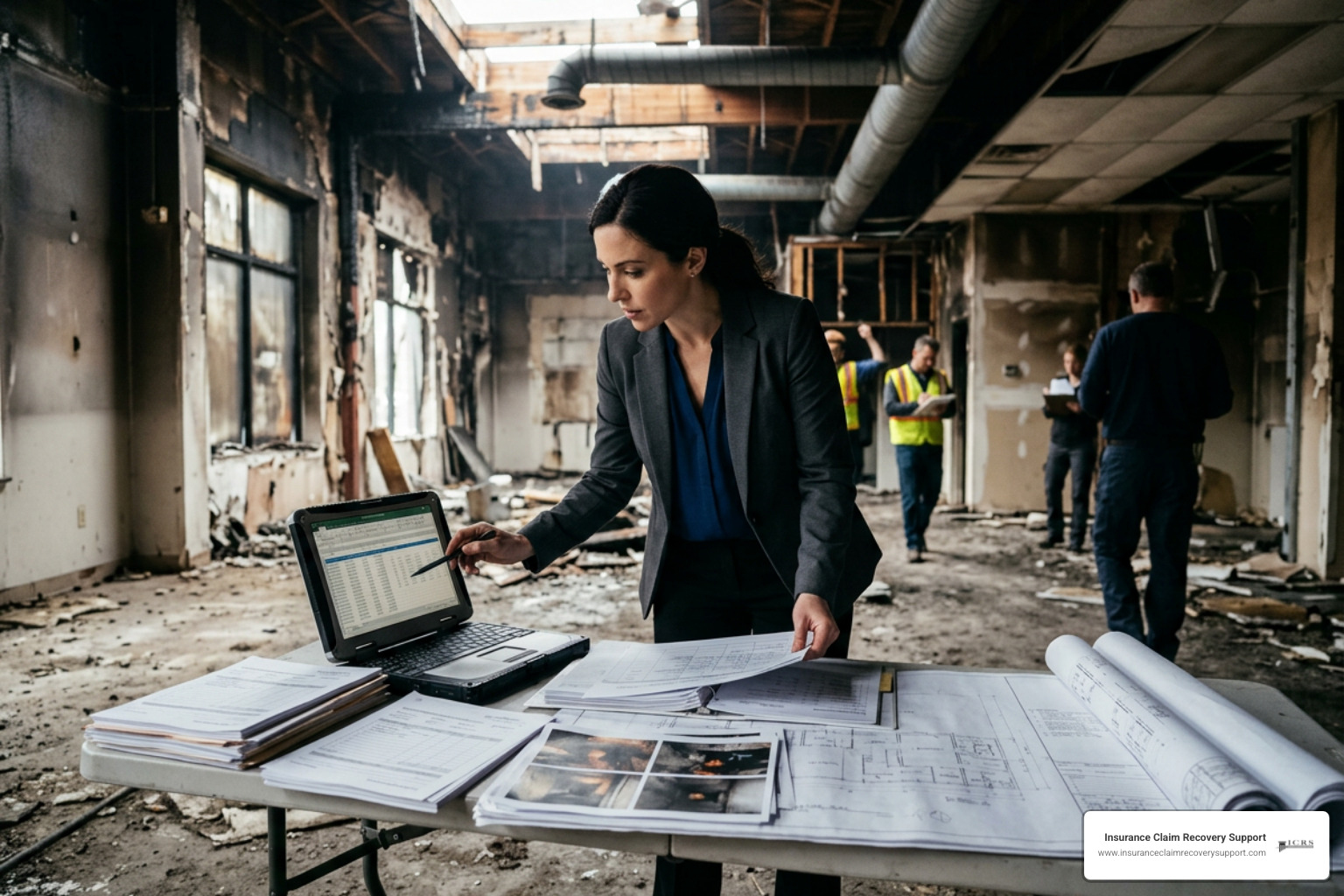
A commercial or multifamily claim is vastly more complex than a standard single-family home claim (which our firm does not handle). It involves massive square footage, specialized roofing systems, complex HVAC configurations, tenant displacement, and business interruption calculations. The storm damage insurance adjuster sent by the insurance carrier is tasked with inspecting the physical damage, interpreting the policy’s complex terms, exclusions, and endorsements, and recommending a financial figure to indemnify the loss.
Because commercial policies are highly customized legal contracts, policy interpretation is where the real battle begins. Every word, comma, and exclusion is subject to scrutiny. If you rely solely on the carrier’s assessment, you are essentially letting the opposing team’s referee call the game.
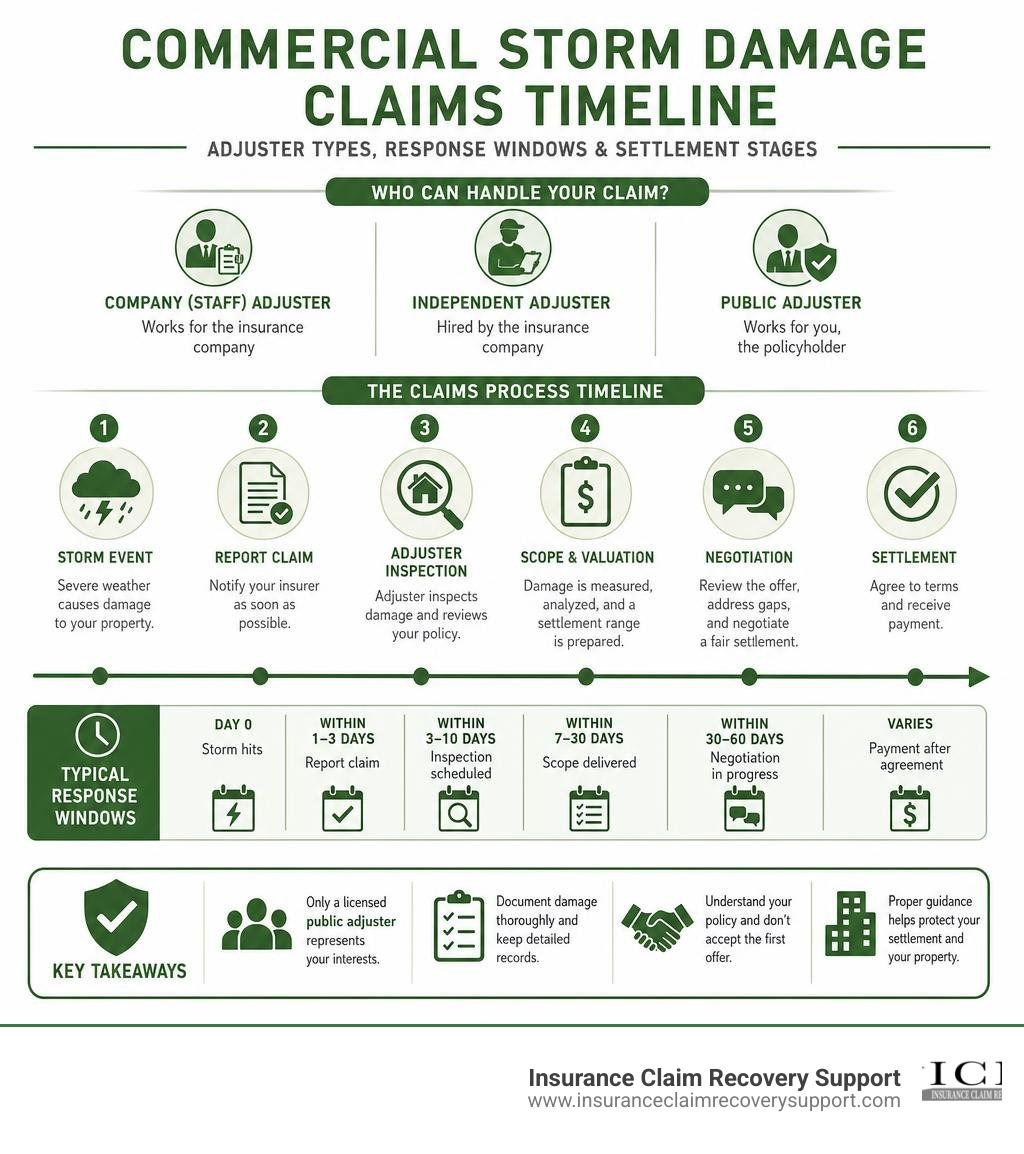
Carrier Adjusters vs. The Independent Storm Damage Insurance Adjuster
It is critical to distinguish between the professionals who may knock on your door after a catastrophe.
- Company (Staff) Adjusters: These are salaried employees of the insurance company. Their primary loyalty is to their employer, and they are trained to apply carrier-specific guidelines to limit the company’s financial exposure.
- Independent Adjusters: These adjusters do not work for a single insurance company; instead, they are third-party contractors hired by insurers to handle high-volume catastrophe response. While “independent” sounds neutral, they are paid by the insurance company. If they consistently recommend high settlements, they risk losing future contracts from the carrier. Furthermore, during widespread weather events, independent adjusters face severe licensing gaps and may lack the specialized expertise needed to evaluate complex commercial structural systems.
- Public Adjusters: These are licensed professionals who work exclusively for you, the policyholder. We do not work for insurance companies. Our job is to identify, document, and negotiate your claim to ensure you receive every dollar your policy promises.
| Feature | Company Adjuster | Independent Adjuster | Public Adjuster |
|---|---|---|---|
| Who Pays Them? | The Insurance Carrier | The Insurance Carrier | The Policyholder (Contingency) |
| Whose Interests Do They Represent? | The Insurance Carrier | The Insurance Carrier | The Policyholder Only |
| Primary Goal | Minimize claim payouts | Process claims quickly for the carrier | Maximize and secure a fair settlement |
| Methodology | Standardized, high-speed guidelines | High-volume, rapid field assessments | Forensic, detail-oriented documentation |
Why Claims Over $250K Require a Public Storm Damage Insurance Adjuster
If your commercial building or multifamily asset has sustained damage estimated at over $250,000, managing the claim yourself is a massive risk. Large-loss claims require hundreds of hours of detailed documentation, structural engineering reviews, and policy analysis.
Multifamily operators and commercial building owners simply do not have the time or specialized software (such as Xactimate) to build an indisputable, line-item proof of loss. Carrier adjusters are incentivized to move quickly, often overlooking hidden structural compromises, micro-cracks in roofing membranes, or complex electrical issues. Partnering with a public adjuster early in the process ensures that you have an expert advocate who can match the insurer’s resources blow-for-blow. For a deeper dive into how this protection works, read our Public Adjuster Storm Damage Complete Guide.
Systemic Insurer Tactics and the Cost of Doing Business Model
Over the past several years, property insurance companies have increasingly adopted a “cost of doing business” model for commercial and multifamily assets. Instead of promptly investigating and paying claims in good faith, many carriers systematically delay, underpay, or deny valid commercial claims. They know that a percentage of policyholders will simply give up, accept a lowball offer, or settle for a cheap patch repair out of sheer exhaustion.
On average, policyholders wait 2.3 days just to get a callback from an agent, and an additional 3 to 5 days (or longer) for an adjuster to visit the property. In a major disaster, these delays stretch into weeks or months. According to the National Association of Insurance Commissioners, the number one consumer complaint is insurance companies delaying claim payments.
To combat these tactics, states like Texas have enacted statutory protections. Texas Statutes 541 and 542 (the Texas Prompt Payment of Claims Act) establish strict timelines for insurers to acknowledge, investigate, and pay claims, imposing statutory interest penalties on carriers that drag their feet. In other regions, like Florida, shifting litigation costs have made the claims environment highly adversarial.
This systemic behavior is drawing massive regulatory and media scrutiny nationwide. For example, major carriers have faced heavy scrutiny for structural delays and claim-handling violations following natural disasters. This pattern of behavior has been widely documented in major publications, including the NYT California article detailing the insurance crisis, and reports by The Guardian and CNN on post-disaster claim handling. Furthermore, the California Enforcement Action highlights regulatory efforts to address these systemic delays. In other cases, policyholders have had to fight all the way to court to get what they were owed, as demonstrated by the landmark State Farm $15.6M settlement where systemic underpayment was exposed.
Policy Interpretation and the “Patch vs. Replacement” Dispute
One of the most common battlegrounds in a storm claim is the “patch vs. replacement” dispute. After a major hail or wind event, the carrier’s storm damage insurance adjuster will often argue that a commercial roof only requires minor, localized repairs (patches) rather than a full replacement.
Carriers frequently rely on cosmetic exclusions, arguing that hail dents on metal roofs or commercial HVAC units are merely “aesthetic” and do not impact structural integrity. However, hail impacts compromise the protective coatings of building materials, leading to premature failure, hidden leaks, and structural degradation over time.
Understanding the nuances of Roof Storm Damage Insurance is vital. If your carrier is trying to force a cheap patch on a roof that requires full replacement, a Hail Damage Public Adjuster can step in to prove the structural necessity of a complete rebuild using forensic testing and manufacturer specifications.
Critical Post-Storm Steps for Commercial and Multifamily Policyholders
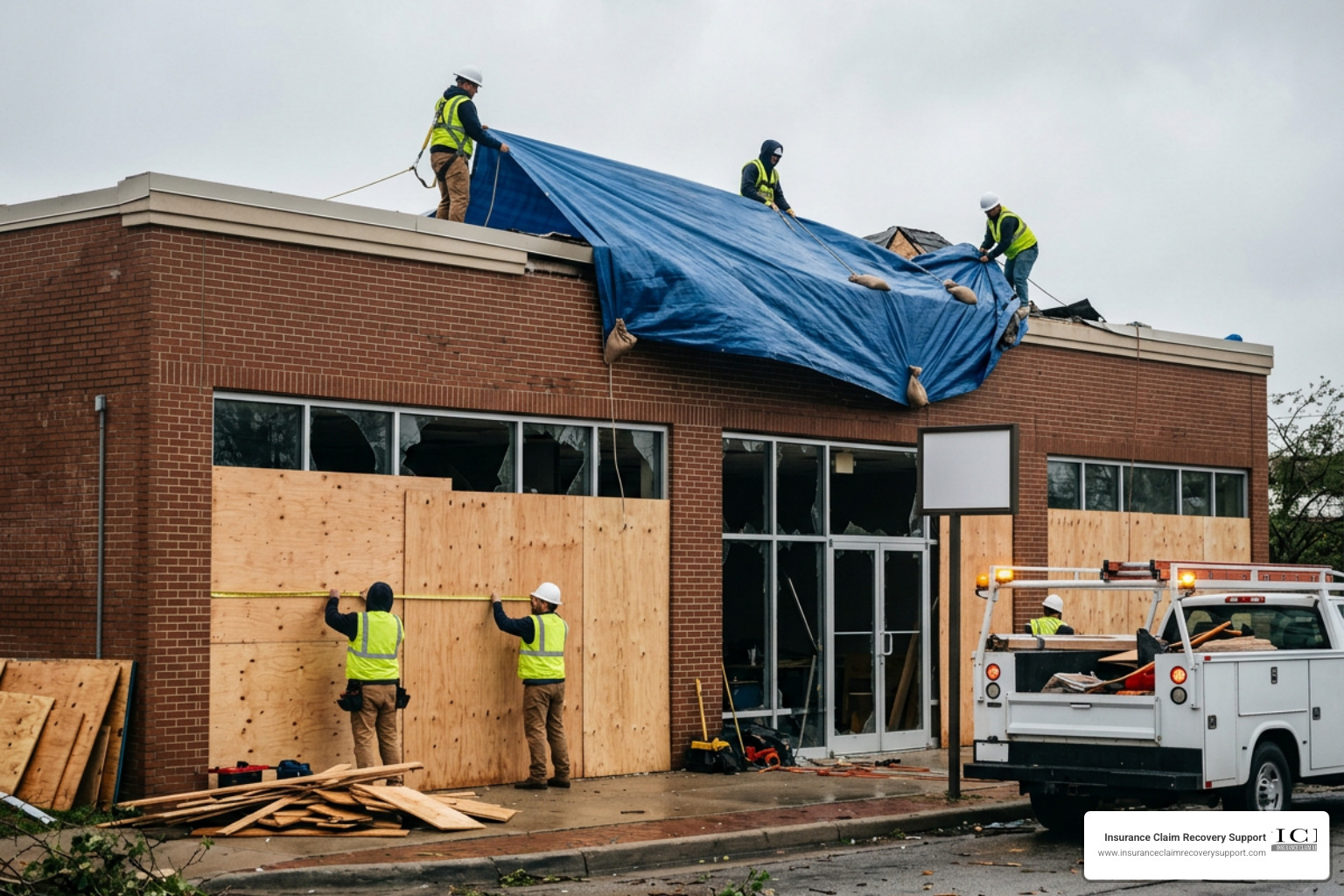
What you do in the first 48 hours after a storm can make or break your claim. To secure full indemnification, commercial and multifamily operators must act quickly, methodically, and safely.
- Prioritize Safety and Mitigate Damage: Your policy requires you to take reasonable steps to prevent further damage. This means putting up temporary tarps, boarding up broken windows, or hiring professional water extraction teams. Keep detailed receipts of every penny spent on emergency mitigation.
- Maintain Strict Dry Log Records: If water has entered your building, maintain a daily “dry log” tracking relative humidity, moisture levels, and temperature. This prevents the carrier from claiming that subsequent mold growth was due to your failure to mitigate.
- Address Environmental Hazards Safely: Commercial properties are subject to strict OSHA standards. Before starting any demolition or cleanup, you must account for asbestos and mold protocols. Hire licensed industrial hygienists to test the air quality and building materials. If your carrier pressures you to skip these steps to save money, they are asking you to violate federal safety laws.
- Avoid Contractor Scams and Illegal Deductible Waivers: After a major storm, out-of-state “storm chasers” flood the area. Many will offer to “waive your deductible” or promise rebates. Be warned: under Texas law, it is illegal for a contractor to waive or rebate an insurance deductible. Doing so can invalidate your claim and expose both you and the contractor to criminal insurance fraud charges. Always verify licensing, request local references, and never sign over your insurance rights via an Assignment of Benefits (AOB) contract without legal counsel. For more information on navigating these post-storm challenges, visit our guides on Texas Storm Damage and Dallas Fort Worth Storm Damage.
Documenting the Loss to Secure Full Indemnification
To defeat a carrier’s denial, you must compile irrefutable, scientific evidence. Do not rely on basic smartphone photos alone. Secure your settlement by leveraging:
- Thermal Imaging (Infrared): Detects hidden moisture trapped beneath commercial roofing membranes and inside drywall layers that the naked eye cannot see.
- Forensic Engineering: Professional structural engineers can document uplift damage, foundation shifting, and micro-fractures caused by high winds or hail impacts.
To understand the exact documentation standards required by major carriers, review our resources on How to File an Insurance Claim for Storm Damage and managing complex Weather Damage Insurance Claims.
Regional Nuances and Local Legislation
The rules of the insurance game change depending on where your properties are located. In Texas, our local teams operate directly out of major metropolitan hubs, meaning we understand the local building codes, windstorm requirements (like TWIA compliance on the coast), and regional weather patterns.
Whether you are dealing with a sudden hailstorm in West Texas or wind damage from a coastal storm, local representation matters. We provide localized support across the state, including dedicated resources for San Angelo Storm Damage and Amarillo Storm Damage, ensuring your claim complies with regional municipal codes and state insurance laws.
Frequently Asked Questions: Fact vs. Myth and Policy Translations
Navigating a commercial storm claim is filled with legal pitfalls and confusing policy jargon. Here we break down the most common misconceptions we encounter in the field.
Myth: The insurance company’s adjuster has the final say on the scope of damage.
The Reality: Absolutely not. The carrier’s estimate is merely an offer — a starting point for negotiations.
Translation Callout:
- What the Carrier Says: “Our adjuster inspected your property and determined the total loss is $45,000, which is below your deductible.”
- What It Actually Means: “We wrote an estimate based on the absolute bare minimum, ignoring hidden structural damage, hoping you won’t hire an expert to challenge us.”
If you disagree with the carrier’s assessment, you have the right to present an independent evaluation. If negotiations stall, most commercial policies contain an appraisal provision. This is a dispute resolution process where both sides hire an independent appraiser, and a neutral umpire resolves the differences, resulting in binding appraisal awards without the need for expensive, multi-year litigation. To learn more about challenging a lowball offer, read our guide on filing a Storm Damage Insurance Claim.
Myth: We can save money by letting our contractor handle the insurance negotiations.
The Reality: This is not only a mistake; in most states, it is illegal.
Translation Callout:
- What the Contractor Says: “Don’t worry, we’ll talk to your insurance company and negotiate the whole claim for you.”
- What the Law Says: This constitutes the Unauthorized Practice of Public Adjusting (UPPA). In Texas and many other states, contractors are legally prohibited from negotiating insurance claims, interpreting policy language, or acting as your insurance advocate.
Contractors are experts at building things, but they are not licensed to interpret complex commercial policy exclusions, calculate business interruption losses, or legally bind you to a settlement. If a contractor attempts to negotiate your claim, they risk severe legal penalties, and your carrier can refuse to communicate with them entirely.
Myth: Filing a storm damage claim will immediately result in policy cancellation.
The Reality: State laws strictly protect policyholders who file legitimate claims for “Acts of God,” such as hail, tornadoes, and hurricanes.
Translation Callout:
- What the Carrier’s Renewal Notice Says: “Due to changing market conditions and risk profiles, your policy will not be renewed.”
- What It Actually Means: “We are rebalancing our portfolio to reduce our exposure in storm-prone zip codes, but we cannot legally cancel your active policy mid-term simply because you filed a valid storm claim.”
While carriers can adjust premiums statewide based on regional risk profiles or choose not to renew a policy at the end of its term, statutory protections prevent them from cancelling your active policy mid-term as retaliation for filing a legitimate claim.
Conclusion
Recovering from a major storm is one of the most challenging experiences a commercial property owner or multifamily operator can face. Between managing tenants, protecting your cash flow, and trying to run a business, you do not have the time to fight an insurance carrier that is actively trying to delay or underpay your claim.
At Insurance Claim Recovery Support LLC (ICRS), we level the playing field. As a premier, licensed public adjusting firm, we represent policyholders only — never insurance companies. We specialize in maximizing settlements, reducing delays, and resolving claims with an outstanding 90% settlement success rate without resorting to unnecessary, expensive lawsuits.
If your commercial building, apartment complex, HOA, hotel, or industrial facility has sustained storm damage exceeding $250,000, do not leave your recovery in the hands of the insurance company’s adjuster. Contact us today for professional Claim Help and Public Adjuster Services, and let our team of experts secure the full settlement you deserve.