Who Pays for HOA Water Damage? Here’s the Short Answer
HOA water damage responsibility depends on three things: where the leak originated, what your governing documents say, and which insurance policy covers that part of the building.
Here’s a quick breakdown before we dive deeper:
| Damage Source | Responsibility to Investigate |
|---|---|
| Leaking shared roof | Review association duties, policy and applicable law |
| Burst shared plumbing stack (serves multiple units) | Review association duties, policy and applicable law |
| Pipe inside your unit walls (serves only your unit) | Review unit-owner duties, policy and applicable law |
| Failed appliance (dishwasher, washing machine) | Review unit-owner duties, policy and applicable law |
| Water from upstairs neighbor’s negligence | Review evidence of negligence, duties and relevant policies |
| Exterior wall or foundation crack | Review association duties, policy and applicable law |
| Slab leak under common foundation | Review association and unit boundaries, duties and policies |
Key Takeaway: There is no single boundary rule that resolves every condo water claim. Review the declaration, maintenance obligations, relevant policies and applicable law to distinguish repair duties from insurance coverage and liability.
But here’s the problem: that line blurs fast in real claims. Water doesn’t respect property boundaries, and neither do insurance disputes.
When a pipe behind a shared wall fails and soaks three units, or a neglected roof lets water pour into a top-floor condo, the question of who pays can turn into a months-long battle between your insurer, the HOA’s master policy carrier, and your neighbor’s liability coverage — all at once.
Delayed reporting, ambiguous CC&R language, and HOA boards that default to “file it with your own insurance” make these situations even more costly for property owners who don’t know their rights.
I’m Scott Friedson, a multi-state licensed public adjuster and CEO of Insurance Claim Recovery Support (ICRS). This guide identifies documents to review and practical steps to take when addressing HOA water damage in multifamily buildings and condo communities.
Essential HOA water damage terms:
- HOA Insurance Claims
- how to submit claim to hoa insurance
- why would hoa refuse to submit insurance claim
When is the HOA Responsible for Water Damage?
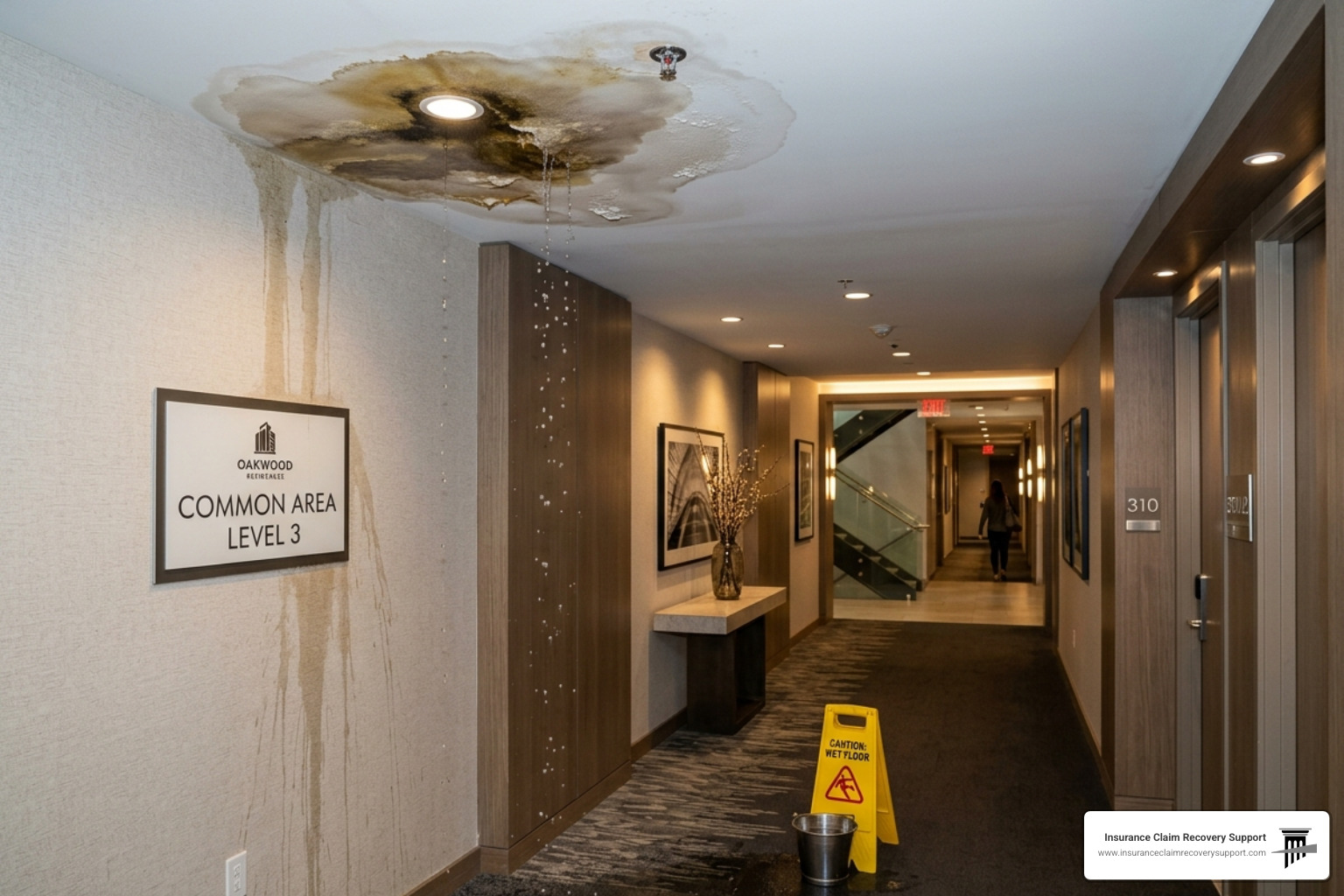
Determining when an association must pull out its checkbook starts with the “Source of Origin.” In Homeowner Association Property Damage Insurance Claims, the HOA is generally responsible for repairing and maintaining “common elements.”
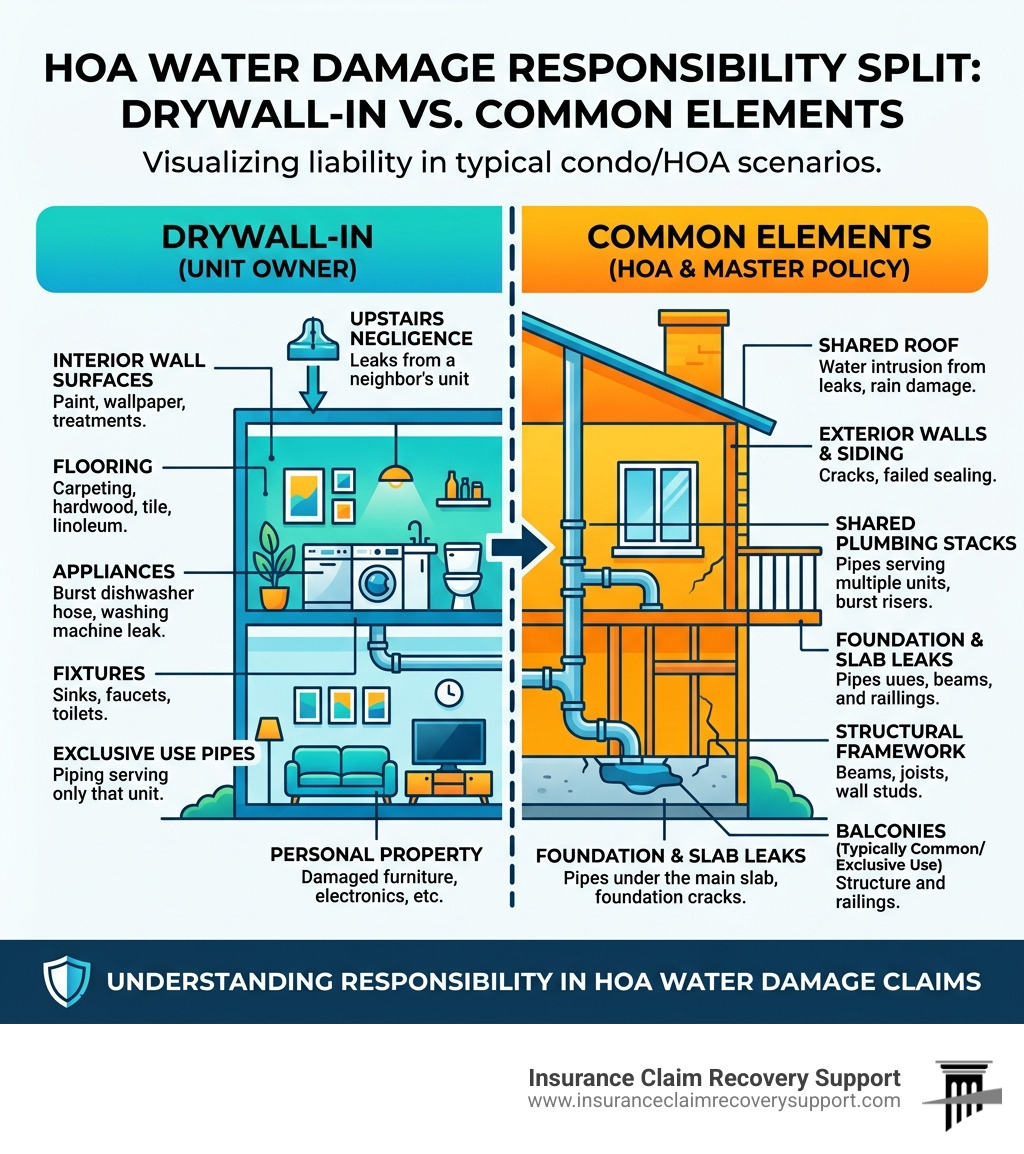
Common elements typically include:
- The building’s exterior envelope (siding, brick, stucco).
- The roof and gutter systems.
- Shared plumbing lines (vertical stacks) that serve more than one unit.
- Foundations and slabs.
- Shared hallways, lobbies, and amenities.
If a leak originates from a failure in one of these areas—such as a worn-out roof shingle or a burst main water line—the HOA is usually responsible for the repair of that component. However, the responsibility for the resulting damage inside your unit (your hardwood floors, your custom cabinets) depends heavily on the specific language in your Declaration of Covenants, Conditions, and Restrictions (CC&Rs).
Understanding HOA Water Damage Liability Under Florida Statute 718
For Florida condominiums, review Florida Statute 718.111, the declaration and both the association and unit-owner policies. A qualified professional can help assess which provisions apply to the particular loss.
Deductible allocation and association response obligations require review of the applicable statute, governing documents and claim facts. Do not assume that the location of a leak alone determines who must pay.
Common Elements vs. Unit Owner Responsibility for HOA Water Damage
The “Gray Area” often involves Exclusive Use Common Elements. These are areas like balconies, patios, or storage lockers that are technically owned by the HOA but used only by one owner.
- Maintenance vs. Repair: In many jurisdictions, the owner is responsible for the daily maintenance (cleaning the balcony drain), but the HOA is responsible for the repair (fixing the structural waterproofing).
- Negligence: Evidence about a known leak and the response may be relevant to liability. Have the facts and applicable duties reviewed rather than assuming responsibility from the location alone.
HOA Water Damage: Master Policies vs. HO-6 Coverage

When HOA water damage occurs, we often see a “finger-pointing” contest between the HOA’s Master Policy and the homeowner’s HO-6 policy. Understanding the type of Master Policy your association carries is the first step in resolving Apartment and Multifamily Claims.
| Policy Type | What the HOA Master Policy Covers | What the Owner’s HO-6 Covers |
|---|---|---|
| Bare Walls-In | Structural framing, roof, exterior walls, and common areas only. | Everything inside: drywall, flooring, cabinets, fixtures, and personal items. |
| All-In (Single Entity) | The structure PLUS original fixtures (standard cabinets, flooring) as built. | Improvements/upgrades made by the owner and personal belongings. |
Who Pays the Insurance Deductible in HOA Water Damage Scenarios?
This is one of the most contentious issues we handle. HOA deductibles have skyrocketed in recent years, often reaching $25,000 to $50,000 or more.
If a common element fails (like a HOA Roof Claim), the HOA typically pays the deductible from its reserve funds. However, many modern CC&Rs allow the association to “assess” the deductible back to a specific unit owner if the leak started in that owner’s unit. This is why “Loss Assessment Coverage” on your HO-6 policy is critical—it can help cover your portion of a massive HOA deductible.
Fact vs. Myth: HOA Insurance Responsibilities
- Myth: “The water came from the roof, so the HOA has to pay for my ruined $10,000 sofa.”
- Fact: Most HOA Master Policies cover “Real Property” (the building). They almost never cover “Personal Property” (your furniture, clothes, electronics). You must file with your own HO-6 carrier for those items.
- Myth: “If the HOA is responsible for the pipe, they are responsible for the mold.”
- Fact: If you delay reporting the leak, the HOA and their insurer may deny the mold portion of the claim, citing your failure to mitigate the damage.
Who Pays for Slab Leaks and Pipes Behind Walls?
Slab leaks are a nightmare for multifamily property owners in cities like Houston, San Antonio, and Austin. Because water escapes beneath the concrete, it can spread laterally through capillary action in concrete, soaking the soil and structural materials long before you see a puddle.
In most Apartment Complex Insurance scenarios, a slab leak is considered an HOA responsibility because the slab is a structural common element. However, the “tear-out” costs—the expense of ripping up your expensive marble floors to reach the pipe—is a frequent point of dispute. Carriers often try to cover the pipe repair (the cheap part) while denying the floor replacement (the expensive part).
Determining the Source: Neighbor Negligence vs. HOA Failure
If water is dripping from your ceiling, the source is either:
- A Common Element: A shared vertical drain line or the roof (review association obligations).
- Upstairs Unit Source: An overflowing bathtub or a burst washing machine hose in the unit above (review unit-owner obligations and coverage).
- Unit Component: A leak in the branch line that only serves the upstairs unit (review unit-owner obligations and coverage).
We recommend hiring a licensed plumber to provide a “cause and origin” report immediately. Without this, the HOA may claim the leak is your problem, while your neighbor claims it’s the HOA’s problem.
Translation: What Your CC&Rs Actually Mean for Water Claims
Reading the governing documents: Terms such as “drywall-in” are shorthand, not a substitute for the actual declaration and policy. Ownership, maintenance duties, repair responsibility, insurance coverage and liability can differ. Review each issue separately.
Documenting and Reviewing a Disputed HOA Water Claim
For a disputed HOA water claim, keep a dated record of the damage, notices, inspections, estimates and insurer responses. Ask the insurer to explain its coverage decision in writing and identify the policy provisions it relied on.
For a complex apartment claim, confirm the roles and relevant credentials of the professionals involved. Seek advice based on the property, policy and documented damage.
Texas Statutes 541 and 542: Protecting Policyholders from Bad Faith
Questions about claim-handling deadlines, remedies or alleged misconduct should be reviewed against the applicable law and facts with a qualified attorney.
- Chapter 541: Prohibits unfair settlement practices, such as misrepresenting policy facts or failing to attempt a fair settlement when liability is clear.
- Chapter 542: Prompt-payment requirements and potential remedies depend on the applicable provisions and claim circumstances. Seek legal advice about any deadline, interest or attorney-fee issue.
The Impact of Florida Litigation Costs and Texas Appraisal Awards
In Florida, the high cost of litigation has led to a surge in “Alternative Dispute Resolution.” Similarly, in Texas, many HOA water damage claims end up in Appraisal. This is a contractual process where two appraisers and an umpire determine the “amount of loss.” At ICRS, we represent policyholders in these high-stakes valuations to ensure the final award covers the actual cost of restoration, not just the carrier’s “budget” estimate.
How to Document an HOA Water Claim
Report water damage promptly and preserve dated photos, videos, correspondence and receipts. Document conditions before cleanup when it is safe to do so, and take reasonable steps to prevent additional damage.
Choosing Qualified Claim Professionals
When the HOA sends an adjuster, remember: they work for the insurance company, not you. See our guide on What to Expect When the HOA Sends an Insurance Adjuster.
For complex apartment and multifamily claims, ask prospective professionals about relevant experience with structural drying, building damage documentation and business interruption.
Steps to Take Immediately After Discovering Water Damage
- Mitigate: Shut off the water. If the HOA won’t act, hire a water extraction company to prevent mold. Save all receipts.
- Notify in Writing: Send an email and a certified letter to the HOA board and property manager.
- Document Everything: Take 50+ photos. Video the water dripping. Don’t forget the “hidden” areas like under sinks and inside closets.
- Call a Public Adjuster: Before you sign anything or accept a “low-ball” initial check, get a professional valuation.
Water Claim Resources for Condo Owners and Associations
For additional water-claim resources, visit free ICRS Water Claim Guide. You can also explore our policyholder claim resources or request an insurance claim review.
Frequently Asked Questions about HOA Water Damage
Can I sue my HOA for water damage negligence?
Whether an owner has a legal claim against an association depends on the governing documents, applicable law and evidence. Preserve notices and repair records, and consult a qualified attorney about possible remedies and deadlines.
Does the HOA cover water damage from the unit above?
The source of a leak does not by itself determine coverage or liability. Review the association documents, the affected policies, the cause of the damage and any evidence of negligence before deciding which party or insurer may be responsible.
Who is responsible for mold remediation after an HOA leak?
Mold-remediation responsibility and coverage depend on the cause, governing documents, policy terms, applicable law and response to the damage. Notify the relevant parties promptly and document the conditions and mitigation work.
Conclusion
Navigating HOA water damage is a complex chess match between governing documents, state statutes, and competing insurance policies. Whether you are dealing with Flood Damage Claims Houston or a burst pipe in a Dallas high-rise, you don’t have to fight the insurance companies alone.
At Insurance Claim Recovery Support (ICRS), we advocate for policyholders with property insurance claims, including multifamily and HOA losses. Results depend on the policy, damage, evidence and circumstances; no particular settlement or avoidance of litigation is guaranteed.
Don’t let a “denial” be the final word on your claim. Contact a Texas Public Adjuster today for a comprehensive claim review.