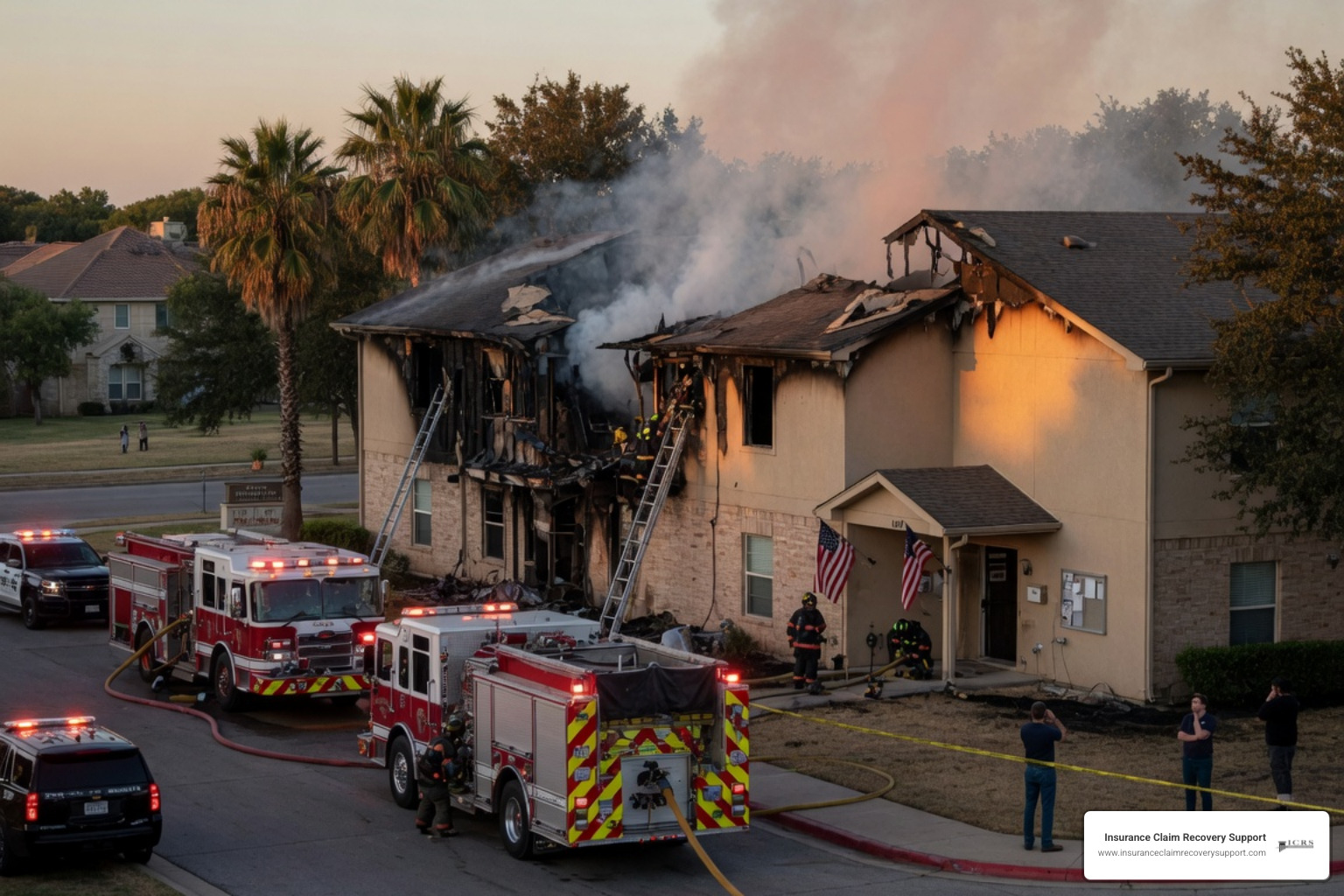
Understanding the HOA Insurance Claim Standoff
Why would an HOA refuse to submit an insurance claim? This question frustrates property owners when damage strikes. The reasons often involve:
- Financials: High deductibles and fear of premium increases.
- Governing Documents: CC&Rs that limit the association’s liability.
- Policy Confusion: Misunderstanding the master policy versus individual HO-6 policies.
- Procedural Problems: Missed reporting deadlines or disputes over maintenance.
- Claims History: Worrying that a claim will make future insurance harder to get.
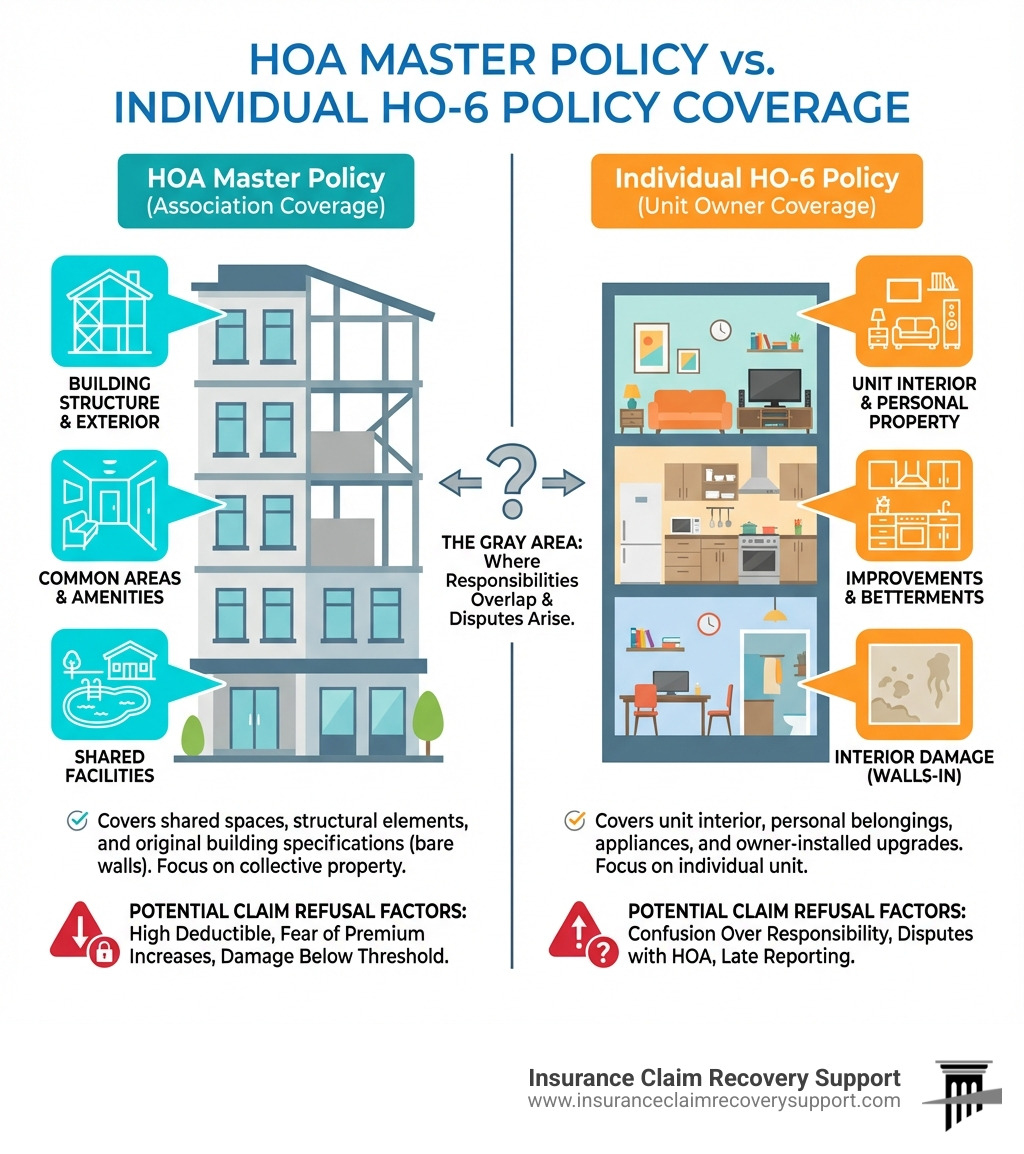
When a disaster like a fire or major leak occurs, the HOA’s master policy generally covers the structure and common areas. Individual owners’ HO-6 policies cover their unit’s interior and personal belongings. This split responsibility can cause confusion and delays, with each party waiting for the other to act.
The consequences of an HOA’s refusal to file a valid claim are serious. Unit owners could face massive repair bills, and the association may be liable for breaching its fiduciary duty. Missing strict policy deadlines can mean losing the chance for recovery entirely. Insurers often use an association’s inexperience to dispute claims based on alleged pre-existing conditions or poor maintenance.
I’m Scott Friedson, CEO of Insurance Claim Recovery Support. For over 15 years, I’ve helped commercial and multifamily property owners steer these disputes, recovering hundreds of millions of dollars. My firm specializes in overturning denied claims and helping HOAs secure the maximum settlement they deserve.
Why Would an HOA Refuse to Submit an Insurance Claim?
It might seem counterintuitive for an HOA to refuse an insurance claim, but several factors influence this decision, creating a complex web of financial, legal, and operational considerations.
Financial Disincentives: The High Cost of Filing
One of the most common reasons an HOA refuses to file is the financial fallout.
- High Deductibles: Commercial policies often have deductibles of $10,000, $25,000, or more. If repair costs are near or below this amount, the board may decide filing isn’t worth the small net recovery.
- Fear of Premium Hikes: Many boards worry that filing a claim will increase their insurance premiums for years to come. A significant claims history can make an association appear high-risk, leading to higher rates or even difficulty finding coverage at renewal.
- Avoiding Special Assessments: If a claim is denied or the payout is insufficient, the HOA may need to levy a special assessment on all owners to cover the shortfall. To avoid this unpopular step, boards might opt not to file a claim for what they perceive as minor damage, hoping to pay for it from reserve funds.
For more detailed information on navigating these financial considerations for commercial properties, you can explore our resources on commercial claims adjustment.
Governing Documents: When Bylaws Dictate the Decision
An HOA’s Covenants, Conditions, and Restrictions (CC&Rs) and bylaws dictate insurance duties and can be a reason for refusing a claim.
- “Walls-in” vs. “All-in” Coverage: The CC&Rs define where the HOA’s responsibility ends and the unit owner’s begins. Under a “walls-in” policy, the master policy covers only the structure, leaving owners responsible for everything from the drywall inward (flooring, cabinets, fixtures). If damage is confined to the unit’s interior, the board may direct the owner to their own HO-6 policy.
- Maintenance and Liability: These documents specify who maintains what. If damage stems from an element an owner is responsible for (like a water heater), the HOA may refuse to file. Conversely, if a common element like the roof fails, the HOA is typically responsible. Some documents also contain clauses that limit the HOA’s liability for certain events, which boards may use to justify not filing.
- Improvements and Betterments: The master policy usually only covers restoring a unit to its original, builder-grade state. It won’t cover custom upgrades an owner has made. The HOA may hesitate to file a claim that only partially covers an owner’s loss.
Understanding these intricate details is crucial. For strategies on navigating these complexities, consider our insights on maximizing your claim in multi-family property damages.
Why would an HOA refuse to submit an insurance claim due to misunderstandings?
Simple misunderstandings often lead to an HOA’s refusal to file a claim, usually due to a lack of claims expertise on the volunteer board.
- Wear and Tear vs. Covered Peril: Boards may incorrectly assume damage is just “wear and tear” (which isn’t covered) when it was actually caused by a sudden, covered event like a storm. They may fear an automatic denial based on “pre-existing conditions” and decide not to file, even for a valid claim.
- Underestimating Damage: What looks like a small problem can hide extensive issues, like water damage leading to mold. A board might pay for a minor fix out-of-pocket, only to find a much larger problem later, by which time it may be too late to file a claim.
- Missed Deadlines and Policy Language: Insurance policies have complex language and strict reporting deadlines. A volunteer board can easily misinterpret their coverage or miss a reporting window (sometimes just 48-72 hours), leading them to believe filing a claim is pointless.
Navigating these complexities requires a thorough understanding of the entire claims process. Our complete insurance claim process guide offers valuable insights for HOAs and property managers.
Fact vs. Myth: Common Questions About HOA Insurance Claims
When dealing with property damage in an HOA setting, confusion often reigns. Let’s clear up some common misconceptions.
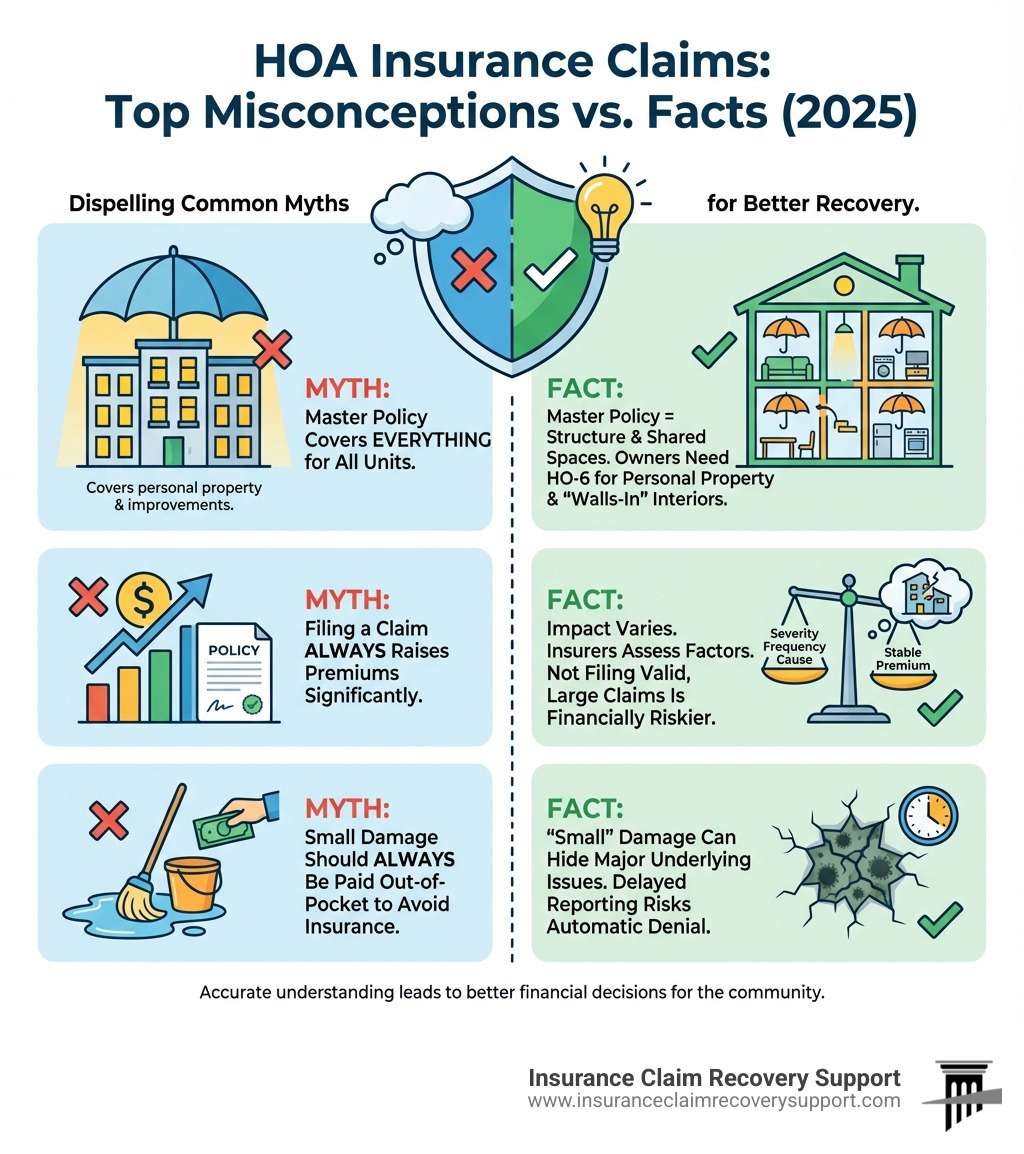
- Myth: The HOA’s master policy covers everything.
- Fact: The master policy typically covers the building’s structure and common areas. Unit owners need their own HO-6 policy for personal property, interior finishes, and liability inside their unit.
- Myth: Filing any claim will cause a huge premium increase.
- Fact: While claims can affect premiums, insurers consider the claim’s size, cause, and frequency. Refusing to file a necessary, large claim is often far more costly than any potential premium hike.
- Myth: The HOA should always pay for small damage out of pocket.
- Fact: This can be risky. What appears to be minor damage can hide larger, more expensive problems like hidden water intrusion and mold. A professional assessment is crucial before deciding not to file.
- Myth: The HOA board doesn’t need outside help with insurance.
- Fact: Boards are volunteers and usually not insurance experts. Without professional advice from a public adjuster, they can make costly mistakes that lead to claim denials, leaving the community financially exposed.
- Myth: If a unit owner caused the damage, the HOA isn’t responsible.
- Fact: It depends. If the damage originates from or affects a common element (like a pipe in a shared wall), the master policy may still apply. The HOA has a duty to address damage to common elements.
For a deeper dive into these and other frequently asked questions, refer to our FAQ on HOA insurance claims.
Your Next Steps: A Roadmap for Resolution
When facing property damage, knowing your rights, responsibilities, and when to seek professional help is paramount.
For HOA Boards: Best Practices for Claim Management
As a board member, you have a fiduciary duty to protect the association’s financial interests. This requires diligent claim management.
- Communicate Clearly: Be transparent with residents about the master policy, claim procedures, and deadlines. Clearly explain any decision to file or not file a claim.
- Review Your Policy Annually: Don’t wait for a disaster. Review your master policy with an expert every year to ensure your coverage limits are adequate and you understand all exclusions.
- Document Property Condition: Maintain detailed records of maintenance and inspections. This documentation is your best defense against an insurer’s claim of pre-existing damage or neglect.
- Understand Your Fiduciary Duty: Improperly refusing a valid claim can expose the board to legal liability. If unsure, consult with legal counsel to clarify your obligations.
- Create a Claims Protocol: Establish a written policy for how the HOA will handle damage reporting, claim assessment, and communication to ensure a swift, consistent response.
- Act Quickly: Insurance policies have strict reporting deadlines, sometimes as short as 48-72 hours. Delays can result in an automatic denial, so your procedures must allow for immediate action.
For more assistance with managing claims for large properties, explore our resources on commercial property insurance claims.
For Unit Owners: What to do if your HOA refuses to submit an insurance claim
If your HOA refuses to file a claim you believe is valid, you have options.
- Make a Formal Written Request: Submit a detailed letter to the board explaining the damage and why you believe it’s covered by the master policy.
- Review Your Governing Documents: Carefully read the CC&Rs and bylaws to understand the HOA’s insurance responsibilities and any dispute resolution procedures.
- Request Mediation: Before pursuing legal action, your documents may require mediation. For general information on navigating insurance issues, resources like the National Association of Insurance Commissioners (NAIC) can be helpful.
- Send a Demand Letter: Have an attorney send a formal demand letter. This serious step often prompts the board to act.
- Seek Legal Counsel: If other methods fail, an attorney specializing in HOA law can advise you on your options, which may include suing the board for breach of fiduciary duty.
- Document Everything: Keep detailed records of all emails, letters, and conversations with the board. This paper trail is vital if the dispute escalates.
If your claim is underpaid or delayed, learn more about what to do with an underpaid or delayed insurance claim.
The Professional Path: Public Adjuster vs. Insurance Claim Lawsuit
When a claim is denied, underpaid, or never filed, the board faces a choice: engage a public adjuster or file a lawsuit.
-
The Public Adjuster Path (Negotiation): A public adjuster is a licensed professional who works only for you, the policyholder, not the insurance company. We handle the entire claim for you:
- Process: We independently assess and document all damage, prepare a detailed claim, and negotiate directly with the insurer. The process is faster and less adversarial than a lawsuit.
- Cost: We work on a contingency fee, meaning we are paid a small percentage of the final settlement. There are no upfront costs.
- Outcome: Our goal is to secure the maximum settlement you’re entitled to under your policy without the time, cost, and stress of litigation. Our firm has a 90% success rate in settling claims without unnecessary lawsuits.
-
The Lawsuit Path (Litigation):
- Process: This involves formal legal proceedings that can take years to resolve.
- Cost: Legal action is expensive, involving attorney’s fees (often a large percentage of the recovery) and court costs, which you may have to pay even if you lose.
- Outcome: The result is uncertain and depends on a judge or jury, creating significant financial and reputational risk for the HOA.
By presenting a carefully documented claim, a public adjuster can often de-escalate disputes and achieve a fair settlement, making litigation unnecessary.
Insurance Claim Recovery Support is a licensed public adjusting firm that represents only policyholders in large-loss commercial and multifamily claims. We advocate for HOAs, apartment investors, and commercial property owners facing damage from fire, storms, freezes, and water loss. We serve clients across Texas (including Austin, Dallas, Fort Worth, San Antonio, and Houston), Florida, Georgia, Colorado, North Carolina, South Carolina, Oklahoma, and many other states. We help clients steer situations where an HOA refuses to submit a claim and ensure they receive fair treatment from their insurer. For a more comprehensive understanding of our role, visit what is a Public Insurance Adjuster?.
Guides for HOA Property Damage Claims
ICRS offers educational resources to help boards and property managers prepare. For leaks, pipe bursts and related losses, explore the Water Damage Insurance Claim Guide. For a fire loss, see the Fire Claim Guide. Each resource explains its access options and any pricing. These guides complement a review of your association’s actual policies and governing documents.
Claim Review for HOA Boards and Property Managers
If your association is dealing with significant property damage, ICRS can discuss the documentation needed to evaluate a potential insurance claim. Have the master policy, insurer correspondence, repair estimates and damage photographs available. Request an HOA property damage claim review.
Learn about ICRS public-adjuster services for HOAs and public-adjuster fees and contract questions. Disputes about board duties or governing documents may also require advice from your association’s attorney.