Navigating the Role of an Insurance Adjuster in San Antonio
When a major storm rolls through Bexar County or a fire breaks out in a commercial plaza, the first person the insurance company sends to the scene is an adjuster. However, not all adjusters are created equal. In San Antonio, you will encounter three primary types, and knowing the difference is critical to your financial recovery.

Staff Adjusters
These are full-time employees of the insurance company. Their paycheck comes directly from the carrier. While they are often professional, their primary goal is to close the file quickly while adhering to the insurance company’s internal guidelines and bottom line.
Independent Adjusters
Don’t let the name fool you. An “independent” insurance adjuster San Antonio carriers hire is a third-party contractor. Firms like Frontier Adjusters or Empathy Claims are often brought in during “catastrophe” (CAT) seasons when local staff adjusters are overwhelmed. While they aren’t employees, they are still paid by the insurance company to represent the insurance company’s interests.
Public Adjusters
A Public Insurance Adjuster (PIA) is the only professional licensed by the Texas Department of Insurance (TDI) to represent the policyholder. We don’t work for the insurance company; we work for you. We handle the heavy lifting: performing forensic inspections, line-iteming Xactimate estimates, and negotiating the settlement.
The San Antonio Risk Profile
San Antonio is unique. We aren’t just dealing with the occasional thunderstorm. According to scientific research on flood risk in San Antonio, this region is one of the most flood-prone areas in North America due to the Balcones Escarpment. When you combine flash flooding with the high frequency of hailstorms in the Texas Triangle, the complexity of property claims in Bexar County skyrockets.
| Feature | Company/Independent Adjuster | Public Adjuster (ICRS) |
|---|---|---|
| Who pays them? | The Insurance Company | The Policyholder (You) |
| Primary Loyalty | The Insurance Carrier | The Policyholder |
| Goal | Minimize claim liability | Maximize fair settlement |
| Scope of Work | Verify policy coverage limits | Document every cent of damage |
| Licensing | Texas Dept. of Insurance | Texas Dept. of Insurance |
Why Commercial Property Owners Need a Public Insurance Adjuster in San Antonio
If you manage a 300-unit apartment complex in Medical Center or an HOA in Stone Oak, a “standard” settlement offer rarely covers the true cost of restoration. Insurance companies often use “replacement cost value” (RCV) math that doesn’t account for local San Antonio building codes or the specialized labor required for large-scale commercial roofing.
Multifamily operators and professional property managers face unique pressures. You have tenants to protect and a fiduciary duty to investors. When a claim is underpaid, that money often comes out of your capital improvement budget or maintenance reserves. By hiring a Public Adjuster for Insurance Claims, you ensure that the “burden of proof”—which legally sits on your shoulders—is met with professional precision.
A Licensed Adjuster on your side understands how to read the fine print of a commercial policy, including “ordinance or law” coverage that pays for required upgrades during repairs. Without this expertise, you might be left holding the bill for thousands of dollars in mandatory code improvements.
Common Property Damage Claims for a San Antonio Insurance Adjuster
San Antonio’s climate is a “choose your own adventure” of property perils. Here are the most common claims we handle for commercial clients:
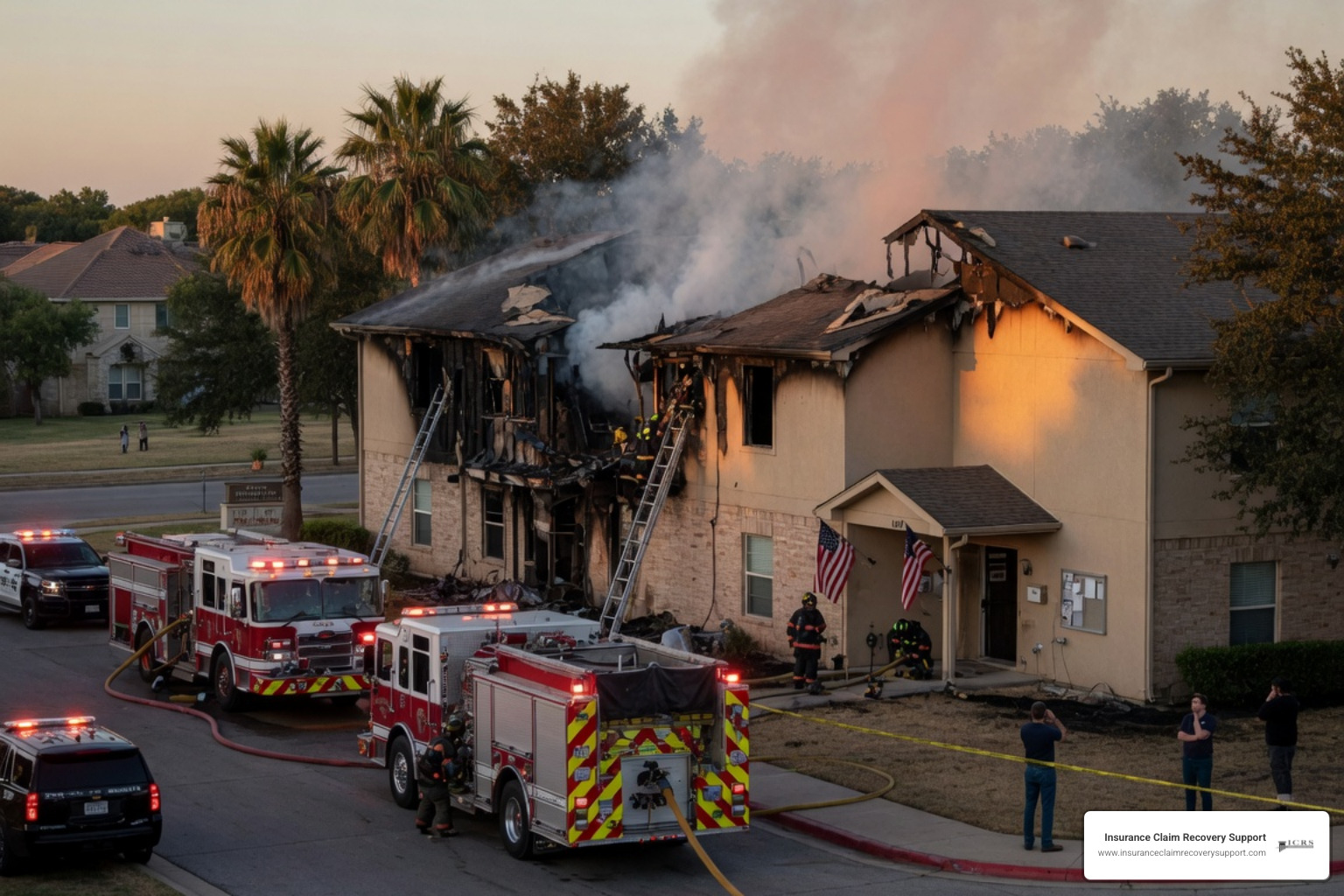
- Commercial Fire and Smoke: Fire damage is never just about what burned. It’s about the soot in the HVAC system, the water damage from the fire department, and the lingering odor that can shut down a retail center for months.
- Flash Flooding: With the San Antonio River Authority constantly working to manage drainage, the risk remains high. Water loss claims require rapid response to prevent mold, which is often capped or excluded in many Texas policies.
- Hail and Windstorm: Hail is the “silent killer” of commercial roofs. While it might not cause a leak today, it bruises the membrane and voids warranties. We use thermal imaging and moisture probes to prove damage that a staff adjuster might call “cosmetic.”
- Winter Freeze: As we saw during the recent historic Texas freezes, burst pipes in uninsulated commercial crawlspaces can cause catastrophic losses across multiple floors of an office building.
Whether you need Public Adjusters in San Antonio TX for a single warehouse or a San Antonio Public Adjuster for a multi-city portfolio, the strategy remains the same: document early, document often, and never accept the first check as the final word.
Fact vs. Myth: The Truth About Texas Insurance Settlements
There is a lot of “street knowledge” about insurance claims that is simply wrong. Let’s clear the air:
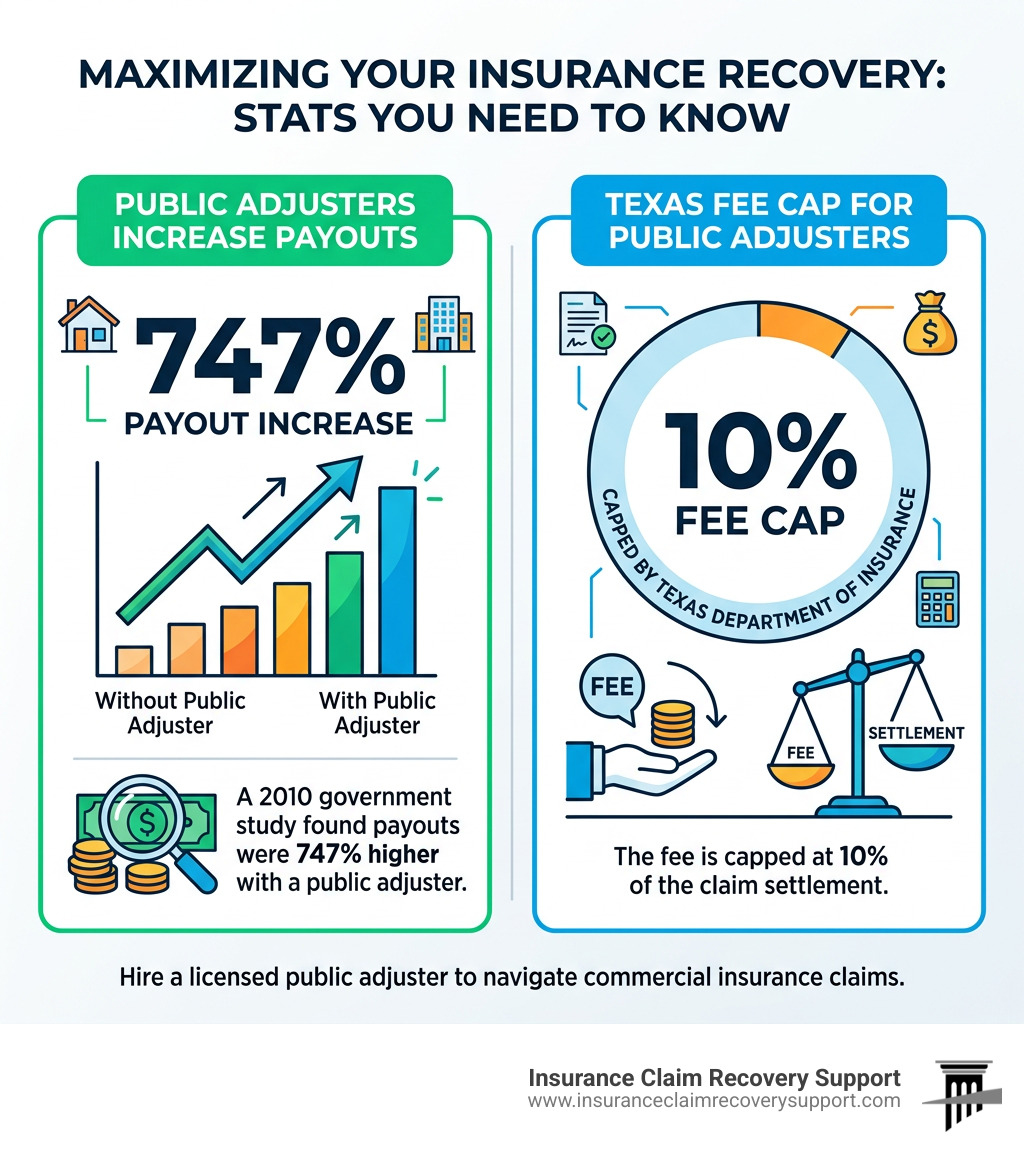
Myth: Public Adjusters are too expensive. Fact: In Texas, the fee for a public adjuster is capped by the Texas Department of Insurance at 10% of the claim settlement. When you consider that a government study found payouts can increase by 747% with a public adjuster, the service effectively pays for itself many times over.
Myth: I should give a recorded statement to the insurance company right away. Fact: Be careful. Insurance companies often record these calls and can use specific phrasing to justify a denial. If you aren’t sure of the exact cause of loss or the date it occurred, wait until you’ve consulted with a professional. Our Denied Insurance Claim Ultimate Guide covers how to handle these high-pressure tactics.
Myth: My contractor can negotiate my claim for me. Fact: In Texas, this is actually illegal. It is a conflict of interest (and a “unauthorized practice of public adjusting”) for a general contractor to act as your adjuster and your builder on the same claim. You need a separate, licensed advocate for the financial negotiation.
Maximizing Your Recovery: Public Adjusting vs. Litigation
One of the biggest mistakes San Antonio property owners make is jumping straight to a lawsuit when a claim is denied or underpaid. Litigation is slow, expensive, and adversarial. In Texas, the legal process can take years, during which your property continues to deteriorate.
At Insurance Claim Recovery Support, we focus on a different path. We utilize Public Adjusting Services to resolve claims through the administrative process. By presenting a “bulletproof” claim—backed by thermal imaging, forensic engineering reports, and Xactimate line-item estimates—we make it difficult for the carrier to maintain an underpayment.
Benefits of Public Adjusting Over Litigation:
- Speed: Most of our claims reach a settlement in months, not years.
- Cost: You don’t have to pay massive hourly legal fees or 33-40% contingency fees to an attorney.
- Appraisal Clause: We are experts in the “Appraisal” process, a contractual dispute resolution tool that can bypass the court system entirely.
- 90% Success Rate: We resolve the vast majority of our claims without ever needing to file a lawsuit.
The Claims Process and Timeline in Bexar County
The clock starts ticking the moment the storm ends. In San Antonio, the timeline usually looks like this:
- Immediate Mitigation: You have a duty to prevent further damage (e.g., tarping a roof).
- Claim Filing: Assigning the claim to the carrier.
- The Inspection: This is where the insurance adjuster San Antonio carriers send will walk the property. We recommend having us present for this walk-through to ensure they don’t “miss” key areas.
- The Estimate: The carrier will provide an estimate, often using Xactimate. We will provide our own competing, more detailed estimate.
- Negotiation: This is the “back and forth” where we argue for the true cost of repairs.
Whether you are in Texas Bexar County Castle Hills or Texas Bexar County Converse, the state-mandated timelines for insurers to acknowledge and pay claims (Texas Insurance Code Chapter 542) apply. We ensure they stick to those deadlines.
Strategic Advantages for Multifamily and Commercial Assets
For a hotel on the River Walk or a retail center in Alamo Heights, the physical damage is only half the story. Business Interruption (BI) is often the larger loss. If your building is unusable, you are losing rental income or daily revenue.
A public adjuster helps you calculate “extra expense” and lost profits, ensuring your BI claim is as robust as your property damage claim. We provide specialized support for areas surrounding the city, including Adjuster Claim Support in Helotes TX and Public Adjusters in Castroville TX, bringing “big city” expertise to every corner of the San Antonio metro.
Conclusion: Partnering with Insurance Claim Recovery Support
Navigating an insurance claim alone is like going to court without a lawyer, except the “judge” is the person you are suing. You wouldn’t do it.
Insurance Claim Recovery Support (ICRS) is here to level the playing field. We are a “no-win-no-fee” firm, meaning our interests are perfectly aligned with yours. We only get paid when you get paid. Our mission is to provide the most comprehensive, aggressive, and professional representation for policyholders in San Antonio and throughout Texas.
If you are dealing with a large-loss commercial or multifamily claim, don’t leave your settlement to chance. Contact us today for a free claim review. We’ll look at what the insurance company offered and tell you exactly what’s missing.
For More info about public adjusters near me, reach out to our team. Let’s get your San Antonio property restored and your settlement maximized.