Understanding Responsibility for an HOA Roof Claim
When a leak appears or a storm rolls through, the first question is always: “Who is responsible for this?” In an HOA environment, the answer isn’t always found on the roof—it’s found in the paperwork. Every community is governed by a set of documents that act as the “law of the land.”
To determine who is responsible for an HOA Roof Claim, we must look at three primary sources:
- CC&Rs (Covenants, Conditions, and Restrictions): This is the master deed. It defines what parts of the property are “Common Elements” (owned and maintained by the association) versus “Separate Interests” or “Units” (owned by you).
- Bylaws: These outline how the board operates and their fiduciary duty to maintain the community.
- Maintenance Matrix: Many modern HOAs provide a cheat sheet or “matrix” that explicitly lists items like “Roof Shingles,” “Gutters,” and “Skylights,” and assigns repair vs. replacement duty to either the HOA or the owner.
Defining Common Elements vs. Exclusive Use
In most multifamily settings, the roof is a Common Element. This means the association owns it, and your monthly dues pay for its upkeep. However, some townhome documents define the roof as an Exclusive Use Common Element or even part of the individual unit. This distinction is critical because it dictates whose insurance company gets the phone call.
| Property Type | Typical Roof Responsibility | Insurance Policy Triggered |
|---|---|---|
| Condominium | HOA / Association | Master Policy |
| Townhome | Varies (Check CC&Rs) | Master Policy or Individual HO-6 |
| Single-Family Home | Homeowner | Individual HO-3 Policy |
Determining Responsibility for an HOA Roof Claim
State laws often provide a safety net when HOA documents are vague. For example, the California Davis-Stirling Act and Florida Chapter 718 (Condominium Act) create baseline requirements for associations to maintain structural integrity.
Recent legislative shifts, such as the 2024 Florida HB 1021, have increased transparency requirements, forcing associations to be more accountable for structural maintenance. In Texas, while the laws are different, the principle remains: the board has a fiduciary duty to protect the assets of the community. According to the Community Associations Institute, over 74 million Americans live in HOA communities, making the management of these shared assets a massive economic driver.
If an HOA neglects a roof until it fails, they may be liable for the interior damage caused to individual units. Conversely, if a homeowner installs a satellite dish or a skylight without approval and it causes a leak, the HOA Roof Claim might be denied, leaving the owner with the bill.
Master Policies vs. HO-6 Loss Assessment Coverage
The interaction between an HOA’s master insurance policy and a homeowner’s individual policy is where most “claim friction” occurs.
- The Master Policy: This is a commercial-grade policy held by the association. It typically covers the “shell” of the building, including the roof, siding, and common areas. These policies often have massive deductibles—sometimes 2% to 5% of the total building value.
- HO-6 Policy: This is what the unit owner carries. It covers the “walls-in” (flooring, cabinets, personal items) and, crucially, Loss Assessment Coverage.
The Dutch Knolls Case Study: Consider the cautionary tale of the Dutch Knolls community. After hail damage, the association faced a total roof replacement cost of nearly $1.6 million. However, the master policy had a deductible of $1,576,712. This left the insurance company paying a measly $16,617. The remaining $1.5 million+ was split among 96 units, resulting in a special assessment of over $16,400 per homeowner.
Many owners thought their insurance would cover it, only to find their HO-6 policy had a $1,000 limit for loss assessments. We strongly recommend that every HOA resident check their policy; increasing loss assessment coverage often costs as little as $20–$40 per year but can save you tens of thousands in a disaster. For more on this, see our guide on Navigating Multi-Family Property Insurance Claims.
Immediate Steps After Discovering a Roof Leak
If you see a yellow stain on your ceiling, time is your enemy. Insurance carriers expect “prompt notice,” which usually means within 48 to 72 hours of discovery.
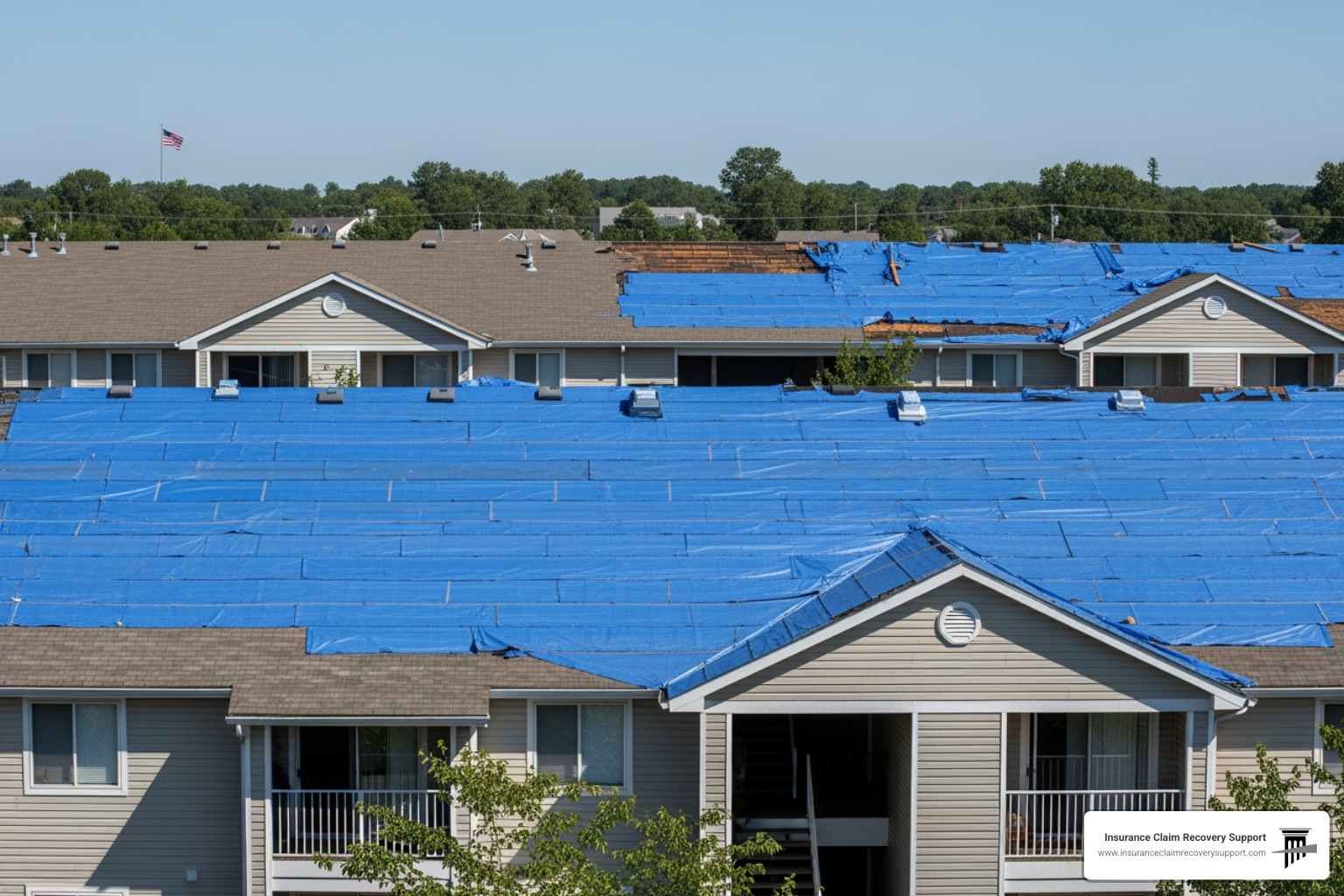
- Mitigate the Damage: If it’s safe, place buckets or move furniture. If the HOA is responsible for the roof, they should be the ones to “tarp” it, but you must act to protect your personal property.
- Written Notification: Do not just call the property manager. Send an email or certified letter to the board. Documentation is the only currency that matters in a dispute.
- Document Everything: Take photos of the leak, the damaged ceiling, and any ruined electronics or furniture.
- Professional Inspection: Before the HOA sends their “preferred” contractor (who may have a bias toward the board’s budget), consider hiring an independent expert. Searching for the Best Public Adjuster for Roof Leak Insurance Near Me can help ensure you have an advocate who understands the “gray areas” of causation.
Resolving Disputes and Maximizing Your HOA Roof Claim Settlement

Insurance companies are in the business of managing risk, which often translates to “denying claims whenever possible.” The most common excuse for a denied HOA Roof Claim is “wear and tear” or “lack of maintenance.”
Carriers love to point at a 20-year-old roof and claim the leak was inevitable, even if a massive hailstorm just blew through. This is where the distinction between a “covered peril” (like wind or hail) and “maintenance” becomes a legal battlefield. If you suspect storm damage, you can learn more about the signs in our article on Hail Damage Roof.
Fact vs. Myth: Challenging an HOA Roof Claim
There are several myths that prevent HOAs and homeowners from getting the settlements they deserve:
- Myth: “If the HOA denies it, I have to pay.”
- Fact: HOA boards are not judges. If the governing documents say they are responsible, and they refuse to act, they are in breach of contract. You can pursue mediation or arbitration to force their hand.
- Myth: “My insurance company’s adjuster is an expert.”
- Fact: Company adjusters work for the carrier. A Public Adjuster Home Insurance Claim expert works only for you.
In Texas, the Insurance Claim Assistance for Roofs in Texas process is governed by strict codes. Research from the Florida OPPAGA has shown that policyholders who use public adjusters receive settlements that are significantly higher than those who go it alone.
Public Adjuster vs. Litigation for HOA Disputes
When a claim is underpaid, many boards think their only option is to hire an attorney and sue. However, litigation is slow, expensive, and adversarial. It can take years to resolve a roof claim in court, all while the roof continues to leak and mold grows.
At ICRS, we offer a different path. We focus on maximizing settlements through expert documentation and negotiation, often avoiding the “appraisal” process or the courtroom entirely. We have a 90% success rate in settling claims without the need for unnecessary lawsuits.
| Feature | Public Adjuster (ICRS) | Litigation / Attorney |
|---|---|---|
| Speed | Faster resolution (months) | Slow (years) |
| Cost | Contingency fee (no upfront cost) | Often hourly + contingency (40%+) |
| Goal | Accurate damage assessment & payment | Legal victory / judgment |
| Tone | Collaborative negotiation | Adversarial / Conflict-heavy |
By focusing on Multi-Family Property Claims, we ensure that the complex needs of an entire community are met. We handle the “carrier roadmap,” managing the timelines and documentation so the board can focus on running the association.
Proactive Maintenance and Reserve Funding
The best way to handle an HOA Roof Claim is to be prepared before the clouds turn gray.
- Annual Inspections: Don’t wait for a leak. Have a professional roofing contractor or a public adjuster perform a “health check” on your roofs every year.
- Reserve Funding: Ensure your reserve study is up to date. If your roofs are 15 years old, you should already have the funds set aside for the deductible.
- Loss Assessment Education: Send a newsletter to your residents explaining the importance of HO-6 coverage.
Our team at Insurance Claim Recovery Support LLC serves major hubs across Texas, including Austin, Dallas, Fort Worth, San Antonio, and Houston, as well as Lubbock, San Angelo, Waco, Round Rock, Georgetown, and Lakeway. We understand the local weather patterns—from West Texas hail to Gulf Coast hurricanes—and how they impact multifamily roofing systems.
If your association is struggling with a denied claim or a low-ball offer from an insurance carrier, don’t let the board pass a massive special assessment to the homeowners without a fight. There is often money left on the table by insurance companies that simply hope you won’t notice.
For more resources, check out our detailed info about HOA and Condo claims or contact us for a no-obligation consultation. We represent policyholders only, ensuring your community gets every penny it is owed to restore its most vital asset: the roof over your heads.