When Your Claim Gets Denied: What Commercial and Multifamily Property Owners Need to Know
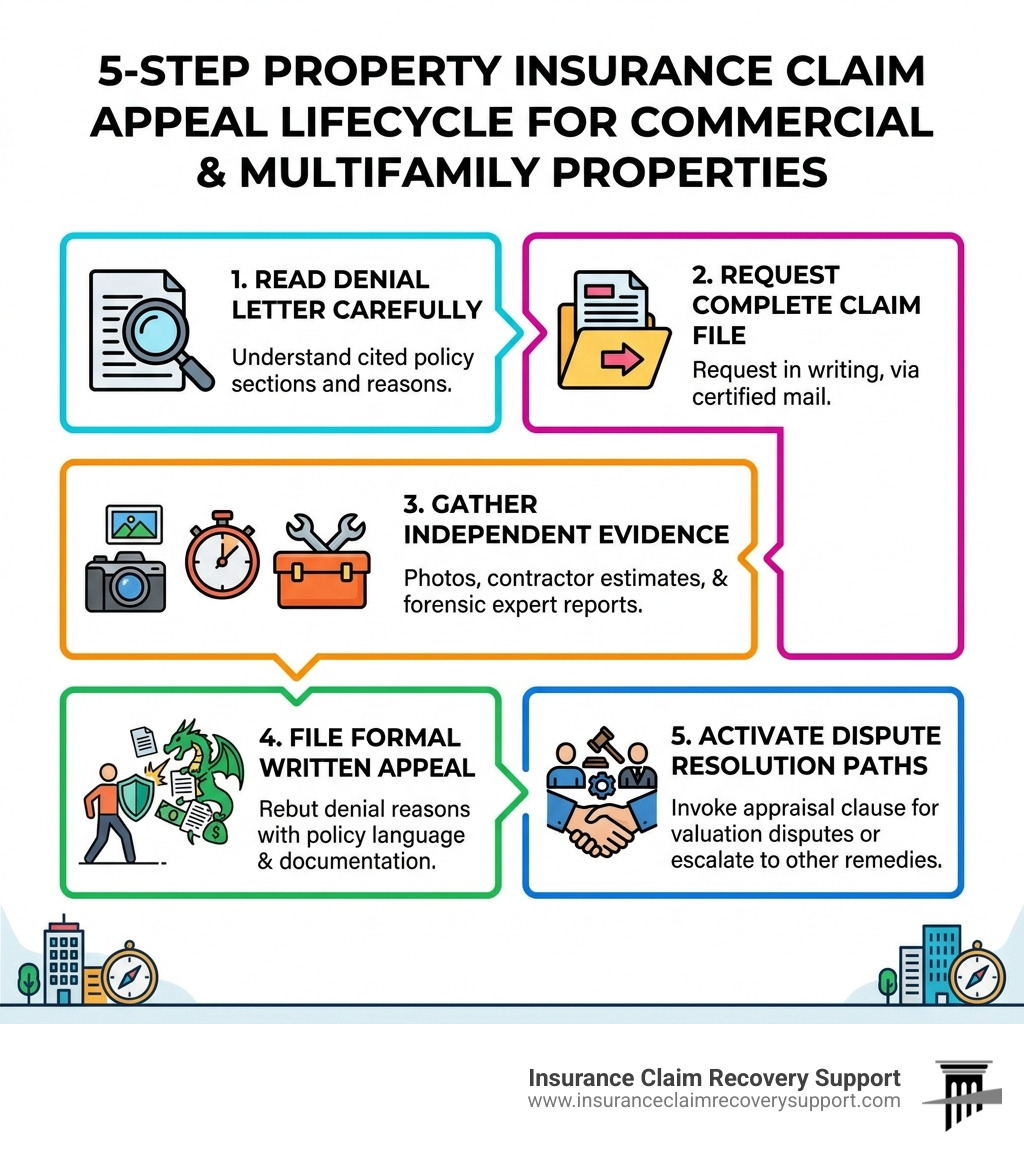
Fighting insurance claims after a denial is not just possible — for most commercial and multifamily property owners, it’s the right and necessary move. Here’s a quick-reference summary of how to start:
- Read the denial letter carefully — identify the exact reason and any cited policy sections.
- Request your complete claim file in writing, sent via certified mail.
- Gather independent evidence — photos, contractor estimates, and forensic expert reports.
- File a formal written appeal that rebuts each denial reason with policy language and documentation.
- Consider invoking the appraisal clause to resolve disputes over loss amounts without going to court.
- Hire a licensed public adjuster to level the playing field against the insurer’s team.
- Escalate to your state Department of Insurance or consult a bad faith attorney if the insurer continues to stall or refuses to act in good faith.
You paid your premiums. You maintained your property. Then a storm, fire, or water loss hit — and instead of a check, you got a denial letter packed with policy jargon and exclusion clauses. If that sounds familiar, you’re not alone.
Nearly three in ten home insurance claims were denied in 2023, and the picture isn’t much better for commercial and multifamily properties. What’s more striking is this: research shows that up to 80% of appealed claim denials are overturned — yet fewer than 1% of policyholders ever file an appeal. That gap represents an enormous amount of money left on the table by property owners who assumed the denial was final.
It’s not.
For commercial property owners, apartment operators, and multifamily portfolio managers, a denied or underpaid insurance claim isn’t just a paperwork headache — it’s a business emergency. Tenants are waiting. Lenders are watching. Revenue is bleeding. The last thing you need is a months-long lawsuit against your insurer when faster, more effective paths exist.
That’s exactly what this guide covers: how to fight back strategically, efficiently, and without unnecessary litigation.
I’m Scott Friedson, Multi-State Licensed Public Adjuster and CEO of Insurance Claim Recovery Support (ICRS), with over 15 years of experience fighting insurance claims on behalf of commercial and multifamily property owners across the country — settling hundreds of millions of dollars in large-loss claims. In the sections ahead, I’ll walk you through the exact strategies we use to overturn wrongful denials and maximize recoveries for our clients.
Fighting insurance claims basics:
Proven Strategies for Fighting Insurance Claims

When we talk about fighting insurance claims, we aren’t suggesting you just “get angry” on the phone with your adjuster. Success in large-loss commercial claims requires a tactical, evidence-based approach. According to a 2022 Accenture analysis, 31% of property claimants were not fully satisfied with how their claim was handled. This dissatisfaction often stems from a lack of transparency or a feeling that the insurer is looking for any excuse to say “no.”
To move from a denial to a settlement, you need to understand why the insurer said no in the first place. If you find yourself stuck, seeking insurance claims dispute assistance is often the most efficient way to break the deadlock.
Common reasons for denial include:
- Exclusion Clauses: Claiming the damage was caused by something not covered (like “wear and tear” instead of wind).
- Late Reporting: Alleging you waited too long to file the claim, prejudiced their investigation.
- Insufficient Documentation: Claiming you haven’t “proven” the loss occurred during the policy period.
- Maintenance Issues: Blaming the damage on a lack of upkeep rather than a sudden event like a fire claim process guide.
Analyzing Denial Letters and Policy Exclusions
The first step in fighting insurance claims is dissecting the denial letter. Insurers are legally required to provide a written explanation for a denial, usually citing specific policy language. However, these letters are often filled with jargon designed to make the decision feel final.
For those managing apartment and multifamily claims, you must look closely at “anti-concurrent causation” clauses. These can be used to deny a claim if two events happened at once—one covered and one not. For example, if a storm causes both wind damage (covered) and flooding (often excluded), the insurer might try to deny the whole thing.
Understanding the glossary of property insurance claim terms is vital here. Are they citing “gradual deterioration”? Are they claiming the damage was “pre-existing”? Don’t take their word for it. Their adjuster works for their bottom line; you need an interpretation that works for yours.
Gathering Evidence for Fighting Insurance Claims
Evidence is the “ammo” in your battle. If the insurer says your roof leak is just old age, you need forensic proof it was a hailstorm. When handling commercial property claims, “eyeballing” the damage isn’t enough.
We recommend a comprehensive evidence file including:
- Visual Proof: High-resolution photos and narrated videos of the damage taken immediately after the loss.
- Independent Estimates: Get quotes from contractors who understand commercial-grade materials, not just residential roofers.
- Expert Reports: Forensic engineers or building consultants can provide scientific evidence of causation.
- Maintenance Records: Proof that you’ve kept the building in good shape can dismantle “wear and tear” arguments.
For specific perils, like following the hail damage roof insurance claim process, you may need weather data reports to prove exactly when the storm hit your specific coordinates.
Invoking Appraisal to Avoid Costly Litigation
Many policyholders believe their only options are “accept the lowball” or “sue.” There is a powerful middle ground: The Appraisal Clause. This is a contractual mechanism found in most policies to resolve disputes over the amount of loss.
| Feature | Appraisal | Litigation |
|---|---|---|
| Primary Goal | Determine the cost of damage | Determine coverage and legal liability |
| Timeline | Typically 60–90 days | 1–3 years |
| Cost | Shared cost of appraisers/umpire | High attorney fees and court costs |
| Finality | Binding on the loss amount | Can be appealed through higher courts |
| Atmosphere | Professional/Technical | Adversarial/Legal |
Invoking appraisal can be a game-changer in the building insurance claim process. Each side selects a competent appraiser, and those two select a neutral “umpire.” A decision by any two of the three is binding. It bypasses the “delay and defend” tactics of the insurer’s legal team. Before hiring an appraiser, always perform a Texas license verification to ensure they are qualified to represent your interests.
Recognizing Bad Faith and Unreasonable Delays
Sometimes, an insurer isn’t just “disagreeing”—they are acting in bad faith. In states like Texas, insurers are bound by strict statutory deadlines to acknowledge, investigate, and pay claims.
Signs of bad faith include:
- Failing to conduct a thorough investigation.
- Offering a settlement that is “shockingly low” compared to the actual damage.
- Constant requests for the same documents to stall the process.
- Misrepresenting policy language to trick the policyholder.
If you suspect these tactics, our bad faith insurance complete guide explains your rights. Dealing with an underpaid delayed insurance claim is a drain on your business’s capital, and in many jurisdictions, you can recover penalties and interest if bad faith is proven.
The Role of a Public Adjuster in Fighting Insurance Claims
A public adjuster is the only type of insurance adjuster licensed to represent the policyholder exclusively. While the “company adjuster” works for the insurance company, and the “independent adjuster” is also hired by the insurer, a public adjuster is your advocate.
We specialize in public vs company adjuster who’s on your side for roof damage claims. Our goal is to maximize your settlement by identifying hidden damage—like smoke in HVAC systems or structural issues behind walls—that the insurer’s adjuster might “miss.”
Regarding public adjuster fees for property damage claims, most work on a contingency basis. This means we only get paid if we recover money for you. For large-loss commercial claims, the increase in the settlement often far exceeds the fee, making it a high-ROI decision for property owners.
Fact vs. Myth: Common Policyholder Fears
Myth: “If I appeal, the insurance company will cancel my policy.” Fact: In most states, insurers cannot legally cancel your policy or raise your rates solely because you exercised your right to appeal a claim decision.
Myth: “The insurance company’s estimate is the final word.” Fact: Their estimate is an offer. Statistics show that 80% of appeals are successful. The insurer is banking on the fact that less than 1% of people fight back.
Myth: “I have to sue to get more money.” Fact: Litigation is slow and expensive. At ICRS, we have a 90% settlement success rate without ever needing to file a lawsuit. Between formal appeals and the appraisal process, there are many ways to win without a courtroom.
Before you give up, consult an insurance claim process Texas guide to understand the specific protections available to you.
Conclusion: Securing Your Commercial Recovery
Fighting insurance claims is an art that requires patience, expertise, and irrefutable evidence. For commercial building owners and multifamily investors in Austin, Houston, San Antonio, Dallas, and Fort Worth, the stakes are too high to accept a “no” at face value.
At Insurance Claim Recovery Support (ICRS), we don’t just “help” with claims—we lead the charge. We understand the carrier’s roadmap and how to navigate around their roadblocks. Whether you are dealing with a fire damage claim in Lubbock or a tornado damage claim in Waco, our team is ready to advocate for your full recovery.
Don’t let a denial letter be the final word on your property’s future. If you need help with a denied claim, reach out to us today for a professional review. We represent you—and only you—to ensure you get every penny your policy promises.