When Your Commercial Insurance Claim is Denied: Understanding Your Next Steps
A denied commercial insurance claim lawyer represents property owners when insurers wrongfully deny, delay, or underpay claims. But litigation isn’t your only option. Many wrongfully denied claims can be resolved through strategic negotiation with a good public adjuster, avoiding costly unnecessary lawsuits.
Quick Answer: What to Do After Your Commercial Claim is Denied
Immediate Actions:
- Review the denial letter to understand the insurer’s reasoning.
- Check your policy against the denial’s justification.
- Gather all evidence: photos, repair estimates, and all correspondence.
- Consider your options: an internal appeal, hiring a public adjuster, or consulting an attorney for complex legal disputes.
Learn more about the benefits of a public insurance adjuster at www.whatisapublicadjuster.com
When You Need Legal Help:
- The insurance company refuses to negotiate in good faith.
- There is evidence of bad faith practices (unreasonable denial, failure to investigate).
- A breach of contract requires litigation.
As a business owner, a denied commercial insurance claim is frustrating. You’ve paid your premiums, only to be denied when you need coverage most. The good news? A denial is not the end of the road. Studies show that claimants with professional representation receive significantly higher payouts, according to the Insurance Research Council.
Why Commercial Claims Get Denied
Insurance companies deny claims for various reasons, some legitimate and some questionable. Common reasons include:
- Policy exclusions: The damage isn’t covered by your specific policy.
- Insufficient documentation: Lack of photos, estimates, or proof of loss.
- Missed deadlines: Failure to report the claim promptly as required.
- Disputed causation: Disagreement over what caused the damage.
- Undervalued assessments: The insurer’s adjuster lowballs the actual repair costs.
- Alleged maintenance issues: Claims of neglect or pre-existing wear and tear.
The reason for denial is often more complex than it appears. Insurance companies are for-profit businesses, and without proper representation, policyholders are at a disadvantage.
The Path Forward: Negotiation vs. Litigation
Many assume hiring a denied commercial insurance claim lawyer is the only recourse. In reality, litigation should be a last resort. Most commercial claim disputes can be resolved through strategic negotiation led by an experienced public adjuster.
A public adjuster works exclusively for you, assessing damage, analyzing your policy, and negotiating with the insurer to maximize your settlement. This approach often resolves claims faster and costs less than litigation.
I’m Scott Friedson, CEO of Insurance Claim Recovery Support. Over the past 15 years, I’ve settled hundreds of millions in commercial property claims, overturning wrongful denials and dramatically increasing recoveries. Understanding your options is the first step toward recovery.
Understanding Your Options After a Commercial Claim Denial
When your commercial property claim is denied, a denial is often a step in the process, not the final word. We’ve helped countless commercial property owners and managers across Texas, Florida, and other states turn denials into successful recoveries. The steps you take next are critical.

Common Reasons Your Commercial Claim Was Denied
Insurers are adept at finding reasons to deny claims. Understanding these common tactics is the first step in formulating your response:
- Policy Exclusions: The insurer claims the damage is not covered. We review the policy’s exact wording for any ambiguity or misinterpretation.
- Wear and Tear: The insurer attributes damage to poor maintenance rather than a covered event. We work to prove the damage was sudden and accidental.
- Insufficient Documentation: A frequent reason for denial is inadequate proof of loss. Meticulous documentation is key to countering this.
- Failure to Mitigate Damages: The insurer alleges you didn’t take reasonable steps to prevent further damage after the incident.
- Late Reporting: Most policies require prompt notification. Failing to report a loss in time can lead to a denial.
- Disputed Cause of Loss: The insurer argues the damage was caused by an uncovered event. Expert analysis is crucial here.
- Under-Valued Damage Assessment: While not an outright denial, an insurer’s low estimate is effectively a partial denial of your rightful compensation.
First Steps: Appealing the Denial vs. Pursuing Legal Action
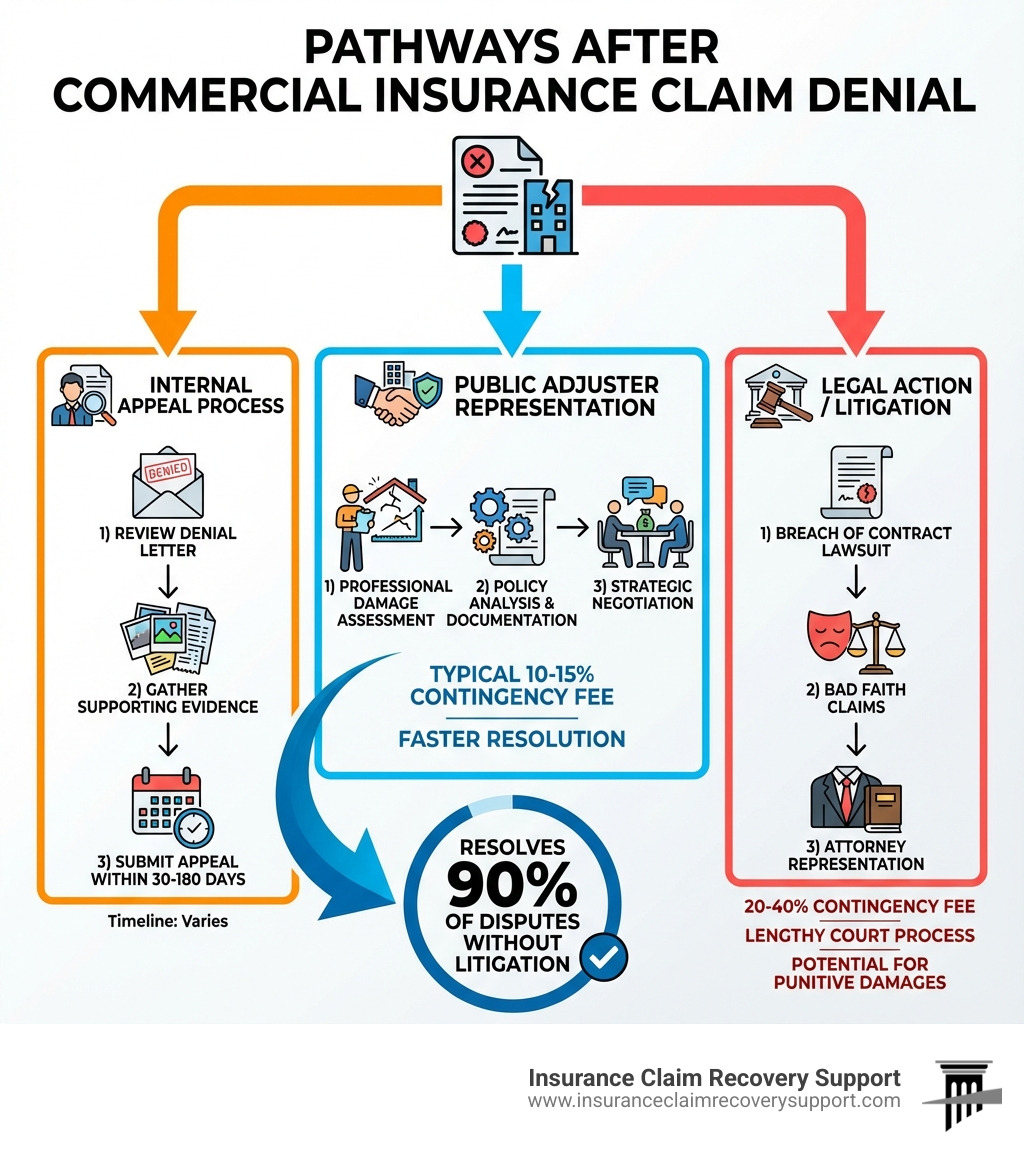
After a denial, you have two main avenues: an internal appeal or legal action. The first step is always to review the denial letter, which must state the specific reasons and policy language used. Next, gather all evidence, including photos, contractor estimates, expert reports, and all written communication with your insurer.
Internal Appeal Process
An internal appeal involves formally disputing the denial with your insurance company by submitting a written appeal with supporting evidence. This process has strict deadlines. While you can do this yourself, a public adjuster can significantly strengthen your appeal.
Filing a Complaint with the State
If an appeal fails, you can file a complaint with your state’s Department of Insurance. In Texas, for example, the Texas Department of Insurance can investigate whether the company acted in good faith. This can prompt the insurer to re-evaluate your claim.
| Feature | Internal Appeal Process | Litigation (Legal Action) |
|---|---|---|
| Goal | Reverse denial, get claim paid | Enforce contract, recover damages (including punitive) |
| Parties Involved | Policyholder, Insurer | Policyholder, Insurer, Attorneys, Courts |
| Cost | Minimal (time, expert reports) | High (attorney fees, court costs, expert witness fees) |
| Timeframe | Weeks to months | Months to years |
| Complexity | Moderate (policy review, evidence gathering) | High (legal strategy, findy, trials, appeals) |
| Outcome | Reversal of denial, claim payment | Settlement, judgment (can include bad faith damages) |
| Representation | Public Adjuster highly recommended | Denied Commercial Insurance Claim Lawyer essential |
| Risk | Low (minimal financial outlay) | High (significant financial and time commitment) |
What is Insurance Bad Faith and How Does it Affect Your Claim?
“Bad faith” refers to an insurer’s failure to uphold its legal and contractual duties to policyholders. Insurers must deal with claimants fairly, honoring their contracts and paying legitimate claims promptly. When they fail to do so, it may constitute bad faith.
Common bad faith actions include:
- Denying a claim without a proper investigation.
- Unjustifiably delaying the processing or payment of a claim.
- Deliberately misinterpreting policy language to avoid payment.
- Offering a settlement that is substantially less than the claim is worth.
- Failing to provide a clear and specific reason for a denial.
When an insurer acts in bad faith, they may be forced to pay the original claim amount plus additional damages, including legal fees and, in some cases, punitive damages. Proving bad faith requires meticulous documentation and often the expertise of a denied commercial insurance claim lawyer who understands the legal standards in your state.
The Role of a Denied Commercial Insurance Claim Lawyer vs. a Public Adjuster
When facing a denied commercial insurance claim, it’s crucial to understand whether you need a denied commercial insurance claim lawyer or a public adjuster. While both advocate for you, their roles and methods differ significantly.

A public adjuster, like our team at Insurance Claim Recovery Support (ICRS), specializes in the claim adjustment process. We assess damages, interpret policy language, and negotiate with the insurer to maximize your settlement without going to court. A denied commercial insurance claim lawyer specializes in legal action, representing you in court if a lawsuit for breach of contract or bad faith becomes necessary.
When Should You Hire a Denied Commercial Insurance Claim Lawyer?
While we aim to resolve claims without litigation, hiring a lawyer is essential in certain scenarios:
- Breach of Contract: Your insurer clearly violated the policy, requiring a lawsuit to enforce the contract.
- Bad Faith Litigation: The insurer engaged in bad faith practices, and you wish to pursue additional damages.
- Refusal to Negotiate: The insurer is unwilling to offer a fair settlement after negotiation attempts.
- Complex Legal Disputes: The claim involves highly complex legal interpretations that require an attorney’s expertise.
- Litigation is Imminent: The claim is already moving toward depositions, findy, or trial.
Legal action is a lengthy, expensive, and stressful process. That’s why we prioritize resolving claims without needing a lawyer whenever possible.
How a Public Adjuster Can Help You Avoid Litigation
Our value at ICRS is our ability to resolve complex commercial claims without costly litigation. Our 90% settlement success rate without unnecessary lawsuits speaks to our effective approach.
Here’s how a public adjuster helps you avoid court:
- Expert Claim Preparation: We have deep knowledge of commercial policies and conduct thorough damage assessments, often using our network of engineers and contractors. This counters the insurer’s lowball estimates.
- Strategic Negotiation: As seasoned negotiators, we understand insurance company tactics. We present a carefully documented claim and advocate forcefully for a fair settlement, often reversing denials through negotiation alone.
- Faster, Cost-Effective Resolution: We typically resolve claims faster than the years-long litigation process. Our contingency fees (10-15%) are generally lower than attorney fees (20-40%), maximizing your net recovery.
Our primary goal is to achieve the maximum settlement for you without an adversarial court battle. For more information, see how we can help with denied claims.
Fact vs. Myth: Common Questions About Denied Commercial Claims
- Fact or Myth? “You must always sue after a denial.”
- Myth: This is a common misconception. Many claims are successfully resolved through strategic negotiation with a public adjuster. Litigation is a last resort.
- Fact or Myth? “A public adjuster can’t help after a denial.”
- Myth: Public adjusters are often most effective after a denial. We review the insurer’s reasoning, find flaws, and present a compelling case to reverse the decision.
- Fact or Myth? “Legal action guarantees a higher payout.”
- Myth: Litigation is uncertain and costly. While professional representation leads to higher payouts on average, a skilled public adjuster can often achieve comparable settlements without the stress and higher fees of a lawsuit.
Understanding the Costs and Potential Outcomes
Understanding the costs of professional help is crucial. A denied commercial insurance claim lawyer typically works on a contingency fee of 20% to 40% of the recovery, plus court costs. Public adjusters also work on contingency, but fees are generally lower, between 10% and 15%.
At ICRS, our focus is on maximizing your net recovery. The value of expert representation is clear, but our goal is to achieve that outcome while reducing delays and avoiding the need for litigation. We advocate for property managers, building owners, and HOAs across Texas, Florida, Georgia, and other states to help them recover fully.
Don’t let a denial be the final word. With the right professional support, you can challenge your insurer and secure the settlement you deserve.
Get help with your denied claim today, and let us help you steer the storm.