What You Need to Know About HOA Insurance Claims
HOA Insurance Claims are filed by homeowners associations to recover costs for damage to common areas and shared structures after covered events like fire, wind, or hail. Here’s what you need to know:
Key Facts:
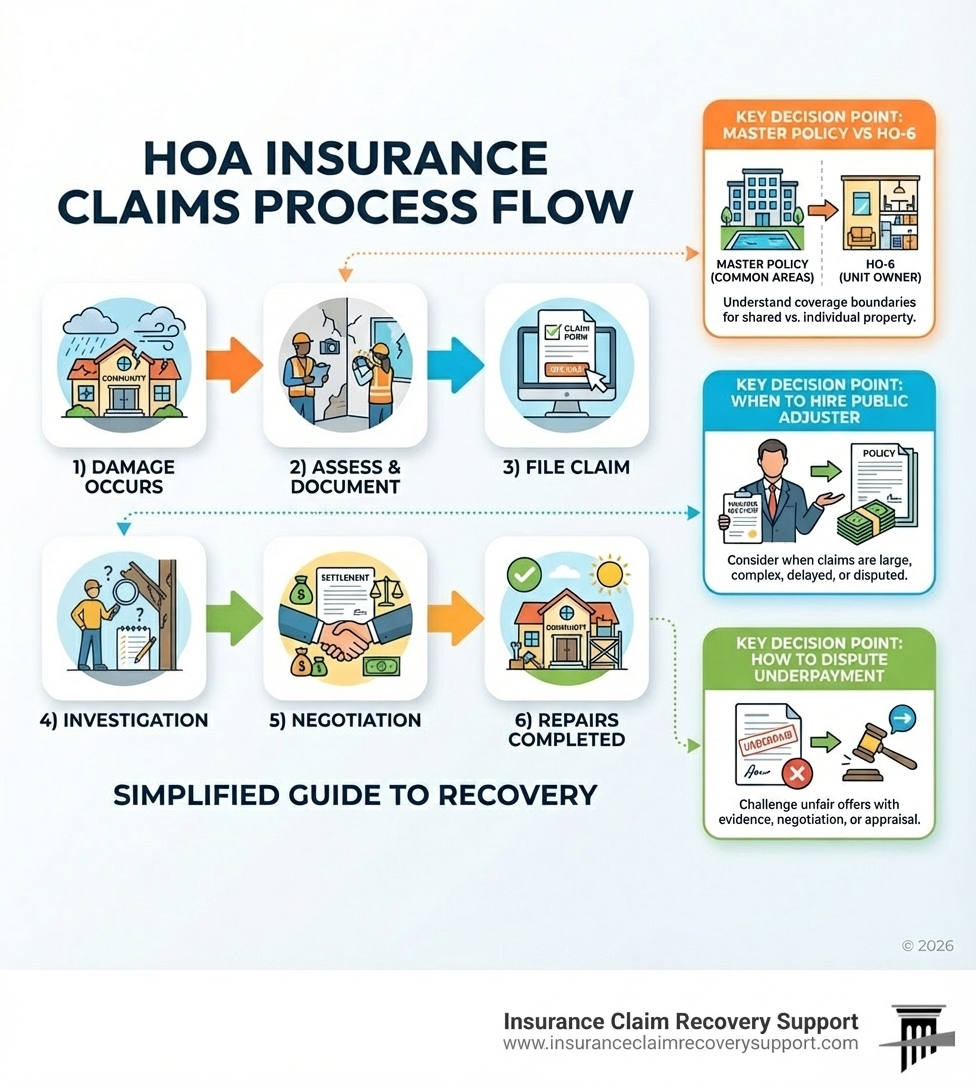
- Coverage Division: The HOA’s master policy covers common areas (roofs, hallways, pools) and building structures. Individual unit owners’ HO-6 policies cover their interiors and personal property.
- Filing Process: Claims must be reported promptly, typically within 48-72 hours, with thorough documentation like photos and damage descriptions.
- Common Challenges: HOA claims are often complex and prone to delays, underpayments, or denials due to disputes over coverage, insufficient documentation, or alleged maintenance issues.
- Dispute Resolution: When disputes arise, associations can negotiate, hire a public adjuster to maximize their settlement, or pursue appraisal/litigation as a last resort.
When disaster strikes a condominium or multifamily community, the HOA board must act quickly to file an insurance claim. However, the process is uniquely complex. It involves overlapping coverages between the master policy and individual HO-6 policies, strict reporting deadlines, and governing documents that dictate responsibility. Insurers often dispute these claims, citing maintenance issues or coverage exclusions, leading to frustrating delays and underpayments.
With insurance rates for community associations at an all-time high, maximizing every claim dollar is more critical than ever. Understanding the claims process is essential to protecting your association’s financial health and avoiding costly litigation.
As Scott Friedson, CEO of Insurance Claim Recovery Support (ICRS), I’ve successfully settled hundreds of millions of dollars in HOA Insurance Claims for communities nationwide. This guide will walk you through the process, from understanding your policy to overcoming disputes and securing a fair settlement.
Understanding HOA Insurance: Master Policies and Key Coverages
When disaster strikes, an HOA has a fiduciary duty to its members to manage repairs and steer the intricate world of HOA Insurance Claims. With insurance rates at historic highs, understanding your policies is crucial for a successful recovery.
HOA Master Policy vs. Individual HO-6 Insurance
A common point of confusion is the difference between the HOA’s master policy and an individual owner’s HO-6 policy. They serve separate, distinct roles.
HOA Master Policy: This policy is the HOA’s primary protection, covering shared property. This generally includes:
- Building Structure: The roof, foundation, exterior walls, hallways, lobbies, and elevators.
- Common Areas: Clubhouses, pools, fitness centers, playgrounds, and landscaping.
- Liability: Protects the HOA if someone is injured in a common area.
Individual HO-6 Insurance: Purchased by unit owners, this policy covers what the master policy doesn’t:
- Personal Property: Furniture, electronics, clothing, and other belongings.
- Interior Finishes: Depending on the master policy, this can include flooring, cabinets, and fixtures within the unit.
- Personal Liability: Covers injuries that occur inside your private unit.
- Loss Assessment Coverage: An important add-on that covers the owner’s share of a special assessment levied by the HOA after a large loss.
Master policies are typically structured as either “Bare Walls-In” (covering only the basic structure) or “All-In” (also covering fixtures and installations within units). The HOA’s governing documents (declarations and bylaws) define which type of policy is in place and who is responsible for what. These documents, often guided by standards from organizations like the Community Associations Institute (CAI), are your primary resource for determining liability.
| Feature | HOA Master Policy | Individual HO-6 Policy |
|---|---|---|
| Covers | Building structure, common areas, HOA liability | Personal property, interior fixtures, personal liability |
| Filed By | HOA board or property manager | Individual unit owner |
| Typical Damage | Roof damage, structural issues, common area fires | Damage to personal items, interior unit damage |
Essential Coverages Your HOA Policy Must Include
A comprehensive policy is vital. Key coverages include:
-
Commercial Property Coverage: This is the core protection for physical damage to common buildings and structures. We often recommend Guaranteed Replacement Cost (GRC) to ensure the policy covers the total replacement cost, protecting your HOA from inflation and initial estimate shortfalls. For more details, see our guide on Commercial Property Insurance Claims.
-
General Liability: Protects the HOA against claims of bodily injury or property damage occurring in common areas, such as a slip-and-fall at the community pool.
-
Directors & Officers (D&O) Liability: Protects board members from personal liability for their decisions. Claims can arise from alleged mismanagement or rule enforcement disputes, and defense costs alone can be substantial.
-
Crime and Fidelity Insurance: Protects the HOA from financial losses due to theft, embezzlement, or fraud by employees, board members, or volunteers.
Understanding these coverages is a cornerstone of responsible management. For more on protecting your association, explore our resources on Business Insurance Claims.
The Step-by-Step Process for HOA Insurance Claims
When your community sustains damage, the HOA board has a fiduciary duty to act in the association’s best financial interest. Following a clear, step-by-step approach is key to managing a large-loss claim for a multifamily property or condominium association.

Step 1 & 2: Immediate Response and Filing the Claim
The hours following an incident are critical. Your prompt response can significantly impact the claim’s outcome.
Immediate Actions:
- Mitigate Damage: Your policy requires you to take reasonable steps to prevent further damage, such as tarping a damaged roof or boarding up a broken window. Failure to do so can lead to a partial or full denial of your claim.
- Document Everything: Before any cleanup, take extensive photos and videos of all damage. Create a written report detailing the incident and inventory any damaged common area contents.
- Keep Receipts: Save all receipts for temporary repairs and related expenses, as these are often reimbursable.
Notifying the Insurer: Most policies require you to report a claim “as soon as reasonably possible,” ideally within 48 to 72 hours. Delays can jeopardize your claim. The property manager or a board member typically files the claim. Be ready to provide your policy number, the date and location of the damage, and a clear description of what happened. A crucial first step is to Assess the Damages thoroughly.
Step 3 & 4: Navigating the Investigation and Settlement
Once filed, the claim moves to the investigation and negotiation phase, where complexities often arise.
Working with the Insurer’s Adjuster: Your insurance company will assign an adjuster to your case. This adjuster works for the insurance company. They will inspect the site, review your documentation, and determine the covered loss amount based on their own estimates.
Negotiating and Reviewing the Settlement: Cooperate with the adjuster, but understand that their initial settlement offer is a starting point, not the final word. It is common for insurers to undervalue damages, especially in complex HOA Insurance Claims involving perils like HOA Fire or widespread Texas Storm Damage.
Review the settlement offer carefully. If the amount is insufficient or if additional damage is finded later, you have the right to dispute the offer and reopen the claim. After reaching an agreement, follow the proper Steps to Take After a Property Damage Insurance Claim is Settled to ensure a smooth repair process.
Overcoming Disputes and Maximizing Your Settlement
The path to a fair settlement for HOA Insurance Claims is often an adversarial process. At ICRS, our goal is to protect your association’s financial interests and secure a full settlement without resorting to protracted legal battles.
Why HOA Insurance Claims Get Delayed, Underpaid, or Denied
HOA claims are uniquely challenging. Here are common reasons they are disputed:
- Complex Policy Language: Insurers can use intricate policy details to find loopholes and deny coverage.
- Insufficient Documentation: A lack of thorough photos, videos, and repair estimates weakens your position.
- Late Reporting: Delaying a claim gives the insurer grounds to argue the damage worsened or cannot be accurately assessed.
- Disputes Over Cause: Insurers often blame damage on pre-existing conditions, poor maintenance, or wear and tear instead of a covered event.
- Low Valuation: The insurer’s repair estimate is often far below the actual cost to restore the property.
If you are dealing with an Underpaid, Delayed Insurance Claim, you have the right to dispute it. You can even File a Complaint Against Your Insurance Company if you believe they are acting in bad faith.
Fact vs. Myth: Understanding Your Claim
- Myth: The insurance company’s adjuster works for you.
- Fact: The insurer’s adjuster’s loyalty is to the insurance company.
- Myth: You must accept the first settlement offer.
- Fact: Initial offers are negotiable, and claims can be reopened if more damage is found.
- Myth: You must use the insurer’s recommended contractors.
- Fact: You have the right to choose your own licensed contractor.
When to Hire a Public Adjuster for Your HOA Insurance Claims
Navigating complex HOA Insurance Claims requires specialized expertise. A public adjuster is a licensed insurance professional who works exclusively for you, the policyholder—never the insurance company.
Consider hiring a public adjuster when:
- You Disagree with the Settlement: If the offer is too low or the claim is denied, a public adjuster can reassess the damage and negotiate on your behalf.
- The Loss is Large or Complex: For major damage from fire, hurricanes, or floods, a public adjuster’s expertise is invaluable. They specialize in large-loss commercial and multifamily property claims.
- You Lack Time or Expertise: Board members are volunteers. A public adjuster manages the entire claims process, saving you time and stress.
- You Want to Avoid Litigation: Hiring a public adjuster is the most effective way to resolve a claim dispute without a costly lawsuit. As detailed in our comparison of a Public Adjuster vs. Insurance Company for Property Damage Claim, a public adjuster focuses on negotiation and settlement, while litigation is a last resort. Our firm, ICRS, has a 90% success rate in settling claims without unnecessary litigation.
We specialize in maximizing settlements for HOAs and condominium associations facing damage from fire, hail, hurricanes, tornados, winter storms, and water loss. Our team serves clients in Texas (including Austin, Dallas-Fort Worth, Houston, San Antonio), Florida, and many other states.
If your HOA is facing a complex or underpaid claim, don’t go it alone. Contact us for help with your Homeowner Association Claim for a free consultation.