Why Fire Central Texas Is a Growing Threat to Commercial and Multifamily Properties
Fire central texas is an active, year-round danger — and right now, conditions are serious. Here’s a quick snapshot of what property owners and managers need to know:
🔥 Current Fire Central Texas Situation at a Glance
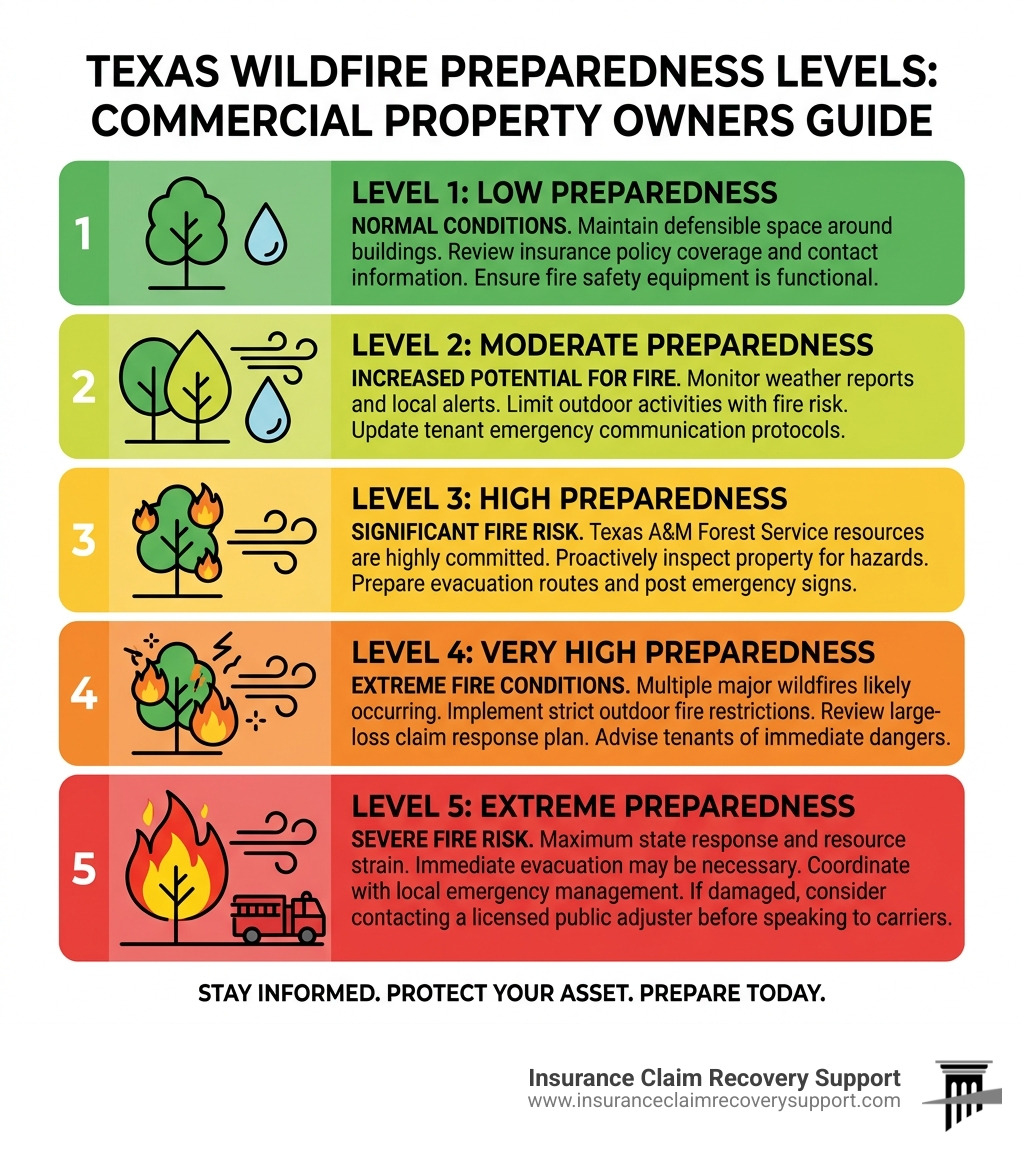
- Preparedness Level: Texas A&M Forest Service is currently operating at Level 3
- 2025 Activity: More than 350 wildfires have burned nearly 44,000 acres statewide
- Recent Central Texas fires: Nebo Mountain (Gillespie County, 1,160 acres), Cedar Gulch (Burnet County, 237 acres), Granite Valley (Llano County, 169 acres), Onion Creek (Hays County, 174 acres), Sandy Creek (Bastrop County, 20 acres, 75% contained)
- Peak season: Late February through April, with red flag warnings nearly doubling in March and April
- At-risk properties: Nearly 100,000 homes and countless commercial and multifamily structures in Travis County sit inside the wildland-urban interface (WUI)
- If you have an active fire claim: Contact a licensed public adjuster before speaking with your carrier’s adjuster
If a wildfire has already damaged your commercial or multifamily property, your next move matters enormously. The insurance claims process for large-loss fire damage is complex, and underpaid or delayed settlements are common — especially when carriers send their own adjusters to assess your loss.
Texas ranks third in the nation for homes at risk from wildfires, and 85% of Texas wildfires ignite within two miles of a community. For apartment operators, commercial property owners, HOA managers, and hospitality businesses in Central Texas, that statistic isn’t abstract — it’s a direct threat to your asset, your tenants, and your bottom line.
The stakes are high and the window to act is narrow. Understanding both the fire risk landscape and your insurance claim rights is the first step toward protecting what you’ve built.
I’m Scott Friedson, CEO of Insurance Claim Recovery Support (ICRS) and a multi-state licensed public adjuster based in Austin, TX — ground zero for fire central texas risk — with more than 15 years of experience settling hundreds of millions of dollars in large-loss commercial and multifamily fire claims. In this guide, I’ll walk you through exactly what’s happening on the ground, what your policy should cover, and how to avoid the costly mistakes that leave property owners undercompensated.
Important fire central texas terms:
Navigating the Current Fire Central Texas Landscape
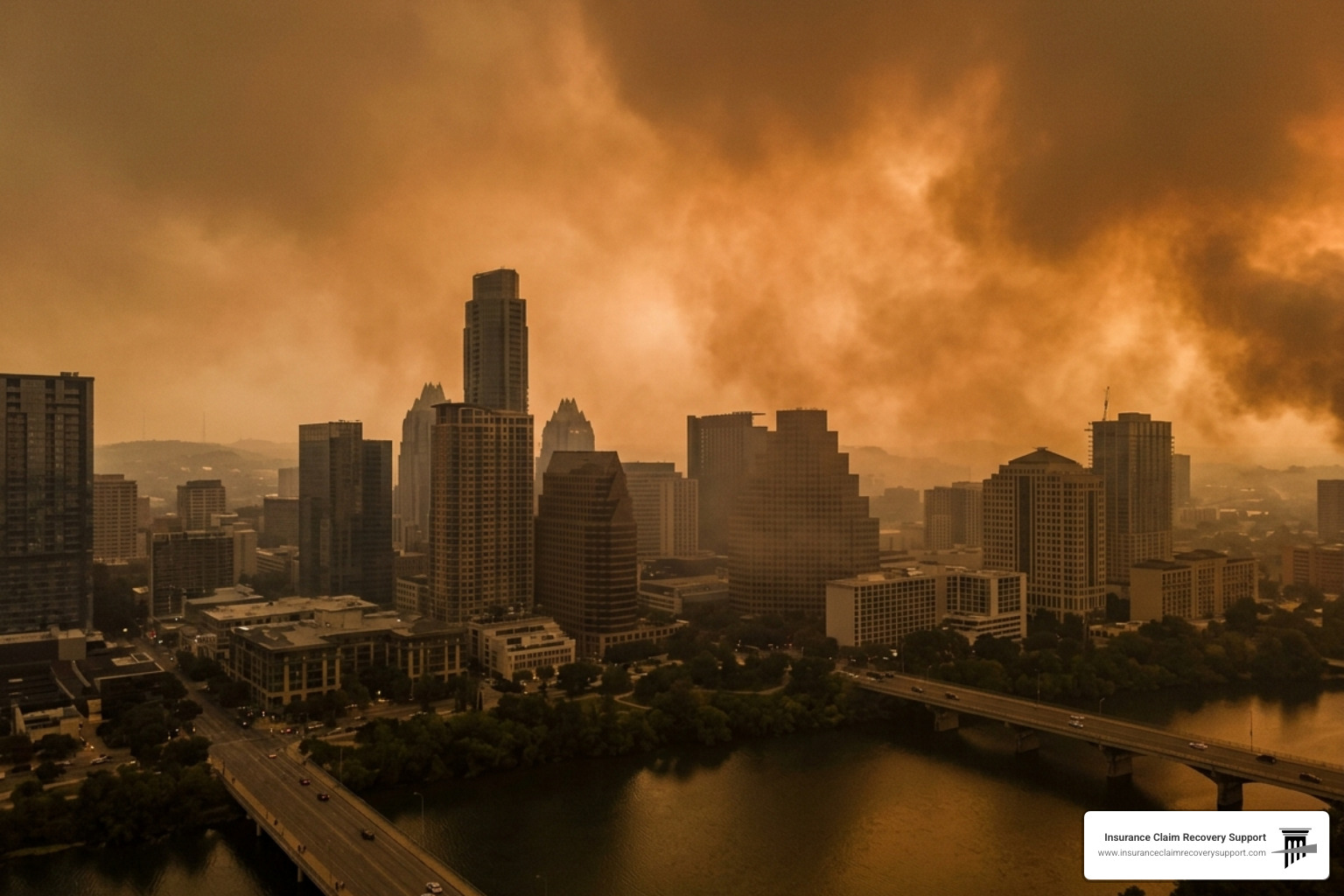
The reality of fire central texas is that it is no longer a seasonal concern; it is a persistent operational risk. We are seeing a significant uptick in activity as we move through 2025. The Texas A&M Forest Service has been working overtime, responding to hundreds of calls as dry conditions and high winds create a “perfect storm” for ignition.
For those of us managing large assets in Austin, San Antonio, or Waco, staying informed isn’t just about safety—it’s about business continuity. When the smoke clears, the financial health of your property depends on how well you documented the risk before the embers flew.
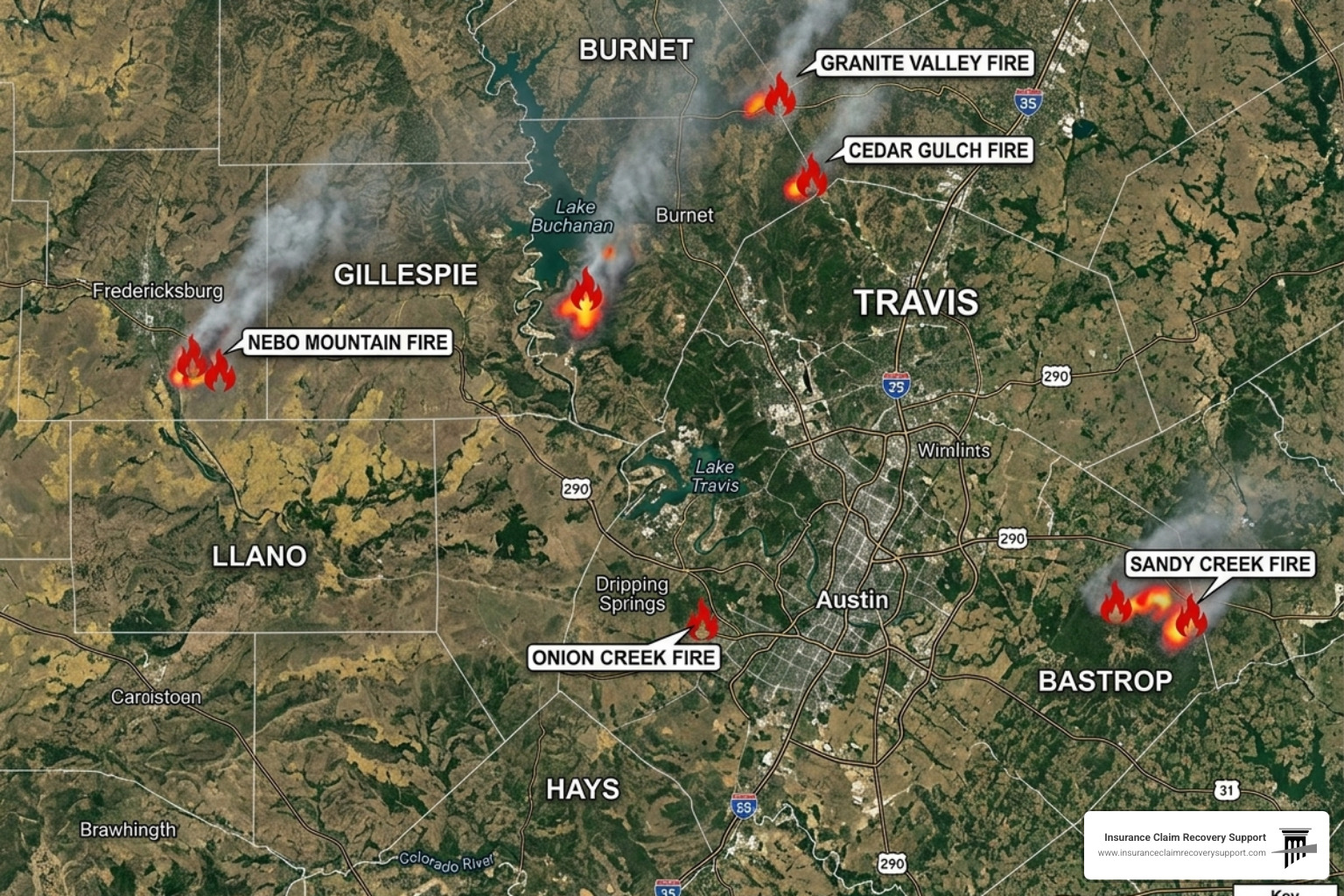
Active Wildfires and Regional Risk Factors in Fire Central Texas
Currently, several incidents are drawing the attention of state resources. The Nebo Mountain fire in Gillespie County recently scorched 1,160 acres, while the Cedar Gulch fire in Burnet County and Granite Valley in Llano County collectively burned over 400 acres. Closer to the I-35 corridor, the Onion Creek fire in Hays County grew to 174 acres, and the Sandy Creek fire in Bastrop County destroyed two outbuildings before reaching high containment levels.
What is driving this? It’s a combination of “freeze-cured” grasses and volatile weather. In late winter and early spring, grasses that were killed or “cured” by winter freezes become highly flammable fuel. When you add humidity levels as low as 10-15% and wind gusts reaching 40-50 mph, you get “red flag” conditions. These conditions are statistically most prevalent in March and April, making this the most dangerous window for fire central texas.
Furthermore, human activity remains a primary cause. Whether it’s a discarded cigarette or a downed power line, 85% of these fires start within two miles of a community. This proximity is why the Wildland-Urban Interface (WUI) risk is the single greatest threat to multifamily and commercial real estate in the region.
Protecting Multifamily Assets in the Fire Central Texas WUI
If your apartment complex or shopping center is located in Travis County, you are likely part of the 100,000-home equivalent risk group within the WUI. Austin was the first major Texas city to adopt the International Wildland-Urban Interface Code, which sets standards for fire-resistant construction materials.
To mitigate risk, we recommend several “Ready, Set, Go!” steps:
- Defensible Space: Maintain a 30-foot buffer of cleared vegetation around your structures.
- Hardening the Structure: Clear roofs and gutters of debris that can ignite from wind-blown embers.
- HIZ Evaluations: Request a Home Ignition Zone (or Structure Ignition Zone) evaluation. The Austin Fire Department offers these to help identify vulnerabilities like ember intrusion points.
- Emergency Alerts: Ensure your management team is signed up for “Warn Central Texas” to receive real-time evacuation and burn ban updates.
For owners already facing damage, getting professional Fire Damage Claim Help/ is critical. Wildfire damage isn’t always as obvious as a charred wall; smoke, soot, and ash can infiltrate HVAC systems and building envelopes, leading to long-term liability and health issues.
Managing Large-Loss Commercial and Multifamily Fire Claims
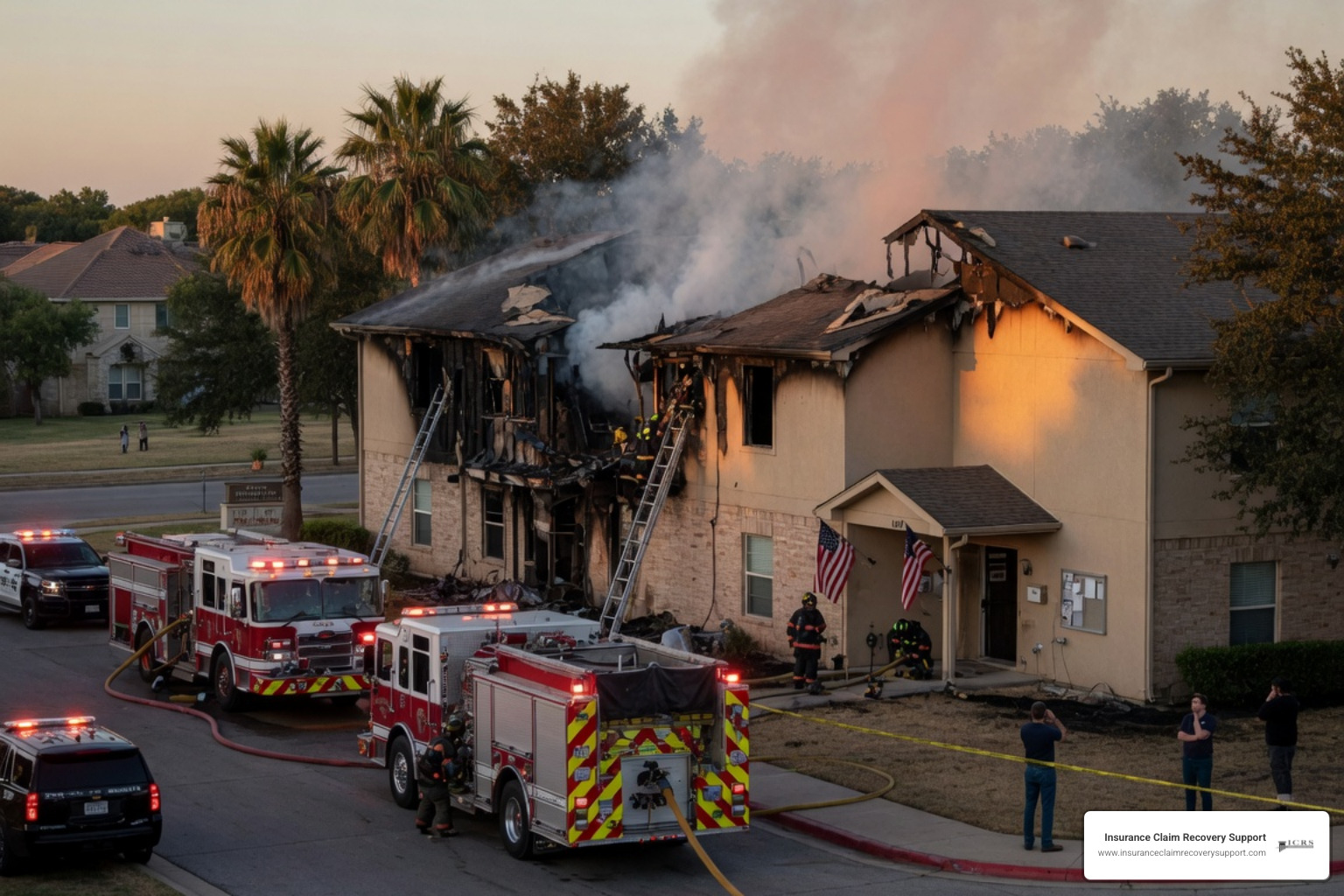
When a major fire hits a multifamily complex or an industrial facility, the “loss” extends far beyond the physical structure. You’re looking at displaced tenants, lost rental income, and massive business interruption. This is what we call a “large-loss” claim.
Managing these claims requires more than just a standard contractor; it requires a deep understanding of policy language and the ability to prove every cent of the loss to an insurance company that is incentivized to pay as little as possible.
Public Adjuster vs. Litigation: Avoiding Unnecessary Lawsuits
One of the biggest mistakes we see property owners make is jumping straight into a lawsuit when a claim is delayed or underpaid. While attorneys have their place, litigation is often slow, expensive, and adversarial. At ICRS, we take a different approach. We are licensed public adjusters who represent you—the policyholder—exclusively.
Our goal is to resolve claims through a rigorous, evidence-based adjusting process. We boast a 90% settlement success rate without the need for unnecessary lawsuits. By avoiding the “appraisal” trap and litigation, we often get our clients paid faster and more fairly.
Consider the “demand surge” factor. After a major event like a fire central texas outbreak, the cost of labor and materials in Austin or San Antonio skyrockets. An insurance company’s “standard” pricing won’t cover these real-world costs. We use our expertise as a Fire Insurance Public Adjuster/ to ensure your settlement reflects current market reality. For a deeper dive into these complexities, see our Fire Damage Disputes Ultimate Guide/.
Essential Steps for Commercial Property Fire Recovery
If your property has been impacted, your priority (after safety) is documentation.
- Secure the Scene: Prevent further damage (like water intrusion or theft), but do not begin permanent repairs until the adjuster has seen the site.
- Professional Documentation: We don’t just take photos; we use thermal imaging and moisture meters to find hidden smoke and water damage.
- Business Interruption: Gather your rent rolls and financial statements. You are entitled to recover the income lost while your building is uninhabitable.
- Environmental Concerns: In older buildings, fire can disturb hazardous materials. Be sure to check for Asbestos Fire/ risks and Fire Mold/ issues resulting from firefighting water.
Managing a Multifamily Fire Insurance Claim/ is a full-time job. While you focus on your tenants and operations, we focus on the carrier.
Fact vs. Myth: Commercial Fire Insurance Realities
Myth: My insurance company’s adjuster is looking out for my best interests. Fact: The carrier’s adjuster works for the carrier. Their job is to settle the claim according to the company’s “roadmap,” which often includes minimizing payouts. A Fire Claim Adjuster/ hired by you is the only one legally obligated to represent your interests.
Myth: I have to accept the first check the insurance company sends. Fact: That check is often an “undisputed” amount. You can—and should—seek additional funds if the initial estimate doesn’t cover the full cost of restoration.
Myth: I need a Fire Property Damage Attorney/ to get a fair settlement. Fact: Most claims can be settled through professional public adjusting. Attorneys take a large percentage of the total settlement and often move at a much slower pace than an adjuster who is focused on the technical details of the damage.
Conclusion: Securing Your Settlement with Expert Advocacy
The threat of fire central texas is a reality of doing business in the Lone Star State. From the high-risk WUI areas of Austin and Lakeway to the growing corridors of Waco and San Antonio, property owners must be vigilant.
When disaster strikes, don’t leave your financial recovery to chance. Insurance companies have teams of experts working to protect their bottom line—you deserve a team working to protect yours. Insurance Claim Recovery Support (ICRS) specializes in maximizing settlements and reducing the stress of the claims process for multifamily and commercial owners.
We serve all major Central Texas hubs, including:
- Austin
- San Antonio
- Waco
- Round Rock
- Georgetown
- Lakeway
If you are dealing with a large-loss fire, smoke, or wildfire claim, reach out to us for a professional consultation. We advocate for property managers, apartment investors, and commercial owners to ensure they receive every dollar they are owed under their policy.
Ready to secure your recovery? Contact Insurance Claim Recovery Support for Public Adjuster Services
Frequently Asked Questions
Q: What is the current wildfire situation in Central Texas? A: As of early 2025, Texas is at Preparedness Level 3. Hundreds of fires have burned tens of thousands of acres, particularly in the WUI areas surrounding Austin and the Hill Country.
Q: Does my commercial policy cover wildfire smoke damage? A: Most commercial property policies cover smoke and soot, but carriers often dispute the extent of the damage. Professional testing is usually required to prove the need for specialized cleaning or HVAC replacement. More info on wildfire smoke impacts can be found here.
Q: How long do I have to file a fire claim in Texas? A: While Texas law provides a window, your specific policy likely has “prompt notice” requirements. Delaying a claim can give the carrier a reason to deny coverage.
Q: What is the difference between a public adjuster and a company adjuster? A: A company adjuster is an employee or contractor for the insurance company. A public adjuster is an independent professional licensed by the state to represent the policyholder’s interests only. Fire Damage Claims/ are significantly more successful when handled by a public adjuster.