Navigating Systemic Obstacles to Maximize Apartment Fire Settlement
When you are dealing with a large-loss multifamily claim, you aren’t just fighting a “valuation” issue; you are navigating a systemic corporate strategy designed to protect the insurer’s bottom line. In April 2026, the landscape for commercial property owners is more scrutinized than ever. Recent history has pulled back the curtain on how major carriers handle—or mishandle—catastrophic fire claims. To truly maximize apartment fire settlement results, you must recognize these systemic hurdles early.
The scrutiny reached a boiling point during the May 2025 Senate Hearing, where Senator Josh Hawley leveled accusations of “institutionalized fraud” against major carriers like State Farm. The testimony revealed internal “corporate savings targets” that incentivized adjusters to hit predetermined payout outcomes rather than actual repair costs. This followed the Oklahoma Attorney General’s 2025 Hail Focus Initiative, which exposed how carriers used “delay, deny, underpay” roadmaps to hit financial benchmarks. These roadmaps aren’t just theories; they are documented strategies used to suppress the true cost of restoration for apartment complexes and retail centers.
Regulatory pressure has expanded beyond the Senate. In California, the Insurance Commissioner and Los Angeles County officials have launched investigations into carrier transparency, while in Illinois, regulators are probing systemic issues regarding how deductibles are applied and how claims are undervalued. Even at the highest levels of government, the pressure has mounted. In early 2026, President Trump publicly criticized State Farm’s handling of wildfire and fire-related claims, calling for greater transparency and faster payouts for property owners. For an apartment investor in Austin or a property manager in Houston, this means the adjuster walking your site is likely operating under a “playbook” that prioritizes corporate savings over your restoration.
Learn more about the fire claim process guide
Overcoming the “Delay, Deny, Underpay” Playbook to Maximize Apartment Fire Settlement
In Texas, property owners have powerful tools to fight back, specifically Texas Insurance Code 541 (unfair settlement practices) and Texas Insurance Code 542 (the Prompt Payment of Claims Act). These statutes are designed to prevent carriers from dragging their feet. According to the Texas Department of Insurance, carriers must adhere to strict timelines for acknowledging, investigating, and accepting or rejecting a claim. However, carriers often bypass these by using “fragmented decision-making.”
We often see “adjuster licensing gaps” where the person inspecting your multifamily roof or charred units isn’t actually a licensed adjuster, or they lack the authority to make a final call. This allows the carrier to claim they are “still investigating” while non-licensed personnel in a remote office slash the estimates provided by local contractors. This “bad faith” behavior is a primary reason why self-managed claims result in significantly lower payouts. By involving professional advocacy, you force the carrier to deal with experts who speak their language and understand the legal requirements for prompt, fair payment.
Explore effective negotiation strategies for multifamily properties
Why Appraisal and Litigation Often Fail to Maximize Apartment Fire Settlement
Many owners think that if a claim is stalled, their only options are the “Appraisal” clause in the policy or hiring a lawyer. While these have their place, they often come with high costs and massive delays that eat into your recovery.
| Method | Typical Cost | Timeline | Success Rate |
|---|---|---|---|
| Litigation | $10k – $50k+ in legal fees | 12 – 36 months | High, but expensive |
| Appraisal | $5k – $15k (Umpire/Appraiser) | 6 – 12 months | Variable |
| Public Adjuster Advocacy | Contingency % | 3 – 6 months | 90% Settlement Success |
In Florida, litigation costs for property claims average over $10,000 per case, compared to just $1,500 for non-litigated resolutions. In Texas, data shows that 99% of appraisals are policyholder-initiated, and while they result in an average award uplift of $10,000 to $28,000+, the process can still leave the owner waiting months for funds needed to house tenants. For large-loss claims exceeding $250,000, professional public adjuster advocacy is the most efficient route. We focus on settling claims through aggressive negotiation and documentation before you are forced into a multi-year legal battle. Our goal is to resolve the claim for the full replacement cost without the “haircut” taken by legal fees.
Unpacking the process of multifamily property damage claims
Strategic Steps for Multifamily Owners to Secure Full Replacement Costs

To maximize apartment fire settlement outcomes, you must move faster and be more detailed than the insurance company. This starts with mitigation. Most policies require you to protect the property from further damage. If you don’t board up windows or tarp a fire-damaged roof, the insurer may deny the subsequent water or mold damage. This is a common trap used to trigger “failure to mitigate” exclusions.
However, the “obvious” damage is just the tip of the iceberg. Fire produces fine particulate matter (soot and char) that is acidic and corrosive. Scientific research from organizations like the National Fire Protection Association (NFPA) highlights how these particulates can infiltrate HVAC systems, electronics, and structural components, causing long-term degradation. If not professionally cleaned and documented by forensic analysts, these hidden damages will lead to massive out-of-pocket repairs years later. Furthermore, you must account for “Loss of Rents.” If your units are uninhabitable, your business interruption coverage should replace that lost income—but only if you can prove the “period of restoration” required to fix the building correctly. Carriers often try to shorten this period to save money, ignoring the realities of modern supply chains and permitting delays.
Multifamily fire safety and recovery tips
Documenting Large-Loss Damages for Commercial Claims
Documentation is the backbone of any seven-figure settlement. We look beyond the charred wood to building code violations and “Ordinance or Law” coverage. If your 1980s apartment complex in San Antonio burns, you can’t just rebuild it to 1980s standards; you must meet 2026 codes, which often include expensive fire sprinklers, updated electrical systems, or ADA upgrades. Without the right advocacy, insurers will only offer to pay for “like kind and quality,” leaving you to foot the bill for mandatory code upgrades.
Consider the Heidi Manor case, a tragic apartment fire that resulted in a $13 million settlement. While that was a negligence and liability case, it highlights how much is at stake regarding building safety and code compliance. In a property claim, if your policy includes “Replacement Cost Value” (RCV), the insurer owes you the cost to rebuild at today’s prices. If you accept “Actual Cash Value” (ACV), they will subtract years of depreciation, leaving you with a massive out-of-pocket bill. We ensure every square inch of damage is accounted for, from the structural integrity of the foundation to the microscopic soot in the attic insulation.
Get support for apartment complex and HOA claims
Fact vs. Myth: The Truth About Carrier Adjusters
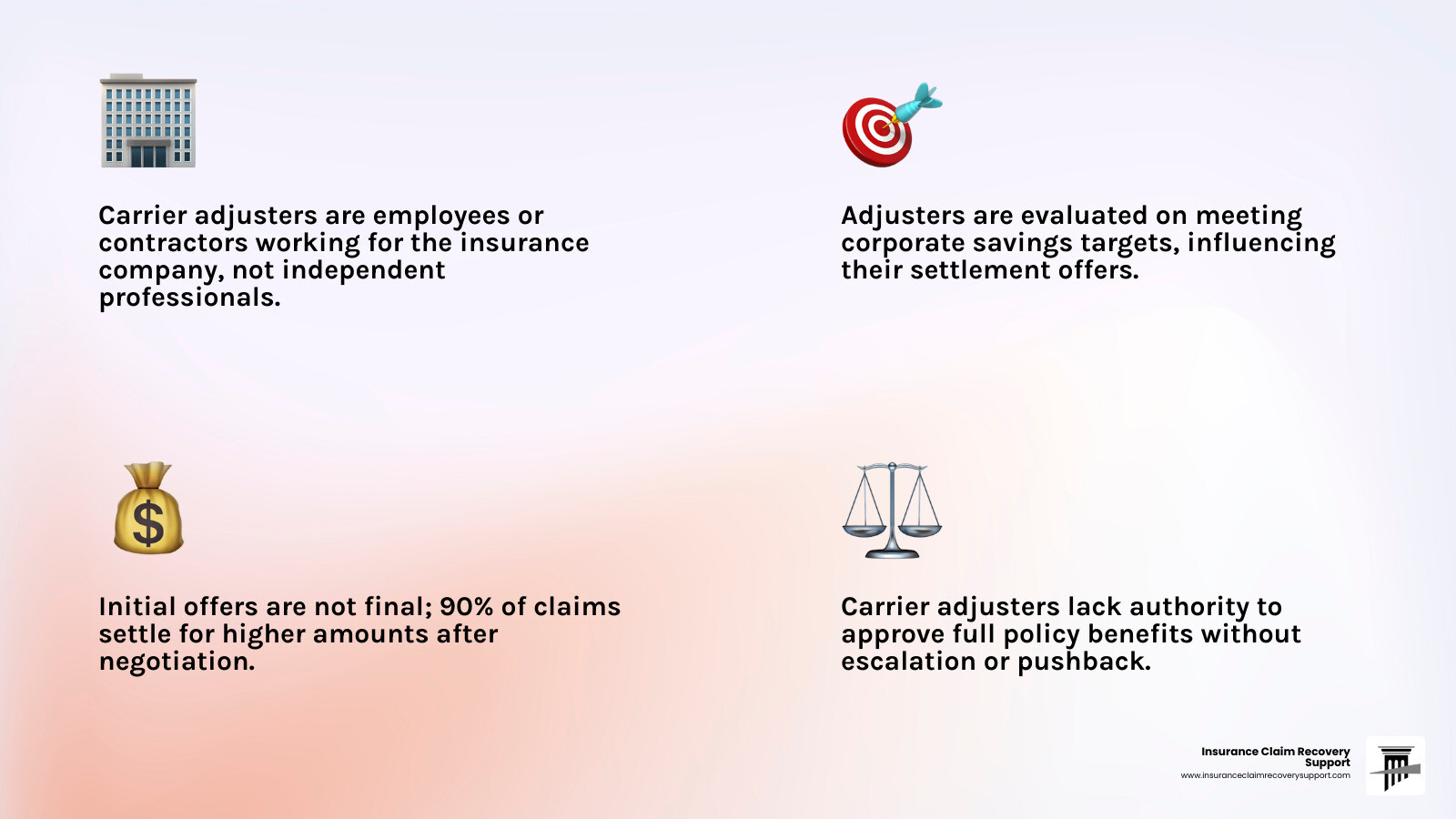
Myth: The adjuster sent by the insurance company is an independent professional looking out for my interests. Fact: Carrier adjusters are employees or contractors for the insurer. They are often measured by their ability to hit corporate savings targets. Translation: When they say, “This is all the policy covers,” they often mean, “This is all I am authorized to offer you without a fight.”
Myth: The initial offer is based on the “market rate” for repairs. Fact: Insurers use software like Xactimate, but they often “tweak” the labor rates and material costs downward. Translation: Their “market rate” is usually 20-40% lower than what a reputable Texas contractor will actually charge you for commercial-grade restoration.
Myth: If I hire a public adjuster, it will delay my claim or make the insurer angry. Fact: ICRS has a 90% settlement success rate without litigation. We actually speed up the process by providing the insurer with the “proof of loss” documentation they need to issue payment. Translation: Professional advocacy forces the carrier to stop playing games and start writing checks because they know they are being watched by experts who understand the Texas Insurance Code.
Read our fire insurance claim survival guide
Conclusion: Partnering with Experts for a 90% Success Rate
An apartment fire is a catastrophic event, but it doesn’t have to lead to financial ruin. By taking proactive steps, documenting every inch of damage, and refusing to settle for the first lowball offer, you can maximize apartment fire settlement results and restore your property to its full value. The “delay, deny, underpay” roadmap used by major carriers is designed to wear you down, but with the right advocacy, you can flip the script.
At Insurance Claim Recovery Support (ICRS), we specialize in representing multifamily and commercial property owners. We are Texas-based, with deep roots in Austin, Dallas, Fort Worth, Houston, San Antonio, and surrounding areas like Lubbock, San Angelo, Amarillo, Waco, Round Rock, Lakeway, Bee Caves, and Georgetown. We don’t just “file” claims; we advocate, negotiate, and win. Our team understands the systemic hurdles put in place by carriers like State Farm, and we know how to use the Texas Insurance Code 541 and 542 to your advantage.
Whether you are dealing with a fire, hail, or hurricane loss, our goal is simple: get you the money you are owed under your contract so you can rebuild without the stress of litigation or the uncertainty of appraisal. We handle the heavy lifting of forensic documentation and aggressive negotiation so you can focus on managing your assets and serving your tenants. Don’t let corporate savings targets dictate your recovery.