Why Fire Insurance Claim Help Is Critical After Property Damage
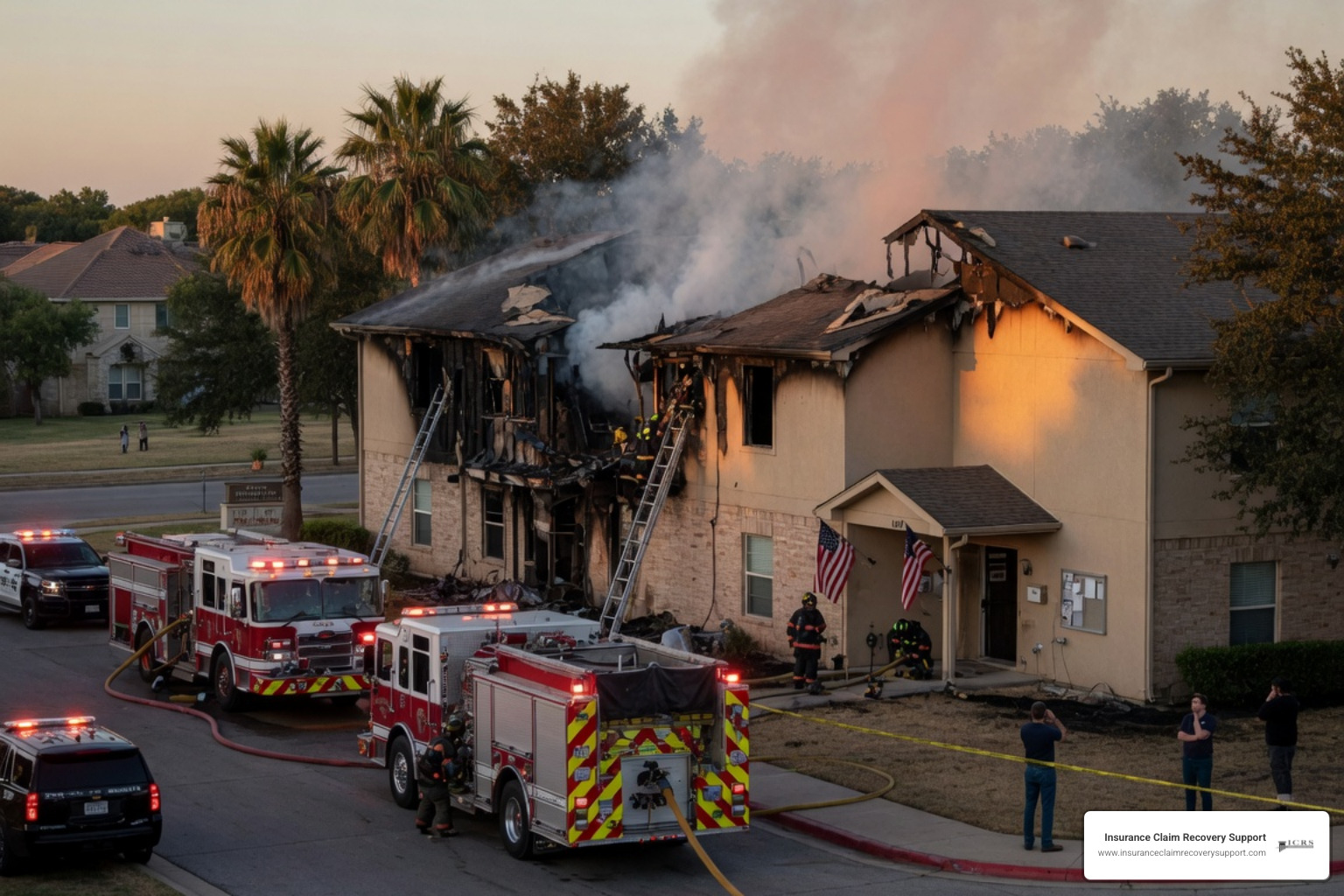
Fire insurance claim help can mean the difference between a full recovery and financial devastation for commercial and multifamily property owners. Whether your office building, apartment complex, hotel, church, or hospital has been damaged by fire, understanding the claim process and knowing when to get professional assistance is essential.
Quick Answer: What You Need to Know About Fire Insurance Claim Help
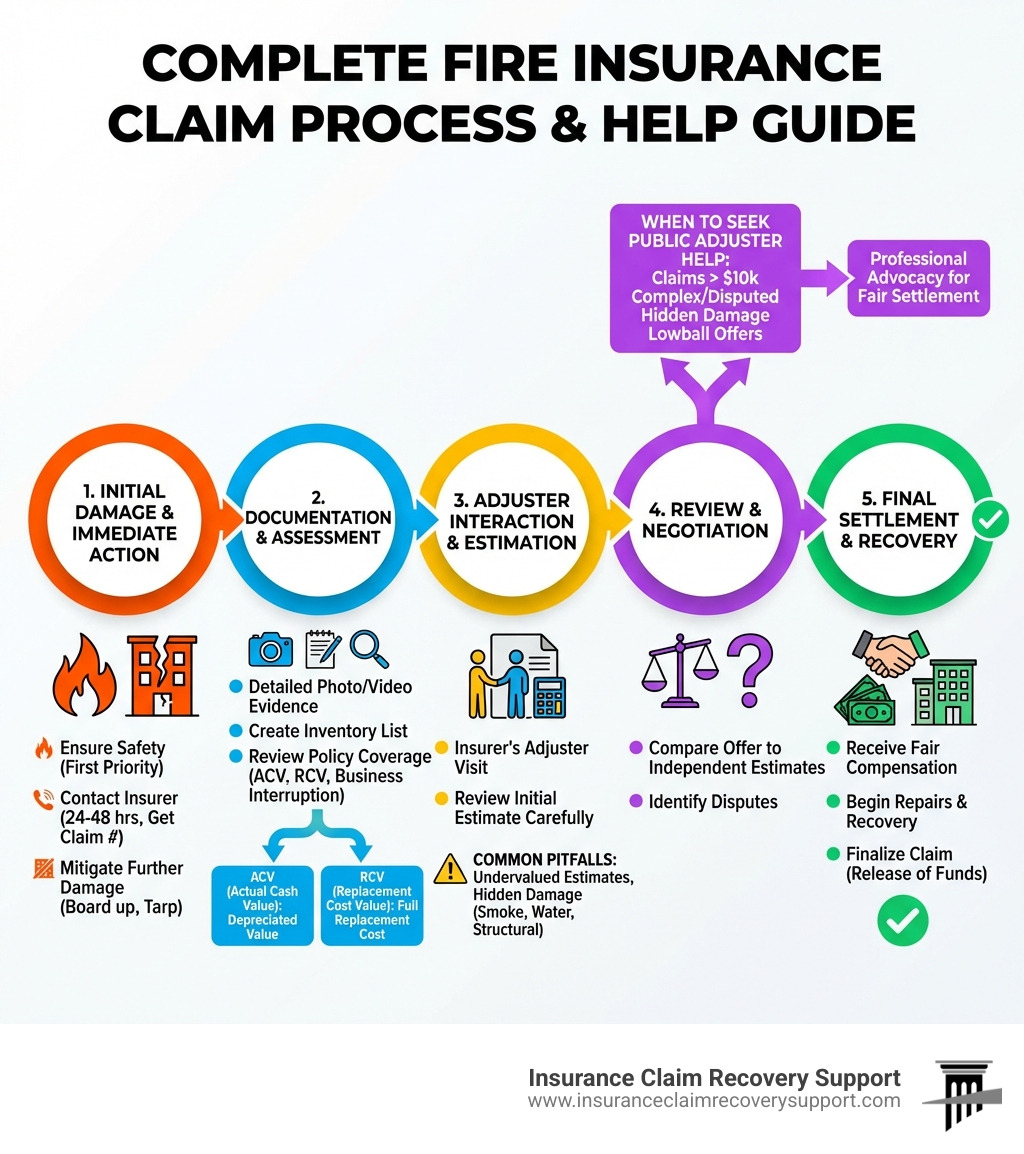
- Contact your insurer within 24-48 hours and request a claim number
- Secure your property immediately to prevent further damage (board windows, tarp roofs)
- Document everything with photos, videos, and detailed inventories before cleanup
- Understand your coverage including ACV vs. RCV, Additional Living Expenses, and Business Interruption
- Consider hiring a public adjuster for claims over $10,000 or when disputes arise
- Never accept the first settlement offer without professional review
- Know your rights regarding building code upgrades and hidden damage (smoke, water, structural)
Fires cause billions in property losses annually. The damage isn’t just what you see; it includes hidden smoke in HVAC systems, water damage from firefighting, and structural issues. Insurers often push for quick, low settlements that overlook these problems, leaving you undercompensated.
Initial settlement offers are often low because they miss hidden damage. For commercial and multifamily owners, the stakes are higher, with business interruption and lost revenue compounding the financial pressure.
As Scott Friedson, CEO of Insurance Claim Recovery Support, I’ve spent over 15 years helping policyholders. We’ve seen professional representation increase fire claim recoveries by 30% to over 3,800%. Proper documentation and expert advocacy can turn an undervalued claim into a fair settlement, often without costly litigation.
Fire insurance claim help basics:
- fire claims adjuster
- fire damage
- fire mitigation companies due diligence checklist for policyholders
Your First 24 Hours: A Step-by-Step Guide After a Property Fire
When a fire strikes your commercial or multifamily property, the actions you take in the first 24-48 hours can profoundly impact your fire insurance claim help and ultimate recovery. Your priorities are safety, securing the property, and notifying your insurer. We understand this overwhelming experience and are here to guide you.

For a detailed federal checklist on returning to a property after a fire, review FEMA’s guidance in After a Fire: Returning to Your Home.
Step 1: Prioritize Safety and Mitigate Further Damage
First, ensure everyone is safe and the fire department has cleared the property for entry. Your policy includes a “duty to mitigate,” which requires you to take reasonable steps to prevent further damage. Failure to do so could jeopardize your claim.
Here is what that involves:
- Secure the Property: Board up broken windows and doors to prevent looting and weather damage. If your roof is damaged, have it professionally tarped. Keep all receipts, as these temporary repairs are often covered.
- Prevent Water Damage: Firefighting leaves behind water that can cause mold within 24-48 hours. Arrange for professional drying and dehumidification immediately.
- Notify Authorities and Utilities: Report the fire to the police and contact your utility providers to shut off services and prevent further hazards.
- Temporary Shelter and Care: For multifamily properties, your policy’s Additional Living Expenses (ALE) may cover temporary housing for tenants. For commercial properties, this might cover temporary operational space. Have any affected pets checked by a vet if applicable to your property.
The goal is to stabilize the situation while preserving evidence for your claim.
Step 2: Document Everything and Notify Your Insurer
Once the scene is safe, begin documenting the damage and notify your insurance company. This is where your journey to successful fire insurance claim help truly begins.
- Contact Your Insurance Company Immediately: Most policies require notification within 24-48 hours. Delays can jeopardize your claim. Get a claim number for all future communications.
- Keep a Detailed Communication Log: Record every call and email: date, time, person’s name, and a summary. This log is your defense against disputes.
- Photo and Video Documentation: Before any cleanup, take photos and videos of everything—every unit, common area, mechanical room, roof, and exterior.
- Create a Comprehensive Inventory (Schedule of Loss): List every damaged item with its description, age, and estimated replacement cost. For commercial properties this is your “Business Personal Property” (BPP) inventory.
- Proof of Ownership and Receipts: Gather purchase receipts, warranties, appraisals, and pre-fire photos to prove ownership and value.
- Do Not Discard Damaged Items: Keep all damaged items, no matter how destroyed, until the insurance adjuster has inspected them. They are evidence for your claim.
For a deeper dive into documenting your claim, explore resources like fire-damage-claims-fl-complete-guide.
Step 3: Understand Your Policy and the Adjuster’s Role
Navigating a fire’s aftermath requires understanding your insurance policy and the adjusters involved. This knowledge is key to effective fire insurance claim help.
An insurance adjuster investigates your claim for the insurance company. A Company Adjuster is an employee, and an Independent Adjuster is a contractor, but both represent the insurer’s interests, not yours.
Your Policy: The Rulebook for Your Claim
Review your policy to understand your coverage, exclusions, and deductibles. Key coverages for commercial and multifamily properties include:
- Dwelling Coverage (Structure): Covers the physical building, including common areas and core systems.
- Personal Property Coverage: For commercial properties, this is “Business Personal Property” (BPP) and covers contents like equipment, furniture, and inventory.
- Additional Living Expenses (ALE) / Loss of Use: Covers costs for displaced tenants or lost rental/business income, depending on how your policy is written.
- Business Interruption (BI): Replaces lost income and covers ongoing expenses while your business is shut down.
Actual Cash Value (ACV) vs. Replacement Cost Value (RCV)
Understanding how your property is valued is critical.
| Feature | Actual Cash Value (ACV) | Replacement Cost Value (RCV) |
|---|---|---|
| Definition | Replacement cost minus depreciation (wear and tear, age). | The cost to repair or replace damaged property with new materials of similar kind and quality, without deduction for depreciation. |
| Initial Payout | You receive the depreciated value of the damaged item. | You typically receive an initial payment based on ACV, with the remaining “recoverable depreciation” paid after the repairs are completed or replacement items are purchased and receipts are submitted. |
| Goal | To put you in the same financial position as before the loss. | To restore your property to its pre-loss condition, often better due to new materials. |
| Impact on Claim | Lower payout, as older items are valued less. | Higher potential payout, but requires you to actually perform repairs/replacements to receive the full amount. There are often time limits for claiming recoverable depreciation. |
| Example | A 10-year-old commercial roof ($150,000 replacement) might get you $40,000 after depreciation and a deductible. | The same roof: you get $40,000 (ACV) upfront. After you replace it for $150,000, you claim the remaining recoverable depreciation, for a total payout close to the full replacement cost, minus your deductible. |
We specialize in ensuring you recover the maximum amount possible, especially for RCV claims. For more on how public adjusters can help, visit public-insurance-claims-adjuster-for-fire-damage.
To better understand general property insurance concepts as a policyholder, you can also review the overview of property insurance on Wikipedia.
Navigating the Claim Maze: Your Guide to Fire Insurance Claim Help
Once you’ve initiated your claim, you enter the complex “claim maze,” where disputes, delays, and underpayments are common. This is where professional fire insurance claim help becomes most critical for commercial and multifamily owners and managers.
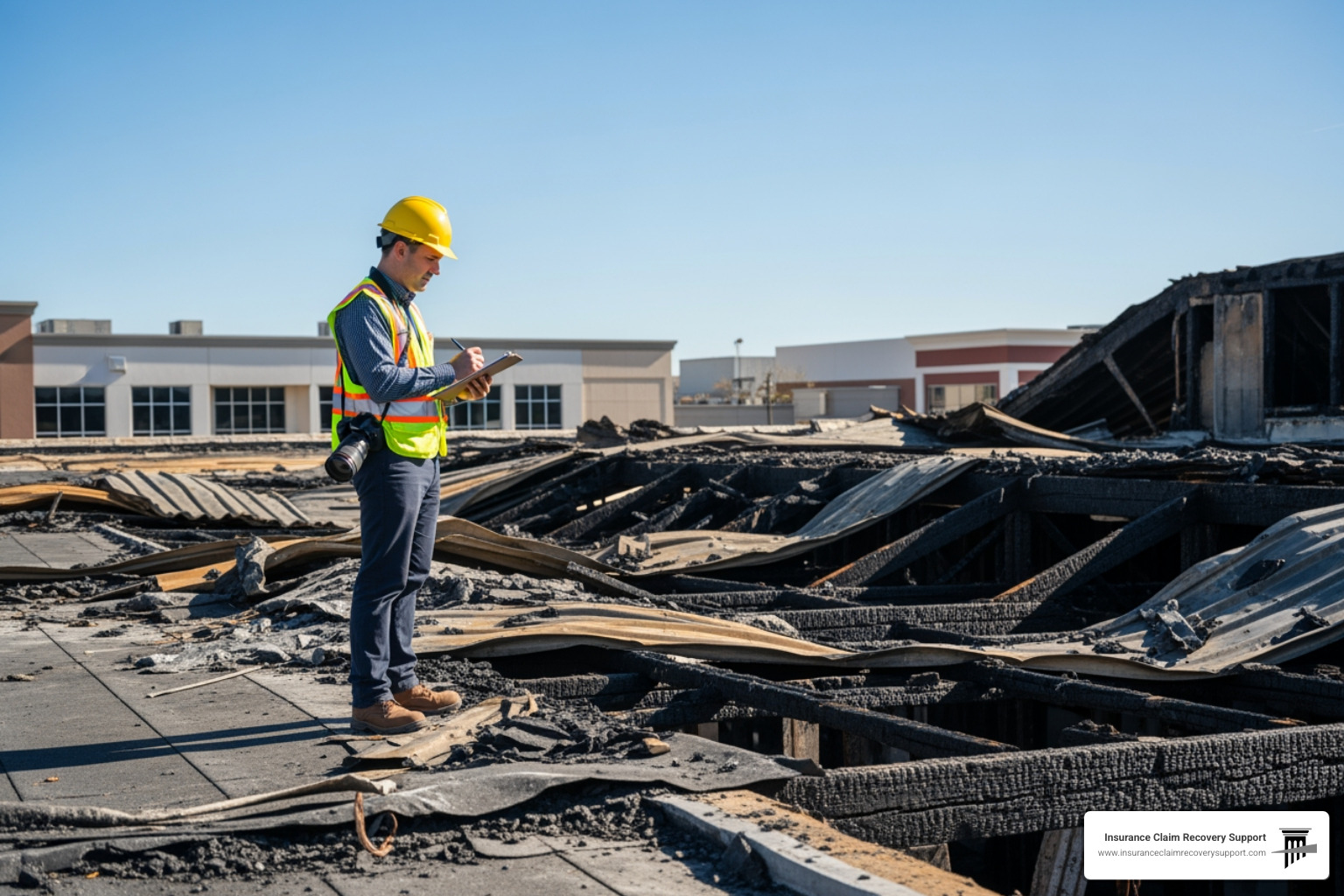
Many property owners battle low settlement offers because the insurance company’s adjuster may not fully capture the extent of hidden damages or accurately value specialized commercial property components.
Common Pitfalls and How to Get the Fire Insurance Claim Help You Need
Here are common challenges and how to overcome them:
- Undervalued Claims: Initial offers are often low because they miss hidden damage from smoke and water in roofs, walls, and mechanical systems.
- Delayed Payments: Insurers may delay payments, pressuring you to accept a low offer out of financial stress from lost rents or business income.
- Scope of Loss Disagreements: Common disputes arise over whether to repair or replace items, like an HVAC system with smoke damage or fire-compromised structural components.
- Hidden Damage: Fire damage includes more than charring. Look for: Smoke and Soot in HVAC systems and behind walls; Water Damage from firefighting leading to mold; and Structural Compromise from extreme heat.
Fact vs. Myth: Public Adjusters and Lawsuits
Myth: “If I hire a public adjuster, I have to sue my insurance company.”
Fact: Public adjusters are licensed claim professionals who focus on negotiation and settlement, not litigation. At Insurance Claim Recovery Support, over 90% of large-loss claims are resolved without unnecessary lawsuits or appraisal.
Myth: “The only way to get a fair fire settlement is to hire an attorney and file a lawsuit.”
Fact: Lawsuits are sometimes necessary, but they are typically slower, more expensive, and more adversarial than working with a skilled public adjuster first. A well-documented, professionally prepared claim often settles without litigation.
Myth: “The insurance company’s adjuster will automatically look out for my best interest.”
Fact: Company and independent adjusters work for the insurer. A public adjuster works for you, the policyholder, to present your loss, challenge low estimates, and push back on improper denials.
When to Hire a Public Adjuster
If you face a low offer, delays, or a denial, you need professional fire insurance claim help. A public adjuster works only for you, the policyholder, to level the playing field by:
- Thoroughly Documenting ALL Damages: We conduct detailed inspections, using experts to find hidden smoke, water, and structural damage that company adjusters miss.
- Building an Evidence-Based Claim: We create a comprehensive claim package based on our findings and your policy to reflect your full loss.
- Negotiating on Your Behalf: We handle all negotiations with the insurer. Public adjusters often help policyholders obtain significantly higher settlements.
- Overturning Denials: We have a track record of overturning wrongful denials by presenting a robust counter-argument. If your claim was denied, visit denied-fire-insurance-claim to see how we can help.
The Road to Recovery: Repairs, Building Codes, and Avoiding Litigation
With a fair settlement in sight, the focus shifts to restoring your property. This stage involves choosing contractors, understanding building codes, and ensuring quality repairs.
- Choosing Contractors and Repair Estimates: You have the right to choose your own licensed contractor. Get multiple, detailed estimates and compare them to the insurer’s.
- Building Code Upgrades (Ordinance or Law Coverage): Repairs may need to meet new, stricter building codes. “Ordinance or Law” coverage is a policy endorsement that pays for these mandatory, and often costly, upgrades.
- Proper Cleaning Standards for Smoke and Water Damage: Insist on professional remediation following industry standards, such as the IICRC standards for fire restoration. This includes comprehensive cleaning of HVAC systems for smoke and immediate drying to prevent mold.
Public Adjuster vs. Lawsuit: What Commercial and Multifamily Owners Should Know
Using a Public Adjuster (Typical Path):
- Claim is filed and a public adjuster is engaged early.
- The public adjuster inspects, documents, and values the loss with experts (estimators, engineers, remediation specialists).
- A detailed claim package is submitted to the insurer.
- The public adjuster negotiates directly with the carrier’s adjusters and consultants.
- Most disputes are resolved through negotiation, reinspection, or appraisal without going to court.
- The owner focuses on operations while the public adjuster manages claim details and deadlines.
Pursuing an Insurance Claim Lawsuit (Typical Path):
- Claim is filed; the policyholder and insurer disagree significantly on scope or value.
- After internal appeals or appraisal fail, an attorney may file suit against the insurer.
- Litigation introduces formal findy, depositions, court deadlines, and potential expert witness costs.
- Timelines can extend for months or years before resolution.
- Legal fees and costs may reduce the net amount you recover.
Public adjusters aim to resolve disputes upfront through documentation, policy interpretation, and negotiation so that litigation becomes a last resort, not a default strategy.
Learn more about the benefits of a public insurance adjuster at www.whatisapublicadjuster.com
For more on how a public adjuster can help avoid litigation while still protecting your rights, see fire-claims-adjuster-2.
Finalizing Your Claim and Protecting Your Investment
As you near the finish line, a few final steps ensure your recovery is complete.
- Wildfire Claims: A Special Consideration: For properties in wildfire-prone areas, damage isn’t just from flames. It’s also from pervasive smoke, ash, and particulate intrusion, which we specialize in documenting.
- Beware of Post-Disaster Scams: Be wary of unsolicited contractors demanding upfront payment. Always verify licenses and get multiple estimates.
- The Final Settlement and Recoverable Depreciation: With an RCV policy, your final settlement should include “recoverable depreciation.” Track your repair expenses and submit receipts to claim this amount, but be aware of deadlines.
- Reopening a Claim: If you find new damage after settling, a claim can often be reopened within certain time limits. Proper documentation is key.
At Insurance Claim Recovery Support, we provide expert fire insurance claim help to commercial and multifamily property owners across Texas (including Austin, Dallas, Fort Worth, Houston, San Antonio, Lubbock, San Angelo, Waco, Round Rock, Georgetown, Lakeway) and in other states where we are licensed, such as Florida, Georgia, Colorado, North Carolina, South Carolina, Oklahoma, Pennsylvania, Ohio, Indiana, Kansas, Kentucky, Maryland, Utah, Nebraska, and Nevada.
We advocate to maximize your settlement, reduce delays, and help you rebuild stronger—while avoiding unnecessary litigation whenever possible.
Don’t let a fire insurance claim burn your bottom line twice. Visit public-claim-adjuster-firm-texas to learn more about our services in Texas, or Contact us for a free claim review today.