Why Fire Insurance Claims Are Critical for Commercial Property Owners
Insurance claim fire damage is one of the most complex and high-stakes challenges commercial and multifamily property owners face. Unlike residential claims, commercial fire losses often involve extensive structural damage, business interruption, tenant displacement, code compliance upgrades, and significant revenue loss—all while carriers scrutinize every detail to minimize payouts.
Quick Answer: What You Need to Know About Fire Insurance Claims
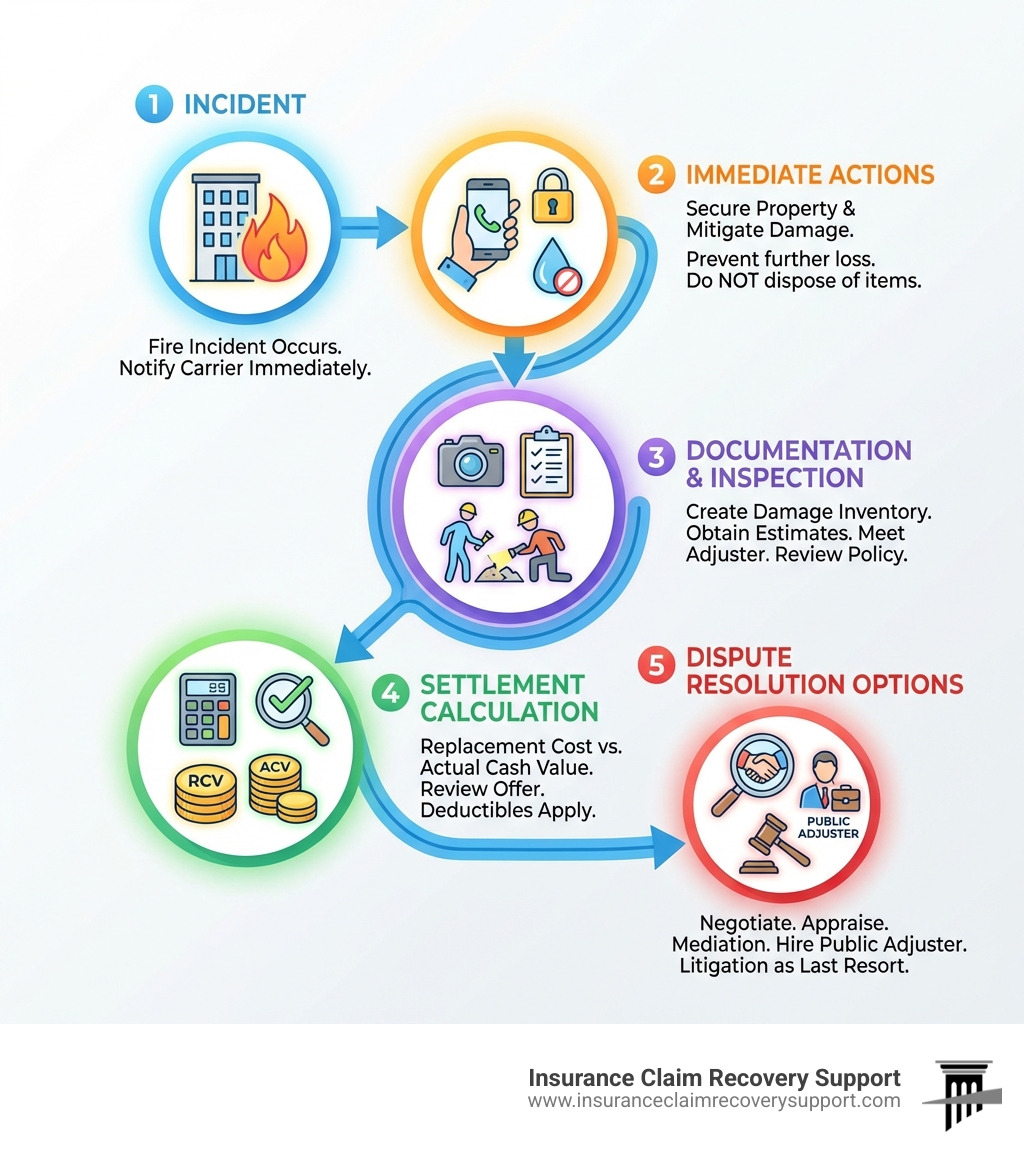
Immediate Actions After a Fire:
- Secure the property (board windows, tarp roof, shut off utilities)
- Contact your insurance company immediately
- Document all damage with photos and video before cleanup
- Do not dispose of any damaged items until adjuster inspection
- Keep receipts for all mitigation and temporary living/relocation expenses
What’s Typically Covered:
- ✅ Structural damage to buildings
- ✅ Personal property and contents
- ✅ Additional Living Expenses (ALE) or Loss of Rents
- ✅ Business interruption losses
- ✅ Smoke, soot, and water damage from firefighting efforts
Common Exclusions:
- �� Arson or intentional acts
- �� Mechanical failure or neglected maintenance
- �� Certain wildfire scenarios (without specific endorsements)
- �� Vacant property fires (depending on policy terms)
Key Settlement Factors:
- Replacement Cost Value (RCV) vs. Actual Cash Value (ACV)
- Policy limits and sub-limits
- Deductibles
- Building code upgrade requirements
Fire is one of the most destructive forces impacting commercial real estate. In Canada alone, there are approximately 24,000 residential house fires each year, with cooking accounting for 27% of home fires. Commercial properties face similar risks at even greater scale—warehouses, apartment buildings, hotels, churches, and office complexes all remain vulnerable to electrical fires, kitchen fires, HVAC failures, and external incidents like wildfires.
The damage caused by fire extends far beyond visible flames. Smoke penetrates throughout premises, combining with humidity to form corrosive residues that etch and pit surfaces. Soot migrates through HVAC systems, contaminating areas far from the fire’s origin. Water damage from firefighting efforts compounds the loss. Appliances and equipment may appear intact but suffer internal malfunctions from intense heat.
For commercial property owners, the financial impact is immediate and severe. Business operations halt. Tenants face displacement. Revenue streams dry up. Lenders demand compliance with loan covenants. Meanwhile, insurance carriers deploy adjusters whose primary goal is to minimize settlement amounts—often by undervaluing structural damage, overlooking hidden losses, or disputing coverage altogether.
Many property owners are shocked to find that their “comprehensive” policies contain significant exclusions. Fire damage from mechanical failure may not be covered. Neglected maintenance can void coverage entirely. Wildfire damage may require specific endorsements. Even when coverage exists, carriers frequently offer lowball settlements based on Actual Cash Value rather than full Replacement Cost, leaving owners to cover the gap.
The claims process itself is daunting. Policyholders must document every damaged item, obtain multiple contractor estimates, complete complex proof of loss forms, and negotiate with experienced insurance adjusters—all while managing the operational crisis of a damaged property. Without expert guidance, owners risk accepting inadequate settlements or facing prolonged disputes that lead to costly litigation.
Myth vs. Fact: Common Fire Claim Misconceptions
Myth: My insurance company will automatically pay what I need to rebuild.
Fact: Carriers typically offer initial settlements well below actual replacement costs. Documentation, expert estimates, and strategic negotiation are essential to maximize recovery.
Myth: I can clean up and start repairs immediately.
Fact: Disposing of damaged items before adjuster inspection can cost you the claim. Secure the property to prevent further damage, but preserve all evidence.
Myth: If my claim is denied or underpaid, my only option is to sue.
Fact: Hiring a public adjuster often resolves disputes without litigation, recovering 30% to 3,800% more than initial offers while avoiding legal costs and delays.
As Scott Friedson, CEO of Insurance Claim Recovery Support, I’ve spent over 15 years settling hundreds of millions of dollars in insurance claim fire damage cases for commercial and multifamily property owners across Texas and nationwide, overturning wrongful denials and increasing recoveries by an average of 30% to more than 3,800%. Whether you’re managing an apartment complex, warehouse, hotel, church, or office building, understanding the fire claim process and your rights under the policy is the first step toward full recovery.
Basic Insurance claim fire damage vocab:
Navigating the Insurance claim fire damage Process for Commercial Properties
When a fire strikes a commercial property in Austin, Dallas, or Houston, the clock starts ticking immediately. The process of filing an insurance claim fire damage is not just about filling out forms; it is a strategic exercise in property preservation and evidence gathering. We cannot stress enough how critical the first 48 hours are for the ultimate success of your settlement.
Immediate Actions and Mitigation Duties
Your insurance policy is a contract, and that contract likely includes a “Duties After Loss” section. One of the most important duties is Fire Mitigation. Failing to protect the property from further damage can give the insurance carrier a reason to deny parts of your claim.
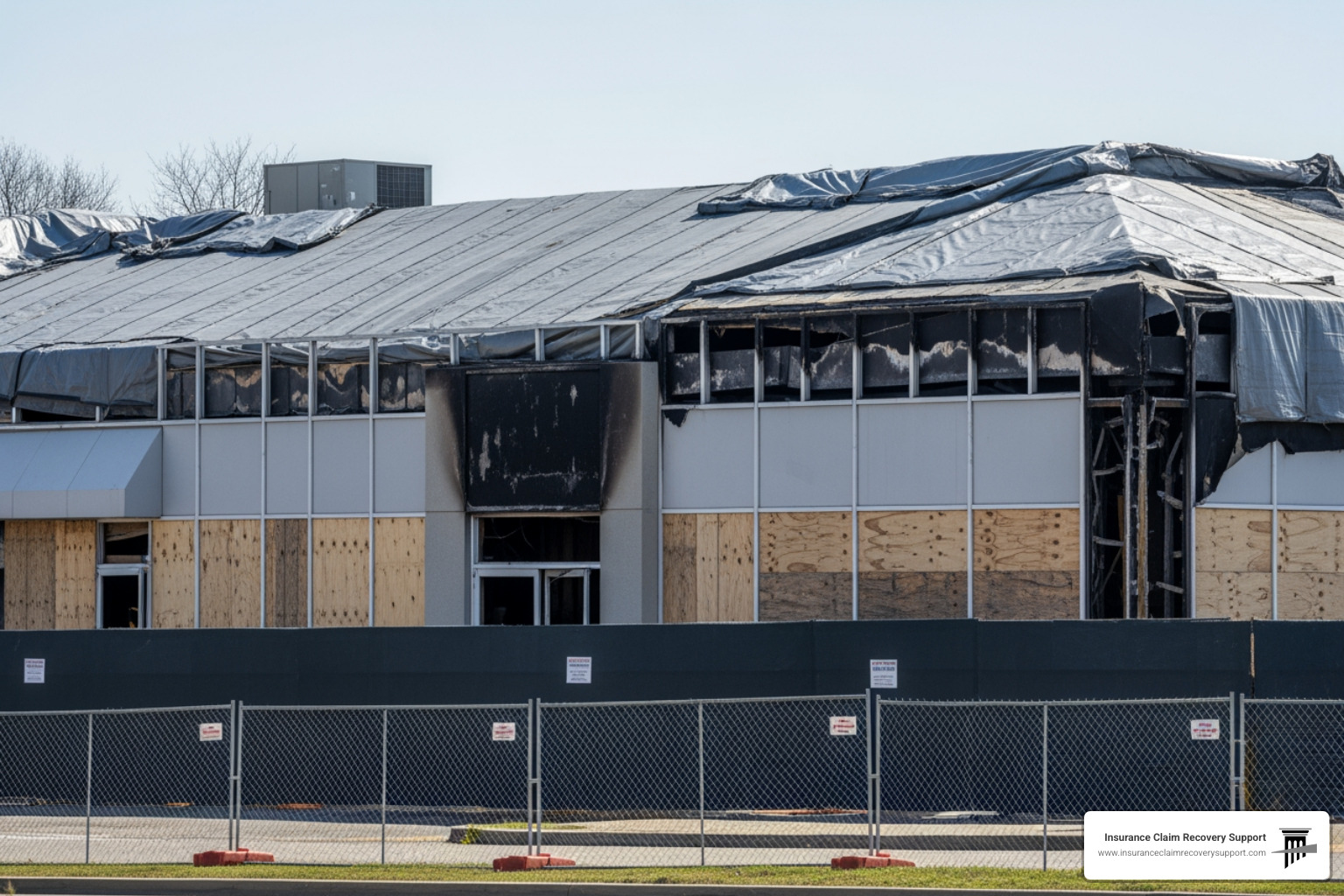
- Secure the Scene: Once the fire department clears the site, you must board up broken windows, secure open doorways, and tarp damaged roofs. This prevents secondary damage from rain or vandalism.
- Contact Your Insurer: Report the loss immediately. Whether you are in San Antonio or Lubbock, call your agent or the carrier’s 24-hour hotline.
- Utilities: Shut off water, gas, and electricity to prevent further hazards, but consult with professionals before doing so to ensure fire suppression systems aren’t compromised.
- Professional Guidance: Use a Fire Mitigation Companies Due Diligence Checklist for Policyholders before signing any contracts. Be wary of “storm chasers” or restoration companies that demand you sign over your entire insurance check upfront.
- Follow FEMA Standards: For larger losses, refer to FEMA guidance on post-fire recovery to ensure you are meeting safety and documentation standards.
What Does Your Policy Cover and Exclude?
Understanding the scope of your coverage is vital. According to NFPA research on commercial fires, office properties and commercial structures face unique risks. Most commercial policies include:
- Dwelling/Structure: The physical building, including permanent fixtures.
- Business Personal Property: Equipment, inventory, and furniture.
- Loss of Rents/Business Interruption: If you manage a multifamily property, our Apartment Fire Claim Complete Guide explains how to claim lost rental income.
- Additional Living Expenses (ALE): Coverage for relocating tenants or maintaining operations.
However, be mindful of exclusions. Carriers often deny claims due to mechanical failure or arson. Furthermore, maintenance negligence—such as failing to clean commercial grease traps or neglecting outdated electrical systems—can lead to a denied claim.
A significant portion of your claim will likely involve a Smoke Damage Insurance Claim. Smoke and soot can be more invasive than the fire itself, requiring specialized cleaning for HVAC systems and porous materials. We also recommend implementing robust fire safety measures; not only do they save lives, but they can also lead to substantial premium reductions.
Calculating Payouts: Replacement Cost vs. Actual Cash Value
How your payout is calculated can be the difference between a full recovery and financial ruin. Most policies fall into two categories:
| Feature | Replacement Cost Value (RCV) | Actual Cash Value (ACV) |
|---|---|---|
| Calculation | Cost to buy new today | Cost to buy new minus depreciation |
| Payout | Higher | Lower |
| Out-of-pocket | Minimal (deductible only) | Significant (due to age/wear) |
If you have an ACV policy, the insurer will deduct for the age and condition of your roof, HVAC, or flooring. Even with RCV, carriers often hold back “depreciation” until you actually complete the repairs. Knowing How to File an Insurance Claim for Fire Damage correctly ensures you don’t leave money on the table. Don’t forget to check for Building Code Upgrades coverage (Ordinance or Law), which pays for the extra cost of bringing an older building in Waco or San Angelo up to modern safety codes during reconstruction.
Documenting Evidence for an Insurance claim fire damage
Documentation is the “currency” of your claim. If you can’t prove it, the insurance company won’t pay for it.
- Inventory Everything: Create a room-by-room list. For commercial kitchens or industrial sites, include model numbers and manufacture dates.
- Visual Evidence: Take hundreds of photos and videos. Don’t just focus on the charred areas; document the Smoke Damage Insurance Claim in areas that look “fine” but smell like smoke.
- Hidden Damage: Check for soot migration in wall cavities and HVAC contamination. Intense heat can cause structural steel to lose integrity even if it didn’t melt.
- Proof of Loss: This is a formal, notarized document you must submit. It’s your official statement of the value of the loss. In places like Austin Fire zones, timelines for submitting this can be strict.
Maximizing Your Settlement and Avoiding Litigation
The ultimate goal of any insurance claim fire damage is a fair settlement that allows you to rebuild. Unfortunately, the path to that settlement is often blocked by delays and underpayments. This is where the difference between a carrier’s adjuster and a public adjuster becomes clear.
The Role of the Adjuster in an Insurance claim fire damage
When you file a claim, the insurance company sends their own adjuster. It is important to remember: the carrier’s adjuster works for the insurance company, not you.
During the inspection, you can expect them to “scope the loss.” This is a brief walk-through where they estimate the damage. However, they often overlook:
- Hidden Soot: Soot is acidic and can destroy electronics and metal over time if not professionally cleaned.
- Internal Malfunctions: Large HVAC units or manufacturing equipment may have suffered internal heat damage that isn’t visible.
- Inadequate Labor Rates: Their software might use national averages that don’t reflect the actual cost of skilled labor in Dallas or Fort Worth.
This is why many policyholders choose to hire a Public Insurance Adjuster for Fire Damage. A public adjuster is a licensed professional who represents your interests. Unlike independent adjusters who are hired by the carrier, Public Adjuster Fire Claims specialists focus on finding every penny you are owed.
Fact vs. Myth: Public Adjusters vs. Litigation
Many property owners believe that if they receive a Denied Insurance Claim for Fire Damage to Commercial Property, they have to hire a lawyer and go to court. This is a common misconception.
Myth: I need a lawyer to get a fair settlement. Fact: While lawyers are necessary for legal disputes, most fire claims are “valuation disputes.” A public adjuster is often more effective at proving the cost of damage through detailed estimates and engineering reports.
Myth: The appraisal process is the same as a lawsuit. Fact: Appraisal is a policy provision designed to resolve valuation disputes without going to court. It’s faster and usually less expensive than litigation.
Myth: Public adjusters are too expensive. Fact: We work on a contingency fee, meaning we only get paid if we increase your settlement. In many cases, the increase we secure far outweighs the fee. For example, in a Panhandle Texas Fire Insurance Claim, having professional advocacy can prevent the carrier from lowballing you on complex agricultural or industrial equipment.
Using Fire Claim Help from a public adjuster allows you to avoid the “litigation trap.” Lawsuits can take years and cost tens of thousands in legal fees. Our goal at Insurance Claim Recovery Support is a 90% settlement success rate without the need for unnecessary lawsuits.
Conclusion: Securing Your Recovery with Expert Advocacy
Recovering from a fire is an exhausting journey, both emotionally and financially. Whether you are dealing with a multifamily complex in Lakeway, a retail center in Georgetown, or an industrial facility in Houston, the complexity of an insurance claim fire damage requires more than just a “wait and see” approach.
Insurance Claim Recovery Support LLC (ICRS) is here to bridge the gap between what the insurance company wants to pay and what you need to recover. We specialize in large-loss commercial and multifamily claims, advocating for professional property managers, HOAs, religious institutions, and hospitality owners. Our expertise in Fire Claims Public Adjuster services means we understand the carrier’s roadmap and how to steer it to your advantage.
Don’t let a “scoped loss” or a lowball offer define your property’s future. By taking immediate action, documenting every detail, and seeking professional advocacy, you can ensure that your “ashes” truly turn back into “answers.”
For More info about public insurance adjuster services, contact us today. We serve property owners throughout Texas—from the busy streets of Dallas and Fort Worth to the growing communities of Round Rock and Bee Caves—and across multiple U.S. states. Let us handle the insurance company so you can focus on rebuilding.