When a Tornado Hits Your School, the Insurance Battle Is Just Beginning
A school insurance claim tornado dispute can leave your district scrambling — caught between urgent repair deadlines, returning students, and an insurer who won’t pay what the damage actually costs. Here’s what you need to know right now:
For a companion claim-documentation resource, see the ICRS Hail & Wind Claim Guide. Coverage and next steps depend on the facts and policy terms.
Quick answers for school districts facing a tornado insurance dispute:
- Document everything immediately — photos, videos, forensic engineering reports, and meteorologist assessments before any cleanup begins. Following FEMA’s documentation standards can help ensure no detail is overlooked for both insurance and potential federal aid.
- Do not accept the first offer — insurers routinely underpay or dispute scope on school claims, as seen when Rogers School District faced a $6 million shortfall on a $25 million tornado claim.
- Understand why claims get disputed — disagreements over “like-kind” repairs vs. code-required upgrades are the #1 trigger for school tornado claim conflicts.
- Know your full coverage — business interruption, ordinance/law, and equipment replacement policies may cover far more than the insurer initially acknowledges.
- Hire a public adjuster before considering litigation — a licensed public adjuster negotiates on your behalf, often resolving disputes faster and for more money than going to court, without the legal fees.
School districts are not typical commercial policyholders. You answer to school boards, taxpayers, and — most urgently — thousands of students who need a safe place to learn. When a tornado tears through a campus, the pressure to reopen fast is immense. But rushing your insurance claim, or relying solely on the insurer’s adjuster, can cost your district millions. Real cases prove this: Amarillo ISD’s claim ultimately settled for $42 million — covering 5.1 million square feet of damaged facilities — only after years of dispute and the involvement of independent experts including engineers, certified meteorologists, and drone thermography specialists. Without that advocacy, far less would have been recovered.
The financial stakes don’t stay inside the insurance file, either. When claims are mishandled or underpaid, the gap gets filled by taxpayers — through bond packages, budget reallocations, and deferred educational spending.
I’m Scott Friedson, CEO of Insurance Claim Recovery Support (ICRS) and a multi-state licensed public adjuster with over 15 years of experience resolving school insurance claim tornado disputes and other large-loss commercial property claims across the country. Over 500+ claims totaling more than $250 million recovered, I’ve seen exactly how insurers undervalue school damage — and how to fight back without unnecessary litigation.
Explore more about school insurance claim tornado dispute:
- condo insurance tornado dispute
- window tornado damage insurance claim
- does insurance cover tornado damage
Navigating a School Insurance Claim Tornado Dispute
When a tornado strikes, the immediate aftermath is chaotic. You are dealing with structural damage, shattered windows, and perhaps most devastatingly, the loss of specialized equipment like high-tech labs or athletic facilities. However, once the initial shock wears off, the true challenge begins: navigating the school insurance claim tornado dispute.
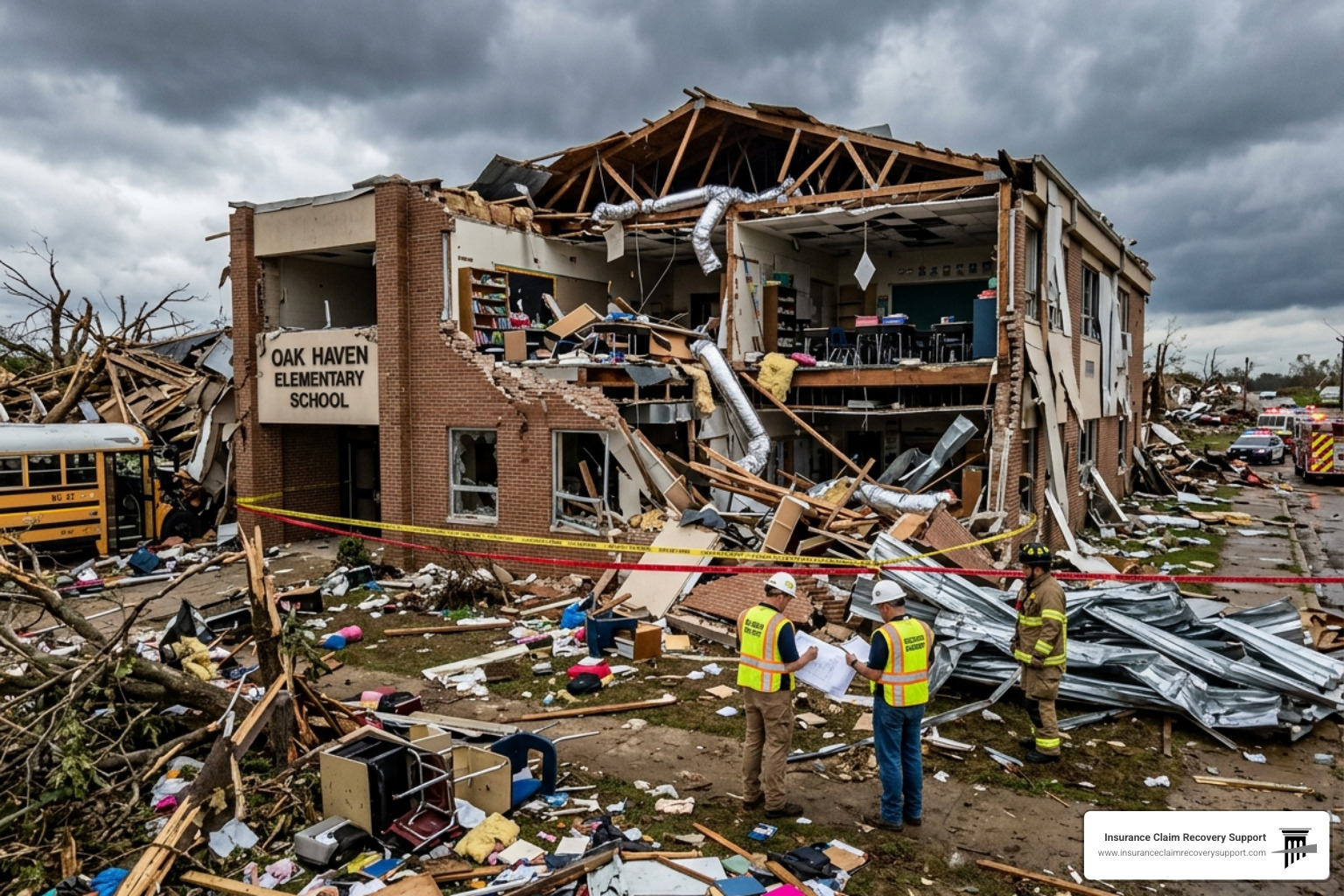
Insurers often approach these large-loss claims with a “wait and see” attitude, or worse, they provide an initial estimate that barely covers the cost of a temporary roof patch. Common reasons for these disputes include disagreements over the “scope of work” (what actually needs to be fixed) and the “replacement cost” (how much it costs to fix it today). For a school district, “fixing it” isn’t just about aesthetics; it’s about safety and meeting strict state building codes.
Comparing Your Options: Litigation vs. Public Adjusting
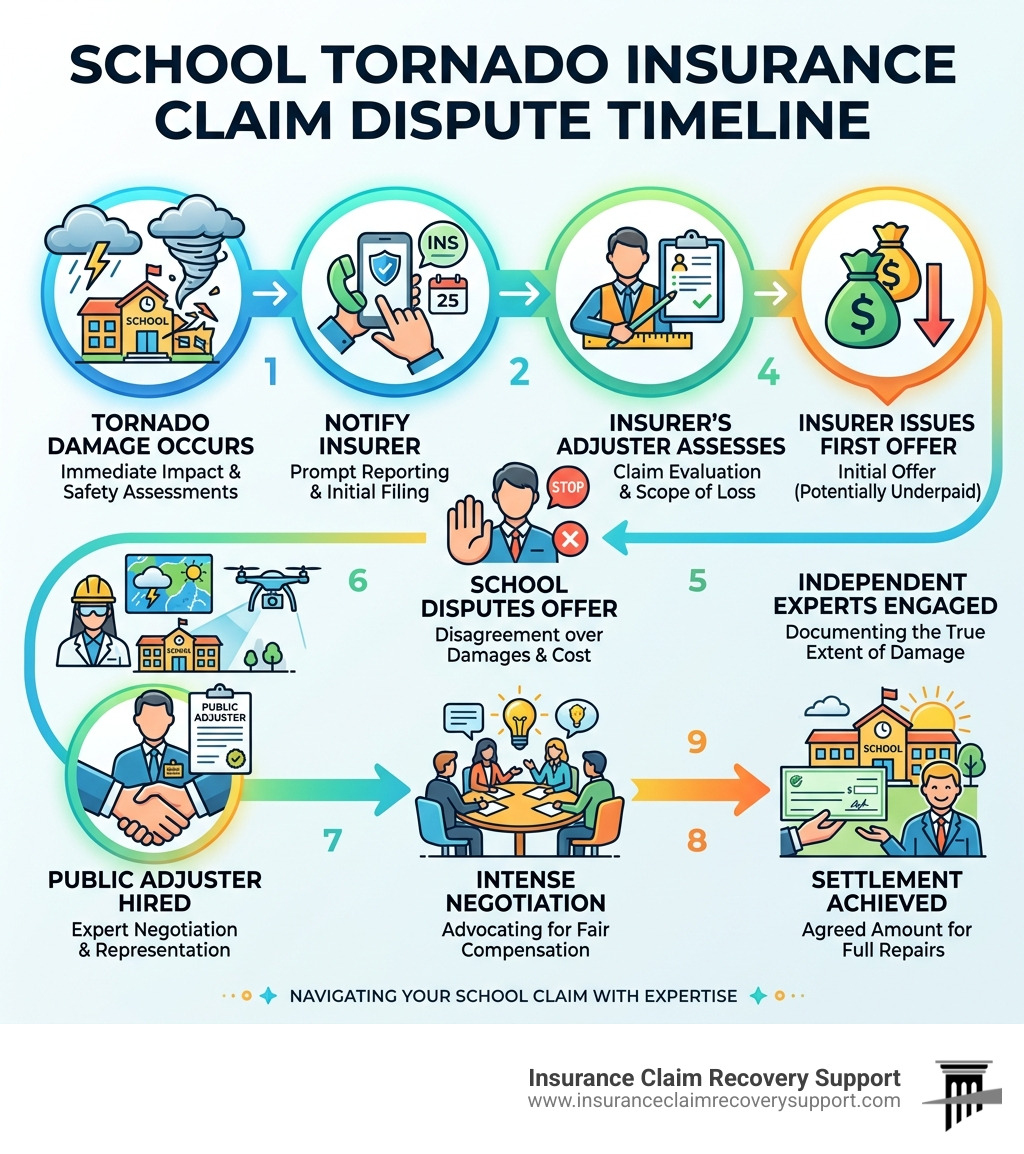
When the insurer offers $16 million on a $25 million loss—as seen in recent regional disputes—district leaders often feel their only choice is to sue. But litigation is slow, expensive, and adversarial. Public adjusting offers a faster, expert-led alternative.
| Feature | Insurance Litigation (Lawsuit) | Public Insurance Adjusting (ICRS) |
|---|---|---|
| Primary Goal | Legal judgment/settlement | Maximized claim settlement |
| Timeline | 2 to 5+ years | Months |
| Cost | High legal fees + expert costs | Percentage of recovered funds |
| Process | Adversarial, court-ordered | Expert negotiation & policy analysis |
| Success Rate | Varies; often settles on courthouse steps | 90% settlement success rate (ICRS) |
| Atmosphere | Hostile; halts repairs | Collaborative; focuses on recovery |
Why Districts Face a School Insurance Claim Tornado Dispute
The core of most School Districts insurance disputes lies in the definition of “Like-Kind and Quality.” Insurers want to pay to replace your 30-year-old HVAC system with another 30-year-old system—which doesn’t exist. This leads to a massive gap when current building codes require a modern, more expensive unit.
We saw this play out in the Rogers School District, where a $6 million disagreement emerged over the repair scope following a 2024 tornado. The district rightfully argued that they couldn’t simply “patch” obsolete equipment that no longer met state standards. This is a recurring theme in 2 Billion In Insured Losses From 9 Tornadoes In Dallas Tx, where the sheer volume of claims led adjusters to cut corners on complex institutional properties.
Insurers may also claim that certain damages—like roof granule loss or subtle structural shifts—are “pre-existing” or “wear and tear.” Without a professional advocate to prove the tornado caused the loss, the district is left holding the bill.
Critical Steps to Document Damage and Avoid Lowballs
To win a school insurance claim tornado dispute, you must have better data than the insurance company. They will send an adjuster who might spend three hours on a campus that covers 50 acres. We recommend a much more rigorous approach to Tornado Insurance Claim Help.
- Forensic Engineering: Don’t just take a contractor’s word for it. Hire forensic structural engineers to examine the foundation and load-bearing walls. Tornadoes create “uplift” forces that can compromise a building’s integrity without leaving a visible crack.
- Drone Thermography: This is a game-changer for school roofs. Infrared cameras on drones can detect moisture trapped under the roof membrane that the naked eye (and the insurer’s adjuster) will miss.
- Meteorologist Reports: Certified consulting meteorologists can provide site-specific wind speed data. If the insurer claims it was just a “windstorm” with a high deductible, but the data shows an EF-2 tornado path directly over the gym, your coverage profile changes.
- Site Security & Inventory: Schools are full of “contents”—computers, textbooks, musical instruments, and athletic gear. Document the “fried” electronics (common in computer labs or server rooms during storms) and smoke-damaged items immediately.
Resolving a School Insurance Claim Tornado Dispute Without Litigation
Many school boards fear that if they don’t sue, they won’t get paid. In reality, the most effective way to resolve a dispute is through the appraisal process or expert-led negotiation. This avoids the “Bad Faith” traps insurers set. If an insurer is intentionally delaying or misrepresenting your policy, you may have a Bad Faith Insurance Claim Texas case, but the goal is always to get the doors open first.
Hiring a Public Insurance Adjuster Texas allows the district to level the playing field. While the insurance company’s adjuster is looking for ways to save the company money, a public adjuster is looking for every covered “cent” the district is owed. We focus on:
- Policy Interpretation: Finding the “Ordinance or Law” coverage that pays for those mandatory code upgrades.
- Prompt Notification: Ensuring all deadlines are met so the insurer can’t deny the claim on a technicality.
- Challenging Biased Adjusters: If the insurer’s “preferred” engineer says the roof is fine, we bring in an independent expert to prove otherwise.
Fact vs. Myth: School Property Insurance Realities
There is a lot of misinformation surrounding school claims. Let’s clear up the most common myths that lead to a Denied Storm Damage Insurance Claim.
- Myth: “The insurance company’s adjuster is there to help us.”
- Fact: They are employees or contractors of the insurer. Their fiduciary duty is to the insurance company, not the school district.
- Myth: “We have to use the cheapest contractor to satisfy the insurance company.”
- Fact: You have a fiduciary duty to the taxpayers to restore the school to a safe, code-compliant condition. Cutting corners on repairs can lead to long-term structural issues and mold.
- Myth: “Business Interruption doesn’t apply to schools because we don’t make a ‘profit’.”
- Fact: Extra Expense coverage is critical. It pays for portable classrooms and the massive costs of relocating students to keep the academic year on track.
- Myth: “If we accept the initial check, we can’t ask for more.”
- Fact: In most cases, you can accept an “undisputed” payment and continue to negotiate for the remaining funds. Never sign a “full and final release” until you are certain the claim is closed to your satisfaction.
Conclusion: Protecting Your District’s Future
A school insurance claim tornado dispute is more than a financial hurdle; it is a threat to the stability of your community. When schools stay closed or operate in substandard conditions due to underpaid insurance claims, the students suffer most.
At Insurance Claim Recovery Support LLC (ICRS), we specialize in managing these high-stakes disputes. We represent school districts across Texas—including Austin, Dallas, Fort Worth, San Antonio, Houston, Lubbock, San Angelo, and Waco—as well as our neighbors in Amarillo, Lakeway, and Georgetown. Our 90% settlement success rate is built on the foundation of expert evidence, not just legal threats.
If your district is facing a lowball offer, an unreasonable delay, or a dispute over the scope of tornado damage, don’t go it alone. Let us help you fulfill your fiduciary duty to your taxpayers and your students.