What Business Insurance Property Damage Actually Covers (And Why Most Claims Fall Short)
Business insurance property damage is a broad category of commercial coverage designed to protect commercial and multifamily buildings, contents, and income when a fire, windstorm, hail event, freeze, water loss, or other covered peril damages the property.
Quick Answer: What Does Business Insurance Cover for Property Damage?
| Coverage Type | What It Protects |
|---|---|
| Commercial Property Insurance | Building structure, contents, equipment, inventory |
| Business Interruption Insurance | Lost revenue, continuing operating expenses during repairs |
| General Liability Insurance | Third-party property damage you are legally responsible for |
| Inland Marine Insurance | High-value assets in transit or stored off-site |
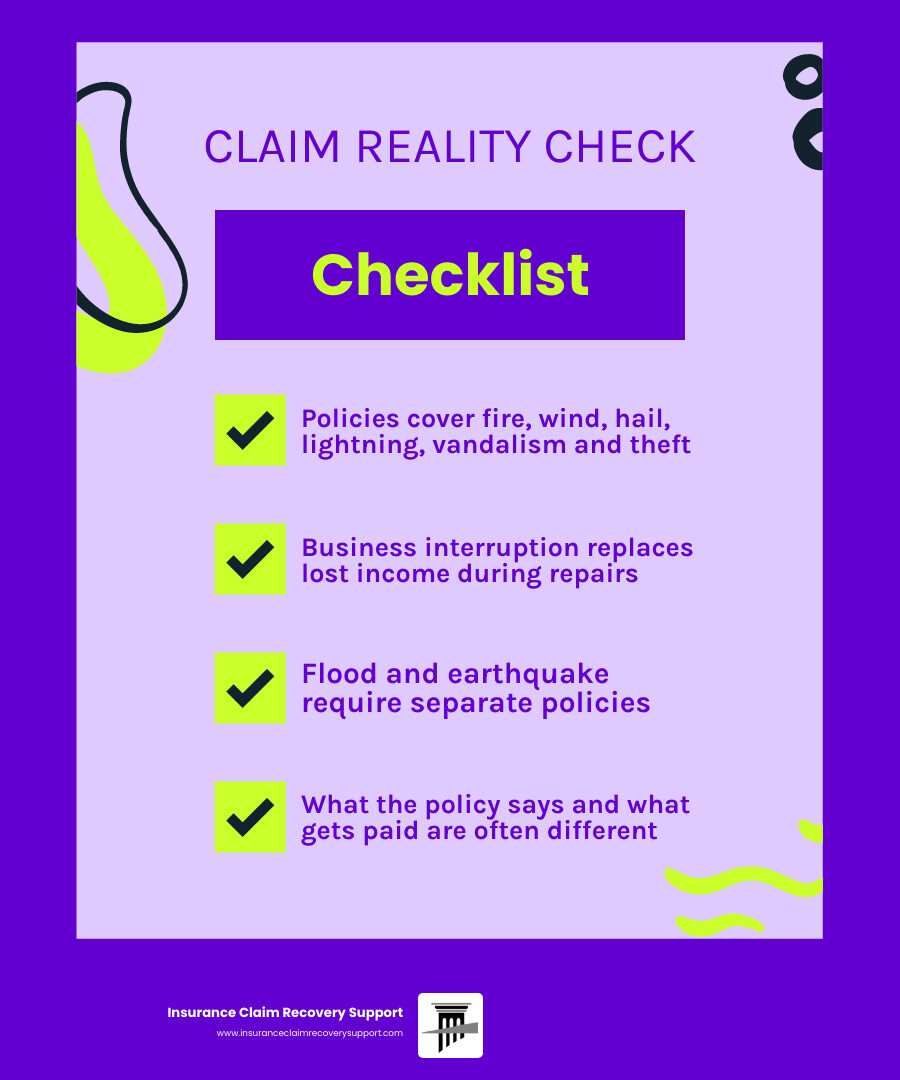
- Most commercial policies cover fire, wind, hail, lightning, vandalism, theft, and certain water losses
- Business interruption coverage can replace lost income while your property is being restored
- Flood and earthquake damage typically require separate policies or endorsements
- What your policy says it covers and what your insurer pays are often two very different things
Here is the uncomfortable truth many commercial and multifamily policyholders do not hear until after a major loss: filing a claim and being fully indemnified are not the same thing. Carriers operate within a cost-of-doing-business model, and underpayment, delay, and narrow policy interpretation are recurring issues in large-loss commercial and multifamily claims. Apartment operators, HOAs, retail centers, office buildings, hotels, churches, schools, and industrial facilities often face the same pattern: incomplete scopes, delayed inspections, overlooked code items, disputed business interruption calculations, and pressure to accept an early low settlement.
That concern is not hypothetical. Industry scrutiny has intensified in recent years, including the State Farm $15.6M settlement, the California Enforcement Action, and broader reporting from The Guardian, The New York Times, and CNN. These examples matter because they reflect how claim handling, policy interpretation, and settlement practices can affect commercial and multifamily policyholders after catastrophic property losses.
I am Scott Friedson, CEO of Insurance Claim Recovery Support (ICRS) and a multi-state licensed public adjuster with more than 15 years specializing in business insurance property damage, with over $250 million settled across 500+ large-loss commercial and multifamily claims nationwide. In the sections ahead, I will explain how these policies work, where claims commonly break down, how Texas Insurance Code 541 and 542 can affect timelines, and why public adjuster representation is often critical on claims above $250,000.
Simple guide to business insurance property damage:
- commercial property damage claims
- denied insurance claim for fire damage to commercial property
- property damage claim attorney
What is Business Insurance for Property Damage?
At its core, business insurance property damage coverage is a financial safety net for commercial and multifamily policyholders. It is designed to indemnify the insured, meaning it should place the business as close as possible to its pre-loss financial position after covered damage occurs. Whether you own a shopping center in Austin, manage an apartment community in Houston, operate a hotel in San Antonio, or oversee an HOA in Dallas-Fort Worth, this coverage can be the difference between recovery and prolonged operational disruption.
Types of Property Damage Covered
Most standard commercial policies are written on an open-peril basis, while others are named-peril forms. Depending on the policy language, common covered causes of loss may include:
- Fire and Smoke: Often among the most severe losses, frequently requiring specialized testing, demolition review, and contamination analysis.
- Wind, Hail, Tornado, and Hurricane Damage: Especially important across Texas and other storm-prone states.
- Theft and Vandalism: Coverage for criminal acts that damage structures or business personal property.
- Certain Water Losses: Such as burst pipes, plumbing failures, and freeze-related damage, subject to policy terms and mitigation requirements.
- Loss of Use and Time-Element Losses: Triggered when covered damage prevents normal occupancy or operations.
Importance of Business Insurance for Property Damage
For commercial property owners, multifamily operators, religious institutions, and industrial businesses, insurance is not just overhead. It is a central part of risk management and business continuity.
- Financial Protection: It helps prevent capital reserves from being consumed by major repair or replacement costs.
- Legal Defense: When third-party property damage is involved, liability coverage can respond to defense and settlement obligations.
- Business Continuity: It can fund continuing expenses and lost income while the property is being restored.
Translation: Coverage exists to indemnify the policyholder, but actual settlement outcomes depend heavily on documentation, policy interpretation, and how aggressively the claim is presented. That is why commercial and multifamily claims often require a more technical approach than smaller property losses.
Key Components of Business Insurance for Property Damage
Understanding your policy is like reading a roadmap. If you do not know the signs, it is easy to miss major categories of recovery. In large commercial losses, we also see adjuster licensing gaps and practical knowledge gaps, where the carrier representative may not fully understand complex commercial construction, code upgrades, environmental protocols, or the operational realities of multifamily and business income losses.
General Liability Insurance
This covers third-party damage and related legal exposure. If conditions at your property damage a tenant’s property, a neighboring structure, or another third party’s assets, general liability may provide defense and settlement protection, subject to the policy terms.
Commercial Property Insurance
This is the core of most business insurance property damage claims. It can include:
- Building Coverage: The structure itself, including permanently installed systems and fixtures.
- Contents and Equipment: Furniture, electronics, machinery, and business personal property.
- Inventory: Raw materials, finished goods, and stock held for sale.
- Code-Related and Repair Scope Issues: In larger claims, disputes often arise over demolition, overhead and profit, matching, code upgrades, and whether replacement should be based on full scope rather than cosmetic patching.
Business Interruption Insurance
This is often the most undervalued part of a commercial claim. If a fire impacts a hotel in Fort Worth or a freeze event shuts down an apartment complex in Georgetown, the loss is not limited to the physical damage. It can include lost revenue, extra expense, payroll considerations, tenant disruption, and continuing fixed costs.
Accurate business interruption presentation often depends on strong financial documentation, including historical statements, occupancy trends, rent rolls, and dry log records where applicable. Without that support, carriers may use narrow assumptions that reduce the settlement.
Inland Marine Insurance
Despite the name, inland marine usually has nothing to do with water. It commonly covers high-value property that moves or is stored away from the primary insured location, such as construction tools, specialized equipment, or materials in transit.
Why These Components Matter in Real Claims
For larger commercial and multifamily losses, policy interpretation drives value. That is one reason appraisal awards, expert estimating, and technical claim preparation have become so important. In many disputes, the issue is not whether damage exists, but how the policy is interpreted, how the scope is measured, and whether the carrier’s number reflects the real cost to indemnify the insured.
How to File a Property Damage Claim
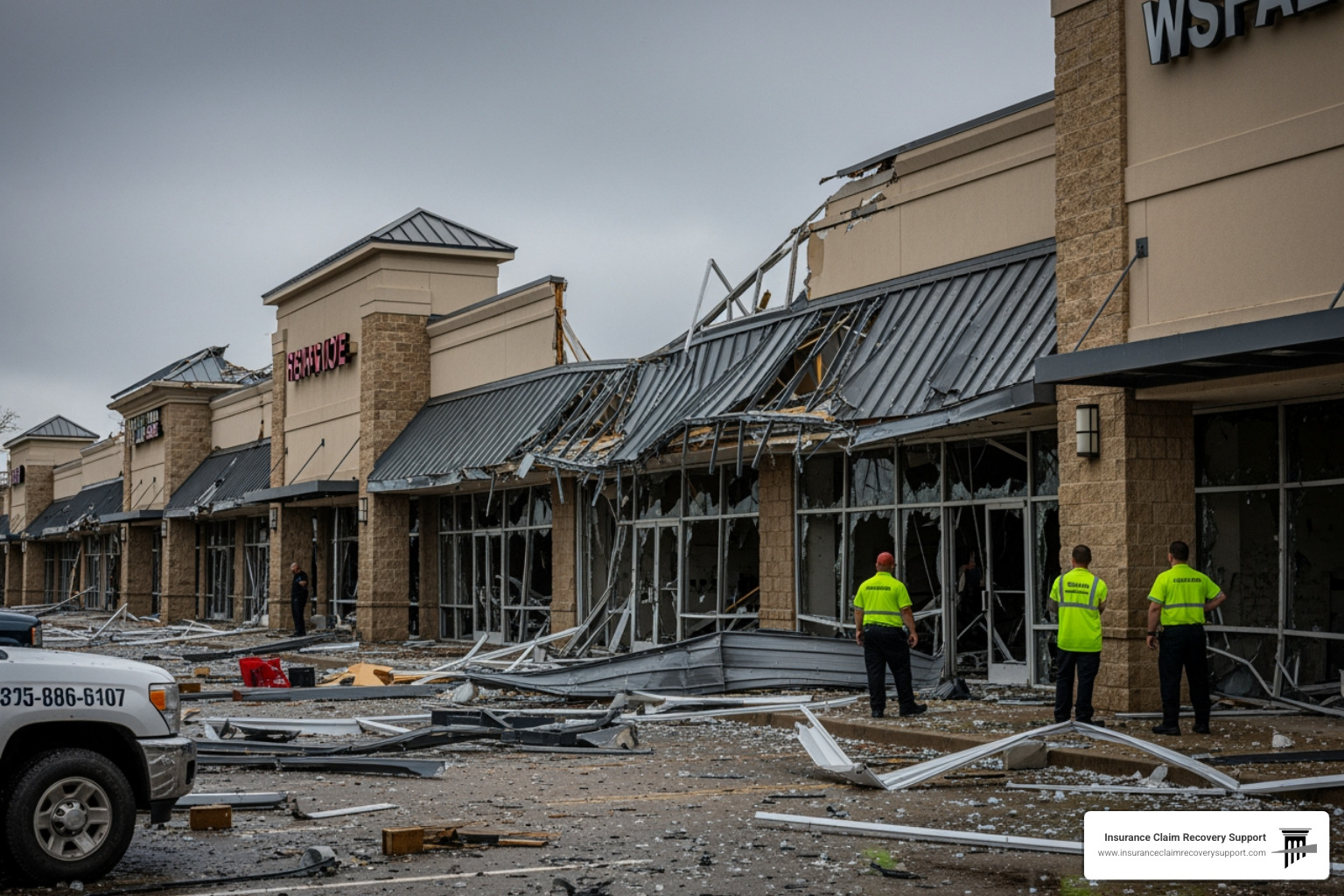
The moment a loss occurs, the clock starts ticking. In Texas, Texas Insurance Code 541 and 542 can affect how claims are acknowledged, investigated, and paid. Those statutes matter, but deadlines alone do not guarantee a fair settlement. Carriers can still rely on narrow policy interpretation, incomplete scoping, or delay tactics that make underpayment part of the claim process.
Steps to Submit a Claim
- Protect People and Property: Address life safety issues first, then take reasonable steps to prevent further damage. Emergency mitigation is often required by the policy.
- Notify the Carrier Promptly: Provide the policy number, insured name, property address, and a concise factual description of the incident.
- Document the Loss Thoroughly: Take photos and video before cleanup, preserve damaged materials when possible, and maintain written logs of mitigation, tenant impact, and repair decisions.
- Request and Review the Policy: Do not rely solely on verbal summaries. Coverage depends on the actual policy language, endorsements, exclusions, and time-element provisions.
- Track Business Income Impact: Preserve financial statements, rent rolls, occupancy reports, vendor invoices, and dry log records where relevant.
- Engage Qualified Experts Early: For claims above $250,000, professional representation is often essential. Public adjusters can help challenge low scopes, underpricing, and unsupported carrier assumptions before the claim drifts toward appraisal or litigation.
Tips for a Successful Claim
- Avoid Admitting Fault: Stick to verified facts about what happened and when.
- Be Accurate, Not Rushed: An incomplete report can damage leverage later.
- Watch for Environmental Hazards: Large losses may involve mold, asbestos, lead, soot, or contaminated water. Insist on OSHA-compliant procedures, proper containment, and certified industrial hygienists where needed.
- Document Delays and Communications: Keep a timeline of inspections, requests, carrier responses, and partial payments.
- Understand the Escalation Path: Some disputes move toward appraisal awards, while others involve counsel. In states like Florida, litigation costs can escalate quickly, which is one reason many commercial policyholders try to build a strong technical claim early and avoid unnecessary legal expense.
Translation: The strongest commercial property claims are not just reported quickly. They are documented, quantified, and presented in a way that limits the insurer’s ability to minimize the settlement.
Frequently Asked Questions about Business Insurance for Property Damage
What is Property Damage Coverage in Insurance?
Translation: It is the insurer’s contractual obligation to pay for repair or replacement of covered physical damage to insured property, subject to the policy terms, limits, deductibles, and exclusions. In commercial settings, this usually includes real property, business personal property, and sometimes associated time-element losses.
Are Business Insurance Proceeds for Property Damage Taxable?
Generally, if the settlement is used to restore the property to its pre-loss condition, it is typically treated as reimbursement rather than taxable income. However, if the recovery exceeds the property’s basis or includes other amounts treated differently under tax law, there may be tax consequences. Consult a qualified tax professional about your specific claim.
What is Classified as Property Damage?
In commercial insurance, property damage generally means physical injury to tangible property or resulting loss of use. Examples include structural fire damage, hail impacts to roofing systems, water intrusion, smoke contamination, equipment damage, and certain chemical-release events affecting buildings or contents.
What Are Common Exclusions or Limitations?
Translation: A policy may appear broad, but important gaps can still exist. Flood, earth movement, wear and tear, deferred maintenance, and ordinance-related issues may be excluded or limited unless specifically covered by endorsement or separate policy language.
Why Do So Many Commercial Claims End in Dispute?
Because the dispute is often about scope, pricing, causation, business interruption calculations, and policy interpretation, not just whether a loss happened. That is especially true for apartment communities, retail centers, office buildings, industrial sites, churches, and HOAs with larger and more technical losses.
The Reality of the Modern Insurance Landscape
We are seeing a broader shift in how major carriers handle catastrophe and large-loss property claims. Recent reporting and regulatory activity have highlighted systemic concerns about claim handling, policy interpretation, and settlement practices. Consider the State Farm $15.6M settlement, the California Enforcement Action, and the related reporting from The Guardian, The New York Times, and CNN. These are not isolated events. They illustrate how catastrophe claim handling has become a subject of ongoing public and legal scrutiny.
For commercial and multifamily owners, the takeaway is straightforward: the insurer’s first number may reflect the carrier’s internal model more than the full cost to indemnify the policyholder. That is why issues such as adjuster licensing gaps, incomplete scopes, delayed engineering, environmental remediation disputes, and restrictive business interruption calculations matter so much in practice.
| Fact vs. Myth | The Insurance Reality |
|---|---|
| Myth: The insurance company’s adjuster is there to protect my interests. | Fact: The carrier adjuster represents the insurance company. Their evaluation is shaped by policy interpretation, internal guidelines, and settlement authority. |
| Myth: If I receive a first check, the claim is basically over. | Fact: Initial payments are often partial. Underpaid claims can be disputed, supplemented, or pushed toward appraisal depending on the facts and policy language. |
| Myth: Litigation is the only way to improve a low offer. | Fact: Many large claims can be resolved through technical claim preparation, negotiation, and public adjuster advocacy without unnecessary lawsuits. |
| Myth: Business interruption is easy to calculate. | Fact: Time-element losses are frequently underpaid when carriers use narrow assumptions or incomplete financial records instead of full operating data and dry log records. |
| Myth: Environmental cleanup is just part of repairs. | Fact: Mold, asbestos, soot, lead, and contaminated water require proper protocols, and failures here can affect both safety and settlement value. |
For many policyholders, especially on losses above $250,000, this is why public adjusters play such an important role. The goal is not to create conflict. The goal is to build a well-supported claim, reduce delay, avoid unnecessary appraisal or litigation when possible, and pursue the full settlement the policy supports.
Conclusion
Navigating a business insurance property damage claim should not become a second full-time job for a commercial owner, property manager, HOA board, apartment operator, hotel, church, school, or industrial facility. At Insurance Claim Recovery Support LLC (ICRS), we represent policyholders only, never insurance companies, and we focus on large-loss commercial, multifamily, and specialty property claims.
ICRS helps clients pursue full indemnity after fire, hail, hurricane and windstorm, tornado, freeze, lightning, flood and water loss, and business interruption claims. We are known for maximizing settlements, reducing delays, and resolving disputes efficiently, with a strong record of settling claims without unnecessary lawsuits or appraisal.
We serve clients across Texas, including Austin, Dallas-Fort Worth, San Antonio, Houston, Lubbock, San Angelo, Waco, Round Rock, Georgetown, and Lakeway, and we are licensed in multiple states nationwide.
If your commercial or multifamily property has suffered a major loss, do not assume the insurer’s first valuation reflects the full amount needed to indemnify your business. A properly prepared claim can make the difference between a partial payment and a meaningful settlement.