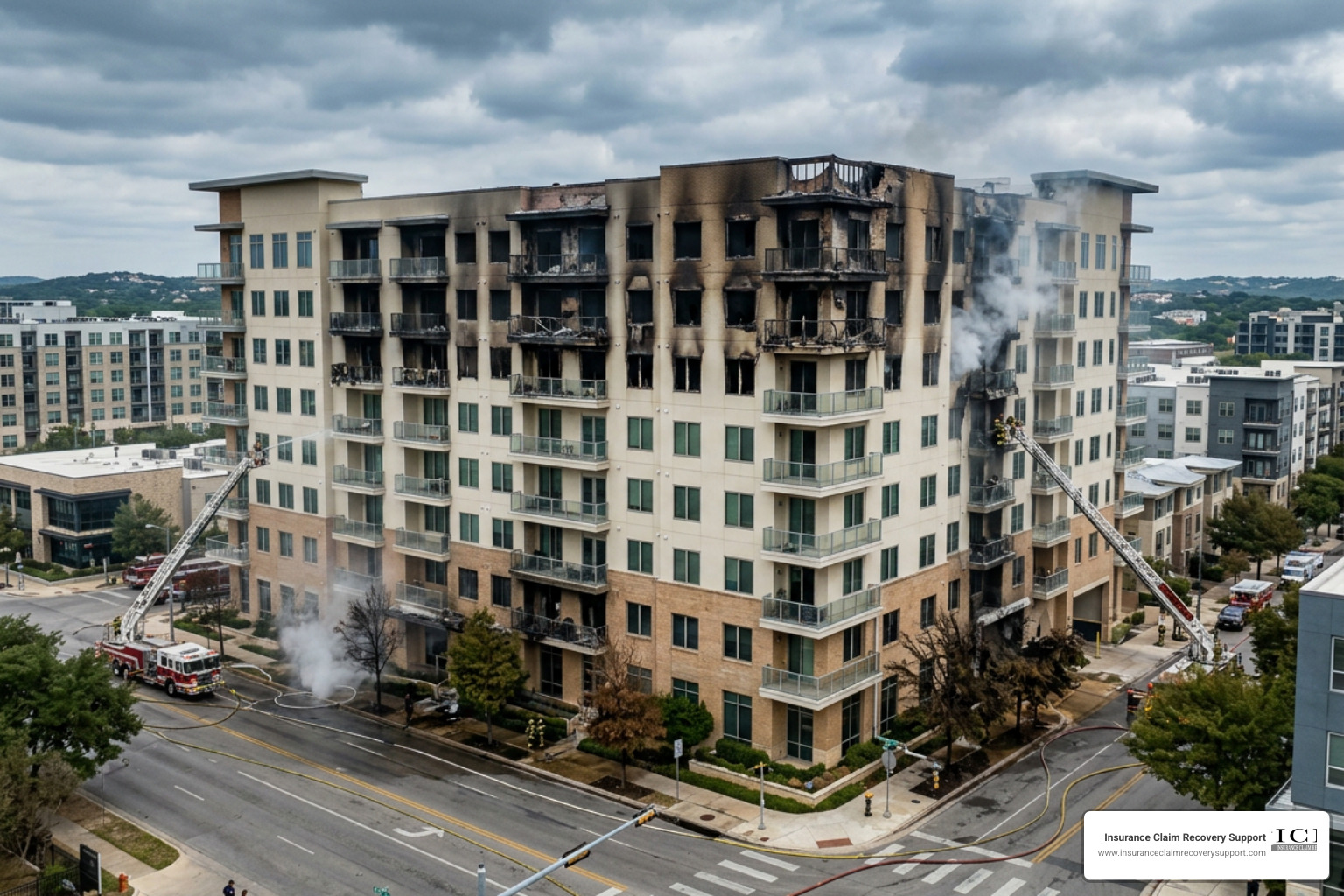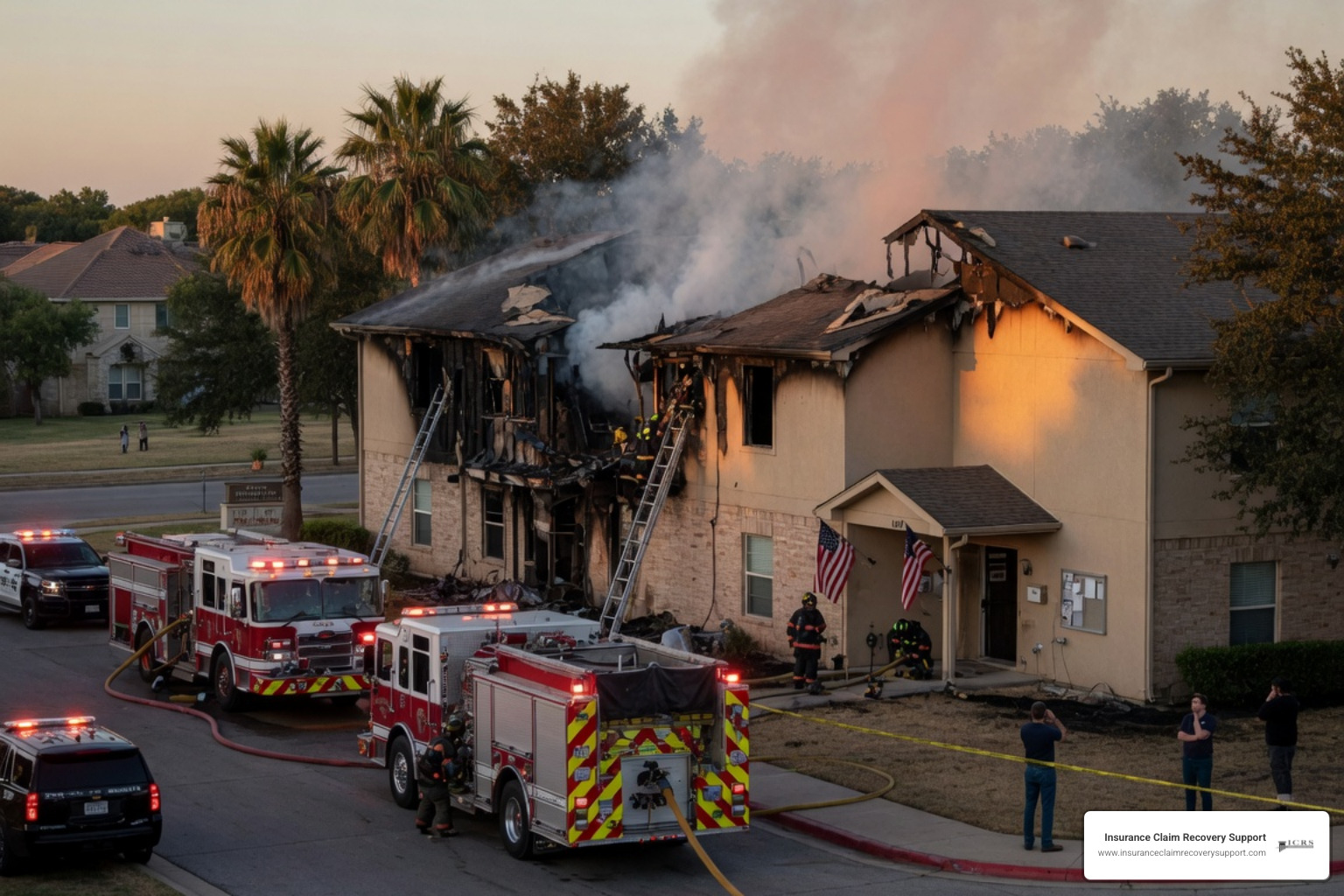
After a major fire, most property owners want a clear answer to one question: how much does a public adjuster cost, and is the fee worth it? For an Austin fire insurance claim, the answer depends on the size and complexity of the loss, but Texas law places strict limits on public adjuster compensation. This guide focuses specifically on Austin public adjuster fire fees so policyholders can compare Austin public adjuster costs, fee structures, and potential claim value before signing an agreement.
In Texas, public adjusters typically work on a contingency fee, meaning the fee is a percentage of the insurance recovery. For many Austin fire insurance claims, public adjuster fees range from 5% to 10%, and Texas public adjuster fees cannot exceed the state’s legal cap. There are generally no hourly charges or upfront retainers when a reputable public adjuster is hired for insurance claim representation.
That fee should be evaluated against the potential value of professional claim documentation, policy interpretation, damage estimating, smoke damage claim evaluation, business interruption analysis, and settlement negotiation. On large fire damage insurance claims in Austin, a well-documented claim package can materially affect the final fire damage insurance settlement.
This guide explains how public adjusters charge after a fire in Austin, what Texas regulations require, when the fee may be justified, and how public adjusters differ from attorneys. It is written for property owners, business owners, apartment owners, and commercial real estate investors in Austin, Lakeway, Westlake, Round Rock, Cedar Park, Pflugerville, and nearby Central Texas communities.
Note: Insurance Claim Recovery Support (ICRS) provides public adjusting and claim advocacy services. We do not provide contracting, restoration, mitigation, or legal services. Our role is to represent the policyholder during the insurance claim process.
How Austin Public Adjuster Fire Fees Work in Texas
Public adjuster fees in Texas are designed to be transparent. A licensed public adjuster represents the policyholder—not the insurance company—and is paid according to the written fee agreement signed by the property owner.
Contingency Fee Structure
Most public adjusters charge a contingency fee. That means the fee is based on money recovered from the insurance company, rather than an hourly rate. If there is no recovery, the policyholder typically owes no fee under a standard contingency agreement.
A simple example:
Insurance settlement x Public adjuster fee percentage = Public adjuster fee
For example, if a fire damage insurance settlement is $1,000,000 and the agreed public adjuster fee percentage is 10%, the public adjuster fee would be $100,000. If the agreed fee is 7%, the fee would be $70,000.
Texas Regulations, Fee Caps, and Disclosure Requirements
Texas regulates public adjusters through the Texas Department of Insurance. Public adjusters must be licensed, must use compliant contracts, and must disclose their compensation in writing. For Texas public adjuster fees, the fee is legally capped at 10% of the claim settlement or indemnification amount.
Before signing any agreement, property owners should confirm that the adjuster is licensed and review the contract carefully. A compliant agreement should clearly explain:
- The public adjuster’s fee percentage
- The services included
- The claim or loss being handled
- Cancellation rights
- The policyholder’s responsibilities
- Any limitations on the adjuster’s role
Consumer Protections for Fire Claim Policyholders
Texas law also provides important consumer protections. Public adjusters cannot act as both the adjuster and the contractor on the same claim, which helps reduce conflicts of interest. Policyholders also have cancellation rights after signing a public adjuster contract.
These protections matter after a fire because the claim may involve emergency mitigation, structural inspections, smoke and soot testing, code upgrades, contents documentation, and business income losses. Clear fee disclosure helps owners understand the cost of representation before the claim work begins.
Typical Public Adjuster Fee Percentages for Austin Fire Claims
Although the Texas legal cap is 10%, not every claim is charged at the same percentage. The actual fee may depend on the size of the loss, the stage of the claim, the amount of documentation required, and whether the claim involves commercial property insurance claims, business income losses, or disputed coverage.
| Property or Claim Type | Common Complexity Factors | Typical Fee Range |
|---|---|---|
| Apartment complexes | Unit-by-unit damage, tenant displacement, loss of rents, smoke migration, code upgrades | 7%–10% |
| Office buildings | HVAC contamination, tenant improvements, business interruption claim issues, extra expense coverage | 5%–10% |
| Retail centers | Multiple tenants, inventory impacts, signage, storefront systems, business income documentation | 5%–10% |
| Churches and schools | Assembly spaces, specialized finishes, code compliance, contents, temporary relocation | 7%–10% |
| Industrial properties | Equipment damage, environmental concerns, production delays, specialized consultants | 5%–8% |
A straightforward smoke damage claim may require less work than a complex apartment fire insurance claim involving multiple buildings and displaced tenants. Likewise, a commercial fire claim in Round Rock or Cedar Park with business interruption and extra expense coverage may require forensic accounting in addition to building damage estimating.
The most important question is not only “What percentage is the fee?” It is also “What expertise, documentation, and negotiation value will the public adjuster bring to the claim?”
Is Hiring a Public Adjuster Worth the Fee After a Fire?
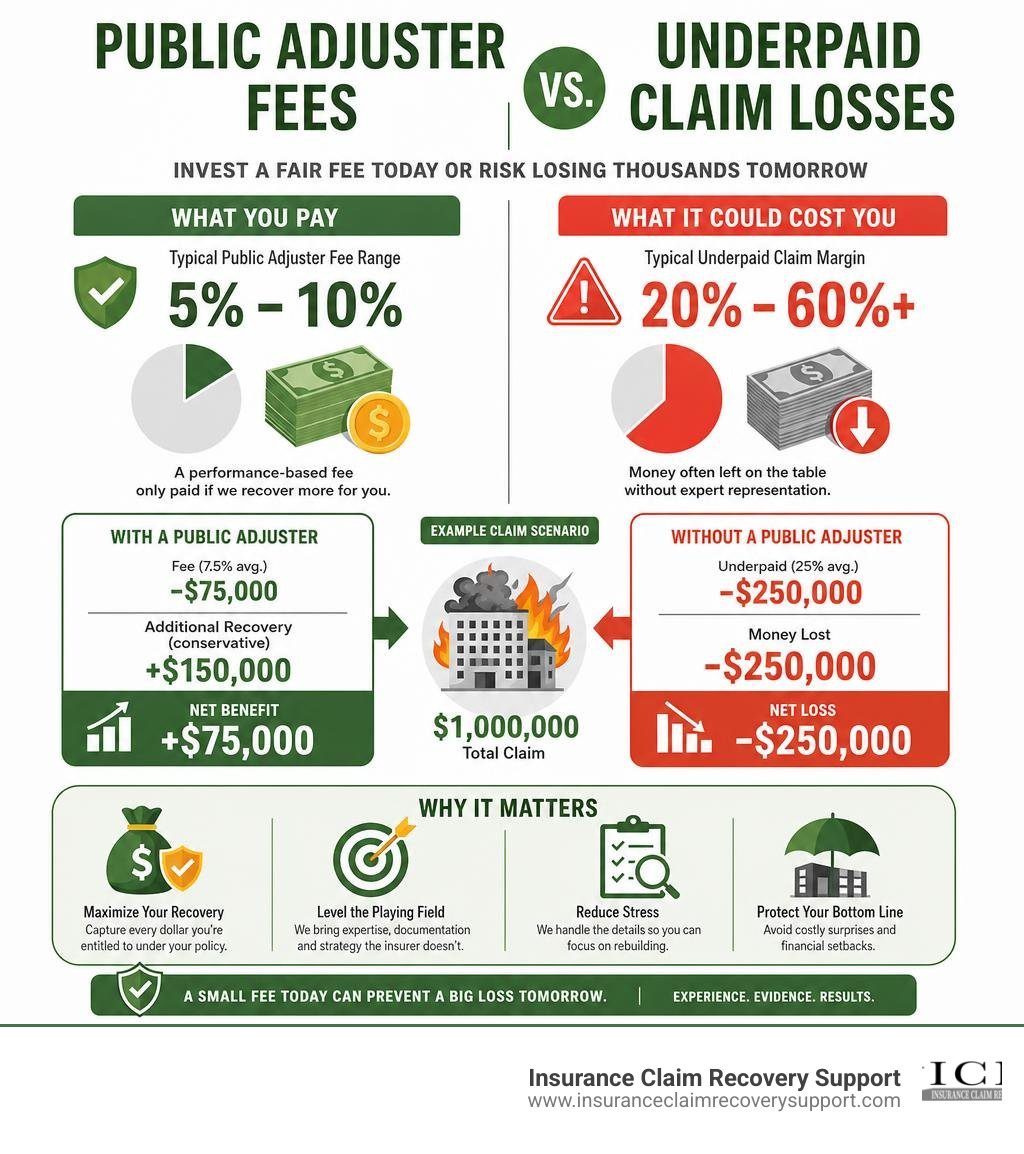
Hiring a public adjuster may be worth the fee when the claim is large, complex, underpaid, delayed, or heavily documented. Fire claims often involve more than visible burn damage. A complete claim may include structural repairs, smoke and soot remediation, water damage from firefighting, debris removal, contents, code upgrades, loss of rents, business interruption, and extra expense coverage.
A Realistic Settlement Example
Consider a commercial property owner in Austin with a significant fire loss:
- Estimated cost to restore the property: $1,500,000
- Initial insurance company estimate: $750,000
- Potential shortfall without further claim development: $750,000
After professional claim documentation, policy review, expert estimating, and settlement negotiation, the insurer agrees to a revised settlement:
- Revised fire damage insurance settlement: $1,350,000
- Public adjuster fee at 10%: $135,000
- Net recovery after fee: $1,215,000
- Net improvement compared with the initial offer: $465,000
This example is not a guarantee of results. Every claim depends on the policy, facts, damage, exclusions, limits, deductibles, and available evidence. But it shows why the value of insurance claim representation should be evaluated based on potential claim recovery—not fee percentage alone.
What Public Adjusters Do to Improve Claim Value
A qualified public adjuster can help by:
- Interpreting commercial property insurance policy language
- Documenting fire, smoke, soot, water, and structural damage
- Preparing detailed repair estimates
- Coordinating with engineers, industrial hygienists, and other experts
- Reviewing business interruption claim and extra expense documentation
- Responding to carrier questions and underpayment issues
- Negotiating toward a supported settlement
For apartment owners, business owners, and commercial real estate investors, this work can reduce the risk of missed damage, unsupported estimates, and settlements that do not reflect the full covered loss.
Why Commercial Fire Claims Require Specialized Representation
A commercial fire claim is rarely simple. Large losses often involve multiple coverage categories, multiple stakeholders, and technical documentation that must be presented correctly to the insurance carrier.
Property Types That Add Claim Complexity
Specialized representation is especially important for:
- Apartment complexes: An apartment fire insurance claim may include unit repairs, common areas, smoke migration, water damage, tenant displacement, and loss of rents.
- Office buildings: Office losses may involve tenant improvements, electronics, HVAC contamination, temporary relocation, and business interruption.
- Retail centers: Retail properties may include multiple tenant spaces, storefront systems, inventory impacts, signage, and extra expense coverage.
- Churches and schools: These claims can involve assembly areas, classrooms, specialized contents, code requirements, and temporary facilities.
- Industrial properties: Industrial fire losses may include machinery, production equipment, environmental cleanup, OSHA-related concerns, and extended downtime.
Whether the property is in downtown Austin, Lakeway, Westlake, Round Rock, Cedar Park, or Pflugerville, the claim must be documented in a way that connects the damage to the covered fire event and the applicable policy provisions.
Hidden Costs That Are Often Missed
Fire losses frequently include hidden or disputed costs, such as:
- Smoke and soot contamination inside HVAC systems
- Water damage from firefighting efforts
- Structural steel, concrete, roof, and framing impacts
- Debris removal and hazardous material handling
- Code upgrade requirements
- Business interruption and loss of rental income
- Extra expense coverage for temporary operations
- Professional fees for engineers, hygienists, and accountants
A public adjuster with fire loss experience can help identify these categories early, preserve evidence, and present a more complete claim package.
Public Adjuster vs Attorney After a Fire Loss
Public adjusters and attorneys serve different roles after a fire. Understanding the difference helps policyholders choose the right type of help at the right time.
| Task | Public Adjuster | Attorney |
|---|---|---|
| Claim preparation | Prepares and presents the insurance claim, estimates, documentation, and supporting evidence | May advise on legal rights, disputes, and litigation strategy |
| Damage documentation | Inspects damage, prepares scopes, coordinates experts, and documents covered losses | May use experts in litigation or coverage disputes |
| Settlement negotiation | Negotiates with the insurance carrier during the claim adjustment process | Negotiates legal disputes, demands, mediations, or settlements when legal issues arise |
| Litigation | Does not file lawsuits or provide legal services | Can file suit, pursue bad-faith claims, and represent the policyholder in court |
For many Austin fire insurance claim situations, a public adjuster is the first professional hired because the immediate need is claim preparation, damage documentation, policy interpretation, and settlement negotiation. If the insurer denies coverage, violates legal obligations, or the dispute becomes legal in nature, an attorney may be necessary.
The two roles can also complement each other. A well-documented public adjuster file can help clarify the scope of damage and the amount in dispute if legal counsel later becomes involved.
How Can Insurance Claim Recovery Support Help Maximize Your Fire Claim Settlement?

Insurance Claim Recovery Support (ICRS) helps policyholders evaluate, document, and negotiate complex fire losses. Our work focuses on public adjusting, policy interpretation, claim documentation, estimating, and settlement strategy for commercial property insurance claims.
For property owners, business owners, apartment owners, and commercial real estate investors, we help organize the claim from the beginning—or review an underpaid claim that is already in progress. That can include building damage, smoke damage claim documentation, water damage from firefighting, code upgrade issues, loss of rents, business interruption, and extra expense coverage.
We represent policyholders throughout Austin, Lakeway, Westlake, Round Rock, Cedar Park, Pflugerville, and other Texas communities. We do not work for insurance companies, and we do not perform construction or mitigation work on the same claim.
Frequently Asked Questions About Austin Public Adjuster Fire Fees
How much does a public adjuster charge for a fire claim in Austin?
For many Austin fire insurance claims, public adjusters charge a contingency fee based on the insurance recovery. The public adjuster fee percentage often ranges from 5% to 10%, depending on claim size, complexity, documentation needs, and whether the claim involves commercial property, business interruption, or disputed damage.
Are public adjuster fees regulated in Texas?
Yes. Texas public adjuster fees are regulated, and compensation must be disclosed in a written agreement. Texas also caps public adjuster compensation, so policyholders should review the contract carefully and confirm that the adjuster is licensed before signing.
Is hiring a public adjuster worth the fee after a fire?
Hiring a public adjuster may be worth the fee when a fire claim is large, complex, delayed, underpaid, or difficult to document. For fire damage insurance claims in Austin, the value depends on whether professional claim preparation, estimating, policy interpretation, and settlement negotiation can help support a more complete recovery.
Who pays a public adjuster after a fire loss?
The policyholder pays the public adjuster according to the written fee agreement. In a typical contingency arrangement, the fee is paid from the insurance recovery after the claim is settled or paid, rather than as an upfront hourly charge.
Conclusion: Evaluate Austin Public Adjuster Fire Fees by Value, Not Just the Percentage
A public adjuster fee is only one part of the decision. After a serious fire, the larger question is whether the insurance settlement will be sufficient to restore the property, protect income, and account for the full covered loss.
Texas public adjuster fees are regulated, disclosed in writing, and commonly structured as a contingency percentage. For a complex commercial fire claim, the right representation may help uncover missed damage, support a stronger estimate, and improve the fire damage insurance settlement beyond the cost of the fee.
If you are comparing Austin public adjuster fire fees or managing a major fire loss in the surrounding area, contact Insurance Claim Recovery Support for a claim review and a clear explanation of your options before accepting a final settlement.
For help organizing photographs, estimates and questions after a fire, download the free ICRS Fire Claim Guide. Guide information is educational; claim terms and next steps depend on your policy and loss.