
What is a Business Interruption Claim and How to Start
When Disaster Closes Your Doors: What You Need to Know About How to Claim Business Interruption Insurance
Knowing how to claim business interruption insurance can mean the difference between surviving a covered loss and watching your business bleed out financially while waiting for a settlement that never fully arrives. Whether you own an office building, manage a multifamily portfolio, or operate a retail center, the moment physical damage shuts down your operations, the clock starts — on your losses, your policy deadlines, and your insurer’s scrutiny.
Here is a quick answer if you need it now:
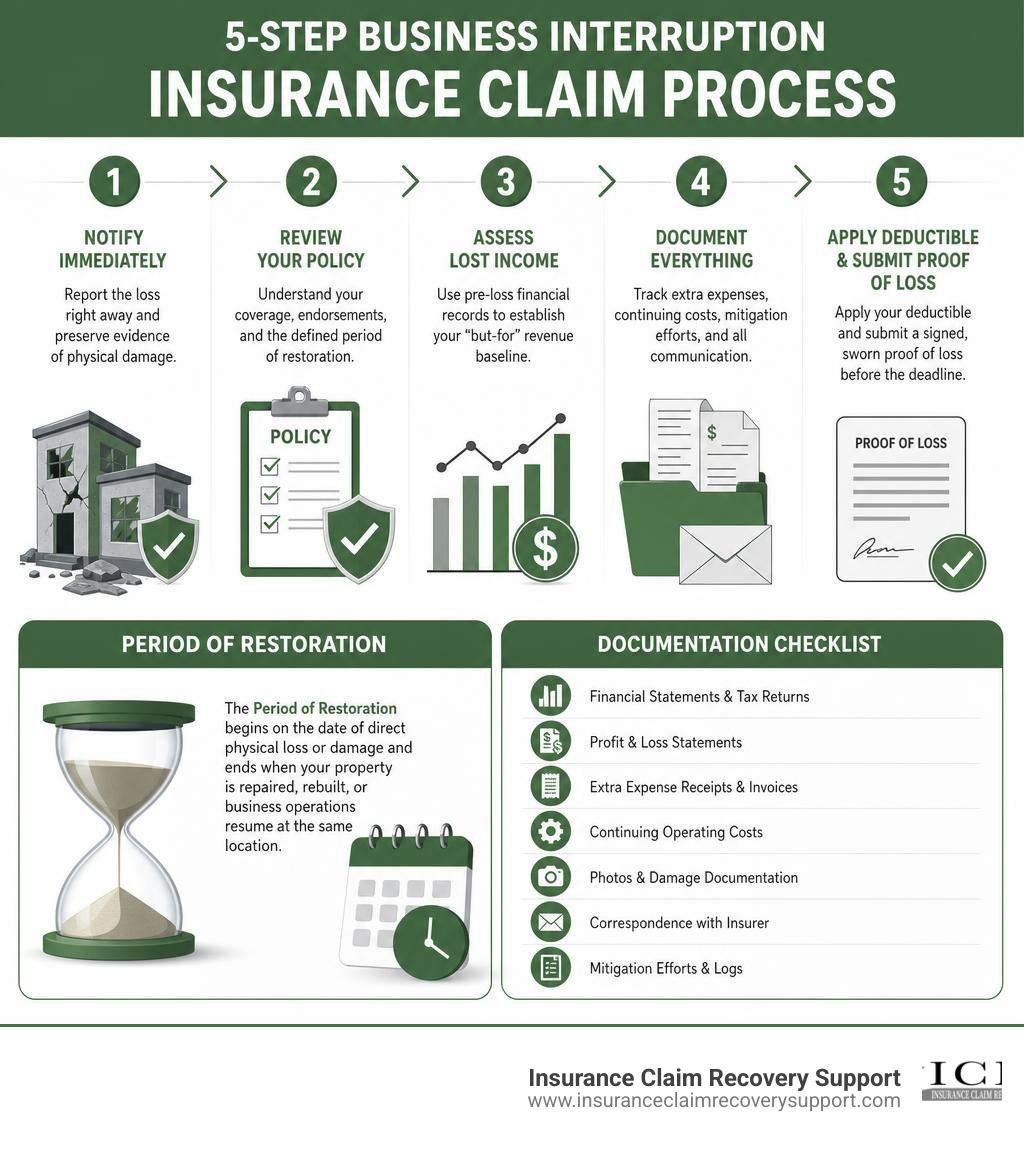
- Notify your insurer immediately after the covered loss occurs and preserve all evidence of physical damage.
- Review your policy for the type of coverage (named perils vs. all-risk), endorsements, and the defined period of restoration.
- Assess your lost income using pre-loss financial records to establish a credible “but-for” revenue baseline.
- Document everything — extra expenses, continuing operating costs, mitigation efforts, and all correspondence with your insurer.
- Apply your deductible (dollar amount or time-period based) and submit a signed, sworn proof of loss before your policy deadline.
✅ Key Takeaway: Business interruption claims are not automatically paid. They are built — with documentation, financial records, and a clear understanding of your policy language.
The hard reality is that most commercial and multifamily property owners significantly underestimate the documentation burden involved. Policies are dense. Adjusters are skeptical. And insurers have a financial incentive to interpret your loss as narrowly as the policy language allows. Many policyholders receive a fraction of what they are actually owed — not because their loss wasn’t real, but because their claim file was thin.
This is not a process you should navigate casually. Business interruption claims often take 6–18 months to resolve, and many businesses face serious cash-flow pressure within the first 30–60 days of a covered loss. Getting this right from day one matters enormously.
I’m Scott Friedson, a multi-state licensed public adjuster and CEO of Insurance Claim Recovery Support (ICRS), with over 15 years of experience and more than $250 million in settled large-loss property claims — including complex business interruption cases for commercial and multifamily property owners. I’ve built this guide specifically to walk you through how to claim business interruption insurance the right way, so you’re not leaving money on the table or missing critical deadlines.
Terms related to how to claim business interruption insurance:
What is a Business Interruption Claim and What Does It Cover?
A business interruption claim is a formal request to your insurance carrier to indemnify you for lost income and ongoing operating expenses when a covered physical loss forces your operations to slow down or halt entirely. Unlike standard property damage coverage, which handles the physical bricks and mortar, business interruption coverage (often called business income insurance) is designed to protect your cash flow and keep your balance sheet from collapsing while repairs are underway.
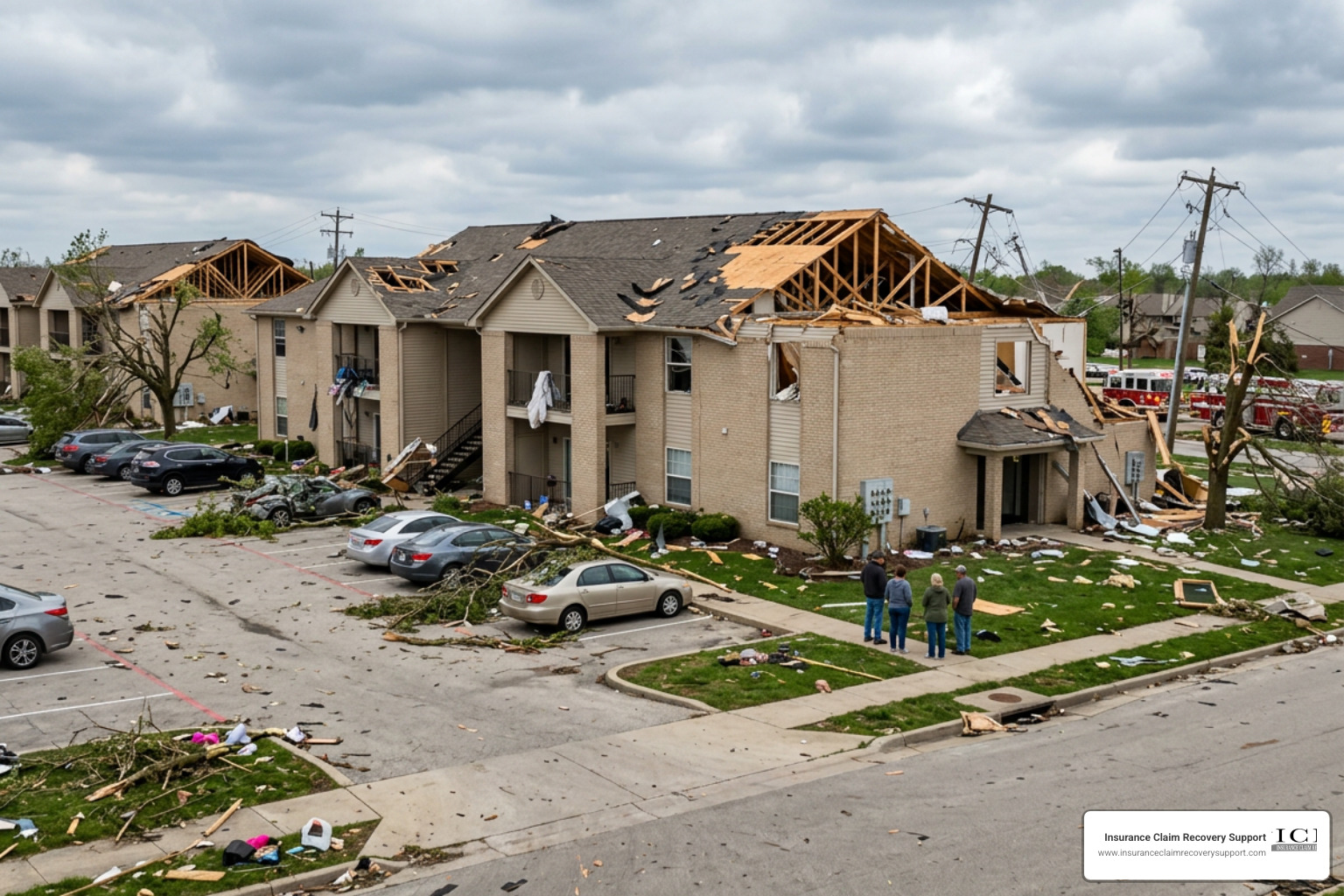
When we look at commercial property damage and multifamily assets, the financial stakes are massive. If a fire rips through a 200-unit apartment complex in Dallas or a severe hail storm destroys the roof of an office building in Austin, the physical reconstruction is only half the battle. The real threat to the property owner is the sudden, catastrophic loss of rental income or tenant occupancy.
Unfortunately, we operate in an environment of systemic insurer scrutiny. Many insurance carriers treat claims not as promises to be kept, but through a “cost of doing business” model. They may delay payments, undervalue your historical revenue, or apply strict policy interpretations to minimize their financial exposure. To protect your assets, you must understand the mechanics of Business Interruption Claims and study our Don’t Let Downtime Derail You: A Commercial Business Interruption Insurance Guide to stay ahead of carrier tactics.
How to Claim Business Interruption Insurance After Commercial Property Damage
To successfully execute how to claim business interruption insurance, you must first satisfy the primary trigger of the coverage: direct physical loss or damage to the insured property by a covered peril.
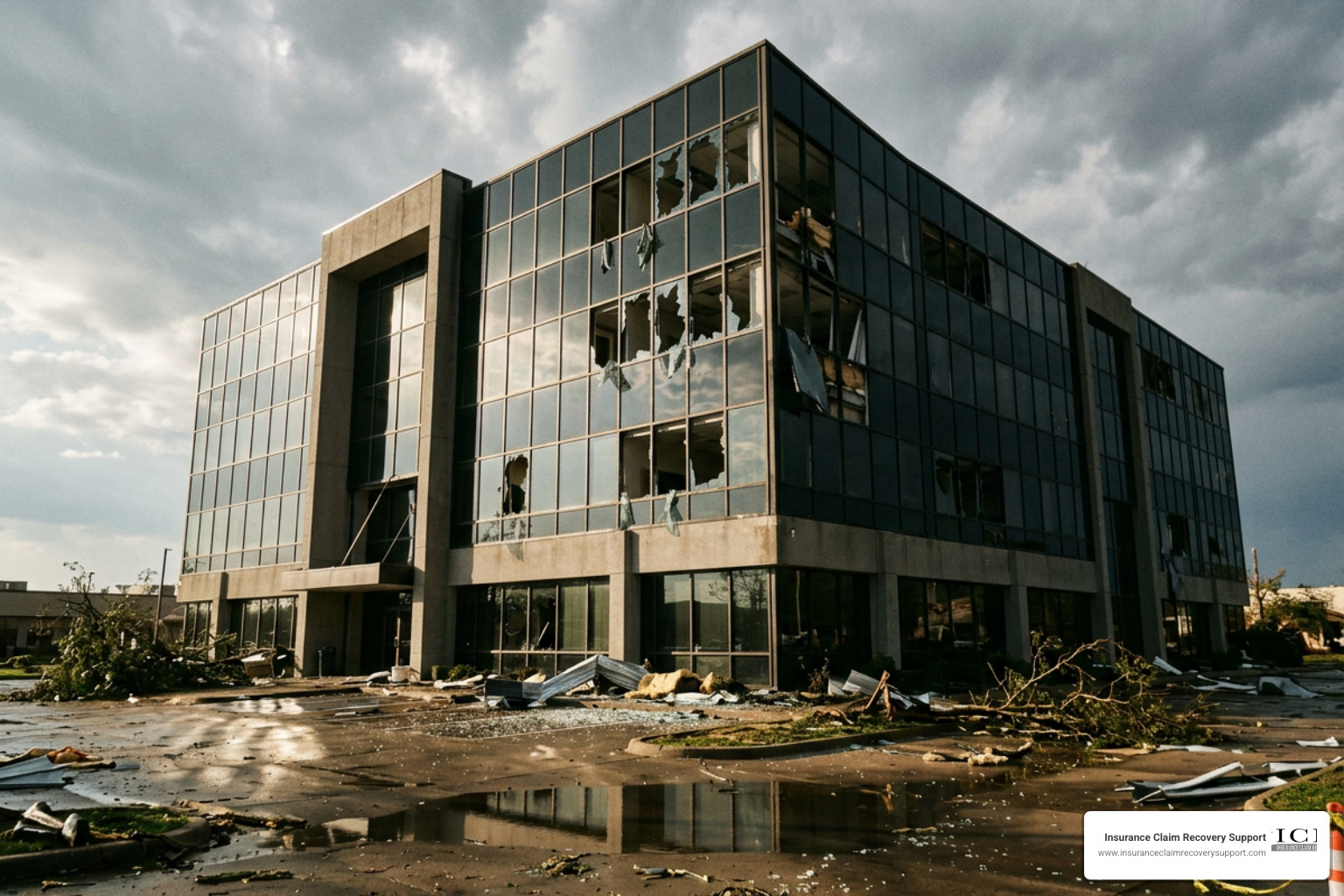
For commercial policyholders, this means you cannot simply claim lost income because of a localized economic downturn or a general drop in market demand. There must be a physical event — such as windstorm, tornado, fire, or water loss — that physically damages your building and directly causes the suspension of your business operations.
When dealing with Commercial Property Damage, the physical damage claim and the business interruption claim must be prepared in tandem. Every day that the physical restoration is delayed by the insurer is another day of lost business income. This is why getting professional Commercial Property Insurance Claim Help early in the process is so critical to streamlining both aspects of your recovery.
Contingent Business Interruption vs. Standard Coverage
Standard business interruption coverage protects you when your own property is damaged. But what happens when your operations are paralyzed because of damage to a property you don’t own? This is where Contingent Business Interruption (CBI) coverage comes into play.
CBI is an essential endorsement for businesses with complex supply chains, manufacturing facilities, or retail properties that depend heavily on anchor tenants or key suppliers.
- Standard Business Interruption: Triggers when physical damage occurs directly at your scheduled premises (e.g., a fire in your retail storefront).
- Contingent Business Interruption: Triggers when physical damage occurs at the premises of a key supplier, customer, or leader business, which in turn causes a loss of income for your business (e.g., a fire at your primary manufacturing supplier’s warehouse, leaving you with no product to sell).
Understanding the differences between standard property triggers and Non-Damage Business Interruption or contingent coverages will help you map out your supply chain risks and ensure your claim is categorized correctly from the start.
How to Claim Business Interruption Insurance: The 5-Step Roadmap
Filing a successful claim requires a highly structured, evidence-based approach. We have simplified this process into a clear 5-step roadmap designed to help you navigate the complex accounting and administrative hurdles. For a deeper dive into these strategies, bookmark our Business Interruption Claim Ultimate Guide and our comprehensive Business Interruption Complete Guide.
Step 1: Reviewing Policy Language and Named Perils vs. All-Risk
The first step in how to claim business interruption insurance is to conduct a meticulous review of your commercial property policy. Do not rely on generic market definitions; you must analyze the exact policy language, exclusions, and endorsements on your declaration page.
One of the most critical distinctions you will identify is whether you have a Named Perils policy or an All-Risk policy:
- Named Perils Policy: Only covers losses caused by perils explicitly listed in the policy (e.g., fire, lightning, windstorm). The burden of proof is on you, the policyholder, to prove the damage was caused by a listed peril.
- All-Risk Policy: Covers all causes of physical loss unless they are specifically excluded (e.g., earthquake, flood, or mold exclusions). Here, the burden of proof shifts to the insurer to prove that an exclusion applies.
Reviewing these terms helps you understand what is covered and highlights the factors that dictate How Much Does Business Interruption Insurance Cost? and how limits are structured.
Step 2: Assessing Lost Income and the Actual Loss Sustained
Insurers do not pay out flat-rate sums for business interruption; they indemnify you for the Actual Loss Sustained. This means they will only pay for the actual net income you lost, plus continuing normal operating expenses, during the period of suspension.
To calculate this, you must establish a credible “but-for” revenue baseline — meaning, what would the business have earned but for the disaster? This requires looking at your historical financial trends, seasonal adjustments, and pre-loss growth trajectories.
| Calculation Element | Gross Earnings Method | Gross Profits Method |
|---|---|---|
| Primary Focus | Replaces lost sales revenue minus non-continuing expenses. | Replaces net profit plus continuing fixed charges. |
| Variable Expenses | Deducts cost of goods sold (COGS) and other variable costs. | Subtracts all variable costs to focus strictly on net profit. |
| Scrutiny Risk | High scrutiny on which expenses are classified as “continuing.” | High scrutiny on pre-loss profit margins and market trends. |
Step 3: Determining the Period of Restoration and Dry Log Records
The Period of Restoration is the window of time during which your policy will pay for lost income. By definition, this period typically begins at the time of physical loss (or after a 48-to-72-hour waiting period) and ends on the date when the property should be repaired, rebuilt, or replaced with “reasonable speed and similar quality.”
Crucially, the period of restoration is not determined by when you actually reopen, but by when you could have reopened with due diligence. If construction is delayed because of insurer foot-dragging, permitting delays, or supply chain shortages, the carrier may attempt to cut off your benefits early.
To defend your timeline, you must maintain exhaustive dry log records and reconstruction timelines. This is especially vital when dealing with environmental hazards (such as mold, asbestos, or lead) that require specialized hygienists, strict OSHA protocols, and complex abatement procedures. If a certified industrial hygienist mandates a 30-day mold remediation protocol, those days must be legally recognized as part of your period of restoration.
Step 4: Calculating Lost Revenue and Documenting Extra Expense
Calculating lost revenue is an intensive accounting exercise. You must collect federal tax returns, monthly profit and loss statements, payroll registers, and inventory records.
Additionally, you must document your Extra Expenses. Extra expense coverage pays for reasonable and necessary costs you incur to avoid or minimize the suspension of business operations (e.g., renting a temporary office space, paying overtime to contractors to speed up repairs, or renting emergency generators).

To keep your claim organized and prevent the insurer from blending your normal operating costs with your disaster-related expenses, you should immediately open separate general ledger accounts to track all loss-related charges.
Step 5: Applying Deductibles and Finalizing the Settlement
Once the total business income loss and extra expenses are calculated, you must apply your policy’s deductible. In commercial property policies, business interruption deductibles are frequently structured as waiting periods (typically 24, 48, or 72 hours) rather than dollar amounts.
For example, if your policy has a 72-hour waiting period, you absorb 100% of the lost income for the first three days following the physical damage. Only the losses incurred after this waiting period are eligible for indemnification. Once these calculations are finalized, we work to compile the ultimate claim package to secure your full indemnification.
Navigating Insurer Scrutiny, Adjuster Licensing Gaps, and Legal Frameworks
For commercial and multifamily property owners, navigating a major business interruption claim means confronting a harsh reality: insurance carriers are highly sophisticated financial institutions that frequently view systemic underpayment as a mere “cost of doing business.” This “cost of doing business” strategy is designed to wear down commercial policyholders, forcing them to accept lowball settlements while their properties sit vacant.
Furthermore, there are significant adjuster licensing gaps in the industry. Many independent or staff adjusters sent by insurance companies to evaluate commercial and multifamily assets are licensed in other states, lack local geographic expertise, or have minimal training in complex commercial accounting. They often overlook critical continuing expenses or miscalculate historical growth trends to undervalue your claim.
To level the playing field, commercial and multifamily policyholders must understand the legal frameworks governing claims. In Texas, for instance, Texas Insurance Code Chapters 541 and 542 (the Prompt Payment of Claims Act) establish strict deadlines for insurers to acknowledge, investigate, and pay claims. Violations of these statutes can subject carriers to statutory interest penalties and attorney fees.
In other states, such as Florida, skyrocketing litigation costs have led carriers to push commercial claims into the appraisal process to resolve disputes over the amount of loss without going to court.
The systemic nature of carrier delay and underpayment tactics is well-documented across the industry. For example, regulatory investigations and legal challenges have repeatedly highlighted these issues, such as the Insurance Journal report on a $15.6M settlement over claim handling practices. Similar patterns of widespread insurer scrutiny and regulatory oversight are evident in major insurance markets, as detailed in the NYT coverage of insurer pullbacks and the formal California Enforcement Action issued to State Farm. These systemic issues have drawn national attention, with extensive coverage by major outlets like The Guardian and CNN, proving that commercial and multifamily policyholders must be incredibly diligent when presenting their claims to secure a fair settlement.
Key Deadlines and Proof of Loss Requirements on How to Claim Business Interruption Insurance
When executing how to claim business interruption insurance for a commercial or multifamily asset, missing a policy deadline can be fatal to your recovery. Most commercial policies require you to submit a signed and sworn Proof of Loss within a specific timeframe (often 60 days from the date of the insurer’s request, or within a set period after the loss).
This document is a formal, legally binding statement of the amount of damage and lost income you are claiming. It must be supported by meticulous financial data. Additionally, pay close attention to your policy’s suit limitation clause, which dictates how long you have to file a lawsuit against the carrier if they underpay or wrongfully deny your claim.
Managing Civil Authority Orders and Extra Expense Claims
Sometimes, your commercial or multifamily property isn’t physically damaged, but a government entity shuts down access to your area due to damage to a neighboring property. This triggers Civil Authority Coverage.

To claim Civil Authority benefits:
- There must be physical damage to a property near your commercial or multifamily premises, caused by a covered peril.
- A civil authority (e.g., city council, fire department, governor) must issue an official order prohibiting access to your property.
- The order must be a direct result of the damage to the neighboring property, not just a general safety precaution.
Frequently Asked Questions About Business Interruption Claims
What is the standard waiting period before coverage begins?
Translation: “How many days of lost revenue do I have to eat before the insurance company starts paying?”
- Fact: Most commercial policies have a 48-to-72-hour waiting period. The lost income during this initial window acts as your deductible and is typically non-reimbursable.
- Myth: “My policy covers me from the exact second the storm hits.” (Always check your declarations page for a “Waiting Period” endorsement).
How do environmental hazards affect the period of restoration?
Translation: “If mold or asbestos protocols slow down my construction, will the insurer pay for that extra downtime?”
- Fact: Yes, provided the environmental hazard was caused directly by the covered peril (e.g., water damage leading to mold). However, you must document this meticulously.
- Myth: “The insurer will automatically extend my period of restoration for mold cleanup.” (In reality, they will fight to exclude these delays unless you have clear dry log records and hygienist reports).
When should a commercial policyholder hire a public adjuster?
Translation: “Can I handle a major business income loss claim on my own, or am I outmatched by the carrier’s forensic accountants?”
If your commercial or multifamily property damage claim exceeds $250,000, you should almost certainly hire a licensed public adjuster. Calculating “but-for” revenue, arguing over the period of restoration, and managing extra expense ledgers require specialized expertise.
A Certified Public Adjuster for Business Income Loss works exclusively for you — the policyholder — to audit the insurance company’s calculations, protect your rights, and maximize your settlement.
Conclusion
Recovering from a major business disruption is a complex, high-stakes process. When your commercial building, retail plaza, or apartment complex is damaged, the insurance company will deploy its own team of adjusters and forensic accountants to protect its bottom line. To secure the settlement you deserve, you need an advocate on your side who understands their playbook.
Insurance Claim Recovery Support LLC (ICRS) is a premier, Texas-based public insurance adjusting firm representing policyholders only. We specialize in large-loss commercial and multifamily property claims, helping professional property managers, commercial building owners, and multifamily operators maximize their settlements and reduce delays.
We serve clients across our home state of Texas — including Austin, Dallas, Fort Worth, San Antonio, Houston, Lubbock, San Angelo, Waco, Round Rock, Georgetown, Lakeway, and Amarillo — as well as multiple other states including Florida, Georgia, Colorado, North Carolina, South Carolina, Oklahoma, Pennsylvania, Ohio, Indiana, Kansas, Kentucky, Maryland, Utah, Nebraska, and Nevada.
If you are dealing with a complex business interruption claim, don’t let carrier delay tactics derail your business. Read our guide on Navigating Multi-Family Property Insurance Claims and contact the team at ICRS today for a professional consultation. We are here to help you rebuild, recover, and protect your cash flow.