What Every Commercial and Multifamily Property Owner Must Know About Tornado House Damage
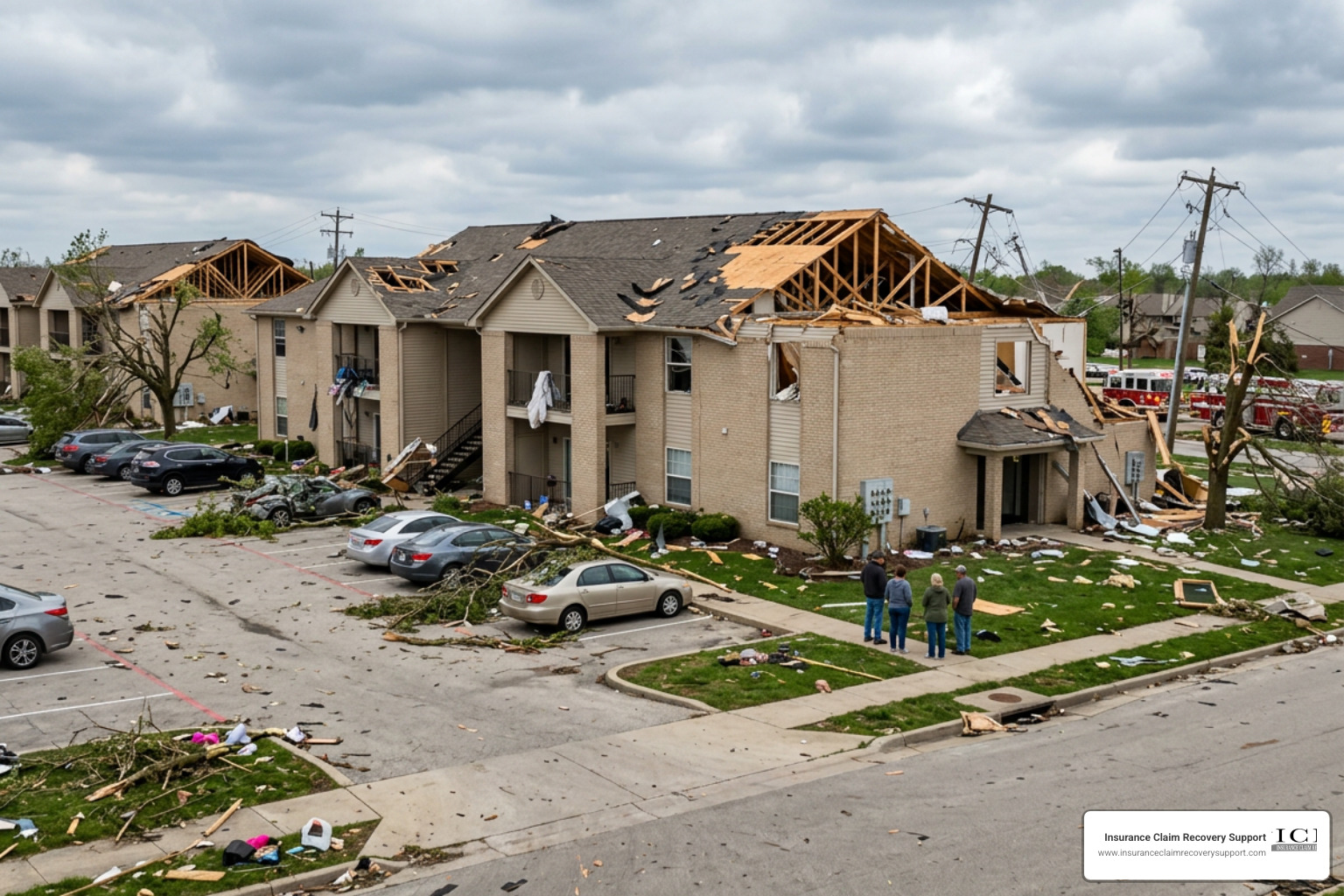
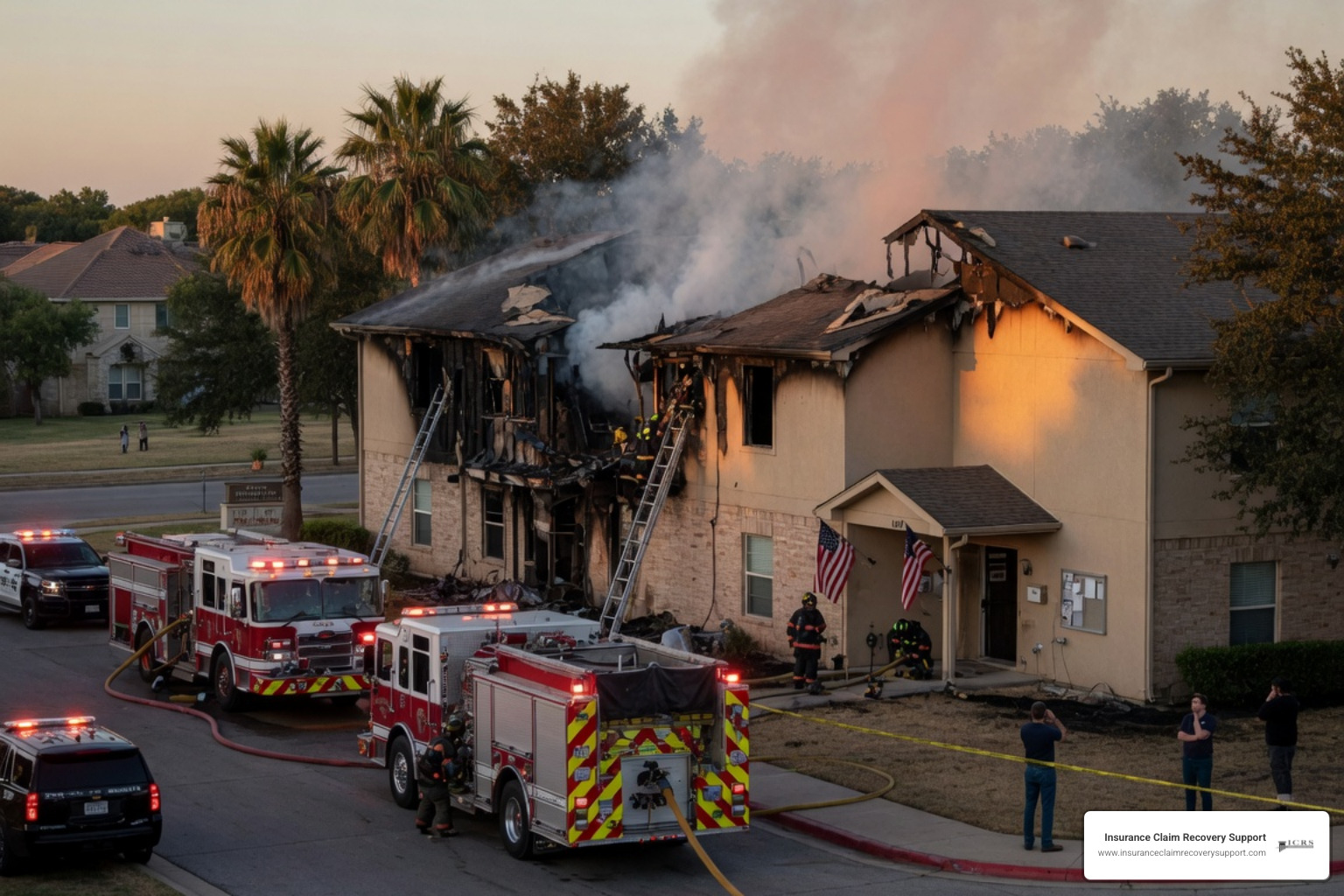
Tornado house damage can strike a commercial or multifamily property in minutes — and the financial and operational fallout can last for months or even years.
For a companion claim-documentation resource, see the ICRS Hail & Wind Claim Guide. Coverage and next steps depend on the facts and policy terms.
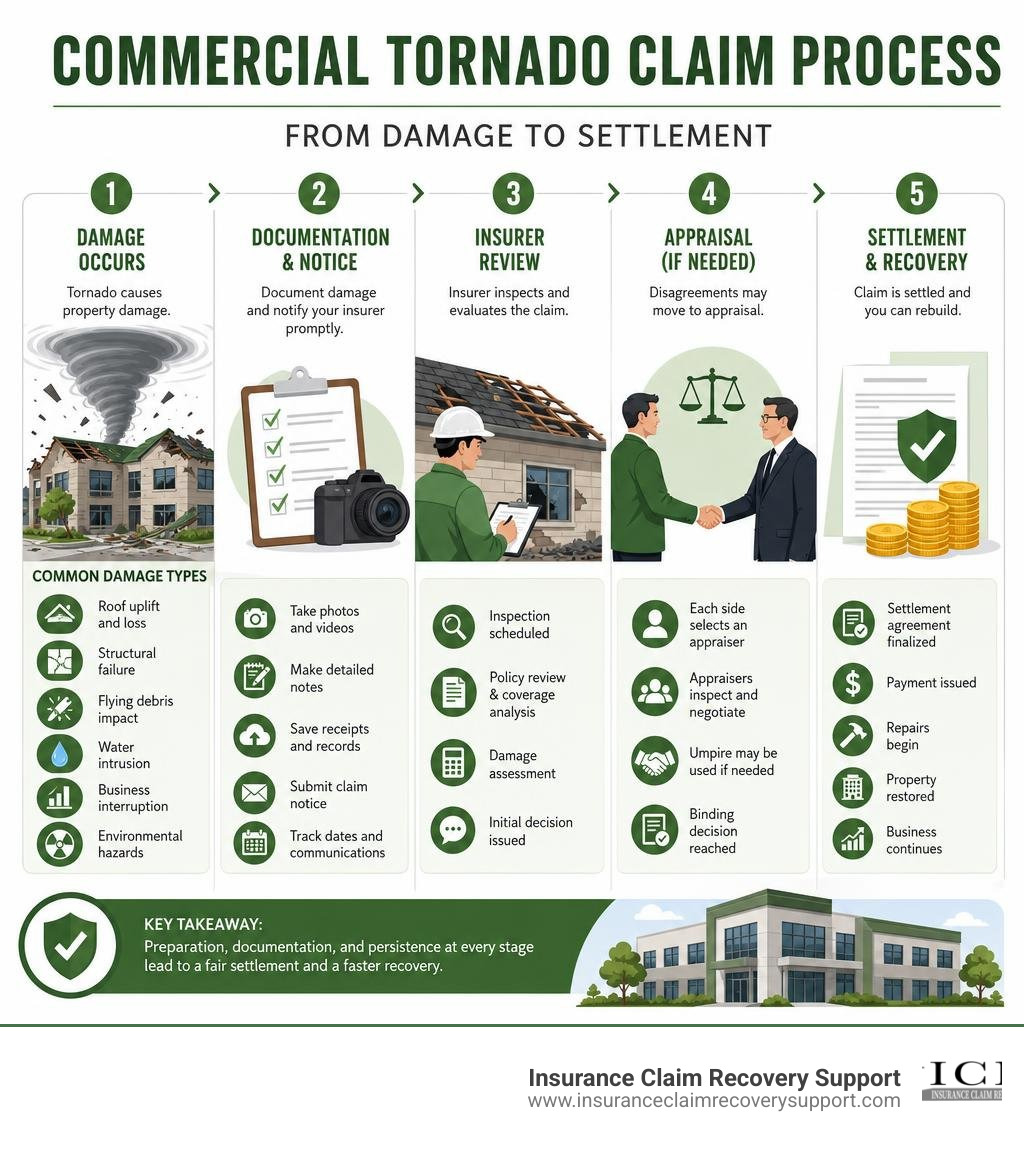
Here’s a quick breakdown of what property owners are typically dealing with after a tornado hits:
| Damage Type | What It Means for Your Property |
|---|---|
| Roof uplift and loss | Partial or total roof failure exposing the building envelope to water intrusion |
| Structural failure | Shear wall collapse, framing connection failure, or foundation displacement |
| Flying debris impact | Breached windows, punctured walls, and damaged mechanical systems |
| Water intrusion | Immediate and secondary damage including mold growth and interior loss |
| Business interruption | Lost rental income, displaced tenants, and lender compliance pressure |
| Environmental hazards | Exposed asbestos, mold, or other materials requiring OSHA-compliant protocols |
The damage is rarely just what you can see. And the insurance claim process that follows? It can be just as destructive to your bottom line if you’re not prepared.
In 2022 alone, more than 1,300 tornadoes tore across the U.S., collectively causing an estimated $700 million in property and crop damage — averaging roughly $685,000 per event. For commercial property owners and multifamily operators, a single direct hit can mean millions in structural repairs, lost rental income, displaced tenants, and a protracted insurance claim battle.
What most owners don’t realize until it’s too late is that their insurer’s interests and their own are not automatically aligned. The claim process — from initial inspection to final settlement — is where money is made or lost. How you document damage, communicate with your carrier, and understand your policy language determines whether you’re made whole or left holding the bag.
✅ Key Takeaway: Tornado damage to commercial and multifamily properties is a multi-layered problem — structural, environmental, operational, and financial. Getting the insurance settlement right requires understanding all of those layers from day one.
I’m Scott Friedson, CEO of Insurance Claim Recovery Support (ICRS) and a multi-state licensed public adjuster with over 15 years of experience handling large-loss tornado house damage claims for commercial and multifamily property owners across the country. Over the course of 500+ claims totaling more than $250 million in settled losses, I’ve seen how the difference between an underpaid claim and a fully indemnified one often comes down to preparation, documentation, and knowing exactly where insurers push back. In this guide, I’ll walk you through everything you need to know — from the anatomy of tornado damage to navigating the claims process and protecting your rights as a policyholder.
Tornado house damage helpful reading:
Anatomy of Tornado House Damage in Multifamily and Commercial Properties
When severe weather strikes, commercial and multifamily structures — often referred to loosely in policy terms as “commercial residential structures” — suffer immense structural strain. The sheer surface area of an apartment building complex, retail plaza, or office park makes it a prime target for severe wind forces. To understand the true scope of the loss, we must look at What Damage Does a Tornado Cause? and realize How Much Damage Can a Tornado Cause? when high winds breach the building envelope.
A tornado’s high winds do not merely blow against a building; they create aerodynamic lift and extreme pressure differentials. The windward walls experience positive pressure, while the roof and leeward walls experience negative pressure (suction). When these forces exceed the design capacity of the building, envelope failure occurs.
Once the roof membrane is compromised or windows are blown out by flying debris, the building becomes pressurized internally. This internal pressure pushes upward on the roof and outward on the walls, while the external wind continues to pull from the outside. This combination of forces is what leads to catastrophic roof uplift and structural failure.

Structural and Foundation Failures from Tornado House Damage
Structural damage from a tornado is not always as obvious as a collapsed wall. In commercial residential properties, the lateral loads exerted by wind speeds exceeding 100 mph can compromise the entire framing system.
- Shear Wall Failure: Shear walls are designed to resist lateral wind forces. When a tornado strikes, the extreme winds can twist or warp these walls, compromising the load path of the entire building.
- Framing Connection Failures: Roof-to-wall connections (such as hurricane clips or truss tie-downs) can fail under uplift pressures. Even if the roof appears intact, these connections may be stretched or broken, leaving the structure vulnerable to future collapses.
- Foundation Displacement: In extreme cases, the lateral force on a large commercial structure can cause foundation displacement or cracking, especially if the framing was not adequately anchored to the concrete slab.
Understanding these structural nuances is critical when analyzing Tornadoes and You: A Guide to Understanding Their Impact. A surface-level aesthetic inspection by a carrier-appointed adjuster will almost certainly miss these underlying structural failures, leading to a severely underpaid claim.
Environmental Hazards and Secondary Tornado House Damage
The immediate physical impact of a tornado is only the first wave of destruction. Once the building envelope is breached, secondary damage begins immediately, introducing complex environmental hazards that require strict compliance with state and federal regulations.
- Water Intrusion and Mold Growth: Rainwater driven by tornado-force winds will saturate drywall, insulation, and concrete subfloors. Within 24 to 48 hours, mold spores begin to colonize. In multifamily settings, this presents a massive liability regarding tenant health and habitability.
- Asbestos and Lead Protocols: Many historical or older commercial properties contain asbestos-containing materials (ACMs) or lead-based paint. When a tornado tears down walls and ceiling tiles, these hazardous materials become friable. Property owners must engage licensed environmental consultants to perform testing and establish containment protocols before any demolition or cleanup begins.
- OSHA Regulations: Any recovery or mitigation work performed on-site must comply with OSHA standards. This includes ensuring workers have proper personal protective equipment (PPE), managing structural stability hazards, and addressing electrical risks from downed power lines.
- The Importance of Industrial Hygienists: To secure a full settlement for environmental remediation, we must utilize certified industrial hygienists to draft protocol designs and perform post-remediation verification (clearance testing).
- Dry Log Records: Carriers frequently dispute the scope of water mitigation. To defeat these arguments, we must maintain comprehensive “dry log records,” including moisture mapping, psychrometric charts, and daily relative humidity readings. These records prove that the drying equipment was necessary and operated in accordance with industry standards (IICRC S500).
Without a professional Tornado Damage Assessment that accounts for these environmental realities, your insurer may try to limit their exposure by applying low sub-limits for mold or denying the cost of hazardous material abatement altogether.
Systemic Insurer Scrutiny and the Cost of Doing Business Model
In the wake of a major catastrophe, commercial property insurance carriers do not simply write checks out of goodwill. Instead, they employ a highly sophisticated “cost of doing business” model designed to minimize payouts and maximize corporate cash flow. By delaying payments, disputing scopes of damage, and relying on systemic policyholder fatigue, insurers keep millions of dollars in their interest-bearing accounts.
This systemic scrutiny is a nationwide pattern affecting commercial and multifamily assets. For instance, in early 2026, regulatory investigations and media reports highlighted the extreme measures carriers take to limit their liabilities. The high-profile State Farm $15.6M settlement exposed bad faith practices in claims handling, demonstrating how carriers systematically underpay and delay valid claims.
Similarly, the crisis detailed in the NYT California article and the subsequent California Enforcement Action shed light on how major carriers face scrutiny for structural violations affecting commercial residential portfolios. Media outlets like The Guardian and CNN documented extensive insurance violations and unilateral policy non-renewals following natural disasters, highlighting systemic issues that impact commercial property owners.
When a tornado hits commercial and multifamily assets, insurers deploy these same delay-and-deny tactics. They know that commercial policyholders are under intense pressure from lenders, tenants, and municipal code authorities. The longer the carrier delays, the more likely the policyholder is to accept a lowball settlement just to get their business back up and running. This is why understanding how to combat a Tornado Insurance Claim Denial is vital to your survival.
Regulatory Frameworks: Texas Statutes 541 and 542
For properties located in our primary service areas—including Austin, Dallas, Fort Worth, San Antonio, Houston, and Lubbock—policyholders are protected by robust state laws designed to curb insurer misconduct.
- Texas Insurance Code Chapter 541 (Unfair Claim Settlement Practices): This statute prohibits insurance companies from engaging in unfair or deceptive acts. This includes misrepresenting policy terms, failing to attempt a good-faith settlement when liability is reasonably clear, and refusing to pay a claim without conducting a reasonable investigation.
- Texas Insurance Code Chapter 542 (Prompt Payment of Claims Act): This is one of the most powerful tools in a policyholder’s arsenal. Under Chapter 542, insurers must meet strict deadlines:
If the carrier fails to meet these deadlines, they are liable for statutory interest (currently 18% per annum for older policies, or calculated based on the prime rate plus 5% for newer claims) on the amount of the claim, plus reasonable attorney’s fees.
In contrast, states like Florida have seen massive changes in litigation costs and bad-faith frameworks, making it harder for policyholders to recover fees. In Texas, maintaining a strict paper trail of insurer communications is the key to holding carriers accountable under Chapters 541 and 542, ensuring your right to be fully indemnified. Learn more about your options by reviewing Does Insurance Cover Tornado Damage?.
Navigating the Commercial Claim and Appraisal Process
Filing a claim for tornado house damage on a commercial scale requires a methodical, evidence-based approach. Because commercial policies are highly customized, a standard “one-size-fits-all” estimate will not suffice.

- Secure the Property: Under virtually all commercial policies, you have a duty to mitigate further damage. This means boarding up windows, tarping damaged roofs, and setting up emergency drying equipment. Keep detailed receipts of every penny spent on temporary repairs.
- Obtain a Certified Copy of Your Policy: Do not rely on a simple “dec page.” You need the full policy, including all endorsements, exclusions, and sub-limits.
- Draft an Independent Estimate: Most major insurance companies use a software program called Xactimate to calculate repair costs. However, Xactimate pricing is based on regional averages and often fails to account for the actual, real-world costs of commercial-grade materials, specialized labor, and municipal building code upgrades. We work with independent contractors and engineers to draft real-world, line-item estimates that reflect actual market conditions.
- Beware of Adjuster Licensing Gaps: Following a widespread tornado outbreak, carriers often import out-of-state “catastrophe adjusters.” Many of these adjusters lack the proper licensing, regional knowledge, or experience required to evaluate large-loss commercial framing and roofing systems. Always verify the credentials of any adjuster sent to your property.
If you find yourself stuck in a loop of endless inspections and lowball offers, you may need to file a formal dispute. This is where Filing a Tornado Insurance Claim properly and preparing for Tornado Damage Claims makes all the difference.
The Role of Public Adjusters in Large-Loss Claims
For property damage claims exceeding $250,000, navigating the process alone is a recipe for financial disaster. Insurance companies hire professional adjusters, forensic engineers, and attorneys to protect their bottom line. You deserve the same level of representation.
A licensed public adjuster works exclusively for you, the policyholder. We take over all communication with the insurance company, conduct comprehensive damage assessments, draft detailed Xactimate estimates, and negotiate directly with the carrier.
According to industry data, utilizing a Public Adjuster to file and advocate for your insurance claim increases the average claim settlement by 747 percent. We ensure that all aspects of your loss — including structural damage, environmental remediation, and business interruption — are fully documented and indemnified.
To understand the full financial and operational scope of recovery, read our guide on Tornado Insurance Claims and explore The Human and Natural Cost of a Twister.
Fact vs. Myth and Frequently Asked Questions
When dealing with severe windstorms and tornado house damage, misconceptions can cost you millions. Let’s separate the myths from the realities of commercial property claims.
| Myth | Commercial Reality |
|---|---|
| Myth 1: Opening windows before a tornado equalizes pressure and prevents structural damage. | Reality: Tornado damage is caused by high-velocity wind and flying debris, not pressure differentials. Keep windows closed and reinforced; open windows only invite water and wind inside, accelerating roof uplift. |
| Myth 2: If the roof is still on, there is no major structural wind damage. | Reality: High winds can break framing connections, compromise shear walls, and lift the roof membrane without blowing it completely off, leaving hidden structural vulnerabilities. |
| Myth 3: Standard commercial property policies cover all water damage after a storm. | Reality: While wind-driven rain entering through a storm-created opening is covered, surface water flooding or rising water requires a separate flood endorsement. |
| Myth 4: You must accept the insurance carrier’s preferred contractor and estimate. | Reality: You have the legal right to hire your own independent, licensed contractors and public adjusters to negotiate a fair, real-world settlement. |
What is the ‘Translation’ of insurer delay tactics?
When dealing with a massive commercial loss, carriers rarely say “we don’t want to pay you.” Instead, they use coded language to stall the process. Here is the translation of common insurer delay tactics:
- Insurer Says: “We are issuing a Reservation of Rights (ROR) letter while we investigate the cause of loss.”
- Translation: “We are looking for any policy exclusion, pre-existing wear-and-tear, or maintenance issue we can use to deny or severely limit your settlement.”
- Insurer Says: “We need to send out an independent forensic engineer to evaluate the structural integrity.”
- Translation: “Our field adjuster found major damage, so we are hiring a preferred engineering firm that regularly works for insurance companies to write a report claiming the damage was pre-existing or non-structural.”
- Insurer Says: “We are waiting on internal management approval for this portion of the estimate.”
- Translation: “We are sitting on your money as long as possible to force you into a corner where you’ll accept a lower settlement just to avoid bankruptcy.”
How do dry log records impact water damage settlements?
Dry log records are the ultimate defense against carrier underpayments for water mitigation. When an insurer claims your water extraction team “over-dried” the building or used too many dehumidifiers, your dry logs provide the scientific proof.
A complete dry log includes:
- Moisture Mapping: Thermal imaging and moisture meter readings showing the exact boundaries of wet materials.
- Psychrometric Charts: Daily logs of air temperature, relative humidity, and grains per pound (GPP) of moisture both inside and outside the containment zones.
- Equipment Verification: Documentation proving that the drying equipment was operating efficiently and was necessary to prevent mold growth and structural decay.
Without these records, insurers will routinely slash water mitigation invoices by 30% to 50%, leaving the property owner to pay the difference out of pocket.
Why are appraisal awards preferred over litigation?
When a claim is at an impasse, policyholders typically have two paths: filing a lawsuit or invoking the policy’s appraisal clause. For most commercial property owners, the appraisal process is the faster, more cost-effective choice.
- Speed: Litigation can drag on in court for years. The appraisal process can often be resolved in a matter of months.
- Cost Efficiency: Litigation involves massive attorney fees, deposition costs, and court filings. While Florida litigation costs have skyrocketed due to recent tort reforms, appraisal keeps the dispute focused purely on the “scope and value” of the damage, minimizing legal overhead.
- Binding Decision: If the two appraisers (one chosen by you, one by the carrier) agree on the damage amount, they sign an award that is binding on both parties. If they disagree, they submit their differences to an independent umpire, and an agreement between any two of the three parties sets the final settlement amount.
Conclusion
Recovering from tornado house damage on a commercial or multifamily scale is an uphill battle, but you do not have to fight it alone.
At Insurance Claim Recovery Support LLC (ICRS), we are licensed public insurance adjusters who represent policyholders only — never the insurance companies. We specialize in maximizing settlements, reducing claim delays, avoiding litigation, and resolving complex commercial claims with a 90% settlement success rate without unnecessary lawsuits.
Based in Texas, we proudly serve property managers, commercial building owners, apartment investors, HOAs, religious institutions, and industrial operators in:
- Austin
- Dallas & Fort Worth
- San Antonio
- Houston
- Lubbock
- San Angelo
- Amarillo
- Lakeway & Bee Caves
- Georgetown & Round Rock
- Waco
If your commercial residential property has been impacted by a tornado or severe windstorm, do not let your carrier dictate the terms of your recovery. Protect your investment, secure your tenants’ safety, and ensure your business is fully indemnified.
📞 Get Professional Claim Help Today
Don’t settle for less than you deserve. Contact the team at Insurance Claim Recovery Support LLC for a comprehensive, no-obligation consultation.
- Request a Professional Assessment: Claim Help and Consultation
- Learn More About Our Services: Insurance Claim Recovery Support
- Stay Updated on Policyholder Rights: Latest Property Insurance News
- Discover the Public Adjuster Difference: What is a Public Adjuster?