Why Understanding What Tornadoes Do to the Earth and People Could Save Your Property and Your Business
What effects do tornadoes have on the earth and people is one of the most urgent questions any property owner in a tornado-prone region can ask — and the answer covers far more ground than most people expect.
Here’s a quick breakdown:
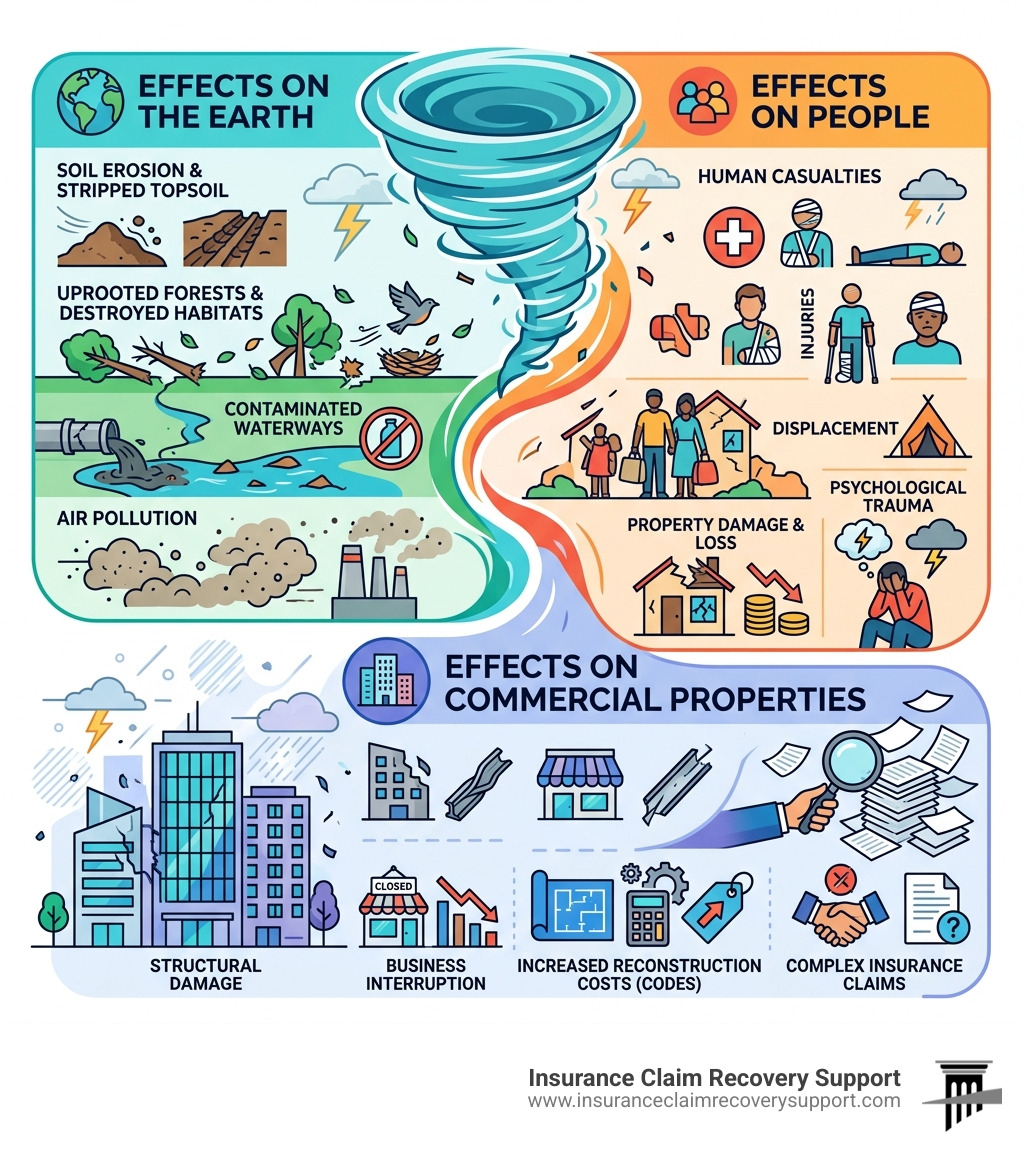
🌍 Effects on the Earth:
- Strips topsoil and triggers severe erosion along damage paths
- Uproots forests and destroys wildlife habitats
- Contaminates rivers, lakes, and groundwater through debris and runoff
- Disperses soil-borne diseases and pollutants across wide areas
- Creates air pollution from lofted debris and damaged industrial facilities
👥 Effects on People:
- Kills an average of 71 people per year in the U.S. (1993–2022 data)
- Injures more than 1,500 people annually
- Displaces families and entire communities
- Causes billions in property damage — the 2023 season alone exceeded $8 billion in losses
- Creates lasting psychological trauma for survivors and displaced residents
🏢 Effects on Commercial and Multifamily Properties:
- Destroys roofs, facades, and structural systems in seconds
- Triggers business interruption losses that compound every day a building stays closed
- Forces compliance with updated building codes during reconstruction, adding unexpected costs
- Generates complex, often disputed insurance claims that can take months or years to resolve without expert help
Tornadoes are among the most violent storms on Earth. A single twister can level a commercial district, displace hundreds of tenants, and leave property owners fighting with insurers while revenue bleeds out. The 2011 spring tornado season — one of the deadliest on record — killed more than 580 people and caused over $21 billion in economic damage. And the threat isn’t shrinking: in 2024, more than 1,500 tornadoes had already occurred by August, including five separate billion-dollar events.
The destruction is fast. The recovery is slow. And for commercial and multifamily property owners, the insurance claim process is often where the real battle begins.
I’m Scott Friedson, a Multi-State Licensed Public Adjuster and CEO of Insurance Claim Recovery Support (ICRS) LLC, with over 15 years of experience settling hundreds of millions of dollars in large-loss property damage claims — including tornado claims — across the country. Understanding what effects do tornadoes have on the earth and people is the foundation of every recovery strategy I bring to commercial and multifamily property owners, and in this guide, I’ll walk you through exactly what you’re up against and how to protect your financial recovery.
Handy what effects do tornadoes have on the earth and people terms:
Introduction
Tornadoes are nature’s most concentrated displays of fury. These violently rotating columns of air extend from the base of a cumuliform cloud—usually a supercell thunderstorm—to the ground. They are fueled by atmospheric instability and wind shear, which is a change in wind speed or direction with height. This creates a rotating updraft known as a mesocyclone.
In the United States, we see more than 1,200 tornadoes annually, more than any other country on Earth. While many are “weak” (EF0 or EF1), the violent ones (EF4 and EF5) account for 70 percent of all tornado-related deaths despite making up only 2 percent of total occurrences. Scientists use the Enhanced Fujita (EF) Scale to rate these storms based on 28 different damage indicators, ranging from EF0 (65-85 mph) to the catastrophic EF5 (over 200 mph).
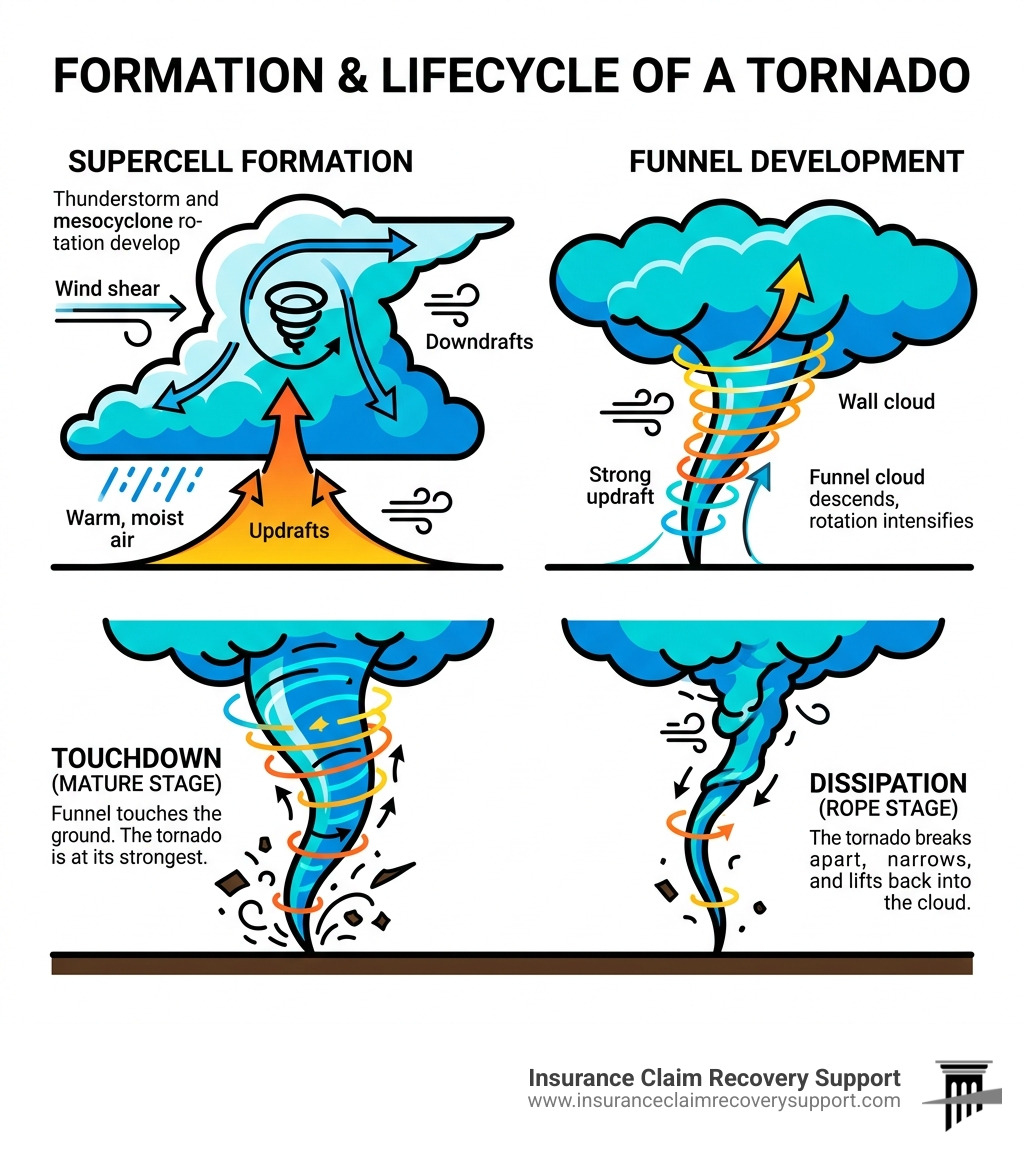
What Effects Do Tornadoes Have on the Earth and People?
The question of what effects do tornadoes have on the earth and people requires looking at both immediate physical destruction and long-term ecological and societal shifts. When a tornado touches down, it doesn’t just “hit” a building; it interacts with the very surface of the planet.
In 2024 alone, we have seen over 1,500 tornadoes by August, resulting in at least 40 lives lost and multiple billion-dollar disasters. The physical path of a typical tornado is about one to two miles long and 50 yards wide, but extreme cases like the 2013 El Reno tornado reached 2.6 miles in width. These storms scour the earth, removing vegetation and topsoil, which leads to immediate erosion and long-term changes in the landscape.
For a deeper dive into the science behind these events, you can explore Scientific research on tornado formation and safety.
Environmental Impact: How Tornadoes Affect the Earth’s Ecosystems
While we often focus on the “human” side of the news, the environmental toll is staggering. Tornadoes can level entire forests in minutes, uprooting ancient trees and stripping bark from those left standing. This habitat destruction leaves local wildlife displaced or killed, disrupting the delicate balance of regional ecosystems.
Furthermore, tornadoes are messy. They pick up everything in their path—pesticides from farms, industrial chemicals from factories, and raw sewage from damaged infrastructure—and dump it into local waterways. This leads to significant water pollution and long-term contamination of groundwater. Interestingly, some research suggests tornadoes might aid in the dispersal of certain plant and small animal species across regions, but this “benefit” is usually overshadowed by the spread of soil-borne diseases and air pollution from lofted debris.
To learn more about these ecological shifts, check out Scientific research on tornado environmental impacts.
Human Toll: What Effects Do Tornadoes Have on the Earth and People?
The human cost is measured in more than just statistics; it’s measured in lives changed forever. Between 1993 and 2022, an average of 71 people were killed by tornadoes each year in the U.S., with more than 1,500 injuries annually. Most of these casualties are caused by flying or falling debris—nature’s shrapnel.
In states like Kansas, where the threat is a constant reality, the psychological trauma of “near misses” and total losses can haunt communities for generations. You can read more about regional impacts in our guide on Kansas And Tornadoes. Similarly, states like Florida often face tornadoes spawned by tropical systems, adding another layer of complexity to emergency response. See our detailed look at Florida Tornado Damage for more.
Economic Consequences for Commercial and Multifamily Properties
For owners of commercial and multifamily properties, the economic impact is a “triple threat”: physical damage, business interruption, and the cost of modernizing to current building codes. The 2023 tornado season saw total damages exceeding $8 billion. When a tornado strikes a shopping plaza in Houston or an apartment complex in Dallas, the loss of rental income or retail revenue begins immediately.
Infrastructure collapse—including downed power lines and ruptured gas mains—can keep a property dark and dangerous for weeks after the storm has passed. This was vividly seen when a Tornado Tears Through Northwest Dallas Texas, causing massive structural failures and long-term displacement for businesses and residents alike. We also see these patterns in our work with Iowa Tornado Damage, where agricultural and commercial hubs face years of rebuilding.
Navigating Commercial Recovery and Insurance Claims
Recovery doesn’t happen by accident; it happens through meticulous documentation and aggressive advocacy. In Texas cities like Austin, Fort Worth, San Antonio, and Lubbock, we’ve seen that policyholders who act quickly to protect their property and document every shingle, window, and piece of equipment fare much better than those who wait for the insurance company’s adjuster.
Your policy has strict requirements. You must report the damage immediately and take “reasonable steps” to prevent further loss—like tarping a roof or boarding up windows. If you don’t, you might face a Tornado Insurance Claim Denial. For a comprehensive list of what to look for, see our guide on What Damage Does A Tornado Cause.
Fact vs. Myth: Understanding Your Property Insurance Policy
There is a lot of misinformation out there about what is and isn’t covered after a twister.
- Myth: “If my roof is still there, I don’t have a claim.”
- Fact: High-velocity winds can cause “uplift” that breaks the seal of your roof or causes hidden structural damage that leads to leaks months later.
- Myth: “Rain damage inside my building is covered under my flood policy.”
- Fact: If the wind created an opening (like breaking a window or tearing a hole in the roof), the resulting water damage is usually covered under your standard windstorm policy, not flood insurance. This is known as wind-driven rain.
Understanding the difference between Actual Cash Value (ACV) and Replacement Cost Value (RCV) is also critical. ACV subtracts depreciation, which can leave you short hundreds of thousands of dollars when you actually try to rebuild. We dive deeper into these nuances in our section on Loss Types/Tornado Damage Insurance Claim.
The Role of Public Adjusters in Maximizing Settlements
Insurance Claim Recovery Support LLC (ICRS) represents you, the policyholder—never the insurance company. Our goal is to maximize your settlement and reduce the delays that keep your business shuttered. We have a 90% settlement success rate without the need for unnecessary, expensive lawsuits.
When you hire a public adjuster, you are hiring an expert to level the playing field. The insurance company has their own adjusters looking out for their bottom line; you deserve the same.
| Feature | Insurance Litigation (Lawyers) | Public Adjuster (ICRS) |
|---|---|---|
| Primary Goal | Legal victory/Settlement | Maximum Policy Payout |
| Process | Adversarial, often takes years | Collaborative & technical, usually faster |
| Cost | High hourly or large contingency | Percentage of recovery |
| Focus | Legal breaches | Damage valuation & policy expertise |
| Success Rate | Varies; often involves court | 90% settlement success rate (ICRS) |
If you are struggling with a complex claim, don’t wait. Visit Tag/Tornado Insurance Claim Help to see how we’ve helped others in your shoes.
Achieving Long-Term Recovery and Resilience for Commercial Properties
Long-term recovery isn’t just about putting things back the way they were; it’s about building back better. This often involves “Code Upgrade” or “Ordinance and Law” coverage. If your building was built in 1990, but the 2024 codes in San Angelo or Waco require more wind-resistant materials, your insurance should help cover those extra costs—if your policy is handled correctly.
Resilience means ensuring you have the funding to incorporate these upgrades so that the next storm doesn’t cause the same level of devastation. We advocate for comprehensive settlements that account for every hidden cost, from debris removal to business interruption. For more resources on navigating these hurdles, explore our Tag/Tornado Damage archives or review our detailed breakdown of Loss Types/Tornado Damage Insurance Claim.
Frequently Asked Questions (FAQ)
Q: Can a tornado really “dig up” the ground? A: Yes. Violent tornadoes can engage in “ground scouring,” where they strip away layers of asphalt, grass, and topsoil, sometimes creating trenches several feet deep.
Q: Does my commercial policy cover “Business Interruption” after a tornado? A: Most large-loss commercial policies include Business Interruption (BI) coverage, which compensates you for lost income while your property is being repaired. However, proving the exact amount of loss requires expert forensic accounting, which we provide as part of our service.
Q: Should I wait for the insurance adjuster to tell me what’s broken? A: Absolutely not. You should have your own independent inspection performed by a public adjuster or a trusted contractor. Insurance adjusters are often overwhelmed after a major outbreak and may miss “soft metal” damage or structural compromises.
Q: Are tornadoes getting worse because of climate change? A: While the link is still being researched, scientists have noted a geographic shift. “Tornado Alley” appears to be moving eastward into the Mississippi Valley (often called “Dixie Alley”), and we are seeing more frequent “outbreaks” where dozens of tornadoes occur in a single day.
Tornadoes are a fact of life in Texas and across the Midwest. While we can’t stop the wind, we can control how we recover. If your commercial or multifamily property has been impacted, reach out to us at Insurance Claim Recovery Support. We serve owners and managers in Austin, Dallas, Houston, San Antonio, and beyond, ensuring that when the dust settles, your business can rise again.