When Water Strikes Your Apartment Building, the Clock Starts Immediately
Apartment building water damage is one of the most frequent — and most financially devastating — property loss events that multifamily owners and operators face. Water doesn’t wait for business hours. A supply-line burst on the third floor at 2 a.m. on a Saturday can cascade through shared wall cavities, ceiling assemblies, and plumbing chases, turning a single-unit incident into a six-figure remediation project before sunrise.
For first-response and claim-documentation steps, explore the ICRS Ultimate Water Damage Insurance Claim Survival Guide. Coverage and next steps depend on the facts and policy terms.
Here’s what you need to know right now:
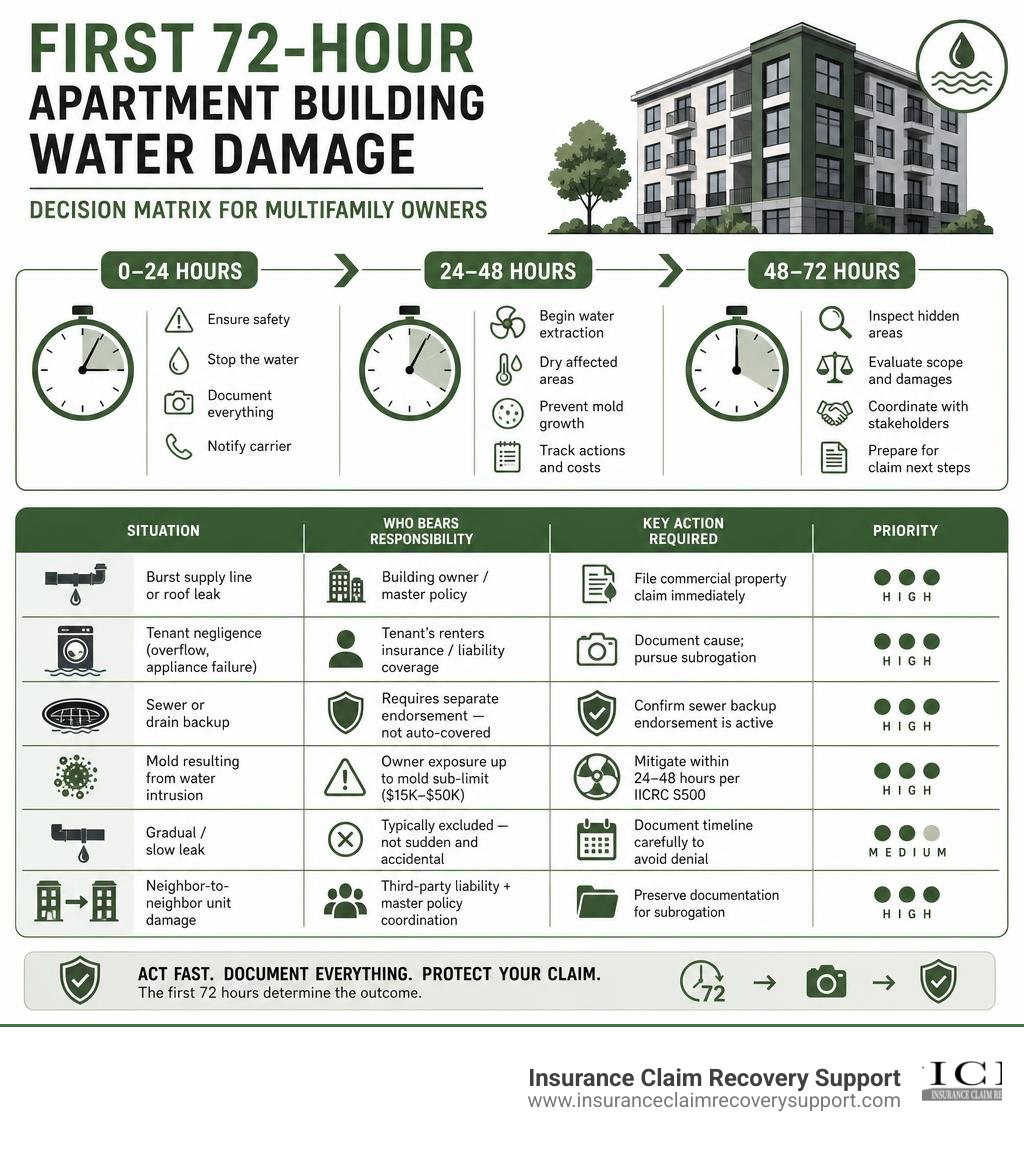
Quick Answer: Apartment Building Water Damage — Who’s Responsible and What Happens Next
| Situation | Who Bears Responsibility | Key Action Required |
|---|---|---|
| Burst supply line or roof leak | Building owner / master policy | File commercial property claim immediately |
| Tenant negligence (e.g., overflow, appliance failure) | Tenant’s renters insurance / liability coverage | Document cause; pursue subrogation |
| Sewer or drain backup | Requires separate endorsement — not auto-covered | Confirm sewer backup endorsement is active |
| Mold resulting from water intrusion | Owner exposure up to mold sub-limit ($15K–$50K) | Mitigate within 24–48 hours per IICRC S500 |
| Gradual / slow leak | Typically excluded — not sudden and accidental | Document timeline carefully to avoid denial |
| Neighbor-to-neighbor unit damage | Third-party liability + master policy coordination | Preserve documentation for subrogation |
The real problem isn’t just the water — it’s what happens in the 72 hours after discovery. Water penetrates drywall, flooring, and structural components within hours. Mold can begin colonizing wet, porous materials in as little as 24 to 48 hours. Every hour of delayed mitigation expands the scope, raises the remediation cost, and gives your insurance carrier more surface area to scrutinize your claim.
⚖️ What real accountability looks like: Multifamily owners have a legal and contractual obligation to act fast — both to protect tenants and to satisfy the mitigation requirements baked into virtually every commercial property policy. Failure to mitigate promptly is one of the most common reasons carriers reduce or deny water damage settlements.
📞 Key Takeaway: If your apartment building has sustained water damage affecting more than one unit, or involves Category 2 or Category 3 water (contaminated or sewage-sourced), you are not dealing with a routine maintenance call. You are managing a complex, multi-stakeholder insurance claim — and the decisions you make in the first 72 hours will directly determine your settlement outcome.
I’m Scott Friedson, CEO of Insurance Claim Recovery Support (ICRS) LLC and a multi-state licensed public adjuster with over 15 years of experience handling large-loss apartment building water damage claims across the country. Over the course of 500+ commercial and multifamily claims totaling more than $250 million in settled losses, I’ve seen how the first hours after a water event either protect or permanently compromise a policyholder’s recovery. In the sections that follow, I’ll walk you through exactly what to do — and what to avoid — so your claim gets settled for what you’re actually owed.
Key terms for Apartment building water damage:
Systemic Insurer Scrutiny and the Reality of Apartment Building Water Damage
When an apartment building experiences a major water loss, owners often assume their commercial property insurance policy will automatically step in to fully indemnify them. Unfortunately, the modern commercial property insurance landscape in June 2026 is defined by systemic insurer scrutiny. For many major insurance carriers, delaying, underpaying, or outright denying legitimate property claims has become a standard “cost of doing business” model.
Carriers know that multifamily owners face immense pressure. Between displaced tenants, ongoing mortgage payments, and the threat of rapid mold growth, owners are often desperate to get repairs started. Insurers exploit this vulnerability by dragging out investigations, requesting redundant documentation, and utilizing bad faith tactics designed to force policyholders into accepting lowball settlements.
This systemic corporate strategy is not unique to water losses. We have seen major carriers repeatedly prioritize their own balance sheets over their contractual obligations to policyholders. Look no further than the recent legal and regulatory battles involving industry giants: the massive State Farm $15.6M settlement highlighted a pattern of systemic underpayment and claim mishandling. Furthermore, the NYT California article and subsequent California Enforcement Action exposed severe regulatory violations. Detailed reporting by The Guardian and CNN further confirmed how carriers routinely use administrative delays to under-indemnify policyholders during catastrophic property losses.
For an apartment building owner, a delayed water damage claim isn’t just an inconvenience — it is a threat to your entire portfolio’s financial viability. When the carrier delays the claim, they are effectively practicing interest rate arbitrage on your withheld funds while you are forced to fund emergency mitigation out of pocket. To survive this onslaught of carrier stalling and administrative hurdles, you must understand how to navigate the complex paperwork and procedural traps set by your insurer. For a deep dive into managing these administrative demands, read our guide on Property Damage Insurance Claims and How to Survive the Paperwork Tsunami.
Navigating Liability, Policy Interpretation, and Texas Statutes

Understanding the legal and statutory framework governing insurance claims is your strongest shield against carrier bad faith. In Texas, multifamily property owners are protected by powerful statutes designed to hold insurance companies accountable to strict timelines.
Under Texas Insurance Code Chapter 541 (Unfair Claim Settlement Practices), insurers are legally prohibited from misrepresenting policy provisions, failing to attempt a fair settlement in good faith, or delaying claims without reasonable cause.
Even more critical for immediate water losses is Texas Insurance Code Chapter 542 (the Texas Prompt Payment of Claims Act). This statute outlines strict, non-negotiable deadlines for how carriers must handle your claim:
- 15 days from receiving notice of a claim to acknowledge it, begin an investigation, and request all necessary items and forms from the policyholder.
- 15 business days after receiving all requested documentation to accept or reject the claim.
- 5 business days after accepting a claim to pay the settled amount.
If a carrier violates these deadlines, they can be held liable for the full claim amount plus statutory interest (currently compounding annually) and reasonable attorney’s fees.
In other states, such as Florida, carriers have successfully lobbied to shift litigation costs back onto policyholders, making court battles incredibly expensive. This makes utilizing alternative dispute resolution mechanisms — such as securing binding appraisal awards — a vital strategy to resolve scope-of-damage and valuation disputes without entering a courtroom.
However, before you can leverage these statutes, you must understand how your policy is interpreted. In a multifamily setting, the intersection of the building’s master policy and individual tenant or condo owner policies (like HO6 policies) creates a massive web of overlapping coverages. Deciding which policy is primary and how they interact is highly complex. To learn how to navigate these adjuster negotiations and protect your rights, consult our playbook on How to Negotiate a Settlement with an Insurance Claims Adjuster.
Identifying the Source of Apartment Building Water Damage
To successfully resolve an apartment building water damage claim, the physical source of the water must be identified and documented immediately. The source of the water dictates which policy coverages apply, which deductibles are triggered, and whether the carrier can argue for an exclusion.
- Supply-Line Bursts: A sudden failure of a pressurized water line inside a wall cavity is the classic “sudden and accidental” event. These are generally covered under standard commercial property policies, though they often trigger high water-damage deductibles ranging from $10,000 to $50,000 per occurrence.
- Frozen Pipes: Especially common during winter storms in Texas cities like Dallas, Fort Worth, or Amarillo, frozen pipes are covered if the property owner maintained heat in the building or turned off the water supply and drained the lines.
- Sewer and Drain Backups: This is the single most-missed coverage gap. Standard commercial property policies almost always exclude water that backs up through sewers or drains. Owners must secure a specific Sewer Backup Endorsement (typically providing $25,000 to $250,000 in limits) to ensure coverage. Without this endorsement, a main-line sewage backup can leave you with six figures in uninsured biohazard remediation costs.
- Gradual Leaks vs. Sudden & Accidental: This is the primary battlefield for insurance adjusters. If a pipe has been slow-dripping inside a wall for six months, the carrier will deny the claim under the “wear and tear” or “gradual seepage” exclusion. If a pipe suddenly bursts, it is covered. Insurers will look for rust, rot, or pre-existing mold to claim the damage was gradual.
For a comprehensive breakdown of how these different water loss scenarios are categorized and claimed under commercial policies, visit our dedicated resource on Apartment Claims.
Fact vs. Myth: Who Pays to Indemnify the Loss?
When water cascades through a multi-story building, finger-pointing begins immediately. Let’s separate fact from fiction regarding who is legally obligated to indemnify the loss.
Myth 1: “If my tenant’s washing machine overflows, my commercial property policy won’t cover the structural damage.”
- Fact: Your building’s commercial property master policy will generally cover the physical damage to the building’s structure (drywall, subfloors, framing), regardless of who caused the leak. However, your carrier’s subrogation team will actively pursue the tenant’s renters insurance liability coverage to recover what they paid out.
- Translation: Don’t let your carrier deny your structural claim by telling you to “go after the tenant.” Your master policy must indemnify your structural loss first, then handle subrogation behind the scenes.
Myth 2: “The upstairs neighbor is automatically liable for all water damage to the unit below.”
- Fact: To hold an upstairs neighbor or tenant legally liable, you must prove negligence (e.g., they left a bathtub running or ignored a visibly leaking toilet for weeks). If a pipe inside the shared wall cavity suddenly fails without warning, it is a structural failure, and liability falls on the building owner or HOA master policy.
- Translation: Unless clear negligence is documented, expect your own master policy to carry the weight of the structural repairs.
Myth 3: “My carrier’s preferred restoration contractor is the best option to handle the cleanup.”
- Fact: Preferred vendors work for the insurance company, not you. They are under immense pressure to limit drying equipment, shorten drying times, and write lowball mitigation estimates to keep the carrier’s costs down.
- Translation: Always hire an independent, IICRC-certified restoration contractor who answers directly to you and will document the full scope of the moisture intrusion.
Navigating these complex liability assignments requires a highly strategic approach when communicating with your carrier’s adjuster. To learn how to counter their arguments effectively, read our guide on How to Negotiate with Insurance Adjuster for Property Damage.
The First 72 Hours: Mitigation, Dry Logs, and Environmental Hazards
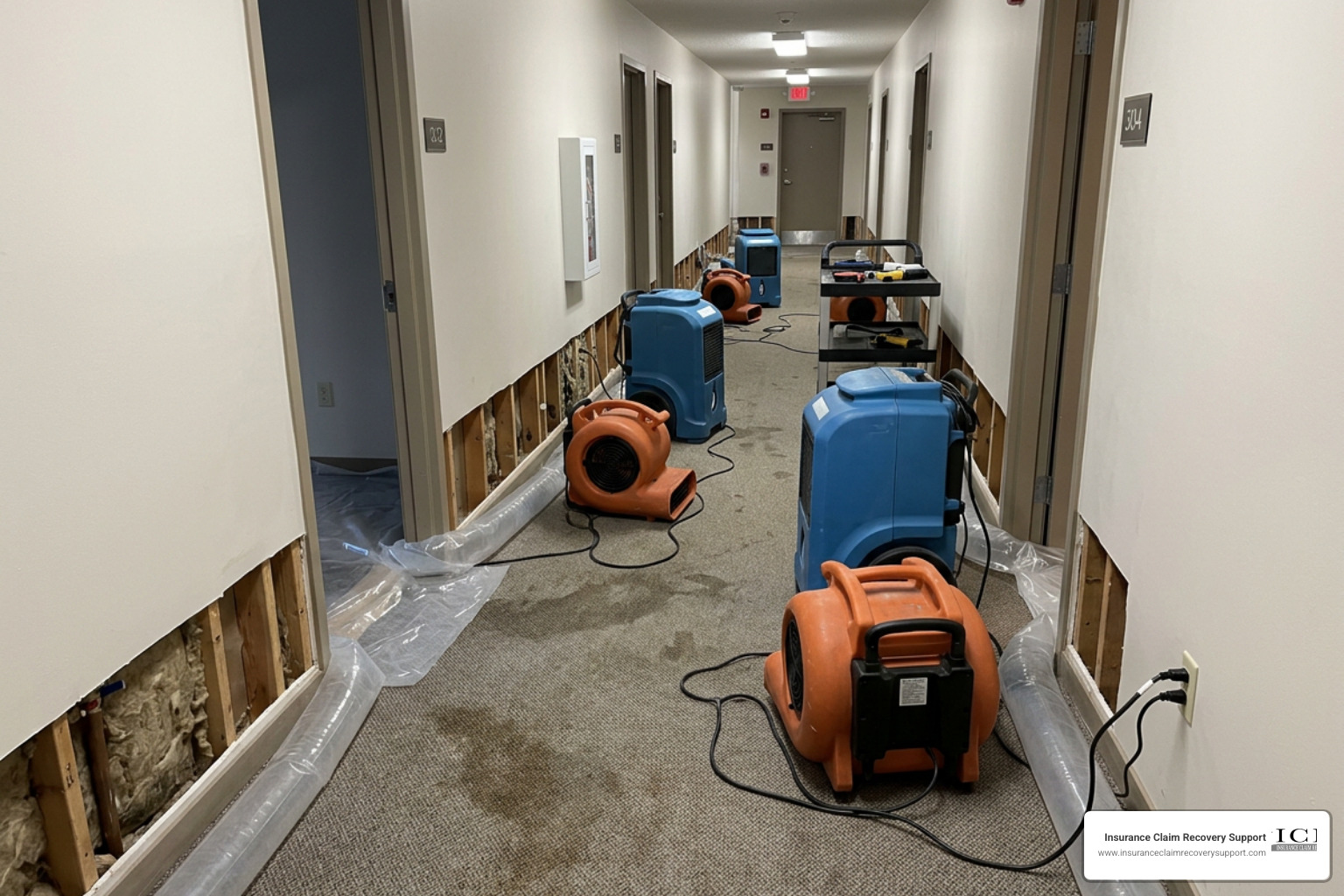
The first 72 hours of an apartment building water damage claim are a race against the clock. According to the IICRC S500 Standard (the professional standard for water damage restoration), rapid, systematic drying is the only way to limit secondary damage and prevent catastrophic mold colonization.
To survive the carrier’s inevitable scrutiny, your restoration team must establish a daily dry log record. This is a precise, scientific log of the drying process that includes:
- Moisture Mapping: Using moisture meters to map the exact boundaries of wet materials across all affected units.
- Thermal Imaging: Deploying infrared cameras to detect hidden water traveling behind drywall, under cabinetry, and down plumbing chases.
- Psychrometric Readings: Daily logs of relative humidity, temperature, and grains per pound (GPP) of air entering and exiting dehumidifiers to prove the drying equipment is actually working.
Unfortunately, many staff adjusters sent out by insurance companies suffer from severe adjuster licensing gaps. They are often catastrophe adjusters flown in from other states, unfamiliar with local building codes, or lacking any formal training in psychrometrics. They will look at a dry wall, declare it “dry,” and demand that drying equipment be pulled prematurely to save the carrier money.
This is why you must hire an independent, certified restoration vendor. Their scientific dry logs are your primary evidence. If your carrier attempts to underpay your mitigation bill, these logs prove that the equipment was necessary and operated in accordance with industry standards. For more insights on how to handle the carrier’s adjuster when they challenge your mitigation efforts, read our article on the role of a Water Damage Adjuster.
Managing Environmental Hazards in Apartment Building Water Damage Claims
Water losses in commercial and multifamily properties are rarely just about water. They almost always trigger complex environmental hazards that are highly regulated by state and federal laws.
- The 24-48 Hour Mold Window: Under normal indoor temperatures and humidity, mold spores will germinate and colonize wet, organic materials (like the paper backing on drywall) within 24 to 48 hours. Once mold is present, simple water mitigation ends, and expensive mold remediation under contained, negative-pressure conditions begins.
- Asbestos Protocols: In older buildings (especially those constructed before 1980), drywall joint compound, vinyl flooring, and thermal insulation often contain asbestos. State laws and OSHA regulations mandate that these materials be tested by a licensed professional before they are cut, demolished, or disturbed during water mitigation.
- Industrial Hygienists: For large-scale losses, you should engage an independent industrial hygienist. They will write a formal remediation protocol, perform air-quality testing, and issue a “clearance report” once the building is safe for reconstruction.
- Mold Sub-Limits: Most commercial property policies contain strict mold sub-limits ranging from $15,000 to $50,000 per occurrence. This is rarely enough to cover a multi-unit remediation. However, if the mold developed because the carrier delayed approving the initial water mitigation, those mold remediation costs can sometimes be argued outside the sub-limit as consequential damages.
Managing these environmental hazards while fighting an insurance company requires specialized expertise. To understand how to protect your property and maximize your recovery under these strict policy limitations, consult a Public Adjuster Water Damage specialist.
Frequently Asked Questions about Commercial Water Claims
What is the difference between water damage and flood damage under commercial policies?
The distinction between “water damage” and “flood damage” is one of the most critical and heavily litigated concepts in commercial property insurance.
Standard commercial property insurance policies cover “water damage” but explicitly exclude “flood damage.”
- Water Damage: Refers to water that originates from an internal source within the building, such as a burst plumbing pipe, an overflowing toilet, a failed water heater, or rain that enters through a roof damaged by a covered windstorm.
- Flood Damage: Refers to water that originates from an external source, specifically the accumulation of surface water over normally dry land. This includes rising groundwater, overflowing rivers or lakes, tidal surges, and storm surges caused by hurricanes.
If rising groundwater enters your ground-floor units, it is classified as a flood, and your commercial property policy will not indemnify the loss. To be covered, you must maintain a separate commercial flood policy, typically secured through the National Flood Insurance Program (NFIP) or the private flood market. For a comprehensive guide on navigating these policy exclusions, read our analysis of Flood Damage Insurance Claims.
Why do insurers use the “cost of doing business” model to delay settlements?
Insurance companies are financial institutions that maximize profits by holding onto capital for as long as possible. By utilizing a “cost of doing business” model, carriers systematically delay claim settlements through several calculated tactics:
- Systemic Denials: Issuing initial blanket denials based on broad exclusions (like “gradual wear and tear” or “lack of maintenance”) to see if the policyholder will simply walk away or accept a token settlement.
- Lowballing Mitigation Estimates: Using proprietary, outdated estimating software to write scope-of-work estimates that are 50% lower than real-world contractor pricing, forcing the owner to stall repairs or pay out of pocket.
- Forcing Appraisal or Litigation: By dragging out negotiations, carriers force policyholders into expensive, time-consuming appraisal processes or court battles.
- Interest Rate Arbitrage: While your claim is delayed for six, twelve, or eighteen months, the carrier keeps millions of dollars in their interest-bearing accounts. The interest they earn on withheld claim payouts nationwide often far exceeds any statutory prompt-payment penalties they might eventually have to pay to a fraction of policyholders who fight back.
When should a public adjuster be engaged for a multifamily water loss?
For minor, single-unit leaks that fall under your deductible, your on-site maintenance team can handle the response. However, you should engage a licensed public adjuster immediately if your claim meets any of the following criteria:
- The Loss Exceeds $250,000: At this scale, the carrier will deploy specialized “large-loss” adjusters, forensic engineers, and corporate attorneys to find ways to reduce their exposure. You need an equal level of professional representation on your side.
- Complex Multi-Unit Losses: When water affects multiple floors, shared common areas, and commercial spaces, coordinating multiple drying protocols and documenting overlapping structural damage is incredibly complex.
- Disputed Scope of Damage: If your carrier’s adjuster claims the building is “dry” but your restoration contractor’s moisture meters show active moisture inside the wall cavities, a public adjuster will step in to prove the true scope of damage using scientific evidence.
- You Face Loss of Use / Business Interruption: Calculating lost rental income, tenant relocation costs, and ongoing operational overhead requires detailed financial forensic accounting that standard adjusters will routinely lowball.
To learn how a public adjuster represents your interests and forces carriers to negotiate fairly, read our guide on Flood Damage Recovery.
Conclusion
Handling apartment building water damage is a high-stakes race against structural deterioration, environmental hazards, and systemic insurance company scrutiny. When a major water loss threatens your multifamily asset in Texas or across the country, you cannot afford to rely on the advice of your insurance carrier’s adjuster. Their goal is to close your file as cheaply as possible.
At Insurance Claim Recovery Support (ICRS) LLC, we do things differently. We are licensed public insurance adjusters who represent policyholders only — never the insurance companies. We specialize in navigating large-loss commercial, multifamily, and specialty property claims, representing professional property managers, commercial building owners, HOAs, and apartment investors in Austin, Dallas, Fort Worth, San Antonio, Houston, and surrounding areas.
Our team helps multifamily owners document the full scope of water damage, coordinate claim records, and pursue a resolution supported by the evidence and policy terms. We seek to resolve claims without unnecessary litigation when possible.
Do not let your carrier drown your investment in delays and lowball offers. More info about commercial property public insurance adjusters is just a click away. Contact Insurance Claim Recovery Support LLC today to schedule a comprehensive, complimentary review of your commercial property claim and let our experts secure the settlement you are legally entitled to.