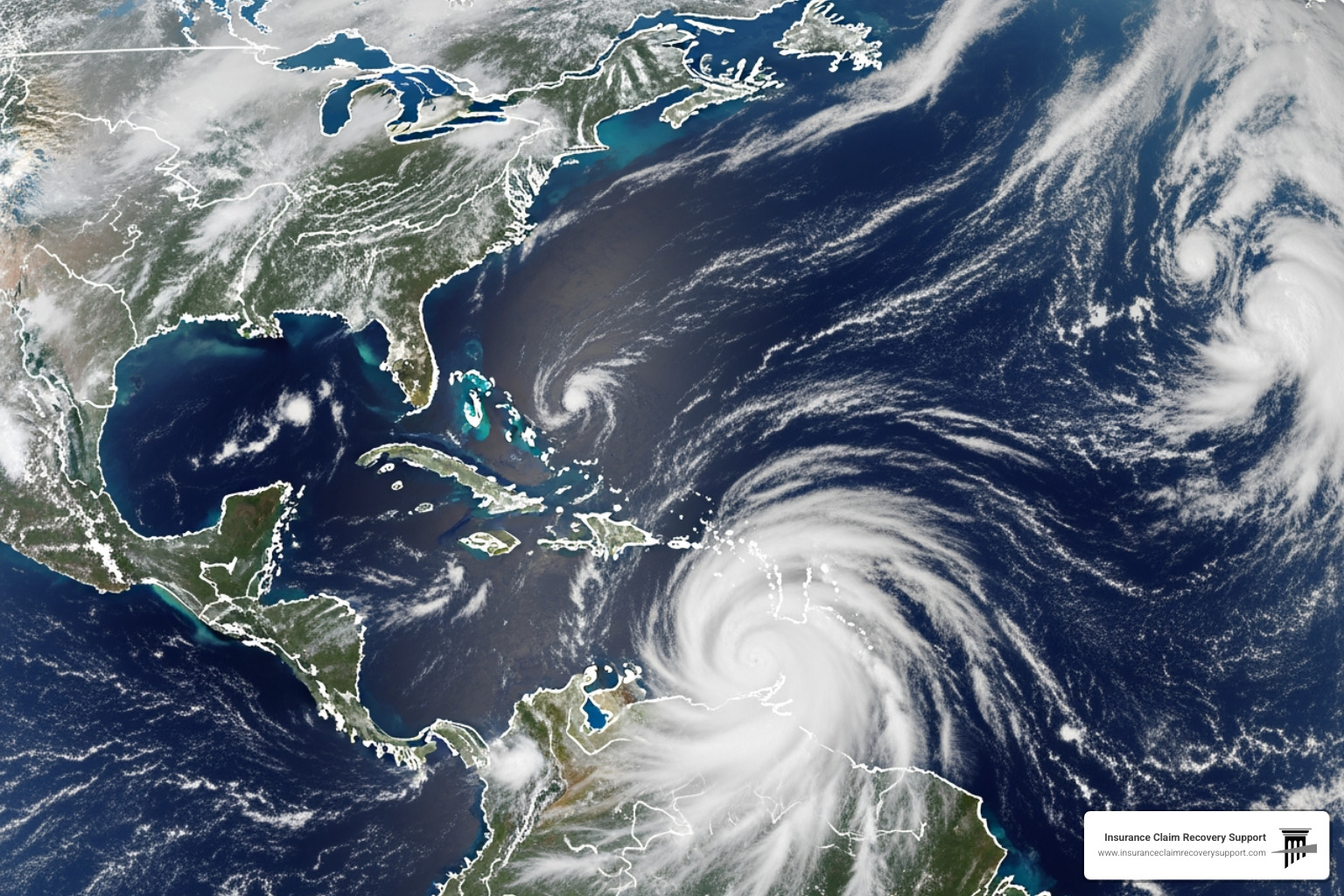
The Storms Behind the Storms: Why Every Tropical Wave Deserves Your Attention
A tropical wave — also called an easterly wave or African easterly wave — is an elongated area of low pressure oriented north to south that moves east to west across the tropics, generating clusters of showers and thunderstorms that can, under the right conditions, grow into the Atlantic’s most destructive hurricanes.
Quick answer for commercial and multifamily property owners:
| What it is | An atmospheric trough moving westward across the tropics, carrying organized convection |
|---|---|
| Where it starts | Over Africa — as far east as Sudan and the Ethiopian highlands |
| Where it goes | Westward across the Atlantic, through the Caribbean, toward the Gulf and Americas |
| How many per year | ~60 tracked annually across the Atlantic basin |
| How many become storms | Only about 10-15% develop into a named tropical system |
| Why it matters to property owners | Even waves that never become named storms can deliver flooding rains, wind-driven water, and roof damage to commercial and multifamily properties |
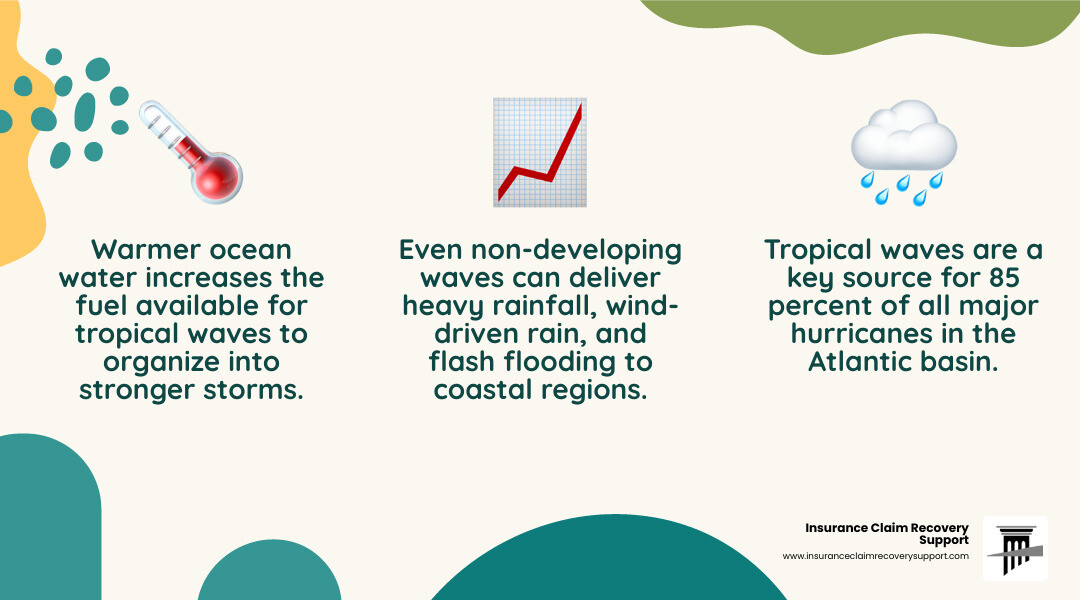
They don’t have names. They rarely make headlines — at first. But tropical waves are the starting point for roughly 60% of all Atlantic tropical cyclones and approximately 85% of the most intense hurricanes (Category 3 and above). Hurricanes Andrew, Irma, Maria, Harvey, and Sandy all began as modest disturbances rolling off the coast of Africa. Most waves quietly dissipate over the open ocean. A small fraction do not.
For owners and managers of commercial properties, apartment complexes, HOAs, hotels, and institutional buildings, a tropical wave is not just a meteorological curiosity. It is an early warning — a signal to check roofs, clear drains, review policy language, and start documenting conditions before a disturbance earns a name or a number.
I’m Scott Friedson, CEO of Insurance Claim Recovery Support (ICRS) and a multi-state licensed public adjuster with more than 15 years of large-loss experience handling hurricane and tropical storm claims for commercial and multifamily assets — many of which trace their origins directly to a tropical wave that few property owners were watching. In the sections ahead, I’ll walk you through exactly how these systems form, how they move, and what they mean for your property and your insurance claim before, during, and after the storm.
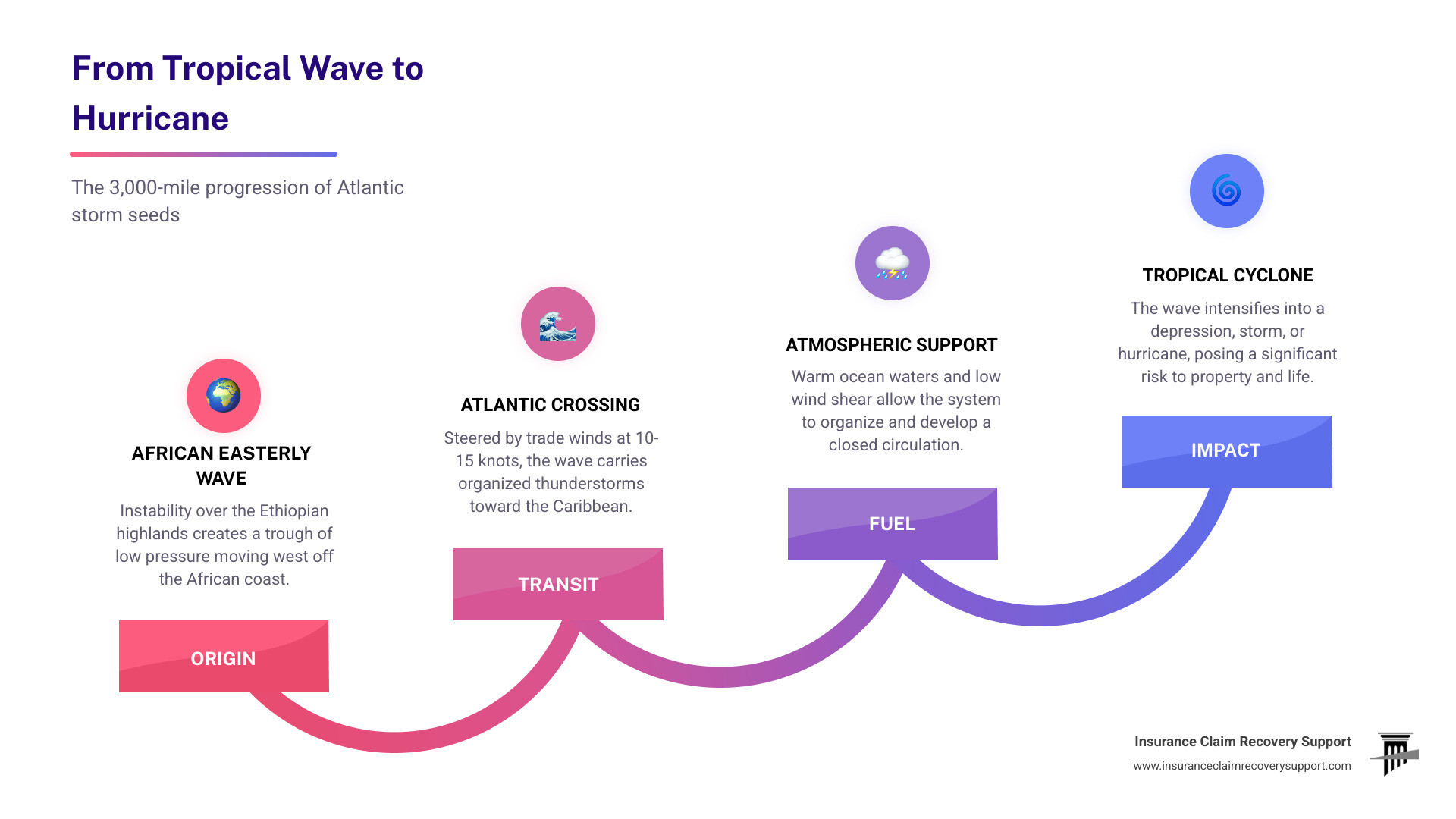
Simple guide to tropical wave terms:
What Is a Tropical Wave and Why Does It Matter?
At its core, a tropical wave is a ripple in the trade winds. Meteorologists often describe it as an inverted trough or a kink in the pressure and wind pattern moving from east to west through the tropics.
Tropical wave definition in plain English
In plain English, a tropical wave is a moving zone where air is a bit more disturbed, a bit more humid, and often more stormy than the air around it. It usually has a north-south orientation and is often tied to cloud bands and thunderstorms.
Think of it like a wrinkle traveling through the atmosphere. Most wrinkles stay wrinkles. A few become very expensive problems.
How meteorologists define a tropical wave
Meteorologists define a tropical wave as a westward-moving trough in the tropical easterlies, often marked by:
- A wind shift
- A subtle pressure minimum or curvature maximum
- Rising air and thunderstorms typically on the eastern side
- Drier, sinking air and relative clearing on the western side
That east-side thunderstorm focus matters. It helps forecasters identify where the wave axis is and whether convection is becoming better organized.
Why tropical waves matter to the Atlantic hurricane season
They matter because they are the seedbed of Atlantic storm development:
- About 60 tropical waves are tracked each year
- About 60% of Atlantic tropical cyclones originate from them
- About 85% of intense Atlantic hurricanes, Category 3 or stronger, trace back to a tropical wave
- About 80% of major Atlantic hurricanes can be linked to one
These systems also give forecasters lead time. A wave leaving Africa can sometimes be watched for days before it threatens the Caribbean, Gulf waters, or parts of the U.S. That early signal is valuable for building owners and managers.
How Tropical Waves Form Over Africa
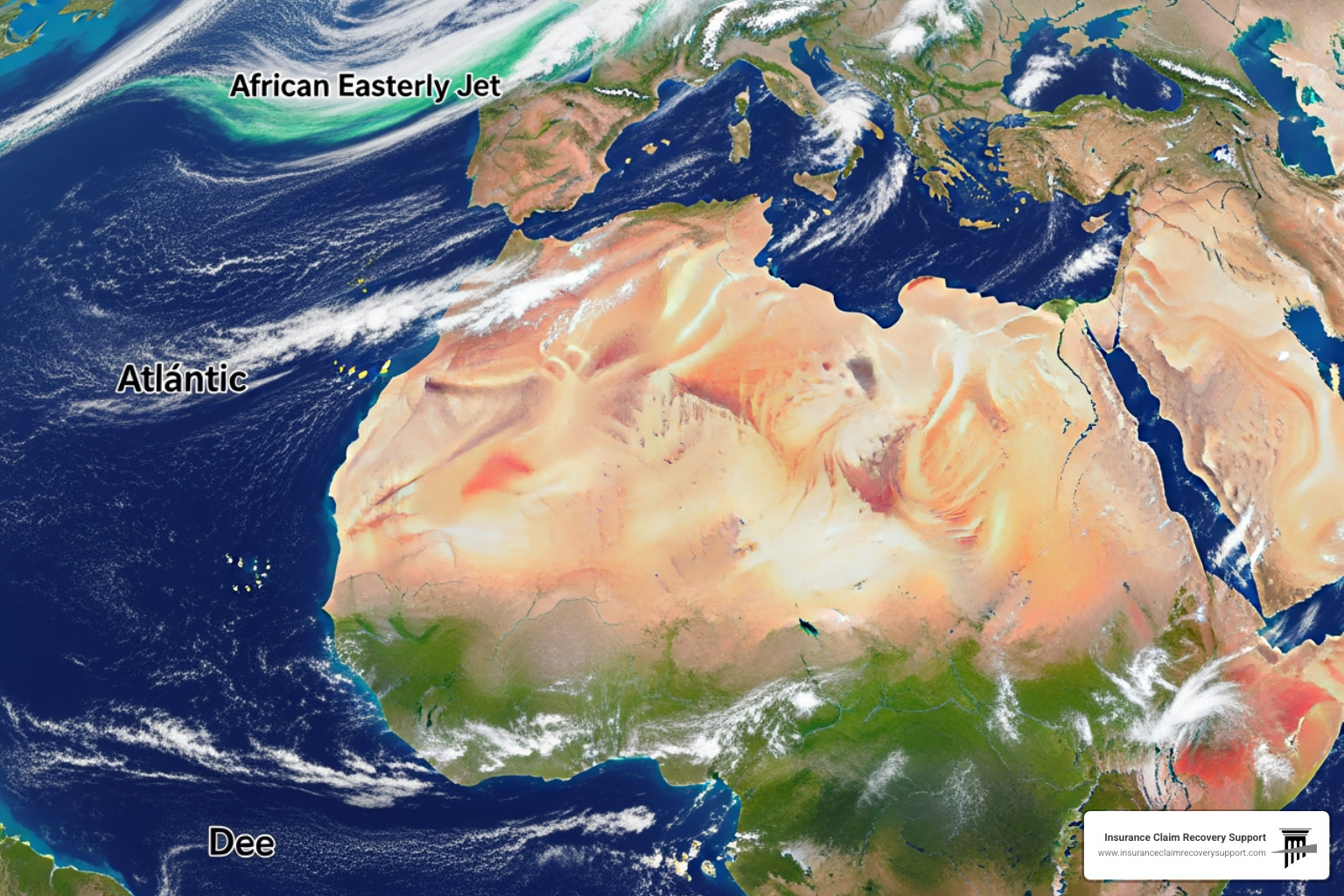
How the African Easterly Jet creates a tropical wave
Most Atlantic tropical waves form over or near Africa because of a strong temperature contrast. The Sahara can heat to around 45 C, while areas near the Gulf of Guinea may be closer to 22 C. That reversed north-south temperature gradient helps create the African Easterly Jet.
This jet can become unstable. When it does, it generates wave-like disturbances in the atmosphere. Those disturbances move westward and can emerge off the African coast into the Atlantic.
This process is often tied to African monsoon dynamics and jet instability. The short version: hot desert air, cooler coastal air, and a favorable wind pattern can produce the atmospheric ripple that becomes a tropical wave.
Where tropical waves begin and when they are most active
Tropical waves may begin as far east as Sudan and the Ethiopian highlands, then organize across the Sahel and West Africa before reaching the Atlantic near Cabo Verde.
They are most active from June through November, with activity increasing in August and peaking around the heart of hurricane season in September. Early-season waves are often too far south and face too much dry air or wind shear to develop much.
Why many waves weaken while only a few organize
Most tropical waves never become named storms because the atmosphere is picky.
Common reasons waves weaken include:
- Dry air intrusion, especially the Saharan Air Layer
- Strong vertical wind shear
- Limited deep moisture
- Poorly aligned circulation
- Cooler waters or less unstable air
So while 40 to 60 waves may emerge off Africa during hurricane season, fewer than two dozen become named storms, and even fewer become hurricanes.
How a Tropical Wave Travels Across the Atlantic
The typical path from Africa to the Caribbean and Americas
A classic Atlantic tropical wave exits West Africa, moves past Cabo Verde, crosses the tropical Atlantic, reaches the Lesser Antilles, and then continues into the Caribbean. From there, paths vary:
- Some keep moving into Central America
- Some enter the Gulf
- Some turn northwest
- Some cross into the eastern Pacific and help spark storms there
A full trip from Africa to North America can take up to about two weeks.
How fast a tropical wave moves and what steers it
Most tropical waves move westward at about 10 to 15 knots, or roughly 12 to 17 mph. Some references place typical movement around 15 mph.
They are mainly steered by:
- Prevailing easterly trade winds
- The subtropical ridge
- The Bermuda-Azores High
- Interactions with nearby weather features
Small changes in latitude or steering currents can have big downstream effects on where the heaviest rain and storm potential go.
Why some tropical waves bring flooding rain without becoming named storms
A tropical wave does not need a name to cause trouble. Even without a closed circulation, it can bring:
- Torrential rain
- Gusty winds
- Repeated thunderstorms
- Local flash flooding
- Rough marine conditions
This is especially true where terrain enhances rainfall. In the Caribbean and nearby tropical waters, waves often deliver much of the summer wet-season rain. For property owners, that can mean roof leaks, drainage overload, parking lot flooding, and moisture intrusion long before anyone starts using storm names on TV.
When a Tropical Wave Becomes a Tropical Cyclone
From tropical wave to disturbance, depression, storm, and hurricane
Here is the simplest way to separate the terms:
| Term | What it means |
|---|---|
| Tropical wave | A westward-moving trough or ripple in the tropical easterlies |
| Tropical disturbance | A broader area of disorganized showers and storms, often 100 to 300 miles across |
| Invest | A system tagged for extra model analysis and monitoring |
| Potential Tropical Cyclone | A disturbance not yet a tropical cyclone, but expected to bring tropical-storm or hurricane conditions to land within about 48 hours |
| Tropical depression | A tropical cyclone with a closed circulation and winds up to 38 mph |
| Tropical storm | A tropical cyclone with winds of 39 to 73 mph |
| Hurricane | A tropical cyclone with winds of 74 mph or greater |
A tropical wave can be the starting ingredient, but it is not automatically a tropical cyclone.
Conditions that help a tropical wave develop
For a wave to organize, several ingredients usually need to line up:
- Warm ocean water
- Moist mid-level air
- Low vertical wind shear
- Atmospheric instability
- Concentrated vorticity or spin
- Upper-level outflow that allows air to evacuate aloft
When those pieces come together, the thunderstorms near the wave can consolidate around a closed low-level circulation. That is the key step into tropical depression territory.
Why only a small percentage of waves become storms
Only about 10% to 15% of the roughly 60 waves that move across the Atlantic each year develop into a tropical system. That is about one in seven.
Why so few?
- Dry air gets entrained into the system
- Wind shear tilts the thunderstorms away from the center
- Convection pulses and collapses
- The system moves too fast
- It interacts poorly with surrounding weather features
A wave can look impressive on satellite one day and fizzle the next. Tropical forecasting has a humbling side.
How some systems rapidly intensify after wave formation
A small number of wave-origin systems become powerful Cabo Verde hurricanes. Once a tropical cyclone forms over warm water with low shear and a healthy inner core, it can strengthen quickly.
Rapid intensification means an increase of at least 30 knots in 24 hours. Deep warm water, efficient upper-level ventilation, and a compact core can all support that process.
How Forecasters Track and Analyze a Tropical Wave
The forecast tools used to monitor a tropical wave
Forecasters track tropical waves with a mix of tools:
- Visible and infrared satellite imagery
- Satellite loops showing motion and convective bursts
- Scatterometer data to estimate surface winds over the ocean
- Surface observations from ships and buoys
- Radar when systems near land
- Model guidance and ensemble forecasts
- Hovmoller diagrams, which help show westward-moving convective signals over time
Because many waves are far from land, satellite analysis is often the main tool early on. Aircraft reconnaissance usually comes later, if the system becomes threatening enough.
National Hurricane Center products the public should watch
The most useful public products include:
- The Graphical Tropical Weather Outlook
- The Tropical Weather Discussion
- 2-day and 7-day formation outlooks
- Invest designations
- Potential Tropical Cyclone advisories
- Watches and warnings
- The NHC glossary at Tropical Definitions
If you manage property in Texas cities like Houston, Austin, Dallas-Fort Worth, San Antonio, Waco, Lubbock, San Angelo, Georgetown, Lakeway, Amarillo, or Bee Caves, these products are worth checking regularly during season.
What it means when a tropical wave appears in official discussions
When the National Hurricane Center mentions a tropical wave, it does not always mean a named storm is imminent. It may simply mean:
- The system is being monitored for development
- It is expected to produce heavy rain
- Marine conditions may worsen
- Forecast confidence is still low
- There is a preparedness window now, before headlines start screaming
Translation: no name does not mean no risk.
Tropical Wave Impacts, Climate Questions, and Property Risk
How tropical waves affect weather and property even without hurricane development
For commercial and multifamily buildings, the practical impacts can be serious even when a wave never develops further:
- Wind-driven rain entering roof systems and wall assemblies
- Overflowing drains and ponding water
- Flash flooding around retail centers and apartment communities
- Moisture intrusion into mechanical rooms or tenant spaces
- Power outages and business interruption
- Hidden damage that shows up days later
That is why early inspections and documentation matter. Our Hurricane Damage Assessment guidance becomes relevant well before a system reaches tropical storm strength.
What scientists are studying about climate change and tropical waves
Climate research is still evolving, but several questions are getting close attention:
- Are tropical waves becoming more intense?
- Are warmer oceans making wave-origin storms more likely to strengthen quickly?
- Are peak-season patterns shifting?
- Is a warmer atmosphere increasing moisture loading and rainfall rates?
Some recent reporting has suggested waves may be getting stronger and that the seasonal peak may be shifting. But there is still uncertainty, especially about long-term frequency and track changes. What we can say confidently is that warmer ocean water can increase the fuel available once a system starts organizing.
What owners and managers of commercial and multifamily properties should do
Before a wave approaches:
- Inspect roofs, flashings, drains, and scuppers
- Photograph current conditions
- Protect records, leases, maintenance logs, and vendor contacts
- Pre-stage drying vendors where appropriate
- Notify tenants and onsite teams
- Review business interruption documentation procedures
After rain or wind impacts:
- Start dry log records immediately
- Follow OSHA-aware site safety practices
- Use hygienists where contamination or indoor environmental concerns exist
- Follow mold and asbestos protocols where building materials may be affected
- Separate emergency mitigation from permanent repair decisions
- Preserve damaged materials and moisture evidence when possible
For larger losses, our Commercial Hurricane Damage Insurance Claim page explains how we approach documentation and settlement strategy for commercial, multifamily, HOA, retail, hospitality, office, and institutional properties.
Frequently Asked Questions About Tropical Wave Risk and Claims
Fact vs. Myth: “It’s only a tropical wave, so there’s no real property risk”
Fact: A tropical wave can cause meaningful property damage without ever becoming a named storm.
Possible losses include:
- Roof membrane uplift or seam failure from gusty squalls
- Wind-driven water entering parapets, wall systems, or units
- Flooding from overwhelmed drainage
- Latent moisture damage that is not obvious on day one
- Operational disruption for hotels, offices, apartments, and retail sites
Translation: If your property manager says, “It was just a wave,” that may be meteorologically true and financially useless.
Fact vs. Myth: “If the insurer sends an adjuster, the building owner’s interests are fully covered”
Myth: The carrier’s adjuster is not the same as your advocate.
Commercial storm claims often involve:
- Causation disputes
- Scope disputes
- Code upgrade issues
- Policy interpretation
- Business interruption analysis
- Delay-driven under-documentation
We also have to be realistic about broader market behavior. Large-loss commercial and multifamily property claims can be subject to systemic scrutiny, aggressive cost control, and underpayment treated as a cost of doing business. Recent 2026 reporting and enforcement-related coverage around claim handling in California has kept those concerns front and center, including the New York Times report, CNN coverage, The Guardian report, and the published California Enforcement Action. Separately, there was also a reported State Farm $15.6M settlement. We mention these not to generalize every claim, but to underline a simple point: policyholders should take documentation and representation seriously.
For Texas commercial claims, issues under Chapters 541 and 542 can matter when claim handling, timing, and communications become contested. Appraisal awards can resolve valuation disputes in some cases, but they are not a cure-all for causation or coverage disagreements. In Florida and other storm-heavy states, litigation costs alone can consume leverage that should have gone toward repairing the property. That is why policy interpretation and early strategy matter.
Adjuster licensing gaps and consultant role confusion can also create problems. Not every person walking a site is there to advocate for the insured’s best outcome.
Translation: An insurer can investigate a claim. That does not mean they are building your claim for you.
FAQ: When should a commercial or HOA property owner bring in a public adjuster?
In our view, owners and managers should strongly consider a licensed public adjuster when:
- The loss is likely above $250,000
- Multiple buildings or phases are involved
- There is business interruption exposure
- The damage includes roofing, envelope, moisture, code, or causation complexity
- Engineers, hygienists, or specialty consultants may be needed
- The insurer’s scope appears incomplete
- Delay is putting operations or tenant relations at risk
At ICRS, we represent policyholders only, never insurance companies. Our focus is to help document, present, and negotiate losses to maximize settlement, reduce delay, and help indemnify the insured without unnecessary litigation. If you want to understand the roadmap better, see our Hurricane Insurance Claim Process and How to File a Hurricane Damage Insurance Claim.
Conclusion: What to Do When a Tropical Wave Is Mentioned
When a tropical wave shows up in official discussions, we should treat it as an alert to get organized, not a reason to panic.
Here is the practical checklist:
- Check the latest Hurricane Update and NHC outlooks
- Inspect roofs, drains, façade transitions, and vulnerable openings
- Protect leases, contracts, maintenance records, and photo baselines
- Brief onsite teams and vendors
- Start documenting any rain intrusion or wind damage immediately
- Preserve dry logs, moisture maps, and consultant findings
- Escalate early if the claim is complex or large
For Texas commercial and multifamily owners, HOAs, hotels, retail centers, office buildings, schools, religious institutions, and industrial facilities, the smartest time to prepare is before the wave becomes a storm with a name. If your property has been impacted by tropical weather, our resources on Texas Public Adjuster Hurricane Damage, Hurricane Texas, and Hurricane Beryl Texas can help you understand the next steps.
The bottom line is simple: a tropical wave is often the first chapter of a much larger story. And for property owners, the earlier we read that chapter, the better positioned we are to protect the building, preserve the record, and pursue full settlement if damage occurs.
If you need guidance on a large-loss commercial or multifamily storm claim, we are here to help.