Why Finding the Right Public Insurance Adjuster Near You Can Save Your Business
When you’re searching for a public insurance adjuster near me, you’re not just looking for help; you’re looking for a professional advocate who understands the complex world of commercial property damage claims and can fight for your maximum settlement.
Quick Answer: How to Find a Public Insurance Adjuster Near You
- Verify licensing: Ensure any adjuster you consider is licensed in your state. For Texas-based claims, you can verify a license through the Texas Department of Insurance (TDI). This is a non-negotiable first step to ensure they are legitimate and accountable.
- Check professional certifications, reviews, results, and how many claims actually get settled without escalation to appraisal or litigation.
- Look for commercial experience: Ask for their track record with properties like yours, whether it’s a multifamily complex in Dallas, a warehouse in Houston, or a religious institution in Austin. Residential and commercial claims are vastly different.
- Read reviews and ask for references: Look for testimonials from other business owners and property managers. A reputable adjuster will gladly provide references from past clients with similar claims.
- Schedule initial consultations: Meet with 2-3 qualified adjusters. Use this time to gauge their expertise, communication style, and strategy for your specific claim.
- Review fee structures: Most public adjusters work on a contingency fee basis, meaning they only get paid if you do. In Texas, this fee is capped at 10% of the settlement, ensuring their services are aligned with your success.
Property damage to your commercial building, multifamily complex, or institutional facility can feel overwhelming. Whether it’s from a fire, hurricane, tornado, or a winter freeze, the insurance claim process is intentionally complex. Insurance companies have entire departments of experts dedicated to interpreting policies in their favor.
As one veteran public adjuster notes: “Insurance companies are tough, but so are we!” The reality is that all carriers look to do three things: deny the claim, underpay the claim, or delay the claim. They might do this by using ambiguous language in their denial letters, burying you in endless and often irrelevant paperwork requests, or making a quick, lowball offer hoping you’ll accept it out of desperation.
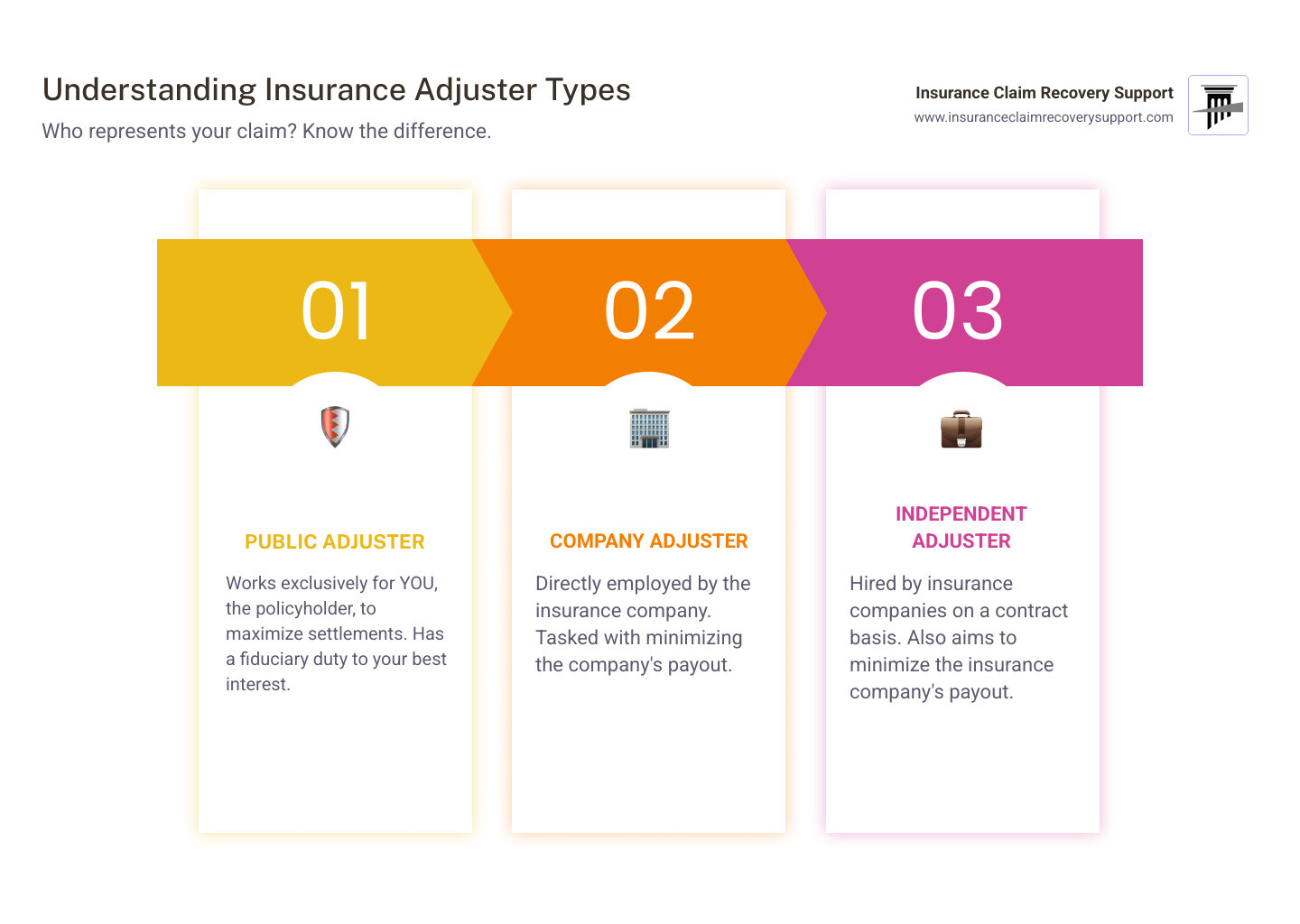
This is where a qualified public insurance adjuster becomes your essential advocate. Unlike company adjusters (who are employees of the insurance company) or independent adjusters (who are third-party contractors hired by the insurer), public adjusters work exclusively for you, the policyholder. They level the playing field and often secure settlements that are significantly higher than what policyholders achieve on their own.
The stakes are especially high for commercial properties. A mishandled large loss claim can be catastrophic. It can involve massive repair costs, prolonged business interruption, lost rental income, and damage to your professional reputation. For a business in a competitive market like San Antonio or Fort Worth, a delayed or underpaid claim can be the difference between a successful recovery and permanent closure. The wrong approach can mean financial disaster.
I’m Scott Friedson, a multi-state licensed public adjuster and CEO of Insurance Claim Recovery Support, headquartered in Austin, Texas. Having settled over 500 large loss claims valued at more than $250 million, I’ve helped commercial property owners find the right public insurance adjuster near me to overturn wrongfully denied claims and avoid unnecessary litigation. My experience has shown that the right adjuster can increase settlements from 30% to 3,800% or more while keeping cases out of court.
What is a Public Adjuster and Why Do You Need One?
Imagine facing significant damage to your commercial building or multifamily complex. It’s a huge headache, right? On top of managing your business or residents, you’re now thrust into the confusing world of insurance claims. This is exactly where a public insurance adjuster near me steps in to be your unwavering advocate.
So, what exactly is a public adjuster? Simply put, we are state-licensed professionals who work exclusively for you, the property owner – not the insurance company. Think of us as your personal guide and champion through the often-stressful insurance claim process. Our main job is to carefully prepare, skillfully present, and then diligently negotiate your commercial property or multifamily HOA insurance claim, making sure you receive every penny you’re rightfully owed under your policy. We operate under a “fiduciary duty,” a legal and ethical obligation to act with the utmost good faith and loyalty, always prioritizing your best interest above all else.
Why is this so incredibly important? Your insurance company has its own team. They have “company adjusters” who are directly employed by them, and sometimes they hire “independent adjusters” to work on a contract basis. The key point is: both of these types of adjusters are tasked with minimizing the insurance company’s payout. Their loyalty is to their employer’s bottom line, not to you. As the Texas Department of Insurance (TDI) wisely advises, “Public adjusters represent the policyholder.” This fundamental difference in allegiance is the core of our value.
When disaster strikes your commercial property, whether it’s a busy apartment complex in Round Rock or a vital religious institution in Waco, the last thing you need is to feel alone against a giant insurance company. We level the playing field. We bring powerful negotiation skills and deep expertise to the table, and this consistently results in significantly higher settlements. In fact, a landmark report by the Florida Legislature’s Office of Program Policy Analysis and Government Accountability (OPPAGA) found that policyholders who hired public adjusters for catastrophic hurricane claims received settlements that were, on average, 747% higher than those who did not. Even after our fee, our clients typically walk away with a much larger net recovery.
Beyond the money, we save you something just as valuable: your time and your peace of mind. Navigating the complex insurance system is a full-time job. We handle the entire claim process for you, from carefully documenting every aspect of the loss to expertly interpreting dense insurance policies and identifying every benefit you might otherwise miss. This frees you from the overwhelming burden of managing the claim, allowing you to focus on what matters most – getting your business or property back on track. For a deeper dive into our role, check out our page on What Is A Public Insurance Adjuster.
To really highlight the difference, let’s look at how claims typically play out depending on who’s on your side:
| Feature | Using a Public Adjuster | Using a Company Adjuster | Handling a Claim Alone |
|---|---|---|---|
| Who They Work For | YOU, the policyholder | The insurance company | No advocate, you’re on your own |
| Primary Goal | Maximize your settlement | Minimize the insurance company’s payout | Steer the process, often under-recovering |
| Expertise | Policy interpretation, damage assessment, negotiation, documentation | Company procedures, minimizing liability | Limited, often learning as you go |
| Time Investment | Minimal for policyholder | Significant for policyholder | Extremely high for policyholder |
| Settlement Potential | Significantly higher | Often lower than deserved | Lowest, high risk of underpayment/denial |
| Stress Level | Low to moderate for policyholder | High for policyholder | Very high for policyholder |
| Fiduciary Duty | YES, to the policyholder | NO, to the insurance company | N/A |
The Critical Difference for Commercial and Multifamily Properties
For commercial properties, multifamily HOA claims, and large institutional facilities, the stakes are incredibly high. These aren’t just small home repairs; we’re talking about large loss claims that can impact your entire livelihood or the well-being of many residents. Imagine the ripple effect of business interruption after a major event – lost income, ongoing expenses, damaged reputation. These types of claims are governed by complex policies with intricate clauses that can easily trip up an untrained eye. For example:
- Co-insurance Penalties: Many commercial policies include a clause that penalizes you for being underinsured. If your property isn’t insured to the required value (often 80-90%), your claim payout can be drastically reduced, even if the loss is well below your policy limit.
- Ordinance or Law Coverage: After a fire in a historic part of San Antonio or a storm in a coastal area, building codes may have changed. This coverage pays for the increased cost to rebuild to new, stricter codes, but it’s often overlooked or underpaid by company adjusters.
- Period of Restoration: For business interruption claims, the insurance company may try to argue that the “period of restoration” (the time for which they’ll pay lost income) is shorter than what is realistically needed to get your business fully operational again.
Furthermore, commercial and multifamily properties often involve multiple stakeholders – owners, tenants, HOA boards, investors, and lenders. A public adjuster experienced in large claims knows how to manage these competing interests and ensure the claim is structured to protect everyone involved.
Trying to tackle such a claim alone, or relying solely on the insurance company’s adjuster, can lead to a drastically underpaid settlement or an outright denial. This often forces property owners into costly, time-consuming lawsuits. A public adjuster’s primary goal is to prevent this. By building an airtight claim with exhaustive documentation and expert analysis from the start, we create a compelling case that is difficult for the insurer to dispute. This proactive approach not only maximizes your settlement but also significantly reduces the likelihood of needing to resort to litigation. To learn more about how we handle these significant losses, visit our pages on Big Claim Public Adjuster and Should I Hire A Public Adjuster.