What You Need to Know About Commercial Insurance Claims Adjusters
A commercial insurance claims adjuster is a licensed professional who investigates, evaluates, and negotiates insurance claims for business property damage. When your commercial property suffers a major loss—whether from fire, hurricane, or flood—an adjuster determines how much the insurance company pays.
Quick Answer: Types of Commercial Insurance Claims Adjusters
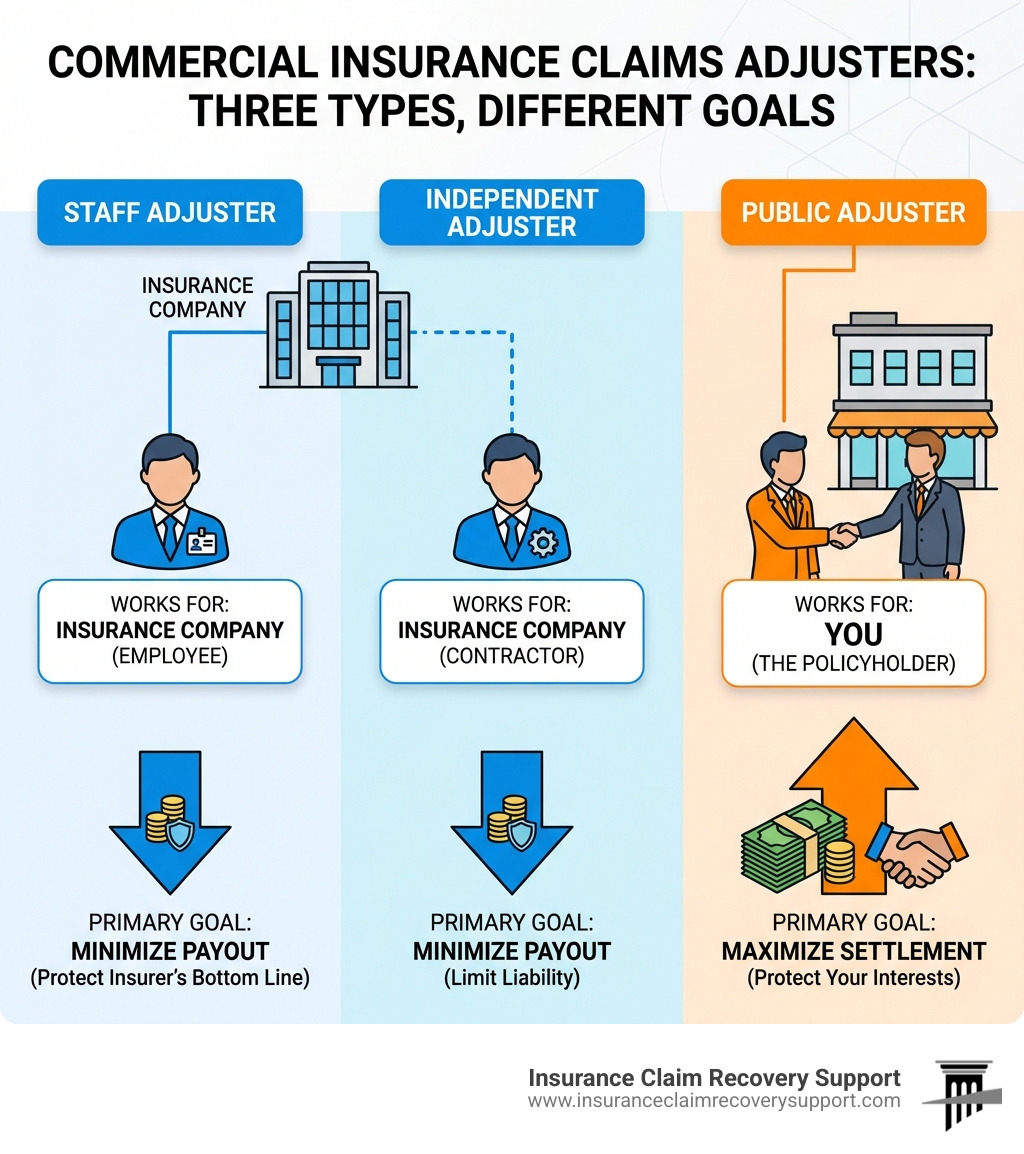
There are three types of adjusters, and who they work for matters:
| Adjuster Type | Works For | Primary Goal |
|---|---|---|
| Staff Adjuster | Insurance company (employee) | Minimize payout to protect insurer’s bottom line |
| Independent Adjuster | Insurance company (contractor) | Same as staff adjuster—hired to limit liability |
| Public Adjuster | You (the policyholder) | Maximize your settlement and ensure fair recovery |
Why This Matters Now
With insured losses from natural disasters surging, commercial property owners face longer delays, increased scrutiny, and more frequent underpayments. Understanding who your adjuster works for can mean the difference between a fair settlement and a financial disaster.
When you file a claim, the insurance company sends a staff or independent adjuster. Both work for the insurer, not for you. Their job is to protect the insurance company’s interests, which often means minimizing payouts.
A public adjuster is the only adjuster licensed to represent you—the policyholder. They document your loss, challenge lowball offers, and negotiate the maximum settlement you’re entitled to. For large losses, a public adjuster can help you avoid unnecessary litigation and resolve disputes faster.
I’m Scott Friedson, CEO of Insurance Claim Recovery Support. As a public adjuster with over 15 years of experience, I’ve settled hundreds of millions of dollars in large-loss claims for commercial property owners. In this guide, I’ll explain how the claims process works and how a public adjuster can help you recover more fully.
Learn more about the benefits of a public insurance adjuster at www.whatisapublicadjuster.com
The Role of a Commercial Insurance Claims Adjuster in Your Recovery
When disaster strikes, a commercial insurance claims adjuster steps in to manage the recovery process. But as we’ve noted, who they work for is the most critical factor in your claim’s outcome.
Who Does a Commercial Insurance Claims Adjuster Work For?
The allegiance of your adjuster directly impacts your settlement. Here’s a quick recap:
- Staff and Independent Adjusters: Both are paid by the insurance company. Their primary goal is to limit the insurer’s financial liability, creating an inherent conflict of interest. Their interests are not aligned with yours. You can learn more about the role of different adjusters and their meanings at claim adjuster meaning.
- Public Adjuster: A public adjuster works exclusively for you, the policyholder. We at Insurance Claim Recovery Support are licensed public adjusters who act as your private advocate, ensuring your claim is handled properly and the maximum settlement is negotiated. Explore why public adjusters for commercial insurance claim are so vital for business owners.
Types of Large Loss Claims Handled
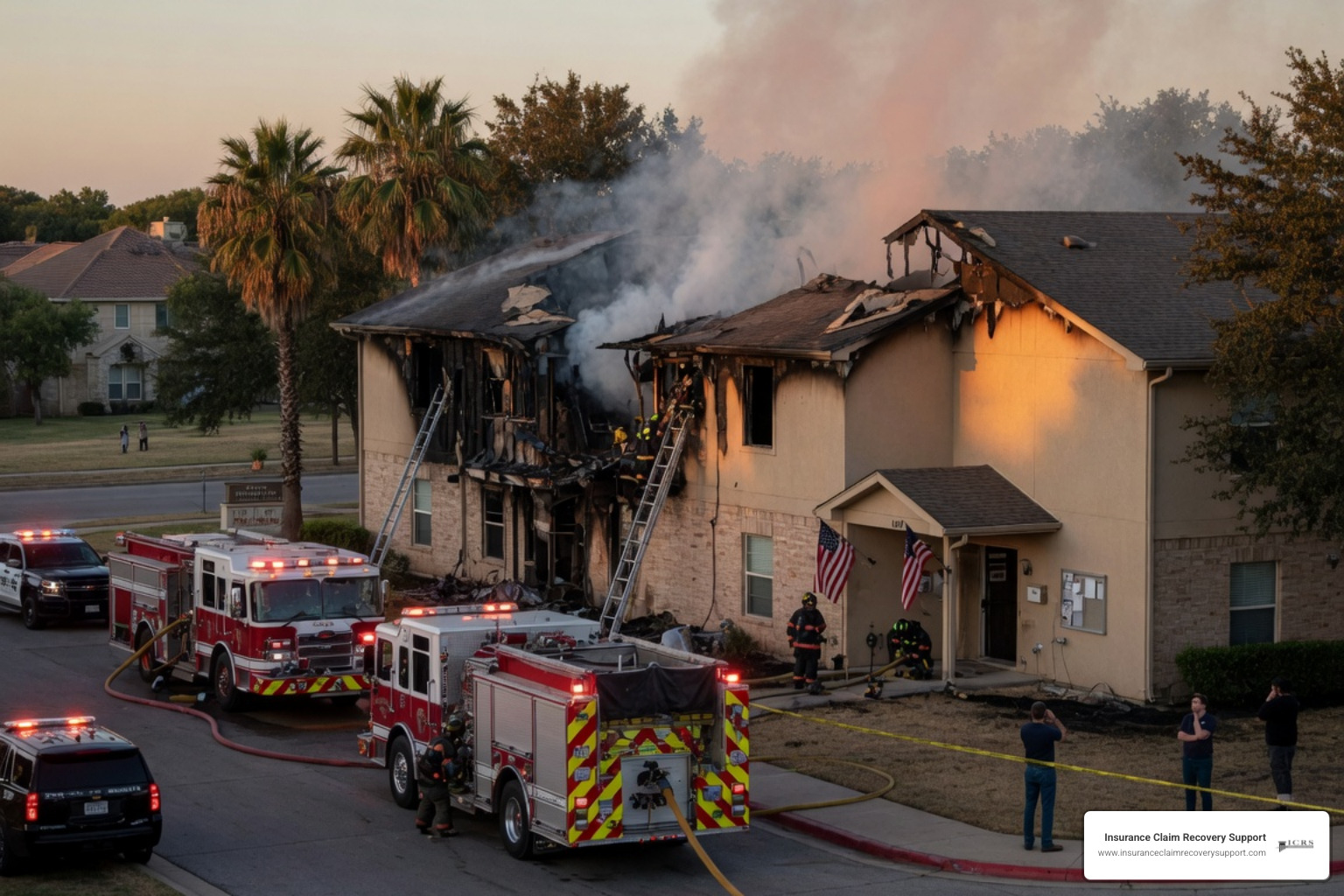
A specialized commercial insurance claims adjuster is required for significant property damage. We specialize in large-loss commercial claims across a wide range of perils:
- Property Damage: Physical damage to your building, its contents, and other insured property from perils like fire, wind, and water.
- Business Interruption: Covers lost income and ongoing expenses while your business is inoperable due to a covered loss. See our business-interruption-complete-guide.
- Fire Damage: Extensive structural damage and smoke contamination. Managing a business-fire-damage-claim requires meticulous documentation.
- Hurricane & Windstorm Damage: Complex claims often involving disputes over wind versus flood damage. See our guide on texas-public-adjuster-hurricane-damage.
- Water & Flood Damage: Damage from burst pipes or rising waters, often requiring a specialized flood-damage-public-adjuster.
- Freeze / Winter Storms: Widespread pipe bursts and infrastructure damage, a major risk in states like Texas.
- Tornado & Lightning: Severe structural damage from tornadoes in “Tornado Alley” or electrical fires from lightning strikes.
We advocate for a diverse range of commercial property owners, including apartment investors, HOAs, hospitality businesses, churches, schools, and industrial facilities.
The Investigation and Evaluation Process
After a claim is filed, the adjuster begins a detailed investigation:
- Policy Review: A deep dive into your commercial policy to identify all applicable coverages, limits, endorsements, and exclusions.
- On-Site Damage Inspection: A thorough physical inspection to document all structural damage, contents, and equipment, sometimes using drones for a comprehensive view.
- Documentation Gathering: Collecting all evidence, including photos, repair estimates, financial records for business interruption, and expert reports. The building-insurance-claim-process guide offers more insight.
- Repair Cost Estimation: Developing a detailed estimate for repair or replacement costs. This is a common area of dispute, as insurer estimates are often low.
- Settlement Negotiation: The adjuster negotiates a final settlement. This is where a public adjuster’s advocacy is most critical, as they fight to maximize your recovery, unlike an insurer’s adjuster. Learn how-to-negotiate-with-insurance-adjuster-for-property-damage.
Be cautious with all communication to an adjuster working for the insurance company, as your statements can be used to limit your claim.
A Business Owner’s Guide to the Commercial Claims Process
Navigating a commercial insurance claim is a complex task. Understanding the skills of an effective commercial insurance claims adjuster and separating fact from fiction is critical for a successful recovery.
Key Skills of an Effective Commercial Insurance Claims Adjuster
An effective adjuster, especially one representing you, needs a unique blend of skills.
- Analytical Skills: The ability to dissect complex insurance policies and financial statements to determine the full extent of coverage.
- Negotiation Tactics: A skilled adjuster can counter low offers and advocate for every dollar you’re entitled to based on market costs.
- Policy Expertise: Mastery of complex commercial policy language, endorsements, and exclusions is essential to maximize your claim.
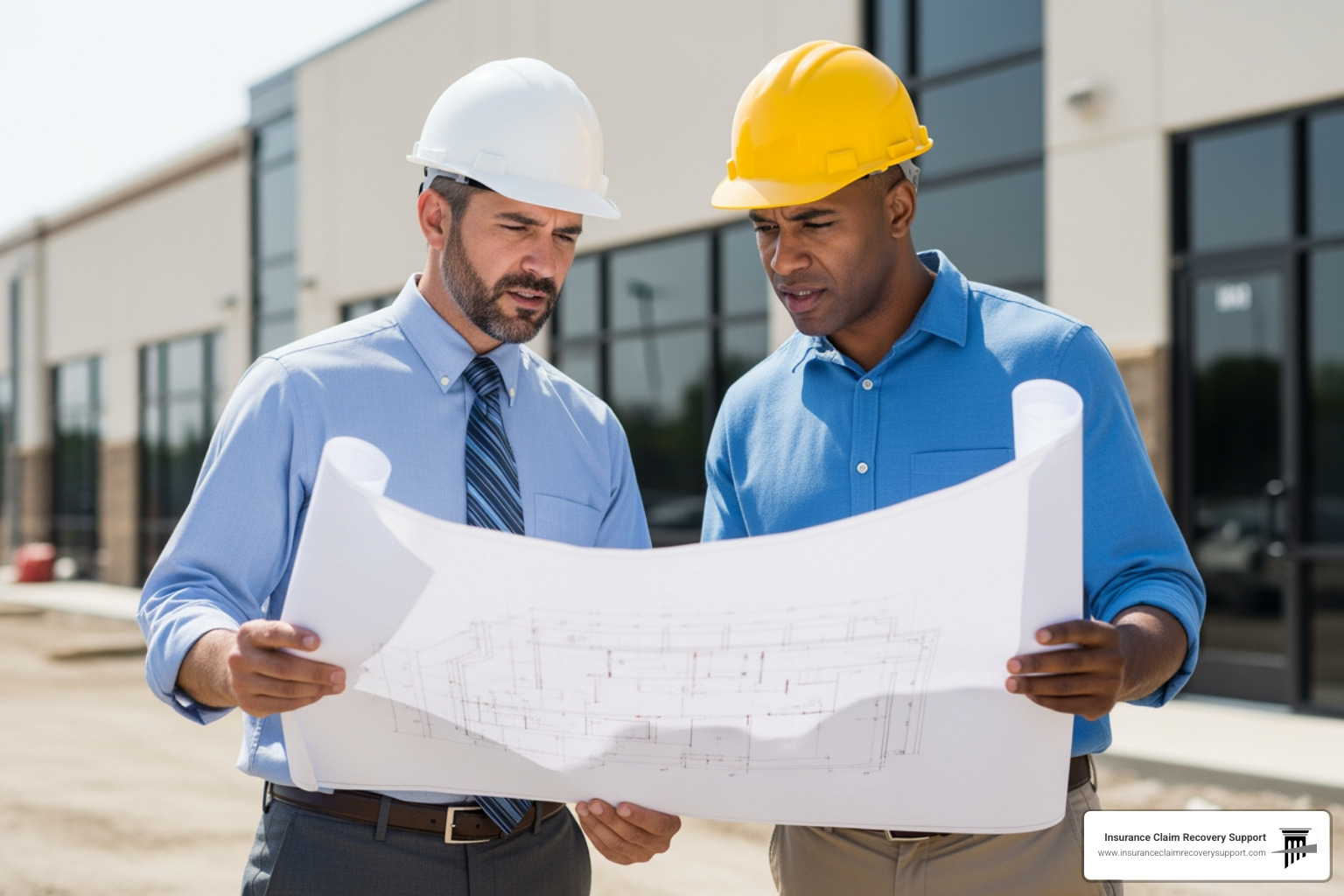
- Construction Knowledge: A strong understanding of commercial construction is needed to accurately assess damage and estimate repair costs.
- Communication: Clear communication is vital to guide you through the process and liaise with all parties. The U.S. Bureau of Labor Statistics highlights problem-solving and decision-making as crucial skills. Learn more about what-does-a-commercial-claims-adjuster-do.
Fact vs. Myth: Navigating the Claims Process
Misinformation can be as damaging as the loss itself. Let’s debunk some common myths.
Myth 1: “I have to accept the insurance company’s first offer.” Fact: No. The first offer is a starting point. It’s often low, and you have the right to negotiate for a fair amount based on a full evaluation of your damages.
Myth 2: “Hiring a public adjuster will delay my claim.” Fact: The opposite is often true. A public adjuster streamlines the process by ensuring all documentation is submitted correctly and preventing unnecessary back-and-forth, which can speed up your settlement.
Myth 3: “Litigation is the only way to resolve a claim dispute.” Fact: Litigation is a costly last resort. A public adjuster can resolve most disputes through expert negotiation or the policy’s appraisal process, avoiding expensive lawsuits.
Myth 4: “A public adjuster can’t really increase my settlement significantly.” Fact: Public adjusters are experts in finding hidden damages and accurately calculating complex losses like business interruption, often resulting in a significantly higher settlement.
Myth 5: “My claim was underpaid or denied. There’s nothing I can do.” Fact: You have recourse. A public adjuster can reopen the claim, gather new evidence, and dispute the insurer’s decision to fight for the payment you are owed. We specialize in disputing-damage-claims.
Your Path to a Fair Settlement: Public Adjuster vs. Litigation
When a claim dispute arises, you have two main paths: hiring a public adjuster or pursuing litigation.
The Public Adjuster Path: Negotiation and Appraisal This path prioritizes a swift and fair settlement without going to court. A public adjuster acts as your advocate, handling the entire process:
- Expert Documentation & Negotiation: We build a detailed claim and negotiate from a position of strength.
- Appraisal Process: If negotiations stall, we can invoke the appraisal clause in your policy—a binding and less costly alternative to a lawsuit.
- Faster Recovery: Our goal is to maximize your settlement and avoid delays. Our 90% settlement success rate without unnecessary lawsuits demonstrates this efficiency.
The Litigation Path: Lawsuits and Delays This path involves hiring an attorney to sue the insurance company. While sometimes necessary, it has major drawbacks:
- High Costs: Legal fees can consume a large portion of your settlement.
- Lengthy Process: Lawsuits can drag on for years, delaying your recovery.
- Uncertainty: The outcome is never guaranteed and the process is stressful.
A public adjuster’s expertise can help you avoid the time, cost, and stress of litigation. For more on legal options, see our guide on property-damage-legal-support.
Why You Need a Public Adjuster for Your Commercial Claim
When a major loss occurs, a public adjuster is an invaluable asset for your business.
- Leveling the Playing Field: The insurer has experts working to minimize your claim. A public adjuster is your expert, putting you on equal footing.
- Maximizing Settlements: Our core mission is to find and document all covered damages to secure the maximum payout you are entitled to. Learn how-to-maximize-your-commercial-property-damage-claim.
- Reducing Stress: We manage the entire claims process, freeing you to focus on running your business and managing your recovery.
- Expert Guidance for Complex Claims: Large-loss events involving fire, hurricanes, or floods are our specialty. We have the expertise to steer these complex claims for all types of commercial properties.
Don’t steer the complex world of commercial insurance claims alone. For expert assistance, reach out to us at Insurance Claim Recovery Support. We are here to help you recover faster and more fully. Explore how we can help with your commercial-insurance-claims-help.