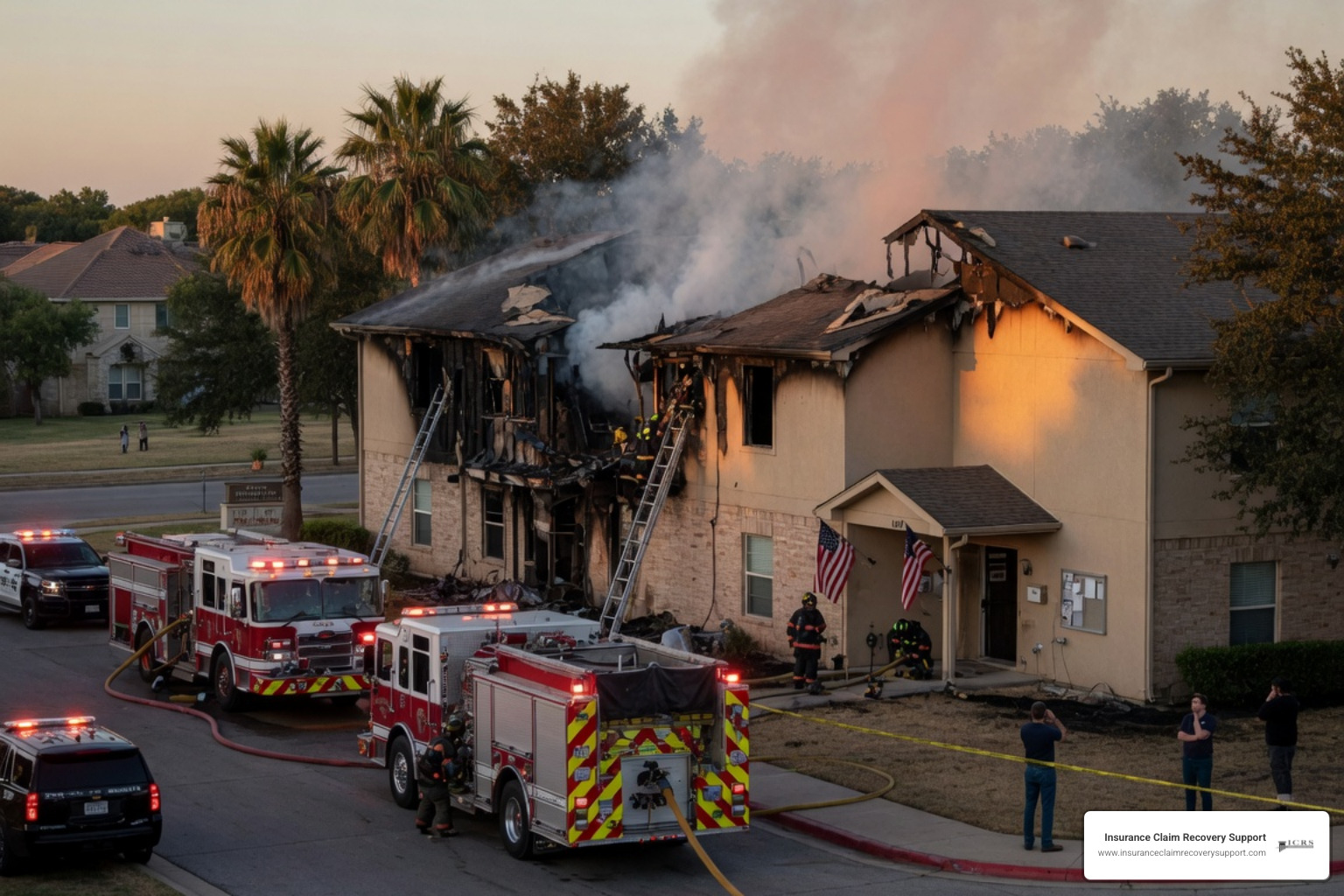
Your Round Rock Roof: What Commercial and Multifamily Property Owners Need to Know First
A Round Rock roof faces some of the most demanding weather conditions in the country — and if you own or manage a commercial building, apartment complex, or multifamily property here, your roof is one of your most financially exposed assets.
For a companion claim-documentation resource, see the ICRS Roof Claim Guide. Coverage and next steps depend on the facts and policy terms.
Here’s a quick snapshot of what Round Rock property owners need to know:
| Topic | Key Fact |
|---|---|
| 🌪 Storm Risk | Round Rock sits in “Hail Alley” — peak season runs March through May, with golf ball-sized hail every 2-3 years according to the National Weather Service |
| 💰 Replacement Cost | Residential replacements typically run $10,000–$30,000; commercial and multifamily projects scale significantly higher |
| ⏱ Timeline | Most residential replacements complete in one day; large commercial projects vary based on scope and materials |
| ✅ Insurance Coverage | Commercial and multifamily property insurance typically covers storm-related losses — but payout disputes are common |
| 📋 Inspection Frequency | Roofs should be inspected at least 2-3 times per year, and after every major storm event |
| 🏢 Common Commercial Systems | TPO, PVC, EPDM, modified bitumen, and standing seam metal are all widely used in the area |
| ⚖️ Claim Disputes | A licensed public adjuster can resolve underpaid or denied claims — often without going to litigation |
Round Rock’s position in Central Texas makes it a storm convergence zone. Hail, high winds, and rapid temperature swings don’t just wear down roofing materials over time — they can trigger sudden, large-scale damage that puts commercial operations, tenant leases, and lender compliance requirements all at risk simultaneously. The challenge for property owners isn’t just fixing the roof. It’s navigating what comes after: the insurance claim.
Many commercial and multifamily owners are surprised to find that their insurer’s initial settlement offer falls well short of actual replacement or restoration costs. That gap — between what you’re owed and what you’re offered — is exactly where the right expertise makes the difference.
I’m Scott Friedson, a Multi-State Licensed Public Adjuster and CEO of Insurance Claim Recovery Support (ICRS), and throughout my career I’ve helped commercial and multifamily property owners across Texas — including those dealing with a Round Rock roof loss — recover hundreds of millions of dollars in property damage claims, frequently without the delays and costs of litigation.
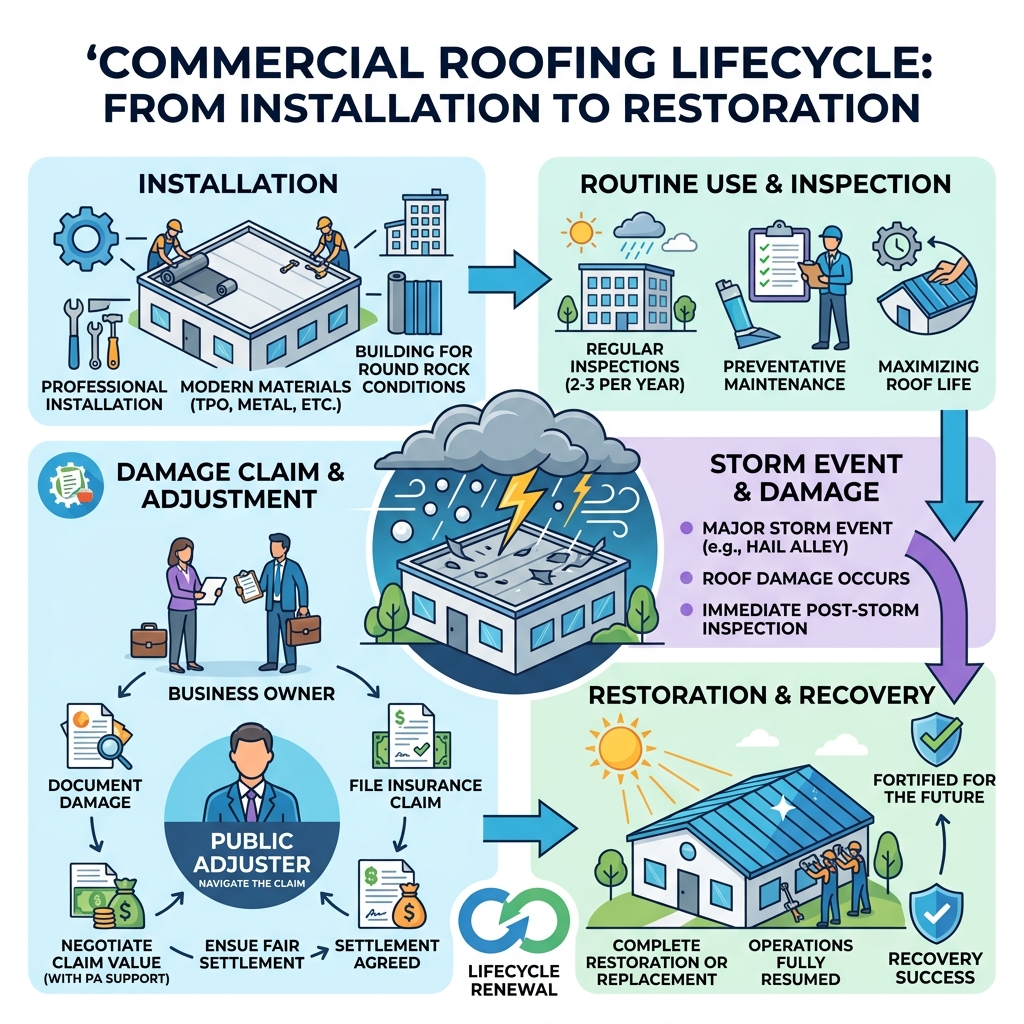
Round Rock roof terms to learn:
Understanding the Round Rock Roof Landscape for Commercial Properties
When we talk about a Round Rock roof, we aren’t just talking about shingles and plywood. For the commercial assets, multifamily complexes, and industrial facilities that drive the Williamson County economy, the roof is a complex engineered system. Whether you are managing a retail center near University Oaks or a sprawling apartment complex in Teravista, your roofing needs are dictated by a unique intersection of climate and regulation.
Round Rock is situated in a geographic “sweet spot” for severe weather. As storm systems move across Central Texas, they often converge over Texas / Williamson County / Round Rock, leading to significant hail and wind events. This isn’t just a seasonal nuisance; it’s a constant threat to the structural integrity of high-value commercial assets.
The Science of the “Cool Roof” and Local Compliance
In our part of Texas, heat is as much an enemy as hail. Scientific research into the “heat island effect” shows that traditional dark roofs can reach temperatures 50°F higher than the ambient air. For a large-scale commercial building, this leads to massive thermal expansion and contraction, which stresses seams and flashings.
Modern Round Rock roof installations frequently utilize “cool roof” systems. These highly reflective surfaces reduce energy consumption and mitigate the thermal stress that leads to premature failure. Furthermore, property owners must navigate strict building codes and, in many cases, HOA compliance. In neighborhoods like Forest Creek or Stone Oak, even commercial or multifamily entities must adhere to aesthetic and material standards that can complicate a quick repair.

Common Systems for a Round Rock Roof
Choosing the right system is about balancing durability with the specific risks of the Central Texas climate. We see a wide variety of systems, each with its own vulnerabilities when flat roof damage occurs.
- TPO (Thermoplastic Polyolefin): This is the “gold standard” for many modern commercial buildings. It is highly reflective, heat-weldable, and resistant to UV radiation. However, during a major hailstorm, TPO can suffer “bruising” that isn’t always visible to the naked eye but leads to roof collapse or structural failure years later.
- PVC Roofing: Similar to TPO but often more resistant to chemicals and greases, making it ideal for restaurants or industrial facilities.
- Modified Bitumen: A multi-ply system that offers excellent “redundancy.” If the top layer is punctured, the layers beneath provide a secondary defense. It’s a rugged choice for roofs with high foot traffic.
- Standing Seam Metal: While expensive upfront, metal roofs offer incredible longevity. The challenge in Round Rock is that while they are structurally durable, they are highly susceptible to “cosmetic” hail damage that insurance companies love to exclude, even when the dents compromise the finish or future resale value.
Professional property management requires understanding these materials not just as construction components, but as insurance line items. When a storm hits, the type of material on your Round Rock roof will dictate the complexity of your insurance claim.
Navigating the Commercial Claim Process After a Storm
If you’ve managed property in Williamson County for more than a few years, you know that hail damage is a matter of “when,” not “if.” When a major cell rolls through, the damage to a commercial Round Rock roof can be catastrophic.
The problem is that hail damage roof issues are often subtle. Unlike a wind damage loss insurance claim, where shingles are visibly missing or trees have fallen, hail damage can be hidden. You might see “dimples” in the granules of an asphalt shingle or small fractures in a TPO membrane. These “hidden” wounds allow moisture to seep into the insulation and decking, leading to mold and structural rot long before a leak appears in the ceiling.
The Importance of Evidence and Documentation
Following a storm, the clock starts ticking on your hail storm roof damage insurance claim. For commercial and multifamily owners, the scale of the loss requires more than just a few cell phone photos.
We recommend a multi-layered approach to documentation:
- Drone Inspections: High-resolution aerial photography can capture the scope of the damage across thousands of square feet that might be missed during a manual walk-through.
- Moisture Mapping: Using infrared technology to find “hidden moisture” trapped beneath the roofing membrane. This is critical evidence for proving that a full replacement is necessary rather than a simple patch.
- Third-Party Experts: Engaging engineers or roof consultants to verify structural integrity.
The insurance company’s adjuster is looking for reasons to limit the scope of the hail storm damage insurance claim. If you don’t have forensic-level evidence of the damage, you are essentially leaving your settlement to chance.
Public Adjuster vs. Litigation: Resolving Large-Loss Claims
When an insurance company offers a settlement that doesn’t cover the cost of a new Round Rock roof, property owners often feel they have only two choices: accept the low-ball offer or sue. However, there is a more efficient middle ground.
As a licensed public insurance adjusting firm, Insurance Claim Recovery Support (ICRS) represents policyholders — never insurance companies. We advocate for commercial building owners and multifamily operators to ensure they get the maximum settlement they are entitled to under their policy.
Why Avoid Litigation?
Many property owners think a lawyer is the first person to call. While attorneys have their place, the litigation process in Texas can be incredibly slow and expensive. With recent changes in Texas hail legislation, the bar for successfully suing an insurance company has been raised, often leading to years of delays while your roof continues to deteriorate.
| Feature | Public Adjuster (ICRS) | Litigation / Lawsuit |
|---|---|---|
| Speed | Focused on rapid settlement and recovery | Can take 12–36 months or longer |
| Cost | Contingency-based; no upfront fees | High hourly rates or 33–40% contingency |
| Approach | Forensic evidence and policy negotiation | Adversarial and legalistic |
| Outcome | Goal is 100% indemnification | Often ends in a settlement minus heavy legal fees |
| Relationship | Collaborative with your contractors | Often freezes communication with the insurer |
When you look at the public vs. company adjuster dynamic, the difference is clear: the company adjuster works for the insurer’s bottom line; we work for yours. Our 90% settlement success rate is built on avoiding the “war” and focusing on the facts of the claim. Is Texas at war with hail damage insurance claims? It can certainly feel that way, but a strategic approach often yields better results than a courtroom battle.
Fact vs. Myth: Commercial Property Insurance Claims
There is a significant amount of misinformation circulating among property managers regarding their Round Rock roof and insurance rights. Let’s clear some of this up.
Myth: “I don’t have a leak, so I don’t have a claim.” Fact: This is perhaps the most dangerous myth. Hail damage is cumulative. Just because water isn’t dripping into your warehouse today doesn’t mean the “bruising” on your roof hasn’t shortened its lifespan from 20 years to 5 years. You can absolutely initiate the hail damage insurance process without an active leak.
Myth: “Insurance doesn’t cover ‘cosmetic’ damage.” Fact: This depends entirely on your specific policy language. While some carriers have added “cosmetic exclusions,” many standard commercial policies still cover any physical loss that alters the appearance or function of the material. Don’t take the adjuster’s word for it; have a professional review your policy.
Myth: “Filing a claim will make my premiums skyrocket.” Fact: In Texas, insurance companies generally cannot raise your individual rates solely because you filed a claim for a “catastrophe” or “Act of God” like a hailstorm. Rates are typically raised by zip code or region based on overall risk. If your neighbors are filing claims and you aren’t, you’re essentially subsidizing their new roofs with your premiums.
Myth: “I can wait a few years to file.” Fact: Most policies have a strict “notice of loss” provision, often requiring you to report damage within one year. Waiting too long gives the carrier an easy excuse to deny the claim based on “wear and tear” or “late reporting.”
Myth: “Storm damage claims are only for residential properties.” Fact: Can you claim on house insurance for storm damage? While many resources focus on homes, commercial and multifamily entities have even greater protections under most policies, though the claims are significantly more complex, involving business interruption and tenant safety.
Cost Estimates and Financing for Major Replacements
The financial reality of a Round Rock roof replacement is significant. While a standard residential roof in the area might cost between $10,000 and $30,000, commercial and multifamily projects operate on a different scale entirely.
Breaking Down the Numbers
For an apartment complex or a large retail center, a full roof replacement can easily exceed $50,000, and for industrial facilities, costs can reach into the hundreds of thousands or even millions.
- Residential Average: $10,000 – $30,000
- Multifamily (Per Building): $30,000 – $75,000+
- Large Commercial/Industrial: $100,000 – $1,000,000+
When you consider that Dallas hailstorm insured losses could reach $2 billion, you begin to see why insurance companies are so aggressive in their “adjustments.”
Financing and ROI
For many property owners, a roof replacement is a major capital expenditure (CapEx). However, when funded through a successful insurance claim, it becomes a massive boost to the asset’s value and Return on Investment (ROI).
If your claim is underpaid, you may find yourself looking for financing options. Many local Round Rock contractors offer 0% interest financing or flexible payment plans. However, the goal of Insurance Claim Recovery Support is to ensure the insurance company pays the full amount you are owed so that your out-of-pocket costs are limited to your deductible.
Conclusion: Securing Your Round Rock Roof Investment
Your Round Rock roof is more than just a cover for your building; it is a critical component of your property’s value and your business’s continuity. In a region where “Golf Ball” and “Baseball” are used to describe hail size more often than sports, you cannot afford to be passive about roof maintenance or insurance claims.
At Insurance Claim Recovery Support (ICRS), we specialize in the “heavy lifting” of the insurance world. We advocate for professional property managers, apartment investors, HOAs, and religious institutions to ensure that when disaster strikes, the recovery is total.
Our USP is simple: We maximize settlements and reduce delays. With a 90% settlement success rate, we help our clients avoid the pitfalls of litigation and the frustration of underpaid claims.
If your property has been impacted by the unpredictable Texas weather, don’t settle for the first check the insurance company cuts. Schedule a consultation for Round Rock storm damage claims with our team today and ensure your investment is truly protected.
Final Checklist for Round Rock Property Owners:
- Inspect: Get a professional on your roof 2-3 times a year.
- Document: Keep a “property log” with photos of the roof’s condition before storm season.
- Act Fast: If a storm hits, document the date and time immediately.
- Professional Help: Contact a public adjuster before you sign any contracts or accept a final settlement from the insurer.