Hawley-State Farm Clash Explained by Insurance Claim Recovery Support
The Senator Hawley State Farm standoff has put one of America’s largest insurers squarely in the crosshairs of federal oversight — and if you own or manage commercial or multifamily property, what’s unfolding in Washington and Missouri should be on your radar.
Here’s the quick picture:
- 🏛️ Who: U.S. Senator Josh Hawley (R-MO), Chair of the Senate Subcommittee on Disaster Management
- 📋 What: Hawley sent a formal letter to State Farm CEO Jon Farney demanding answers on delayed and underpaid tornado damage claims — and threatened to subpoena the company if it didn’t comply
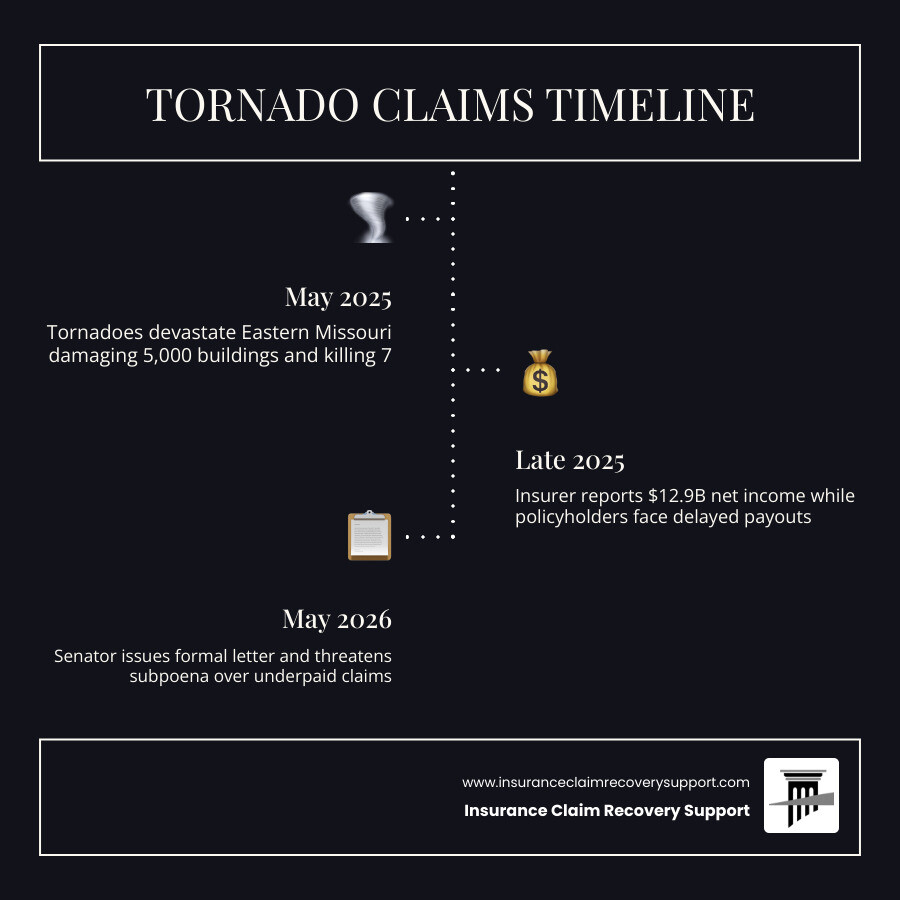
- 📅 When: The investigation escalated in May 2026, nearly one year after devastating Missouri tornadoes in May 2025 killed seven people and damaged approximately 5,000 buildings
- ⚖️ Why it matters: Despite reporting a net income that more than doubled to $12.9 billion in 2025, State Farm stands accused of slow-walking and low-balling legitimate property claims
- 🔍 Broader scope: The scrutiny extends beyond Missouri — California regulators have launched a formal investigation into State Farm’s handling of the 2025 Los Angeles wildfires, and a Senate hearing already produced one dramatic result when an insurer reversed a settlement offer from $46,000 to $497,000 plus attorney’s fees following congressional pressure
This isn’t just a political story. It’s a signal about how major insurers treat policyholders when disaster strikes — and the pattern matters enormously for commercial property owners, apartment operators, HOAs, and institutional building owners who carry large-loss exposure.
I’m Scott Friedson, CEO of Insurance Claim Recovery Support (ICRS) and a multi-state licensed public adjuster with over 15 years of experience settling hundreds of millions of dollars in large-loss commercial and multifamily property claims — the same systemic underpayment issues now driving the Senator Hawley State Farm investigation are ones I confront on behalf of property owners every day. What’s playing out in the Senate confirms what we see in the field: delay and underpayment aren’t accidents, they’re a pattern.
The Catalyst: Senator Hawley State Farm Investigation into Tornado Claims
The friction began in the aftermath of the severe storms that tore through Eastern Missouri in May 2025. The tornadoes left a trail of destruction: seven confirmed fatalities, dozens of injuries, and approximately 5,000 buildings damaged. For commercial property owners, multifamily housing operators, and local businesses, the physical devastation was only the first phase of the crisis. The second phase was securing the financial recovery promised by their insurance policies.
Nearly a year later, in May 2026, Senator Josh Hawley stepped in on behalf of frustrated commercial and multifamily policyholders. In a sharply worded letter to State Farm CEO Jon Farney, Hawley accused the insurer of systematically “slow-walking” payouts and “low-balling” claims. While State Farm pointed to its public relations data—stating it paid more than $360 million to Missouri customers across 20,000 commercial and structure claims related to the May 2025 storms—policyholders painted a vastly different picture.
Many commercial and institutional owners reported that their claims remained open, unresolved, or settled for pennies on the dollar. If your business is currently facing similar roadblocks, seeking professional Help with Denied Claim processes is often the only way to break the corporate logjam.
The optics of the dispute are particularly striking when comparing the policyholders’ struggles with State Farm’s financial performance. Hawley highlighted a glaring disconnect: State Farm’s net income more than doubled to a staggering $12.9 billion in 2025. While the carrier sat on historic profits, local commercial and multifamily policyholders were forced to pay out-of-pocket for tenant relocation, debris removal, and emergency structural stabilization. For many, the only path to recovery has been to file lawsuits to force the payout of settlement benefits they had dutifully paid premiums to secure for decades.
Systemic Insurer Scrutiny: The “Cost of Doing Business” Model
The Senator Hawley State Farm investigation highlights a broader, more calculated reality in the insurance industry: the “cost of doing business” model. In large-loss commercial property insurance, delaying payments, underpaying claims, and forcing policyholders into protracted disputes is treated as a deliberate profit-maximization strategy rather than an operational failure. By holding onto billions of dollars in claim reserves, insurance companies generate substantial investment income while waiting out exhausted commercial policyholders who may eventually accept a settlement for far less than they are contractually owed.

This model relies on several systemic tactics that we regularly identify during the Insurance Dispute Resolution process:
- Altered Adjuster Reports: A recurring issue exposed in congressional hearings is the practice of “desk reviewers” altering the reports of field adjusters. Field adjusters who actually visit the physical property and document the damage frequently have their estimates slashed by managers sitting in remote offices.
- The “Collaboration” Euphemism: Industry whistleblowers have revealed that claims departments use corporate euphemisms like “collaboration” or “quality control” to pressure field adjusters into removing legitimate line items—such as necessary roof replacements or structural repairs—to avoid triggering higher-level internal audits.
- Manipulated Dry Log Records: In water and moisture intrusion claims, insurers sometimes ignore or manipulate dry log records (moisture mapping data) provided by mitigation contractors. By downplaying the extent of water migration, they can deny coverage for hidden structural rot or mold.
- Adjuster Licensing Gaps: During major regional disasters, carriers often flood the affected area with out-of-state, temporary, or under-licensed adjusters who lack a deep understanding of local building codes and complex commercial construction methods, leading to wildly inaccurate damage assessments.
How the Senator Hawley State Farm Inquiry Exposes Corporate Delay Tactics
Senator Hawley, utilizing his authority as Chair of the Senate Subcommittee on Disaster Management, has threatened to issue subpoenas to State Farm executives if they do not provide transparent data regarding their claims practices. The inquiry demands detailed answers on how many claims from the May 2025 storms remain unresolved, the average time to close a claim, and the specific guidelines used to deny coverage for tenant relocation and debris removal.
This federal pressure is not without precedent. In similar disputes, high-profile scrutiny has forced carriers to abandon their delay tactics. For example, Texas commercial policyholders recently saw a massive shift in corporate accountability when a court finalized a State Farm $15.6M settlement over disputed property claims. When carriers realize that their internal claims-handling manuals and delay tactics will be exposed to the public, their appetite for litigation often evaporates. When negotiations stall entirely, commercial property owners frequently must retain a skilled Lawyer to Fight Insurance Company decisions to protect their assets.
National Patterns of Underpayment and the Senator Hawley State Farm Connection
The claims-handling issues exposed in Missouri are part of a nationwide pattern. Across the country, major carriers are facing intense regulatory and legal pressure for their disaster response practices.
In California, the Department of Insurance launched a formal market conduct examination of State Farm following its handling of the devastating 2025 Los Angeles wildfires, as detailed in this NYT California article. Commercial property owners and multifamily operators affected by the fires complained of delayed payments, poor recordkeeping, and arbitrary denials of smoke and ash damage claims.
The state took action through a formal California Enforcement Action, prompting widespread coverage from national outlets like The Guardian and CNN. While State Farm pointed out that it had paid over $4 billion on wildfire claims and expected total payouts to reach up to $8 billion, regulators noted that massive aggregate payouts do not excuse bad-faith delays or unfair claim-handling practices on individual properties.
Whether dealing with tornado damage in the Midwest, wildfire smoke in the West, or wind damage along the coast, the playbook remains remarkably consistent. Understanding these corporate patterns is essential for any commercial property manager facing Denied Hurricane Claims: Why They Happen and How to Fight Back after a major coastal storm event.
Commercial and Multifamily Property Vulnerabilities in Large-Loss Claims
Commercial and multifamily properties—such as apartment complexes, retail centers, office buildings, industrial warehouses, and HOA communities—face unique operational and financial vulnerabilities during a large-loss claim. Unlike a standard residential claim, a commercial property loss involves complex physical structures, business continuity demands, and strict regulatory compliance.

When a major storm or fire strikes a commercial property, the owner must navigate a maze of challenges that standard insurance adjusters often gloss over:
- Environmental Hazards & Protocols: Large-loss events frequently disturb hazardous materials. Under OSHA regulations and local environmental laws, property owners must conduct strict testing for asbestos, lead, and mold before starting demolition or reconstruction. Insurers often balk at paying for certified industrial hygienists and specialized remediation protocols, claiming these essential safety measures are “unnecessary upgrades.”
- Dry Log Records & Structural Integrity: For large-scale water or wind losses, maintaining detailed dry log records is legally and structurally vital. If a concrete-slab or multi-story wood-frame building is not dried to industry standards, structural rot and toxic mold will follow. Insurers frequently try to cut costs by shortening the drying window or refusing to pay for commercial-grade dehumidification equipment.
- Statutory Protections (Texas Statutes 541/542): In our home state of Texas, commercial policyholders are protected by powerful statutory frameworks. Texas Insurance Code Chapter 541 prohibits unfair methods of competition and deceptive practices, while Chapter 542 (the Prompt Payment of Claims Act) imposes strict deadlines on when an insurer must acknowledge, investigate, and pay a claim. If an insurer misses these deadlines, they can be held liable for the full claim amount plus statutory interest and reasonable attorney’s fees.
- The High Cost of Litigation and the Appraisal Alternative: In states like Florida, rising litigation costs have made court battles a challenging path for many policyholders. As an alternative, many commercial policies contain an “appraisal clause.” This dispute-resolution mechanism allows both parties to select independent appraisers to determine the true value of the loss. If the appraisers agree (or if an independent umpire resolves a tie-out), an appraisal award is issued. This award is legally binding and can bypass years of court delays.
- Policy Interpretation: Commercial policies are highly customized documents filled with endorsements, exclusions, and co-insurance clauses. A single word can dictate whether a $500,000 code upgrade or a $1 million business interruption loss is covered. Securing professional Property Damage Legal Support or consulting a dedicated Property Insurance Attorney is often critical to ensuring these complex contracts are interpreted fairly.
Fact vs. Myth: Navigating Large-Loss Property Claims
Navigating a commercial claim over $250,000 requires separating insurance industry myths from contractual facts. The table below highlights some of the most common myths policyholders encounter:
| Insurer Myth | Policyholder Fact | ICRS Practical Translation |
|---|---|---|
| Myth: The insurance company’s preferred contractor will provide an accurate, unbiased estimate to restore your commercial building. | Fact: Preferred contractors rely on steady streams of referrals from the insurance carrier and are heavily incentivized to keep repair costs as low as possible. | Never rely solely on an insurer-appointed contractor’s scope of work. Always obtain independent, comprehensive engineering and construction estimates. |
| Myth: If you do not accept the insurer’s initial settlement offer, your claim will be delayed indefinitely or denied. | Fact: Policyholders have a legal right to dispute low-ball valuations and present independent evidence of the true cost to fully indemnify the property. | Disputing an offer using professional documentation does not void your claim; rather, it sets the stage for a proper Art of the Appeal: Fighting Insurance Denial Like a Pro process. |
| Myth: Public adjusters are only necessary for residential claims or minor disputes. | Fact: For commercial and multifamily claims exceeding $250,000, a licensed public adjuster is essential to manage the complex logistics, forensic testing, and negotiations. | Public adjusters work exclusively for you—never the insurance company. We advocate to maximize your settlement and hold carriers accountable. |
| Myth: “Code upgrades” and environmental testing (asbestos/lead/OSHA protocols) are optional and not covered under standard commercial property policies. | Fact: Most commercial policies include Law and Ordinance coverage, which indemnifies the owner for the mandatory costs of bringing a damaged building up to current local codes. | If local building inspectors or OSHA require a specific repair method or environmental protocol, your carrier is contractually obligated to pay for it under applicable coverages. |
Frequently Asked Questions about Senator Hawley’s Insurance Investigation
What prompted the Senator Hawley State Farm investigation?
The investigation was launched following a wave of complaints from Missouri commercial property owners and multifamily operators who suffered severe property damage during the devastating May 2025 tornadoes. Nearly a year after the disaster, numerous commercial policyholders reported that State Farm was systematically delaying payouts, low-balling damage estimates, and denying coverage for essential recovery services like tenant relocation and debris removal.
Senator Hawley highlighted the contrast between these delays and State Farm’s financial performance, noting that the insurer’s net income more than doubled to $12.9 billion in 2025. In his formal letter to State Farm CEO Jon Farney, Hawley demanded full transparency regarding the carrier’s claims-handling metrics and threatened congressional subpoenas if the company failed to comply.
How do insurers alter field adjuster reports to reduce settlements?
In many large-loss claims, a field adjuster visits the damaged property and writes an honest, detailed estimate reflecting the true cost of repairs. However, before that estimate reaches the policyholder, it must pass through an internal review process. Remote “desk reviewers”—who have never set foot on the property—frequently modify the field adjuster’s report.
Using corporate pressure under the guise of “collaboration” or “quality control,” reviewers may instruct adjusters to delete necessary line items, attribute storm damage to pre-existing wear and tear, or manipulate dry log records to understate water damage. This practice effectively slashes the proposed settlement and forces the policyholder to fight for coverage that was originally validated by the field adjuster.
What legal protections do commercial policyholders have against bad faith delays?
Commercial policyholders have several powerful legal and contractual avenues to protect their interests:
- Prompt Payment Laws: In states like Texas, Texas Statutes 541 and 542 establish strict timelines for insurers. Under Chapter 542, carriers must acknowledge a claim, investigate it, and issue payment within specific statutory windows. Failure to meet these deadlines can result in the insurer paying the full claim plus statutory interest penalties and attorney’s fees.
- The Appraisal Process: If there is a dispute over the value of the damage, most commercial policies allow the owner to demand an independent appraisal. This process bypasses the court system and can result in a binding appraisal award that forces the carrier to pay the true cost of restoration.
- Public Adjuster Representation: Engaging a licensed public adjuster for claims over $250,000 ensures that a professional advocate is managing the claim, documenting the damage to forensic standards, and holding the insurer’s adjusters accountable to the terms of the policy.
Conclusion: Protecting Commercial Policyholders from Systemic Delays
The Senator Hawley State Farm investigation serves as a powerful reminder that even the largest, most profitable insurance companies can fall short of their promises when major disasters strike. For commercial property owners, apartment investors, HOAs, and institutional managers, relying on an insurance carrier’s good faith is a risky business strategy.
When a large-loss event occurs, protecting your financial interests requires professional, independent advocacy. At Insurance Claim Recovery Support LLC (ICRS), we represent policyholders exclusively—never the insurance companies. We specialize in managing complex commercial, multifamily, and specialty property claims involving fire, hail, windstorm, tornado, and business interruption.
Our primary focus is on maximizing settlements, reducing unnecessary delays, and resolving disputes through policy interpretation and appraisal—allowing our clients to secure a fair settlement without the cost and delay of unnecessary lawsuits. If your commercial property has suffered a major loss exceeding $250,000, do not let corporate delay tactics derail your business recovery.
Contact us today to learn more about our comprehensive Insurance Adjustment Services and let our experienced team help you rebuild with confidence.