When the HOA Sends an Insurance Adjuster After Water Damage — Here’s What You Actually Need to Know
An HOA water loss adjuster is a licensed insurance professional assigned to evaluate water damage claims involving a homeowners association’s master insurance policy — and understanding who that adjuster works for can mean the difference between a fair settlement and a significantly underpaid one.
Quick answer for HOA boards, condo associations, and multifamily operators:
| Question | Short Answer |
|---|---|
| Who does the HOA’s adjuster represent? | The insurance company — not you |
| What does the master policy cover? | Common areas, shared systems, and (depending on policy type) unit interiors |
| Can unit owners file separately? | Yes — through their individual HO-6 policy |
| What’s the biggest risk in HOA water claims? | Underpayment, denial based on “gradual damage,” or coverage gaps between master and unit policies |
| When should you hire a public adjuster? | Before accepting any settlement offer on a complex or large-loss water claim |
Water damage is one of the most frequently filed — and most frequently underpaid — property insurance claims in the United States. In multifamily and HOA settings, the stakes are even higher. You’re not dealing with a single unit or a single policy. You’re navigating a web of overlapping coverage responsibilities: the association’s master policy, individual unit owner HO-6 policies, CC&Rs, state statutes, and an insurance adjuster whose job is to protect the carrier’s bottom line — not yours.
This matters especially now. In 2026, with insurers facing increased regulatory scrutiny and policyholders across Florida, Texas, and California reporting systemic delays and denials, knowing exactly what to expect when an adjuster shows up at your HOA property is no longer optional — it’s essential.
I’m Scott Friedson, CEO of Insurance Claim Recovery Support (ICRS) and a multi-state licensed public adjuster with over 15 years of experience handling large-loss HOA and multifamily water damage claims. Over 500+ claims totaling more than $250 million in recoveries, I’ve seen how the presence — or absence — of an experienced HOA water loss adjuster on the policyholder’s side directly shapes whether an association rebuilds fully or is left covering the gap out of pocket. In the sections ahead, I’ll walk you through exactly what the process looks like and how to protect your community’s interests at every step.
Why Your HOA Water Loss Adjuster Matters in the Current Insurance Climate
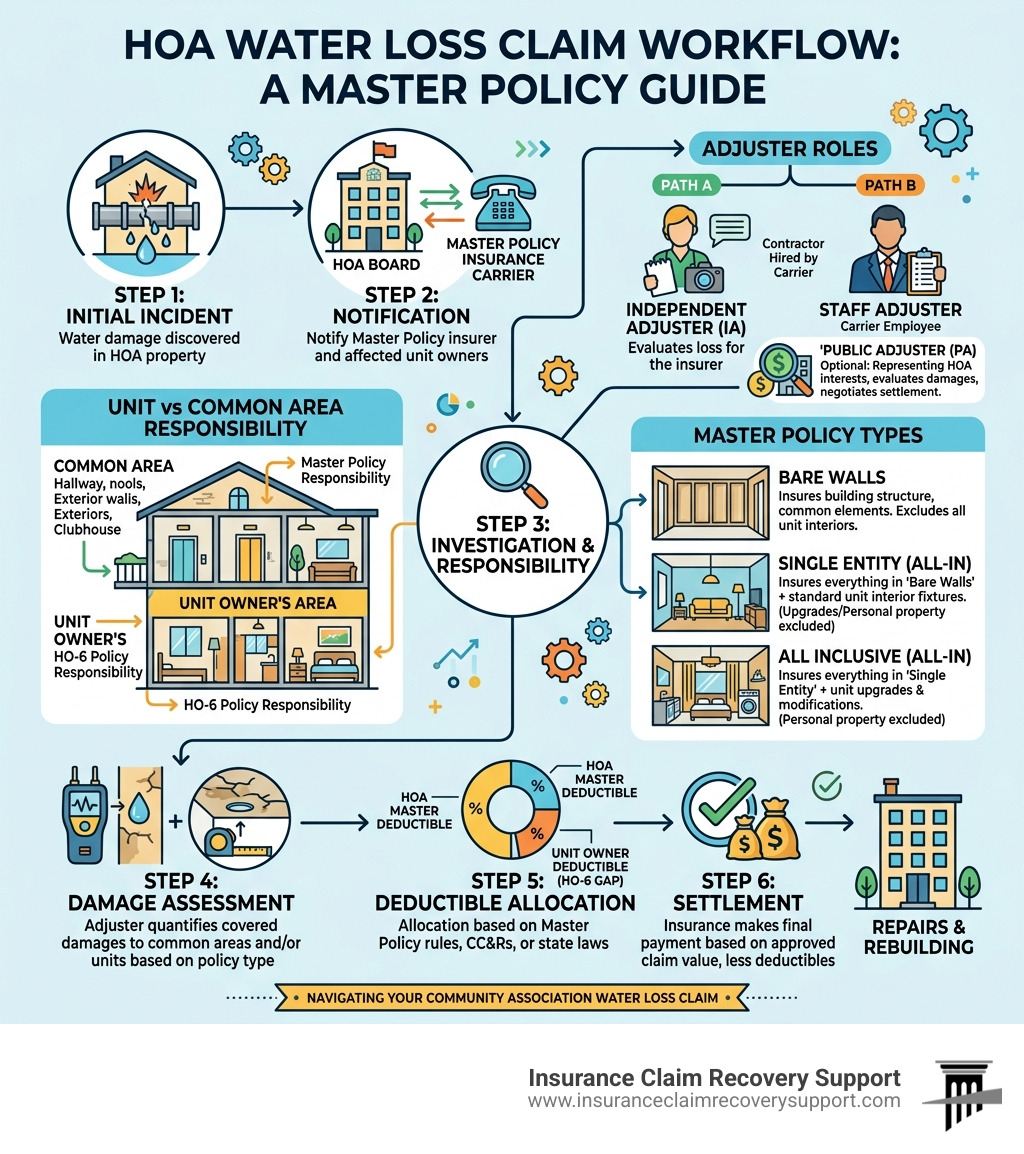
In April 2026, the property insurance landscape for community associations has shifted. Carriers are under immense pressure to reduce payouts, often resulting in a “check-the-box” mentality during inspections. When an HOA water loss adjuster arrives at your property, they are typically one of two types: an “independent” adjuster (a contractor hired by the carrier) or a staff adjuster (a direct employee). Neither has a fiduciary duty to the HOA; their loyalty is strictly to the insurance company.
Recent trends show a growing reliance on non-licensed personnel or “desk adjusters” who make final payment decisions based on photos alone, never setting foot on the property. This fragmented decision-making often misses structural moisture trapped behind commercial-grade drywall or inside mechanical chases. For a deeper look at how these policies are structured, see our guide on Unpacking the Master Policy Your Condo Associations Insurance Blueprint.
Effective management of these claims requires more than just showing the adjuster the damage; it requires professional Multi Family Claims Efficient Handling and Management to ensure that every affected square foot is accounted for before the file is closed.
The Difference Between Independent and Public Adjusters
It is a common misconception that the “independent” adjuster sent by the HOA’s carrier is there to find a fair middle ground. In reality, their fiduciary duty is to the insurer. They are tasked with applying policy exclusions—like the dreaded “14-day seepage rule”—to limit the carrier’s liability.
Conversely, a public adjuster is a private HOA water loss adjuster who works exclusively for the policyholder. We represent the HOA board’s interests, conducting our own forensic moisture mapping and thermal imaging to prove the full extent of the loss. This is critical for Asset Types Public Adjuster for Multifamily Commercial Property Management, where shared plumbing and HVAC systems can turn a small leak into a building-wide catastrophe.
When to Hire a Private HOA Water Loss Adjuster
If the estimated damage exceeds $250,000, or if the water intrusion affects multiple units and common areas, self-handling the claim is a significant risk. You should consider professional advocacy when:
- The carrier’s adjuster offers a settlement that doesn’t cover the contractor’s bids.
- The cause of loss is disputed (e.g., “gradual wear and tear” vs. “sudden pipe burst”).
- The association is facing complex “bare walls” vs. “all-in” coverage disputes.
If you are currently searching for a Public Claims Adjuster for Flood Damage Near Me, ensure they specialize in the commercial complexities of HOA master policies rather than just standard individual unit claims.
Navigating Master Policies: Bare Walls, Single Entity, and All-In Coverage
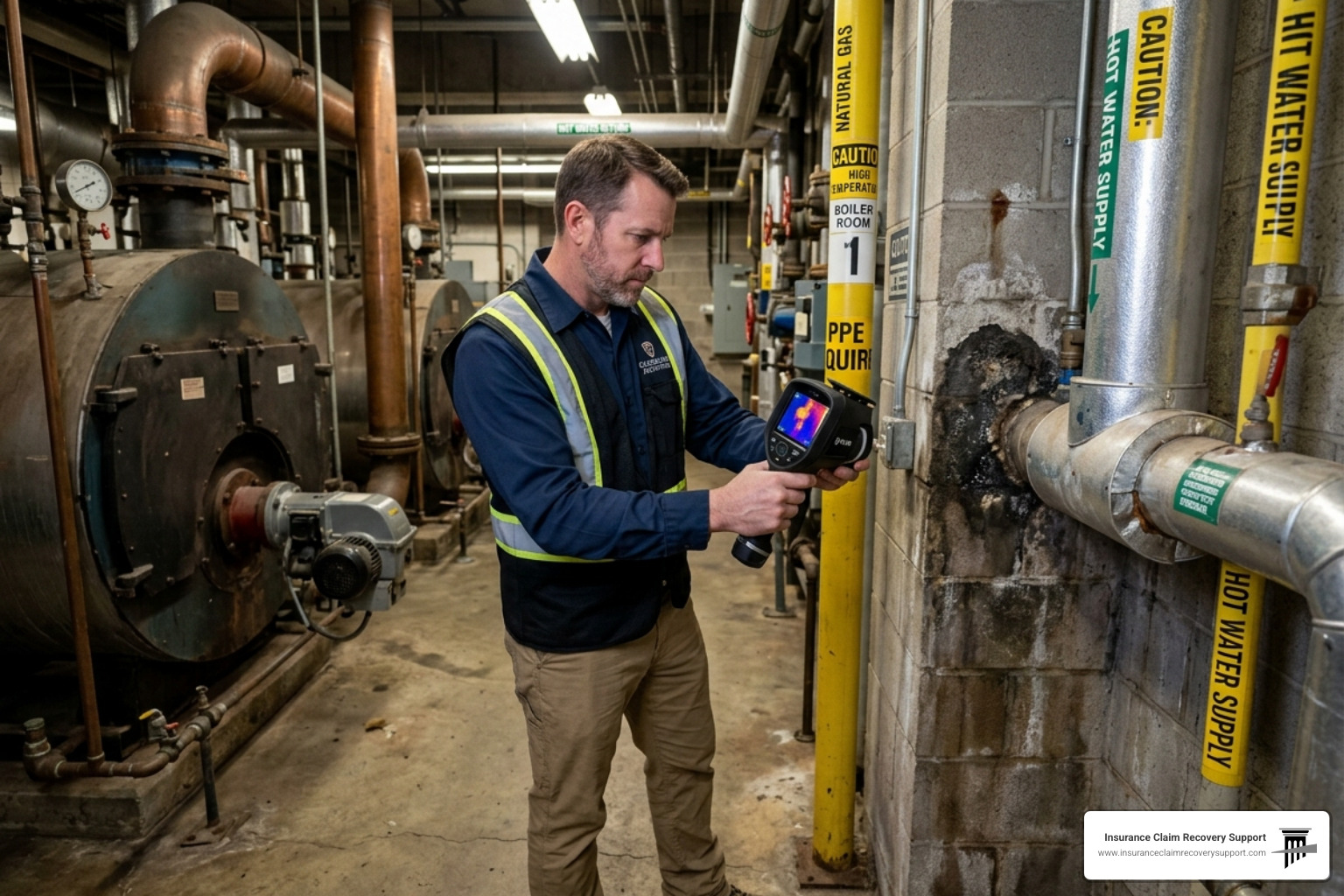
The primary hurdle in any HOA water claim is determining where the association’s responsibility ends and the unit owner’s begins. This is governed by the association’s Covenants, Conditions, and Restrictions (CC&Rs) and state-specific laws like California Civil Code 4775 or Florida Statute 718.
| Policy Type | What the HOA Covers | What the Owner Covers |
|---|---|---|
| Bare Walls-In | Building shell, framing, roofing, and common piping. | Everything from the drywall out: flooring, cabinets, fixtures, and paint. |
| Single Entity | Everything in “Bare Walls” plus original fixtures/finishes as built. | Only personal property and any upgrades/improvements made since original construction. |
| All-In (All-Inclusive) | Covers almost everything inside the unit, including improvements and betterments. | Primarily personal belongings (furniture, clothes, electronics). |
Understanding these distinctions is vital for Tag Multi Family Insurance Claims, as an incorrect classification by the carrier’s adjuster can shift hundreds of thousands of dollars in repair costs onto the residents.
Allocation of Responsibility and Deductibles
Who pays the deductible? This is the most common point of friction. In many associations, if a leak originates in a unit-owner-controlled component (like a toilet supply line), the HOA may “charge back” the master policy deductible to that owner, even if the HOA policy is the one paying for the common area repairs.
It is important to distinguish between maintenance responsibility and insurance coverage. An owner may be responsible for maintaining a pipe, but if that pipe bursts, the damage may still be a covered event under the master policy. For more on how different water events are categorized, see Loss Types Flood Damage Insurance Claims.
The Importance of a Formal HOA Water Loss Policy
Every HOA should adopt a formal “Water Loss Policy.” This document standardizes how the board handles claims, defines “immediate notification” requirements for owners, and outlines the steps for Tag Water Mitigation. Without a written policy, boards often make inconsistent decisions that lead to internal disputes and potential litigation.
The “Delay, Deny, Underpay” Roadmap: Systemic Scrutiny in 2026
The insurance industry, particularly major carriers like State Farm, is currently facing unprecedented scrutiny. In May 2025, a U.S. Senate hearing led by Senator Josh Hawley highlighted what was described as “institutionalized fraud” within major carriers, specifically targeting the “delay, deny, underpay” tactics used to minimize large-loss payouts.
In 2026, President Trump publicly criticized State Farm’s handling of wildfire and storm claims, specifically pointing to the disparity between premiums collected and claims paid. This national attention follows the Oklahoma Attorney General’s 2025 “Hail Focus Initiative,” which uncovered internal carrier documents showing predetermined settlement outcomes and corporate “savings targets” that incentivized adjusters to under-scope damage.
Regulatory Crackdowns and Legislative Protections
For HOAs in Texas, the law provides powerful tools. Texas Insurance Code 541 and 542 (the Prompt Payment of Claims Act) set strict deadlines for insurers to acknowledge, investigate, and pay claims. Failure to meet these deadlines can result in the carrier owing the HOA 18% interest plus attorney fees.
Similar crackdowns are happening elsewhere:
- California: The Insurance Commissioner and LA County authorities have launched transparency probes into how “wear and tear” exclusions are applied to aging HOA infrastructure.
- Illinois: New regulations are targeting “hidden” deductibles that effectively zero out smaller water claims.
- Texas: Recent Tag Tx Winter Storm events have led to increased enforcement of Tag Winter Storm Insurance Claim standards to prevent carriers from blaming “frozen pipes” on owner negligence without proof.
Fact vs. Myth: Translation of Carrier Tactics
When your carrier’s HOA water loss adjuster speaks, you need a “translation” guide:
- Carrier says: “This is a maintenance issue, not a sudden loss.”
- Translation: We found a small amount of rust on the pipe, so we’re going to deny the entire $400,000 flood claim.
- Carrier says: “The damage was caused by gradual seepage over 14 days.”
- Translation: If we can prove the leak started two weeks ago, the “14-day rule” allows us to deny coverage entirely. This is why immediate Tag Burst Pipes documentation is vital.
Maximizing Settlements for Large-Loss HOA Claims Over $250K
For large-scale water losses, the “visible” damage is often just the tip of the iceberg. Water migrates through wall cavities, follows electrical conduits, and settles under subflooring. An HOA water loss adjuster working for the carrier may only write an estimate for what they can see.
To maximize a settlement, we utilize:
- Infrared Moisture Mapping: Identifying trapped water that leads to mold.
- Hygroscopic Testing: Checking if wood framing has reached a point of permanent structural degradation.
- IICRC Standards: Ensuring the Mitigation Fire or water restoration protocols are followed to the letter to prevent secondary damage.
The High Cost of Litigation vs. Public Adjuster Advocacy
Many HOA boards believe their only options are to accept a low offer or sue. However, litigation is slow and expensive. In Florida, the average cost to litigate a property claim exceeds $10,000, whereas non-litigated settlements reached through public adjuster advocacy average approximately $1,500 in fees while yielding faster results.
In Texas, 99% of appraisals are initiated by policyholders. Data shows that when a public adjuster pushes a claim to appraisal, the resulting awards are often $10,000 to $28,000 higher than the carrier’s initial “final” offer. This is especially true for claims involving Tag Thaw Frozen Pipe scenarios where the full extent of the plumbing damage isn’t known until the system is re-pressurized.
The Impact of an HOA Water Loss Adjuster on Large-Loss Settlements
Using a professional public adjuster ensures “Xactimate precision”—using the same software the carriers use, but with line items that reflect real-world commercial construction costs in cities like Austin, Dallas, or Houston. Our 90% settlement success rate is built on providing the carrier with “undeniable evidence,” making it harder for them to justify a denial. This advocacy is central to our work in Tag Multi Family Insurance Claims.
Frequently Asked Questions about HOA Water Claims
Who is responsible for the deductible if a common pipe leaks into my unit?
Generally, the responsibility follows the CC&Rs. If the pipe is a “common area” component, the HOA usually pays the deductible. However, many modern governing documents allow the HOA to pass that cost to the owner if the leak originated within their unit’s boundaries.
Can the HOA deny my claim if they haven’t performed regular maintenance?
The HOA doesn’t deny the claim; the insurance carrier does. A carrier may attempt to deny a claim based on “failure to maintain,” but they must prove that the lack of maintenance was the proximate cause of the sudden water loss. This is a high bar that an experienced HOA water loss adjuster can often challenge.
What is the “14-day seepage exclusion” and how do I fight it?
Most ISO policies exclude water damage that occurs over “14 days or more.” Carriers use this to deny claims that they argue were “ongoing.” To fight this, you need expert testimony and moisture data proving the damage was “sudden and accidental,” even if it wasn’t discovered immediately.
Conclusion
Navigating an HOA water loss is a high-stakes balancing act. Between the “delay, deny, underpay” tactics of major carriers and the complex legal landscape of 2026, HOA boards cannot afford to rely on the carrier’s HOA water loss adjuster to dictate the value of their claim.
Insurance Claim Recovery Support (ICRS) is here to level the playing field. We are a Texas-based public adjusting firm specializing in large-loss commercial and multifamily claims. We represent HOAs and condo associations in Austin, Dallas, Fort Worth, San Antonio, Houston, and beyond, ensuring that your community receives every cent it is owed under the policy.
We work on a “no recovery, no fee” basis, meaning our interests are perfectly aligned with yours: maximizing your settlement and getting your property back to pre-loss condition as quickly as possible.
If your HOA is facing a complex water damage claim, don’t wait for the carrier to underpay you. Contact us today for a complimentary claim review at https://insuranceclaimrecoverysupport.com/commercial-property-insurance-claims/.