Hurricane Claim Guide - Insurance Claim Recovery Support LLC
Hurricane insurance claim tips can mean the difference between a full recovery and a financially devastating settlement gap — especially when you own or manage a commercial property, apartment complex, hotel, or multifamily portfolio.
Here is a quick-reference summary of the most critical steps to take when filing a hurricane insurance claim:
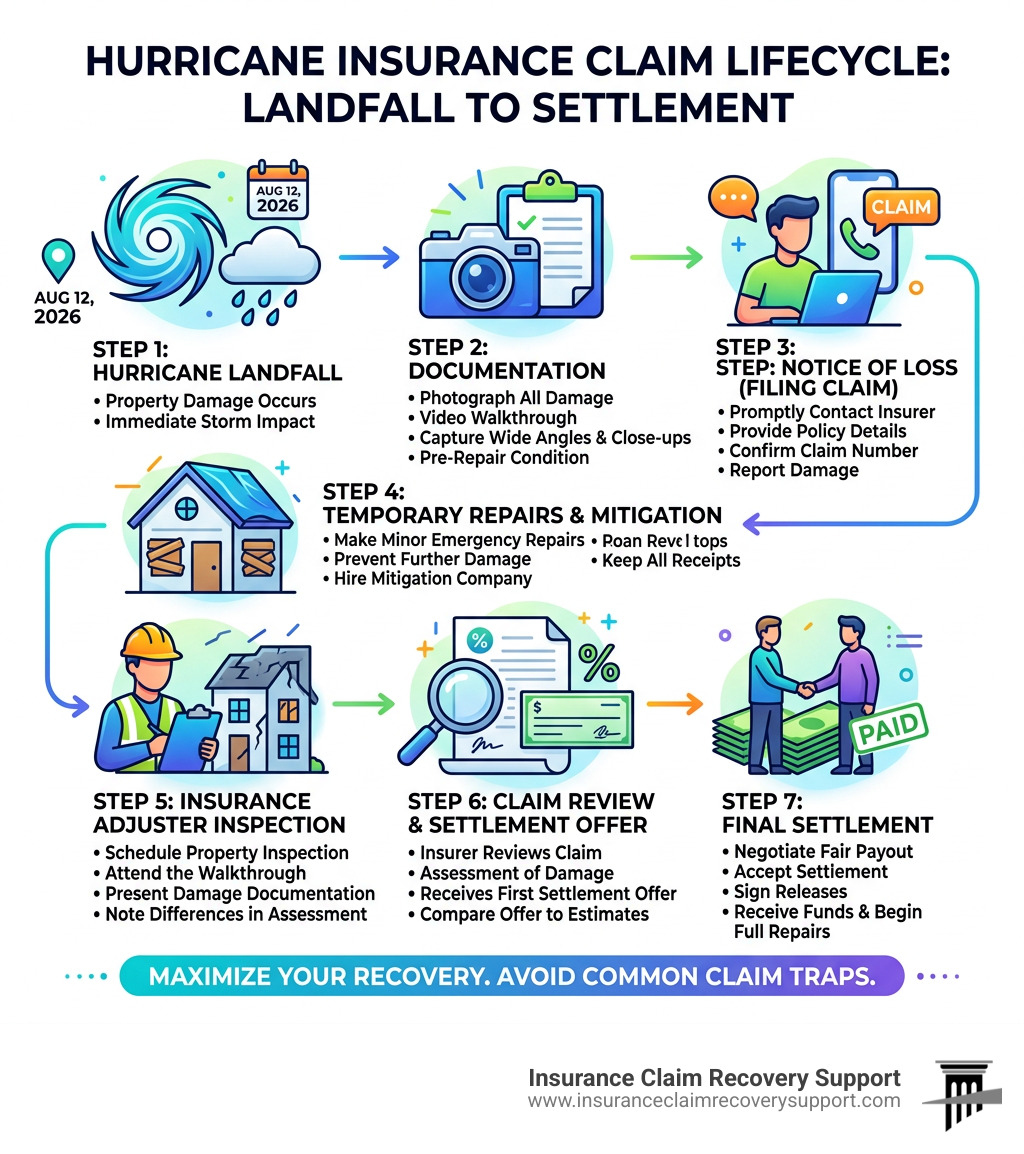
- Document everything immediately — photograph all damage before making any repairs, from wide-angle room shots to close-ups of structural failures
- Contact your insurance company promptly — most policies have strict reporting deadlines (Florida allows 1 year from landfall; Louisiana allows 180 days from the end of the emergency declaration)
- Make only temporary repairs — tarp roofs, board windows, and hire a mitigation company for water damage, but do not start permanent repairs until after the adjuster’s inspection
- Request a certified copy of your full policy — not just the declarations page, but the complete 30-60 page document
- Track every expense — temporary repairs, relocation costs, business interruption losses, and contractor estimates
- Do not accept the first settlement offer — initial offers are frequently below what your policy entitles you to receive
- Consider hiring a public adjuster — especially for large-loss commercial claims, where policy language, concurrent causation, and complex exclusions can dramatically reduce your payout if not properly addressed
With more than $1 trillion in property located within 700 feet of the U.S. coastline — and 2024 storms like Hurricane Helene ($78.7 billion in estimated damages) and Hurricane Milton ($34.3 billion in damages) still fresh in memory according to the National Oceanic and Atmospheric Administration (NOAA) — commercial property owners, multifamily operators, and HOAs are facing an insurance landscape that is more complex and adversarial than ever. A hurricane does not just damage your building. It triggers a claims process full of competing policy interpretations, aggressive adjusters, tight deadlines, and exclusions that many policyholders never see coming until it is too late.
The stakes are especially high for commercial and multifamily owners. You are not just protecting a home — you are protecting rental income, tenant relationships, lender compliance, and the long-term viability of your investment. One underpaid or denied claim can cascade into months of lost revenue, costly litigation, and significant out-of-pocket exposure.
I’m Scott Friedson, a multi-state licensed public adjuster and CEO of Insurance Claim Recovery Support (ICRS), and over 500+ large-loss claims totaling more than $250 million settled, I have built my practice around delivering the hurricane insurance claim tips and expert advocacy that commercial and multifamily property owners need to recover fully — without unnecessary litigation. In the sections that follow, I will walk you through exactly how to protect your claim, maximize your settlement, and avoid the most costly mistakes property owners make after a storm.
Hurricane insurance claim tips helpful reading:
Essential Hurricane Insurance Claim Tips for Commercial Property Owners
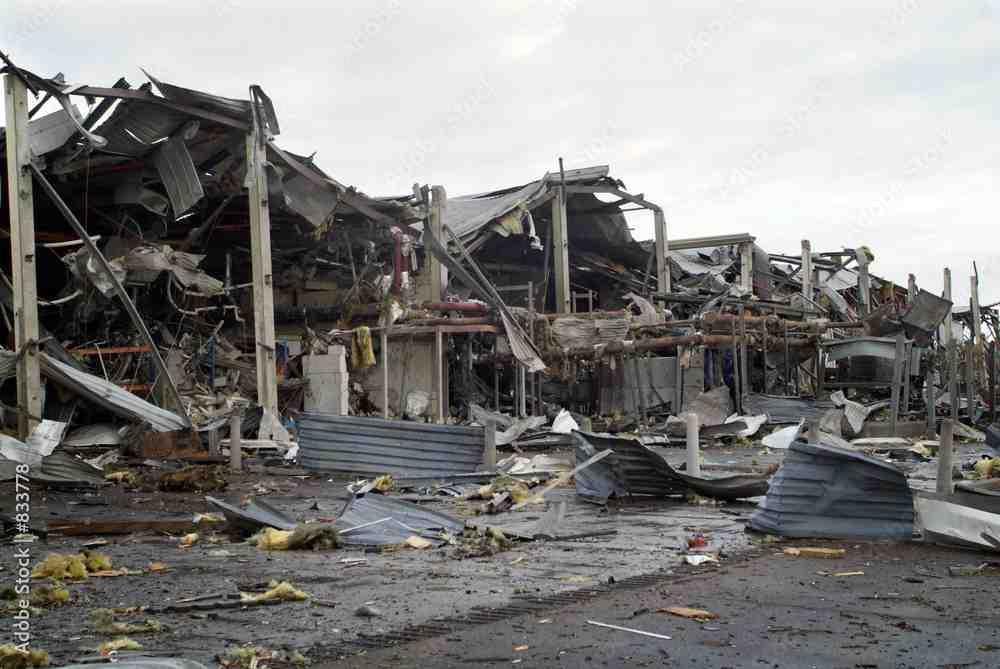
For owners of industrial warehouses, retail plazas, or hospitality assets, a hurricane is a “large-loss” event by definition. These are specialty property claims that involve more than just a leaky roof; they involve complex electrical systems, large-scale HVAC units, and significant Business Interruption (BI) losses.
When a hurricane strikes a commercial asset, the “clock” for your business doesn’t just stop—it starts ticking backward. Every day your retail center is dark or your apartment complex has uninhabitable units is a day of lost revenue that may never be recovered if your claim is handled poorly.
Proactive Documentation and Coverage Preparation
One of the most overlooked hurricane insurance claim tips is the importance of having a certified copy of your insurance policy. Most property managers only keep the “Declarations Page,” which is a 1- or 2-page summary. However, a full commercial policy is typically 30 to 60 pages of fine print, endorsements, and exclusions. Without the full document, you are flying blind.
Timing is also a major factor. For example, a separate flood insurance policy must be purchased at least 30 days in advance to cover any hurricane-caused flooding, a requirement often cited by FEMA’s National Flood Insurance Program. Furthermore, many insurers prevent any policy adjustments—such as increasing coverage limits—once a hurricane enters a “box” of 16,000 square miles surrounding the southeastern United States. If you wait until the storm is on the local news, it’s already too late to fix gaps in your coverage.
For those managing assets in coastal regions, understanding the local landscape is vital. For instance, Texas Public Adjuster Hurricane Damage experts often see claims complicated by the wind vs. water debate, which we will cover in the exclusions section.
Immediate Post-Storm Actions and Hurricane Insurance Claim Tips
Once the storm passes and it is safe to enter the property, your primary duty as a policyholder is to mitigate damages. This is a legal obligation in almost every commercial policy.
- Safety First: Check for downed power lines, structural instability, and gas leaks before allowing staff or tenants back on-site.
- Temporary Repairs: You must take reasonable steps to prevent further loss. This means tarping roofs and boarding broken windows. If you fail to do this, the insurance company may deny the portion of the damage that occurred after the storm (like mold growth from a preventable leak).
- The Claim Log: Start a journal. Note the date and time of every conversation with your insurer, the names of the adjusters, and what was promised.
- Expense Tracking: Save every receipt. Whether it’s for plywood, emergency water extraction, or temporary generators, these costs are often reimbursable under “Extra Expense” or “Mitigation” coverages.
For more detailed steps on handling business-specific losses, see our guide on Commercial Hurricane Damage Insurance Claim processes.
Understanding Deductibles and Complex Policy Exclusions
Hurricane deductibles are not like your standard $1,000 property deductible. In hurricane-prone states, these are often calculated as a percentage of the building’s total insured value—typically 1% to 5%, but sometimes as high as 10% for coastal properties.
If your commercial building is insured for $5 million and you have a 5% hurricane deductible, you are responsible for the first $250,000 of the loss. This is why maximizing the remaining claim is so critical.
Common exclusions to watch out for include:
- Concurrent Causation: This is a legal headache where damage is caused by two perils (like wind and flood) occurring at the same time. If your policy excludes flood, the insurer may try to attribute the majority of the damage to the water to avoid paying the claim.
- Wind-Driven Rain: Many policies exclude water damage unless the wind first creates a “specified opening” (like a broken window or a hole in the roof). If rain seeps through a window seal that wasn’t physically broken by the wind, the insurer might deny the interior damage.
Maximizing Settlements: Public Adjusters vs. Litigation
When you file a claim, the insurance company sends a “staff adjuster” or an “independent adjuster.” Despite the name, independent adjusters work for the insurance company, not you. Their job is to settle the claim for as little as the policy allows.
This is where the role of a Public Adjuster becomes vital. We are the only adjusters licensed to represent the policyholder. At Insurance Claim Recovery Support (ICRS), we focus on maximizing settlements and reducing delays. We have a 90% settlement success rate without the need for unnecessary lawsuits.
Florida law generally requires insurers to pay undisputed claims within 90 days, but they often drag their feet on the “disputed” portions. We step in to bridge that gap. For a deeper dive into the mechanics of this, read Mastering the Hurricane Insurance Claim Process: A Comprehensive Guide.
Why Commercial Policyholders Choose Public Adjusters Over Lawsuits
Many policyholders assume that if an insurer lowballs them, they have to sue. Litigation is expensive, time-consuming, and can take years to resolve. During that time, your property remains damaged and your capital is tied up.
| Feature | Public Adjuster (ICRS) | Litigation (Attorneys) |
|---|---|---|
| Primary Goal | Maximize settlement via expert adjustment | Win a legal judgment or settlement |
| Timeline | Typically weeks to months | Often 1 to 3+ years |
| Cost | Percentage of the settlement | Hourly fees or high contingency + court costs |
| Approach | Evidence-based negotiation | Adversarial legal proceedings |
| Success Rate | 90% settlement without court | Varies; subject to jury/judge |
By choosing a public adjuster, you often avoid the “appraisal” process or the courtroom entirely. We use thermal imaging, moisture meters, and line-item estimates to prove the loss so clearly that the insurer has little room to argue. This is especially important for Hurricanes Tropical Storms where the damage is widespread and adjusters are overwhelmed.
Fact vs. Myth: Critical Hurricane Insurance Claim Tips
Myth: “I have ‘Hurricane Insurance’.” Fact: There is no such thing as a single “hurricane insurance” policy. Coverage is a combination of windstorm, flood, and sometimes sewer backup endorsements. You must check each peril individually.
Myth: “The insurance company’s adjuster is looking out for me.” Fact: The adjuster’s duty is to the insurance company’s bottom line. They may be friendly, but their goal is to minimize the payout.
Myth: “I have to sign an Assignment of Benefits (AOB) to get repairs started.” Fact: Never sign an AOB without extreme caution. This transfers your rights under the policy to a contractor, giving them control over your claim money.
We’ve seen these myths play out recently in the aftermath of Hurricane Beryl Texas. Many owners in Houston and Galveston found themselves underinsured or trapped in bad contracts because they didn’t have professional advocacy from the start.
Conclusion: Securing Your Commercial Property Recovery
Filing a hurricane claim for a large-loss commercial or multifamily property is a high-stakes negotiation. Between the percentage-based deductibles, the complex exclusions like concurrent causation, and the aggressive tactics used by insurance carriers to protect their profits, you cannot afford to go it alone.
At Insurance Claim Recovery Support (ICRS), we represent policyholders only. We understand the local insurance claim legislation and the carrier roadmaps in cities like Austin, Dallas, Fort Worth, San Antonio, Houston, Lubbock, San Angelo, Waco, Round Rock, Georgetown, and Lakeway. Our mission is to ensure that commercial building owners, HOAs, and multifamily operators receive every penny they are owed under their policy—without the delays and costs of a lawsuit.
If your property has been damaged by a hurricane or windstorm, don’t wait for the insurance company to tell you what they think your loss is worth. Take control of your recovery today.