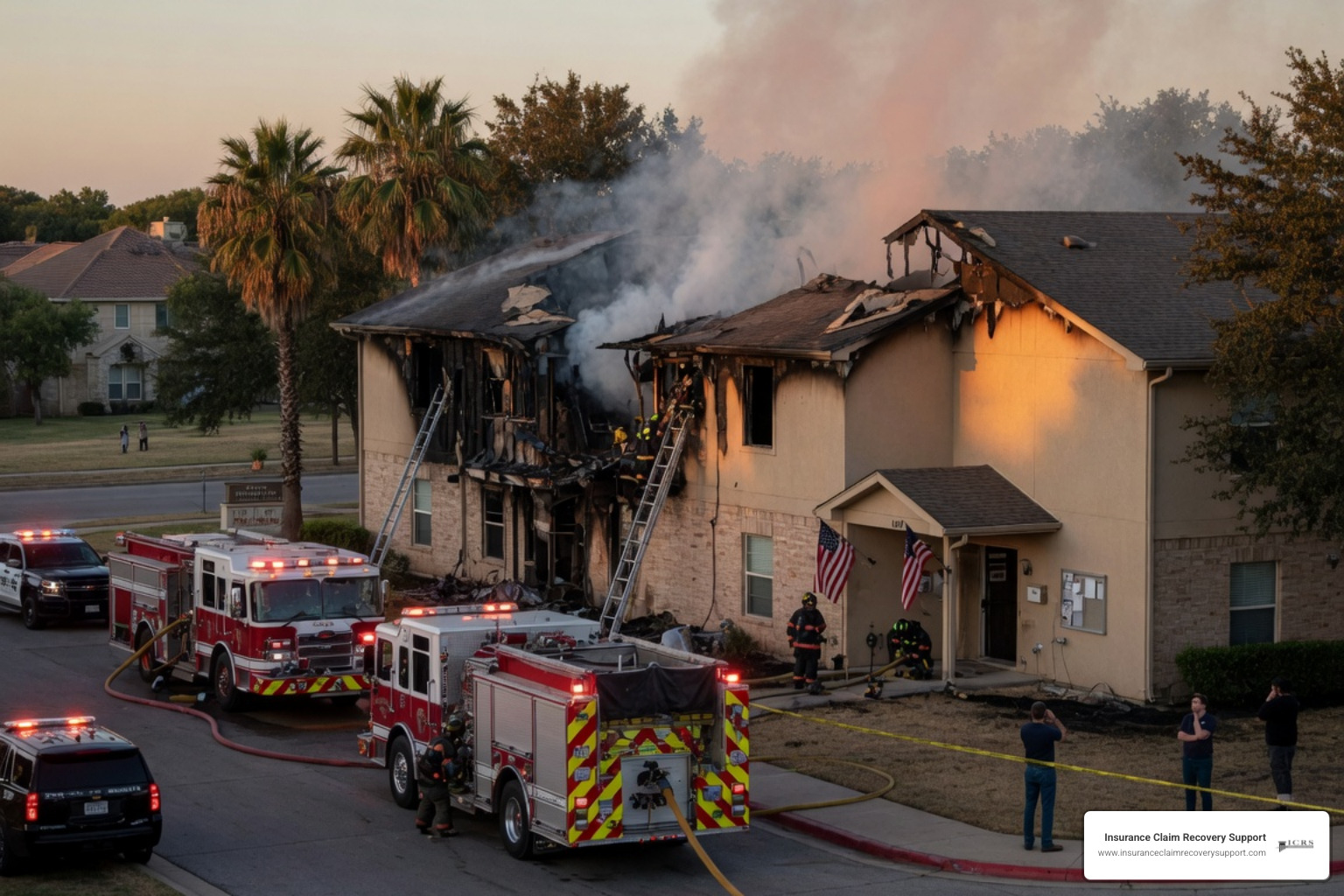
What Every Kentucky Property Owner Needs to Know After a Tornado
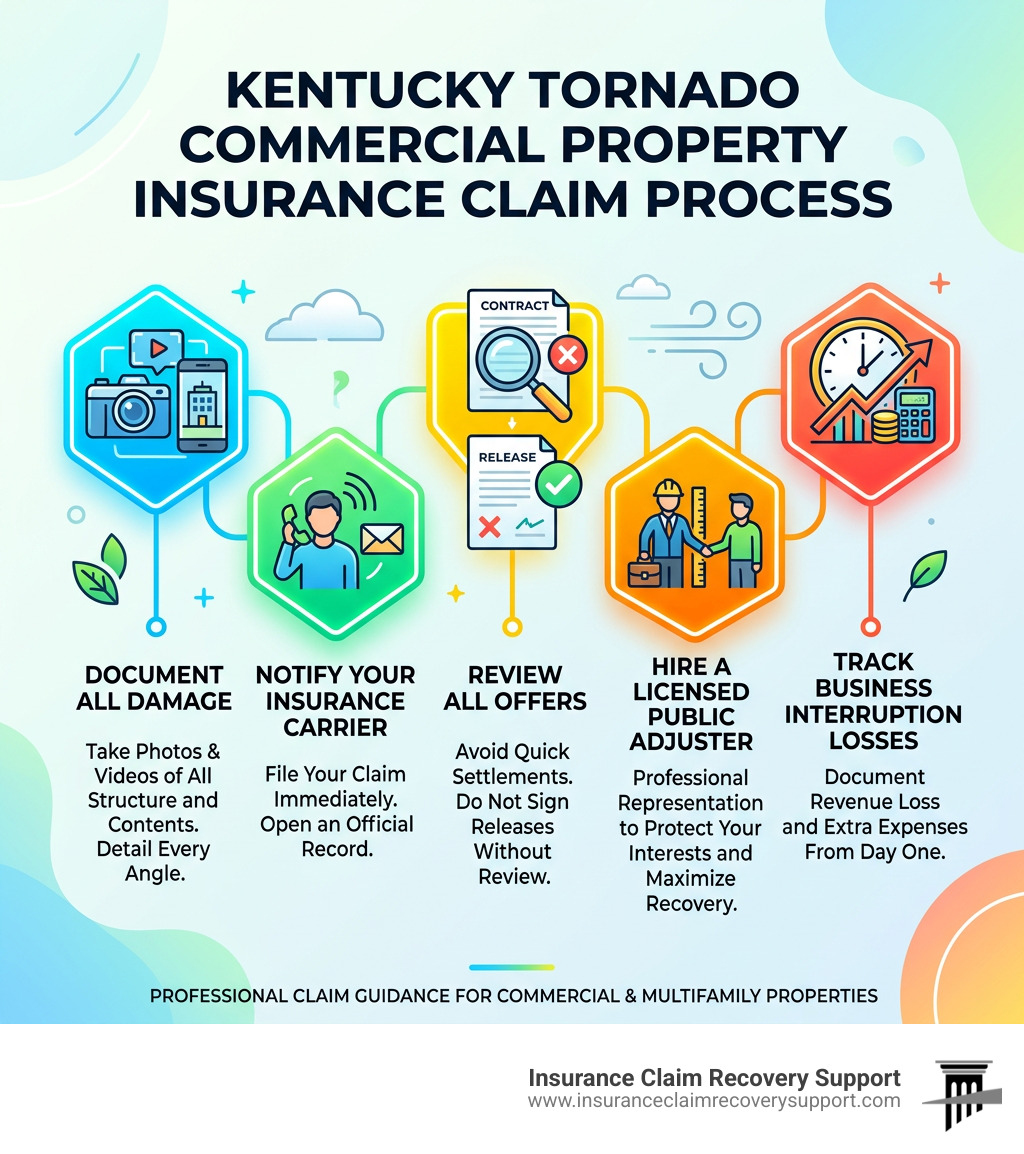
Quick answer for commercial and multifamily property owners dealing with a Kentucky tornado:
| Step | Action |
|---|---|
| 1 | Document all damage thoroughly with photos and video |
| 2 | Notify your insurance carrier and open a claim immediately |
| 3 | Do not sign any releases or accept a settlement without review |
| 4 | Hire a licensed public adjuster to represent your interests |
| 5 | Track all business interruption losses from day one |
A kentucky tornado can erase decades of investment in a matter of minutes — and the 2021 Western Kentucky tornado proved exactly how devastating that can be. Rated a high-end EF4 with peak winds of 190 mph, it carved a 165.6-mile path of destruction across western Kentucky, killing 57 people, injuring 519 more, and damaging or destroying over 4,000 structures in Mayfield alone. For commercial property owners and multifamily operators, the storm didn’t just cause physical damage — it triggered a second crisis: navigating large, complex insurance claims while managing tenant pressure, revenue loss, and the very real risk of an underpaid settlement.
The scale of destruction left businesses, apartment complexes, industrial facilities, and religious organizations facing an insurance process that can be just as overwhelming as the storm itself. Many property owners simply didn’t know where to start — or didn’t realize their insurer’s initial offer fell far short of what their policy actually covered.
I’m Scott Friedson, CEO of Insurance Claim Recovery Support (ICRS) and a multi-state licensed public adjuster with over 15 years of experience recovering hundreds of millions of dollars for commercial and multifamily policyholders after catastrophic events — including kentucky tornado losses. In the sections below, I’ll walk you through exactly what these storms mean for your property and your claim.
kentucky tornado terms to learn:
- Does insurance cover tornado damage
- How much damage can a tornado cause
- Commercial insurance cover tornado
Analyzing the Impact of the 2021 Kentucky Tornado
The 2021 Western Kentucky tornado remains one of the most studied and sobering meteorological events in U.S. history. Often referred to by meteorologists as “The Beast,” this high-end EF4 tornado was part of a historic “Quad-State” supercell that traveled hundreds of miles across the Midwest and South.

The Statistics of Destruction
When we look at the data, the sheer power of this kentucky tornado is staggering. It reached peak winds of 190 mph, just shy of the EF5 threshold. Its path length of 165.6 miles makes it the ninth longest-tracked tornado in recorded U.S. history. For nearly three hours (2 hours and 54 minutes), this massive wedge, reaching a maximum width of 1.5 miles, ground its way through communities like Mayfield, Princeton, and Dawson Springs. Detailed meteorological records from the National Weather Service confirm the unprecedented nature of this event.
From a commercial standpoint, the damage was catastrophic. In Mayfield alone, over 183 commercial buildings were damaged or destroyed. This wasn’t just a loss of physical bricks and mortar; it was a total disruption of the local economy.
Historical Significance of the Kentucky Tornado
This event broke records that had stood for decades. It was the deadliest U.S. tornado in December on record and the deadliest in the country since the 2011 Joplin tornado. Historically, Kentucky has faced violent twisters before—most notably the 1890 Louisville F4, which claimed 115 lives. However, the 2021 event was unique due to its nocturnal nature and the extreme distance it traveled while maintaining devastating intensity.
Understanding how much damage a tornado causes is the first step for any property owner in realizing that “standard” repair estimates from an insurance carrier rarely cover the true scope of a high-end EF4 impact.
Meteorological Triggers and Structural Vulnerabilities
The formation of this tornado was fueled by intense wind shear and rotational vorticity. The Storm Prediction Center issued a record 43 mesoscale discussions during the outbreak, highlighting the atmospheric volatility.
For commercial building owners, the structural failures observed during this storm were a wake-up call. Even “well-built” structures suffered. In some areas, homes were wiped clean from their foundations, and industrial facilities saw roofs peeled back like tin cans. NASA satellite imagery later revealed a “scar” across the landscape—a brown streak of debarked trees and scoured earth visible from space. This scientific research on NASA satellite tornado scars illustrates the extreme ground scouring that occurred. This level of force doesn’t just damage a roof; it compromises the structural integrity of the entire building envelope, often leading to window tornado damage insurance claims that are much more complex than they appear on the surface.
Lessons from the Mayfield and Dawson Springs Recovery
The recovery in Mayfield and Dawson Springs has been a long, painful road. One of the most significant controversies involved the Mayfield candle factory, where a building collapse led to multiple fatalities and subsequent lawsuits alleging that workers were prevented from leaving despite warnings.
For business owners, the lesson is clear: safety protocols are paramount, but so is having a robust business interruption plan. Many businesses in these towns found that their insurance carriers were slow to pay out on “soft costs” like lost revenue and relocation expenses. This is where public adjusters for commercial properties become essential. We ensure that the insurance company doesn’t just look at the visible debris, but also the invisible financial losses that can sink a company.
Professional Recovery Strategies for Commercial Policyholders
If you own a shopping center in Bowling Green or manage a large apartment complex in Mayfield, your recovery strategy must be professional and aggressive. Insurance companies are businesses, and their goal is to minimize their “loss” (your claim).
Large Loss Claims and the “Carrier Roadmap”
When a kentucky tornado hits a commercial property, the claim is classified as a “Large Loss.” This triggers a different set of adjusters and a much more complex “roadmap” from the insurance carrier. They will often use their own “preferred” vendors and engineers to assess the damage.
Our role at ICRS is to provide a counter-balance. We conduct our own forensic investigations to ensure that every snapped tie-down, every cracked foundation, and every compromised HVAC unit is included in the claim. We focus on maximizing settlements and reducing the delays that often lead to tornado insurance claim denials.
Avoiding Litigation: The Public Adjuster Advantage
Many policyholders believe their only options are to accept a low-ball offer or sue their insurance company. Litigation is expensive, time-consuming, and can take years to resolve. At ICRS, we take a different approach. We use professional property damage assessments and expert negotiation to resolve claims without the need for a courtroom.
| Feature | Public Adjuster (ICRS) | Litigation / Lawsuit |
|---|---|---|
| Speed | Faster resolution through negotiation | Can take 2-5 years |
| Cost | Contingency fee (no upfront cost) | High hourly legal fees or 40%+ contingency |
| Success Rate | 90% settlement success rate | Uncertain; depends on jury/judge |
| Relationship | Collaborative but firm | Adversarial |
| Expertise | Specialized in property damage & policy | Legal procedure & law |
Managing Complex Claims for a Kentucky Tornado
The challenges vary depending on the property type. For those navigating multi-family property insurance claims, the primary concern is often tenant displacement and the resulting loss of rent. Industrial facilities, on the other hand, may face specialized equipment losses and supply chain disruptions.
Common tornado damage claim problems we see include:
- Under-scoping: The adjuster “misses” structural damage that isn’t immediately visible.
- Depreciation: The carrier applies excessive depreciation to materials like roofing and siding.
- Code Upgrades: The insurer refuses to pay for modern building code requirements during the rebuild.
Fact vs. Myth: Public Adjusters and the Litigation Dilemma
There is a lot of misinformation out there regarding how to handle a kentucky tornado claim. Let’s clear some of that up.
Myth #1: “My insurance agent will handle everything for me.” Fact: Your agent sells policies; they do not adjust claims. Once a loss occurs, the file is handed to a claims adjuster whose job is to protect the company’s bottom line.
Myth #2: “I have to use the contractor the insurance company recommends.” Fact: You have the right to choose your own contractors. In fact, using a “preferred vendor” can sometimes lead to conflicts of interest where the contractor prioritizes the insurance company’s budget over your property’s needs.
Myth #3: “Public adjusters are only for when a claim is denied.” Fact: The best time to hire a public adjuster is at the very beginning. We set the tone for the claim, ensure the scope is accurate from day one, and help you avoid the tornado damage claim disputes that lead to delays.
Myth #4: “Hiring a public adjuster will make the insurance company angry.” Fact: It is your right under your policy to have professional representation. Insurance companies deal with public adjusters every day; they know that when ICRS is involved, they must be more thorough and fair in their assessments.
Conclusion: Securing Your Property’s Future
The aftermath of a kentucky tornado is a test of resilience. For commercial building owners and multifamily operators, the path to recovery is paved with complex policy language, engineering reports, and high-stakes negotiations. You don’t have to walk that path alone.
At Insurance Claim Recovery Support (ICRS), we are dedicated to helping policyholders receive every penny they are owed. We specialize in large-loss commercial claims, from retail centers and office buildings to HOAs and industrial plants. Our goal is simple: to maximize your settlement and get your business back on its feet without the need for unnecessary litigation.
If your property has been impacted by a kentucky tornado, don’t wait for the insurance company to tell you what they think your claim is worth. Take control of your recovery today.
Contact us for a free property damage insurance claim evaluation and let us show you how we can help you navigate the road to a full recovery.
About the Author: Scott Friedson is the CEO of Insurance Claim Recovery Support (ICRS), a leading public adjusting firm. He has a 90% success rate in settling claims without litigation and is a staunch advocate for commercial policyholders across the United States, including those recovering from a Texas tornado damage insurance claim or a catastrophic Kentucky event.