Why Your Florida Adjuster License Opens Doors Across the Country
If you’re exploring a career as an insurance adjuster in Florida — or you’re a commercial property owner trying to understand who’s really in your corner when a claim hits — you’ve landed in the right place.
Quick Answer: What You Need to Know About Florida Adjuster Licensing
| Question | Answer |
|---|---|
| Who regulates Florida adjusters? | Florida Department of Financial Services (DFS) |
| Main license types | 3-20 Public Adjuster, 6-20 All-Lines Adjuster, 70-20 Non-Resident DHS |
| Minimum age to apply | 18 years old |
| Licensing fee | $50 + $5 per line of authority |
| Surety bond (public adjusters) | $50,000 |
| Continuing education | 24 hours every 2 years |
| Fingerprinting required? | ✅ Yes, through IdentoGO |
| Can non-residents get a Florida license? | ✅ Yes, via the 70-20 Designated Home State (DHS) license |
| States that recognize the Florida DHS license | CO, DC, IL, KS, MA, MD, MO, ND, NE, NJ, OH, PA, SD, TN, VA, WI |
| Public adjuster fee cap during emergencies | 10% (standard rate: ~20%) |
Florida is one of the most active property insurance markets in the country — and for good reason. Hurricanes, water intrusion, mold, and fire claims are a year-round reality here, especially for commercial and multifamily property owners managing apartments, retail centers, office buildings, and HOAs. With over 300 active adjuster job listings in Florida as of June 2026 and a licensing framework that unlocks adjusting authority in more than a dozen additional states, a Florida adjuster license isn’t just a credential — it’s a career multiplier.
But this guide isn’t only for aspiring adjusters. If you own or manage commercial or multifamily property in Florida, understanding how the adjuster system works — and who different types of adjusters actually work for — is critical to protecting your settlement when a major loss occurs.
I’m Scott Friedson, a multi-state licensed public adjuster and CEO of Insurance Claim Recovery Support (ICRS) LLC, with more than 15 years navigating the insurance adjuster Florida landscape across 500+ large-loss commercial and multifamily claims valued at over $250 million. Whether you’re building a career in claims or fighting for a fair settlement on a major property loss, this guide gives you the full picture.
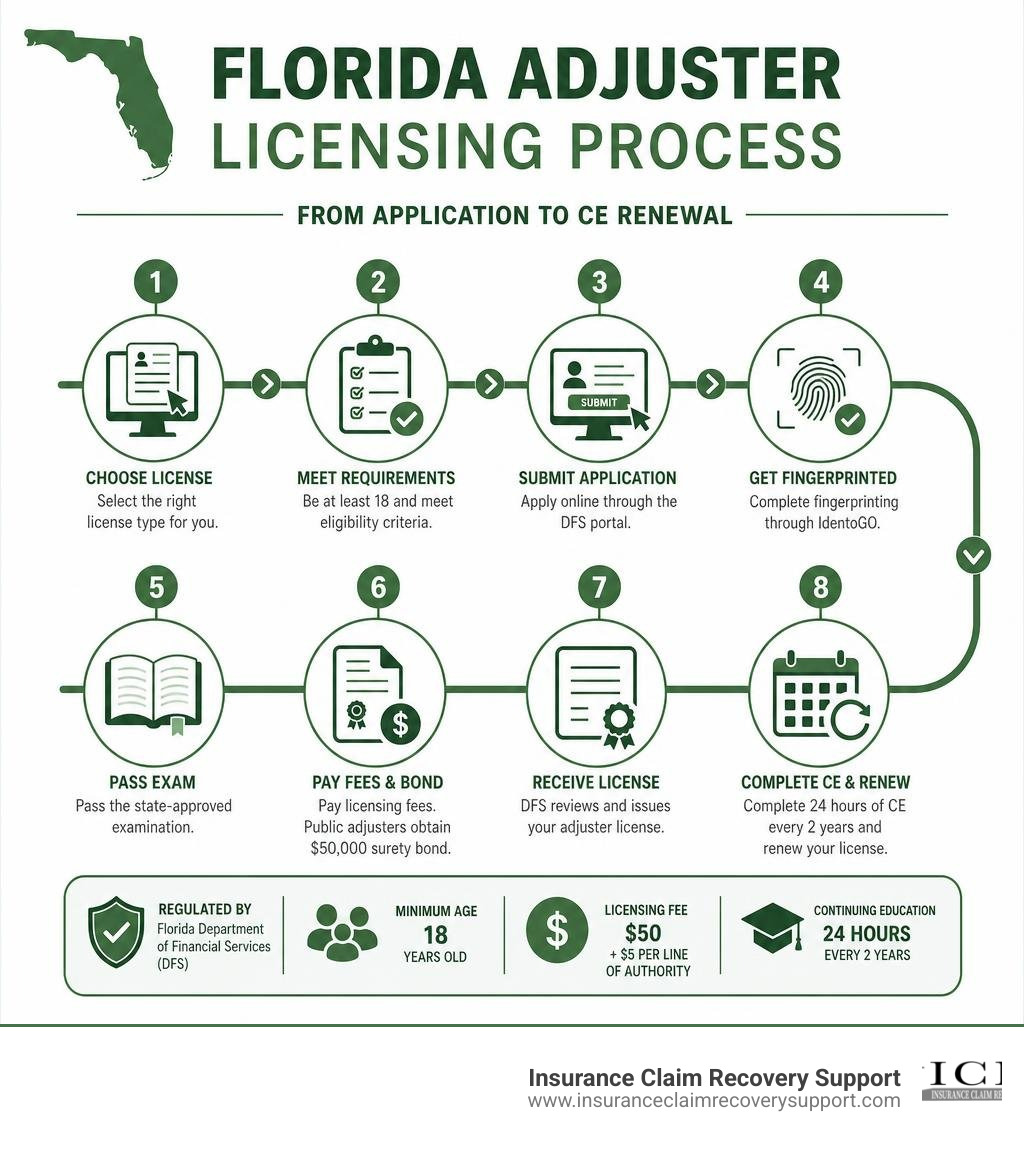
Key terms for insurance adjuster Florida:
Understanding the Roles: Public, Independent, and Company Adjusters

To navigate the insurance world, you must first understand the players. The term “adjuster” gets thrown around loosely, but the legal and functional differences between these roles are massive. Who holds the license dictates whose financial interests are being protected.
To unpack the formal definitions of these roles, it helps to understand the fundamental Claim Adjuster Meaning and how the state of Florida categorizes them under Chapter 626 of the Florida Statutes.
The Role of a Public Insurance Adjuster Florida
According to the legal Public Adjuster Definition, a public adjuster is a licensed professional who represents the policyholder, never the insurance company.
When a commercial building, apartment complex, or HOA suffers catastrophic damage, the property owner is forced to prove their own loss to a highly skeptical insurance carrier. A public adjuster steps in to inspect the damage, interpret complex policy language, write independent repair estimates, and negotiate the final settlement.
If you want to understand how this role operates in the field, check out this guide on Public Adjuster Explained. For commercial property owners dealing with losses exceeding $250,000, knowing What Is A Good Public Adjuster is the difference between a complete, code-compliant property restoration and a devastating financial shortfall.
Independent and Company Adjuster Distinctions
Unlike public adjusters, company adjusters and independent adjusters work directly for the insurance company.
- Company Adjusters (Staff Adjusters): These are salaried employees of the insurance carrier. Their job is to evaluate claims according to company guidelines and protect the carrier’s bottom line.
- Independent Adjusters (IAs): These adjusters are independent contractors or work for third-party adjusting firms. Carriers hire them to perform Field Adjusting or act as a Claim Inspector when claims volume is high—particularly after major Florida hurricanes.
While independent adjusters may present themselves as objective, they are paid by the insurance company. Their primary loyalty is to the carrier that signs their checks, not the policyholder.
How to Become a Licensed Insurance Adjuster Florida

If you are looking to enter this high-demand field, Florida offers a clear but rigorous path to licensure. Whether you want to represent policyholders or work on behalf of carriers, you must meet strict state requirements.
For a comprehensive look at what a career in this field entails, you can read our Property Claims Adjuster Complete Guide.
Steps to Obtain the Florida 6-20 All-Lines License
The Florida 6-20 Resident All-Lines Adjuster License is the standard credential for staff and independent adjusters living in Florida.
To obtain your license, you must complete the following steps:
- Meet the Prerequisites: You must be at least 18 years of age, a United States citizen or legal alien with work authorization, and a resident of Florida.
- Complete Pre-Licensing Education: You can bypass the official state exam by completing an approved 40-hour designation course, such as the Certified All-Lines Adjuster (CALA) designation. These Insurance Adjuster Courses cover policy language, ethics, and Florida-specific insurance codes.
- Submit Fingerprints & Background Check: Florida requires all applicants to submit electronic fingerprints via IdentoGO. This is used to conduct a criminal background check through the Florida Department of Law Enforcement (FDLE) and the FBI.
- Apply Online: File your application through the Florida Department of Financial Services (DFS) MyProfile portal and pay the $50 licensing fee (plus a $5 fee per line of authority).
The Florida 70-20 Non-Resident Designated Home State (DHS) License
What if you do not live in Florida, but your home state does not license adjusters? Florida allows you to designate it as your “home state” through the 70-20 Non-Resident DHS License.
This license is highly coveted because of its broad reciprocity. By obtaining a Florida DHS license, you can adjust claims in states that do not license adjusters or only license independents, including Colorado, Illinois, Maryland, Massachusetts, Ohio, and Pennsylvania.
Alternative Option: Many adjusters also utilize the Texas DHS license as an alternative, which offers similar multi-state reciprocity.
License Maintenance, Continuing Education, and Regulatory Compliance
Getting licensed is only the first step. To keep your credential active, you must comply with strict state regulations and administrative rules.
Continuing Education and Appointment Rules for the Insurance Adjuster Florida
To maintain your license as an insurance adjuster in Florida, you must meet the following ongoing requirements:
- Continuing Education (CE): You must complete 24 hours of approved continuing education every two years. This must be completed by the last day of your birth month.
- The 48-Month Rule: Your license will expire if you go 48 consecutive months without an active appointment by an insurance company, adjusting firm, or self-appointment.
- Adjusting Firm Licensure: If you operate an adjusting business from your residence, Florida law requires you to obtain an adjusting firm license unless you meet specific statutory exemptions under Florida Statute 626.112(9)(a).
Navigating Complex Commercial Claims and Insurer Scrutiny
In the commercial property insurance sector, claims are treated with intense scrutiny. For insurance carriers, minimizing payouts is a standard business model.
Carriers routinely use a “cost of doing business” approach, relying on commercial and multifamily policyholders to accept underpaid claims rather than fight back. This systemic scrutiny has been documented nationwide. For instance, look at the regulatory pressure and public reports surrounding major carriers, such as the State Farm $15.6M Texas settlement or the widespread coverage of fire claim handling in California featured in the NYT California State Farm coverage.
Further evidence of these systemic issues is detailed in the official California Enforcement Action, The Guardian California wildfire report, and CNN LA fires coverage.
To successfully navigate this environment, commercial adjusters must be experts in:
- Dry Log Records & Moisture Mapping: Essential for proving water damage claims in multifamily and commercial structures.
- Environmental Hazards: Managing strict OSHA regulations, hiring industrial hygienists, and executing proper asbestos and mold protocols.
- Statutory Frameworks: Navigating local litigation costs, appraisal awards, and utilizing prompt-payment laws like Texas Statutes 541/542 to keep carriers accountable.
Fact vs. Myth: Commercial Claim Adjusting Realities
- Myth: The insurance company’s adjuster will automatically calculate the full cost of your commercial property repairs.
- Fact: Carrier adjusters often write restricted estimates that ignore code upgrades, business interruption losses, and hidden structural damage.
- Myth: You must accept the insurance carrier’s initial repair estimate as final.
- Fact: Policyholders have the right to hire a public adjuster to re-scope the damage and negotiate a fair settlement.
- Myth: Hiring a public adjuster will delay your claim.
- Fact: Professionally prepared documentation from Claim Adjustment Specialists using Insurance Adjustment Services actually accelerates the settlement process by presenting clear, undeniable proof of loss.
Translation Callout: What the carrier says: “We have determined your roof damage is cosmetic and does not affect the structural integrity.” What it actually means: “We are hoping you do not hire a public adjuster to prove that the windstorm compromised the structural seals of your commercial roofing system.”
Frequently Asked Questions about Florida Adjuster Licensing
What is the difference between a resident and non-resident Florida adjuster license?
A resident license is for individuals living in Florida or maintaining their principal place of business there. A non-resident license is for out-of-state adjusters who want to adjust claims in Florida, often utilizing reciprocity agreements.
How do public adjusters help commercial policyholders maximize settlements?
Public adjusters prepare detailed, independent damage assessments. According to an OPPAGA (Office of Program Policy Analysis and Government Accountability) study, policyholders who hire public adjusters secure 574% more in claim payouts compared to those who negotiate directly with insurers.
Standard public adjusting fees are typically around 20% of the recovered amount, but Florida caps public adjuster fees at 10% during declared state of emergencies (such as after a major hurricane).
What are the primary commercial property claim types in Florida?
The most common commercial claims in Florida involve:
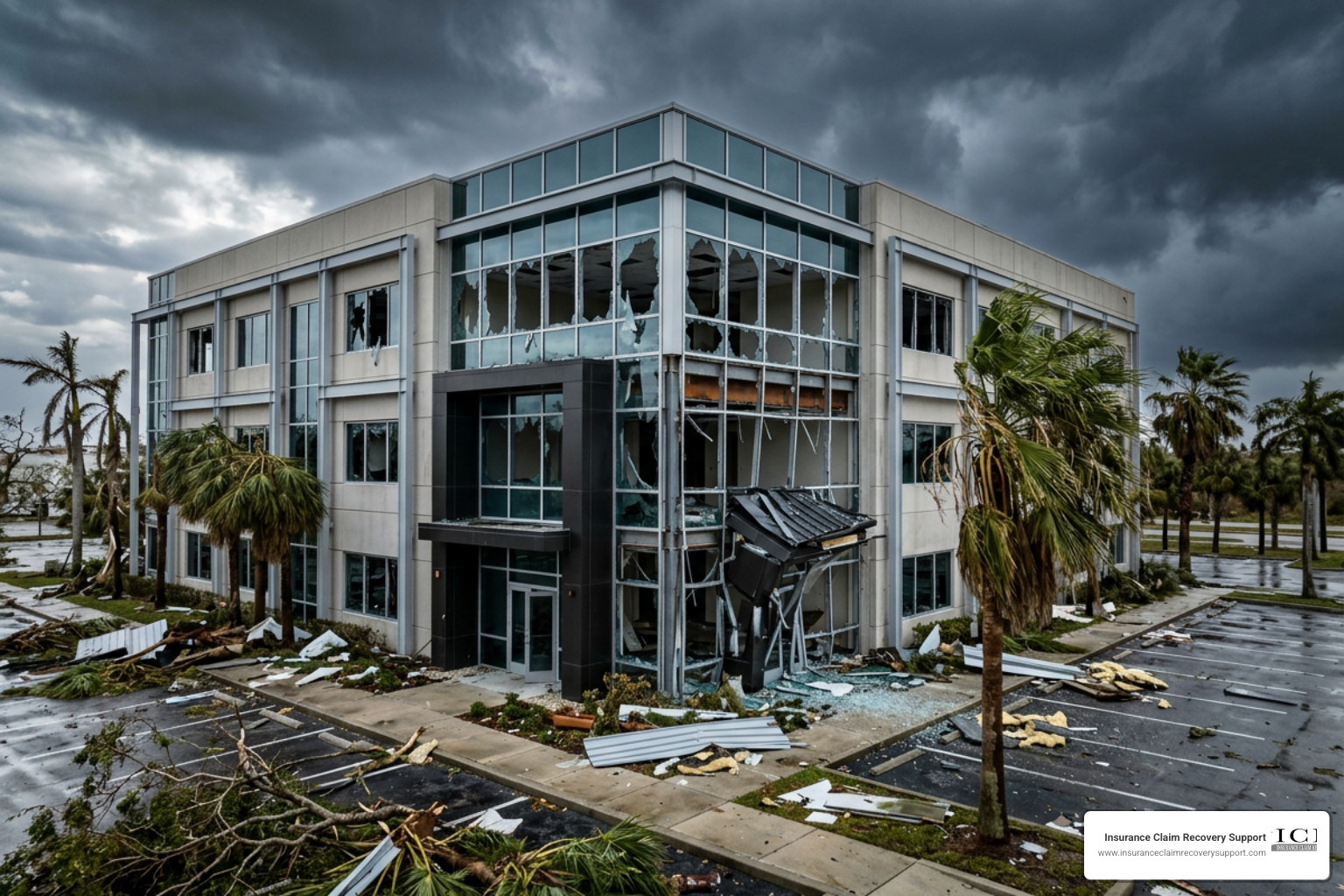
- Hurricane & Windstorm Damage (roof failures, building envelope breaches)
- Water Damage & Broken Pipes (especially in aging multifamily properties)
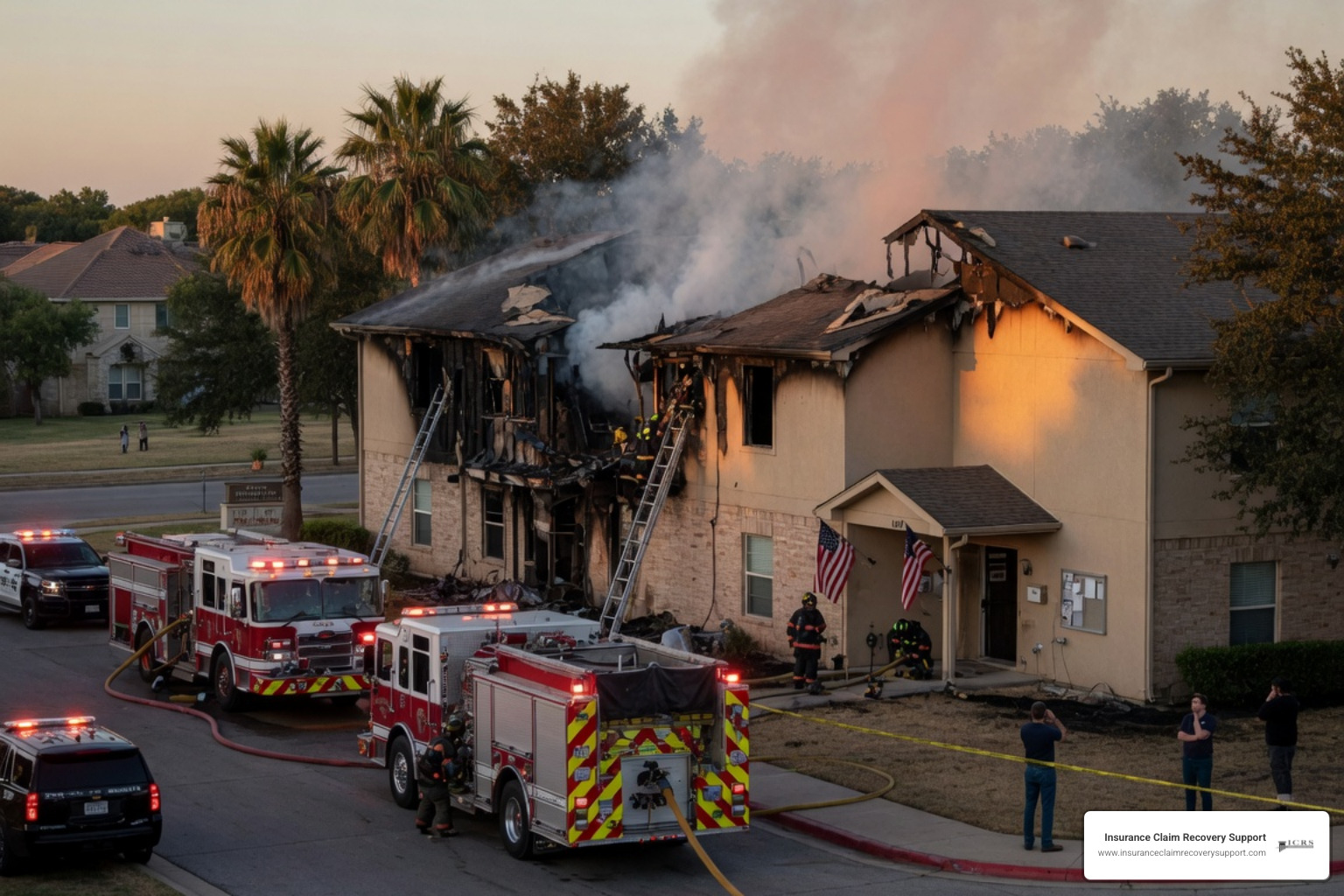
- Fire & Smoke Damage (requiring extensive soot remediation and structural testing)
- Business Interruption (recovering lost revenue while a commercial facility is rebuilt)
Conclusion
Whether you are looking to build a lucrative career as an insurance adjuster in Florida or you are a commercial property owner trying to protect your investment, understanding the rules of the claims game is vital.
For commercial building owners, apartment operators, and HOAs facing a property loss exceeding $250,000, negotiating directly with a multi-billion-dollar insurance carrier is a massive risk. You deserve an advocate who works exclusively for you—not the insurance company.
If your commercial property has suffered severe damage and you want to ensure your claim is fully indemnified, Schedule a Free Claim Consultation with Insurance Claim Recovery Support LLC today. Let our team of expert public adjusters handle the carrier, maximize your settlement, and get your business back on its feet.