The Reality of Policyholder Representation in 2026
Policyholder representation is the practice of having a qualified professional — such as a licensed public adjuster, insurance attorney, or advocacy organization — act on your behalf to protect your rights, interpret your policy, and fight for the full settlement you are owed after a property loss.
Who needs it? If you own or manage any of the following, professional representation can be the difference between a fair recovery and a financially devastating underpayment:
- �� Commercial office buildings, warehouses, or retail centers facing major business disruption after fire, hail, or storm damage
- �� Multifamily properties or HOAs dealing with roof replacement disputes, code upgrade costs, or lender compliance pressure
- �� Hotels, motels, or resorts navigating complex business interruption claims after a catastrophic loss
- ⛪ Churches, schools, hospitals, or government buildings that are chronically underinsured and undervalued by carrier adjusters
Quick answer: When your insurer denies, delays, or underpays a large commercial property claim, a licensed public adjuster or policyholder attorney steps in to re-document your loss, challenge the carrier’s valuation, and negotiate — or litigate — until you receive what your policy actually promises.
Here is the honest reality of commercial insurance claims in 2026: the system was not designed with your interests at the center. Insurance policies are written in dense legal language that protects the carrier’s exposure. Staff adjusters carry caseloads of 125 to 150 open claims simultaneously — well above the industry-recommended threshold of 80 to 100 — which means your multimillion-dollar commercial loss may receive less than 45 minutes of on-site inspection. When you add automated estimating tools that routinely undervalue real contractor costs by 27% to 33%, aggressive depreciation practices, and a growing wave of third-party administrators producing initial offers 18% below what staff adjusters offer, you begin to understand why commercial property owners rarely win by going it alone.
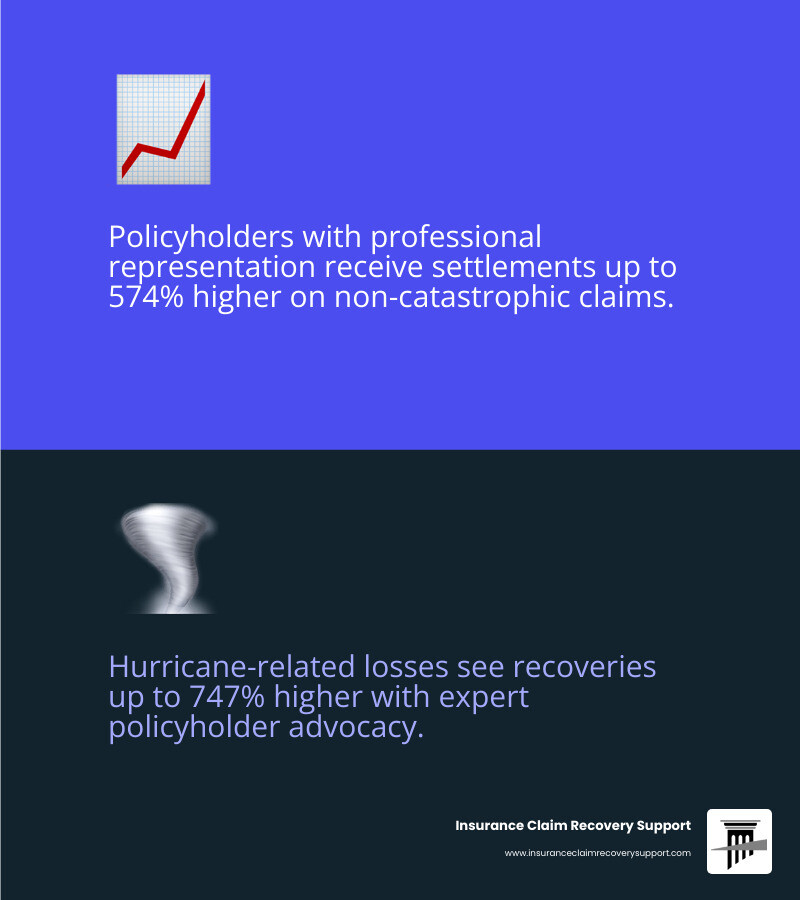
The data backs this up decisively. Policyholders who engage professional representation on non-catastrophic claims receive settlements up to 574% higher than those who handle the process themselves — and for hurricane-related losses, that figure climbs to 747% higher. These are not outliers. They reflect a structural gap between what insurers initially offer and what policies actually require them to pay.
I’m Scott Friedson, CEO of Insurance Claim Recovery Support (ICRS) and a multi-state licensed public adjuster with over 15 years of experience in policyholder representation for large-loss commercial and multifamily claims. Across more than 500 claims valued at over $250 million, I’ve seen how the right advocacy — applied early and strategically — consistently delivers recoveries that policyholders simply cannot achieve on their own. In this guide, I’ll show you exactly how to win the commercial insurance dispute game.
Basic Policyholder representation glossary:
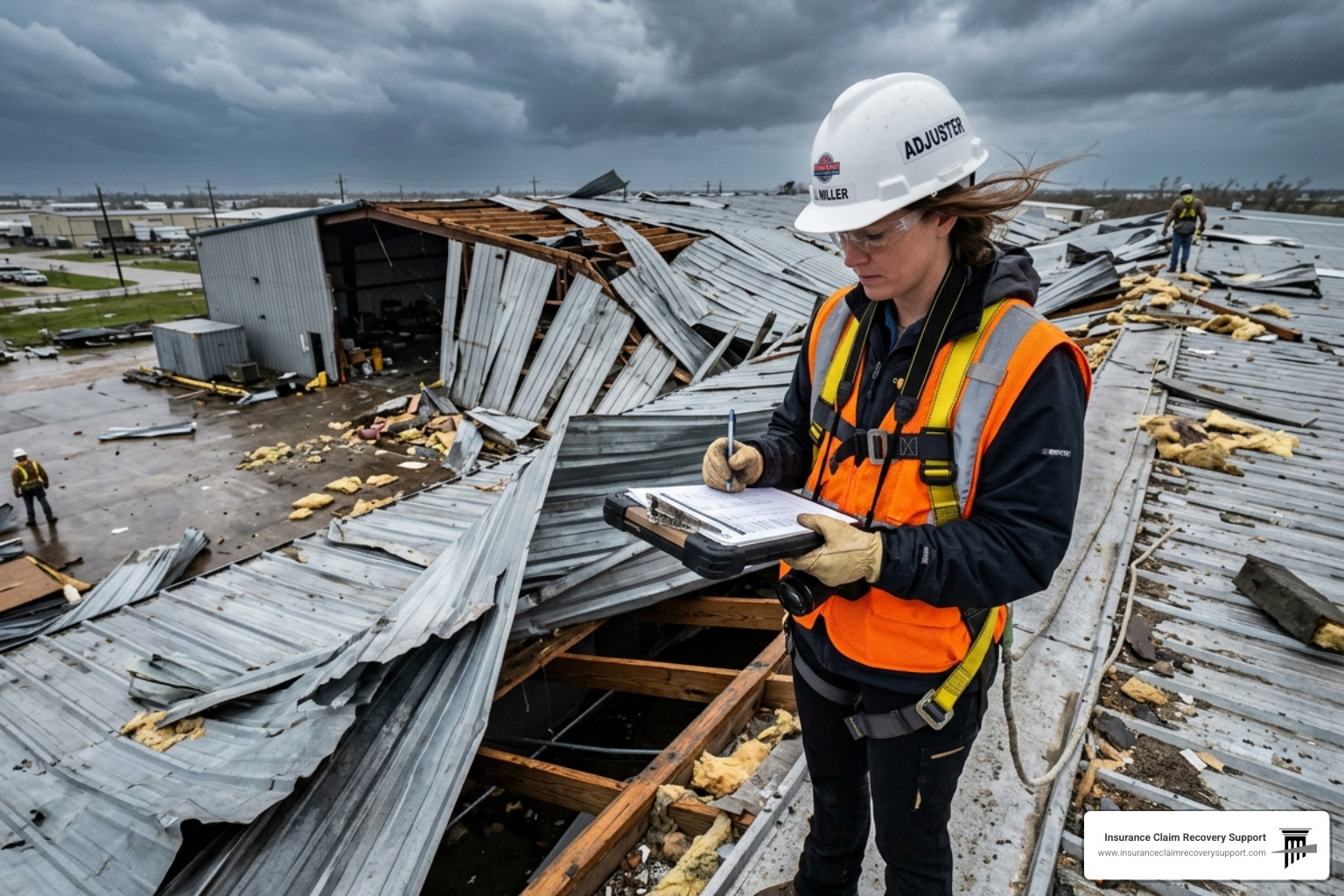
In 2026, the landscape for commercial building owners has shifted toward a more adversarial environment. We’ve moved beyond the era where a simple handshake and a visual inspection sufficed. Today, Policyholder representation is a necessity for any large-loss recovery. Whether you are dealing with a manufacturing facility in Houston or a retail plaza in San Antonio, the insurance company’s primary goal is to minimize their financial exposure.
When we talk about professional advocacy, we are discussing a team that understands the “tripartite relationship” and knows how to break it. While the insurance company has a “duty to defend” in liability cases, in first-party property claims, they are often looking for reasons to apply exclusions or depreciation. This is where Public Adjuster Services become the equalizer.
A common myth is the idea of the “friendly” staff adjuster. In reality, that adjuster works for the carrier, not you. Understanding the difference in Public Adjuster Vs Insurance Company For Property Damage Claim/ is vital. A staff adjuster’s performance is often measured by how quickly they close files and how much they save the company. Conversely, our role in Policyholder representation is to ensure every square inch of damage is documented and priced at current market rates, not outdated software defaults. If you are searching for a Public Adjuster Near Me Guide/, ensure you are looking for those who specialize in commercial assets rather than those who primarily handle smaller, non-commercial claims.
Policyholder representation in Multifamily Claims
Multifamily assets, such as apartment complexes and condominium associations, present unique challenges. When a hailstorm hits Dallas or Fort Worth, it doesn’t just damage a roof; it impacts hundreds of tenants and investor returns. Public Adjuster Licensing/ is critical here because multifamily claims often involve complex “law and ordinance” issues.
For HOAs and condo boards, the Tag/Public Adjusters Role/ extends to navigating the bylaws and ensuring the settlement covers the specific obligations of the association versus the individual unit owners. In the hospitality sector, such as hotels in Austin or San Antonio, business interruption (BI) is the silent killer of profitability. We use forensic analysis to prove lost revenue, which carriers frequently try to “adjust” downward. If you are seeking Public Adjusters Texas Usa/, you need a firm that understands the Texas Insurance Code as well as the local construction market.
Choosing Expert Policyholder Representation
Not all representation is equal. When evaluating credentials, look for firms that exclusively represent policyholders. This avoids the conflict of interest inherent in firms that “swing both ways” by also taking defense work from carriers.
- Avoid Scams: Be wary of “contractor-adjusters.” In Texas, it is illegal for a contractor to act as a public adjuster on the same claim.
- Check the Directory: Use resources like Public Adjusters Near Me/ to verify state licensing.
- Fee Structures: Most reputable firms work on a contingency basis. This aligns our interests with yours—we only get paid if we increase your recovery.
- Local Expertise: A firm based in Austin understands the specific building codes in Round Rock or Georgetown, whereas a national firm might miss those nuances.
The Tag/What Is A Public Adjuster/ question is simple: we are the only licensed professionals who can legally represent your interests during the adjustment of an insurance claim. The Tag/Public Adjuster Benefits/ are clear—higher settlements and significantly less stress for the property owner.
Systemic Barriers: Why Commercial Claims Stall – The State Farm Scrutiny
The year 2026 has seen unprecedented scrutiny of major carriers, specifically State Farm. Recent U.S. Senate Hearings on Institutionalized Fraud, led by Senator Josh Hawley, have exposed what many in our industry have known for years: a “Delay, Deny, Underpay” pattern that appears systemic rather than incidental.
Witnesses at these hearings described “institutionalized fraud” where corporate savings targets influenced individual claim outcomes. This was further highlighted by the Oklahoma Attorney General’s 2025 “Hail Focus Initiative,” which investigated predetermined outcomes in storm claims. For a commercial building owner in Lubbock or Waco, this means your claim might be hitting a “ceiling” before an adjuster even steps foot on your property.
We see this manifest through:
- Fragmented Decision-Making: Your claim is handled by a rotating cast of adjusters, none of whom have the authority to settle.
- Non-Licensed Personnel: Unlicensed “desk adjusters” or AI algorithms often override the findings of field adjusters to hit corporate “savings” goals.
- Cognitive Bias: Scientific research on cognitive bias in insurance adjusting shows that adjusters are often incentivized to find “pre-existing wear and tear” rather than storm-induced damage.
When the system is rigged toward a predetermined underpayment, Policyholder representation isn’t just a luxury—it’s the only way to force a fair evaluation.
Navigating the Legal Landscape: Texas Statutes and Regulatory Oversight
In Texas, we are fortunate to have some of the strongest consumer protection laws in the country, but they only work if you know how to invoke them.
Texas Insurance Code Chapter 541 prohibits unfair methods of competition and deceptive acts. If a carrier misrepresents policy provisions or fails to provide a reasonable explanation for a denial, they are in violation. Chapter 542, known as the Prompt Payment of Claims Act, sets strict deadlines. In Texas, carriers generally have 15 days to acknowledge a claim, 15 days to accept or reject it after receiving all info, and 5 days to pay once accepted. If they miss these windows, they may owe you 18% interest plus attorney fees.
Understanding Public Vs Company Adjuster Whos On Your Side For Roof Damage Claims/ is the first step in identifying bad faith. In 2026, we’ve seen a wave of regulatory investigations:
- California & Los Angeles: Probing “physical loss” definitions and wildfire claim handling.
- Illinois: Investigating transparency issues regarding high deductibles and “actual cash value” (ACV) payouts.
- National Politics: Even President Trump’s 2026 criticism of State Farm’s wildfire handling has brought public attention to the “delay and pray” tactics used by large carriers.
| Feature | Litigation / Appraisal | Public Adjusting Advocacy (ICRS) |
|---|---|---|
| Average Cost | $10k – $28k+ (Appraisal) / $50k+ (Litigation) | Contingency Fee (No Upfront Cost) |
| Timeline | 184 – 419+ Days | 60 – 120 Days (Typical) |
| Relationship | Adversarial / High Conflict | Professional Negotiation |
| Success Rate | Variable | 90% Settlement Success (ICRS) |
| Control | Handled by Umpires/Judges | Policyholder Retains Final Say |
The Financial Impact of Professional Policyholder Representation
The numbers don’t lie. When we step into a claim, we often find that the carrier’s estimate is based on “Xactimate Defaults”—pricing that is often 27% to 33% below actual market costs in cities like Austin or Houston. In 2026, labor and material costs have skyrocketed, yet many insurers are still using 2023 pricing data.
Translation Callout:
- Carrier Claim: “We pay $4.00 per square foot for roofing.”
- Market Reality: “Local Dallas contractors are charging $6.50 due to supply chain inflation.”
- Our Role: We provide the “Market Price” evidence that overrides the “Xactimate Default.”
Data from the Latest GAO reports on insurance settlement disparities indicates that represented policyholders see massive increases. In Texas, 99% of appraisals are policyholder-initiated, and they result in awards that are significantly higher—often by $10k to $28k per unit in multifamily settings. In Florida, the cost of litigation averages $10k+ just to get started, whereas a public adjuster can often resolve the dispute for a fraction of that cost by avoiding the courtroom altogether.
Strategic Advocacy: Maximizing Large-Loss Recoveries
For claims exceeding $250,000, the stakes are too high for “wait and see” tactics. Whether it’s fire damage at an industrial facility in San Angelo or hail impact on a shopping plaza in Lakeway, the strategy must be proactive.
At Insurance Claim Recovery Support LLC, we specialize in:
- Comprehensive Damage Assessment: We don’t just look at the roof; we look at the mechanical systems, the envelope, and the structural integrity.
- Business Interruption (BI) Modeling: We prove the “extra expense” and lost income that carriers try to ignore.
- Avoiding Appraisal: While appraisal is a tool, it can be slow and expensive. We aim to settle 90% of our claims through high-level negotiation, keeping you out of the “appraisal trap.”
By reducing delays and avoiding unnecessary lawsuits, we keep your project moving. We represent the interests of religious institutions, schools, and professional property managers across Texas—from the panhandle in Amarillo to the coast in Houston.
Frequently Asked Questions about Policyholder Representation
What is the difference between a public adjuster and a company adjuster?
The difference is simple: allegiance. A company (staff) adjuster is an employee of the insurance company. Their paycheck and career path depend on the carrier. A public adjuster is hired exclusively by you, the policyholder. We are legally bound to advocate for your best interests, much like an attorney, but we specialize in the valuation and adjustment of the physical and financial loss.
How do Texas Statutes 541 and 542 protect commercial property owners?
These statutes are your “Bill of Rights.” Chapter 541 protects you from “unfair” behavior—like an insurer lying about what your policy covers. Chapter 542 is the “Prompt Payment” hammer. If an insurer delays your claim without a valid reason, they can be forced to pay the claim plus 18% statutory interest. For a $1 million claim, that interest can add up to $180,000 per year, providing a massive incentive for them to stop stalling.
Why are insurance companies, particularly State Farm, facing federal and state scrutiny in 2026?
The scrutiny stems from a perceived shift from “risk management” to “profit extraction.” Between the 2025 Senate hearings and the 2026 executive criticisms, the consensus is that carriers are using AI and non-licensed personnel to artificially deflate claim values. This “institutionalized” approach to underpaying claims has triggered investigations into how these companies handle disasters, particularly regarding “predetermined outcomes” in hail and wildfire claims.
Conclusion
Your insurance policy is a contract, not a suggestion. However, in the current climate of 2026, “winning” the insurance game requires more than just having a good policy—it requires expert Policyholder representation. The systemic barriers of “Delay, Deny, Underpay,” combined with the influence of non-licensed personnel and aggressive corporate savings targets, make the claims process a minefield for the unrepresented.
At Insurance Claim Recovery Support, we are committed to systemic reform through individual results. We leverage Texas Insurance Code Chapters 541 and 542 to hold carriers accountable and ensure that commercial building owners, apartment investors, and HOAs receive every penny they are owed.
Don’t let a “friendly” adjuster’s lowball offer become your financial ceiling. Whether you’re in Austin, Dallas, Houston, or San Antonio, we are here to level the playing field.
Contact Insurance Claim Recovery Support for a Commercial Property Claim Review