Florida Public Adjuster Salaries: What You Need to Know Before You Hire (or Become) One
How much does a public adjuster make in Florida is a question worth answering upfront — whether you’re a commercial property owner weighing the cost of hiring one, or someone considering the career path.
Here’s the quick answer:
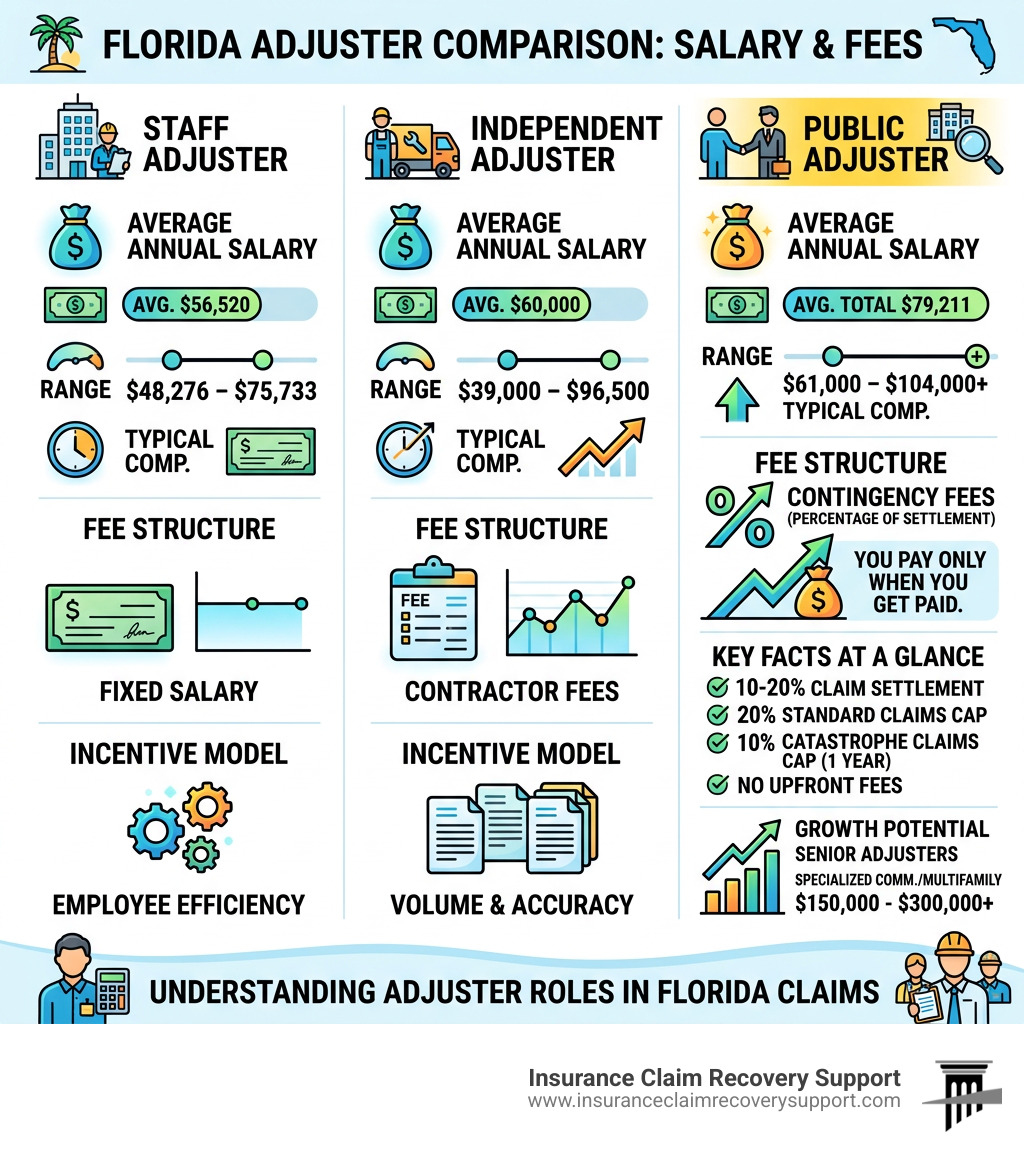
| Adjuster Type | Average Annual Salary (Florida) | Typical Range |
|---|---|---|
| Staff Adjuster | $56,520 | $48,276 – $75,733 |
| Independent Adjuster | $60,000 | $39,000 – $96,500 |
| Public Adjuster | $68,829 base / $79,211 total | $61,000 – $104,000+ |
Key facts at a glance:
- ✅ Public adjusters in Florida earn through contingency fees — typically 10–20% of the final claim settlement
- ✅ Standard claims are capped at 20%; claims filed within the first year after a declared catastrophe are capped at 10%
- ✅ Senior public adjusters with commercial specialization can earn $150,000–$300,000+ annually
- 🚫 No upfront fees — public adjusters only get paid when you do
For commercial property owners, multifamily operators, and hospitality managers dealing with large property damage claims, these numbers matter in two directions. First, they tell you what a public adjuster’s services will cost you. Second — and more importantly — they explain why a skilled public adjuster is highly motivated to fight hard for your settlement. Their income depends on it.
A 2010 Florida OPPAGA report found that policyholders who used a public adjuster received average settlements of $17,187, compared to just $2,029 for those who navigated claims alone — a staggering 747% difference. For a commercial or multifamily property owner facing a six- or seven-figure loss, that gap is not a footnote. It’s the difference between full recovery and a prolonged financial crisis.
I’m Scott Friedson, CEO of Insurance Claim Recovery Support (ICRS) and a multi-state licensed public adjuster with over 15 years of experience settling hundreds of millions of dollars in large-loss property damage claims — experience that gives me a clear, ground-level view of how much does a public adjuster make in Florida and what drives those earnings. In this guide, I’ll break down everything commercial and multifamily property owners need to know about public adjuster fees, earning potential, and how to evaluate whether hiring one is the right move for your claim.
How Much Does a Public Adjuster Make in Florida?
When we look at the financial landscape of the insurance industry, the question of how much does a public adjuster make in Florida reveals a significant gap between those who work for the insurance companies and those who represent the policyholder. Unlike staff adjusters (who are salaried employees of insurance carriers) or independent adjusters (who are contractors hired by carriers), public adjusters operate on a contingency fee model.
This means a public adjuster’s income is directly tied to the success of the claim. In Florida, the average total compensation sits around $79,211, but this figure is a bit like measuring the average depth of a river—it doesn’t tell you where the deep water is. For those specializing in large-loss commercial claims, the ceiling is much higher.
The Breakdown of Earnings
- Base Salary vs. Total Compensation: While some large firms might offer a base salary (averaging $68,829), the “meat” of the income comes from Public Adjuster Fees for Property Damage Claims. Additional compensation through bonuses and commissions typically adds another $10,000 to $15,000 to the annual take-home pay for mid-level professionals.
- The Commission Structure: Most independent public adjusters earn 10% to 20% of the settlement. On a $1 million commercial fire claim, a 10% fee results in a $100,000 payday. This creates a “beautiful alignment” of interests; we don’t get a raise unless you get a higher settlement.
- Commercial Volume: Public adjusters handling multifamily complexes, retail centers, or industrial facilities often see higher annual earnings because the claims are more complex and the dollar amounts are significantly larger than residential “daily” claims.
Factors Influencing How Much a Public Adjuster Makes in Florida
Not all public adjusters in the Sunshine State earn the same. Several critical variables dictate the “juice” they get for the “squeeze.”
- Experience and Specialization: A rookie adjuster might start in the $40,000 to $60,000 range. However, those who understand What Does a Commercial Claims Adjuster Do?—such as calculating complex business interruption losses or navigating industrial building codes—can command much higher fees. Senior adjusters with a decade of experience often exceed $150,000 annually.
- Geographic Location: In Florida, location is everything. Adjusters in high-density, high-value areas like Miami, Fort Lauderdale, and West Palm Beach often earn 10-15% more than the state average due to higher property values and more frequent litigation. Conversely, inland or North Florida areas may see slightly lower average earnings.
- Hurricane Season Demand: The Atlantic hurricane season is the primary driver of income volatility. During active years, a Property Field Adjuster can earn a year’s worth of income in just three or four months. However, this requires the stamina to work 80-hour weeks and manage a massive influx of claims simultaneously.
- Claim Complexity: A standard roof leak is one thing; a smoke damage insurance claim in a high-rise hotel involving 300 rooms and massive business interruption is another. The more technical the claim, the higher the earning potential for the adjuster who can document it correctly.
Legal Fee Caps and Regulations for Florida Public Adjusters
Florida has some of the strictest consumer protection laws in the country regarding public adjuster fees. These are codified in Florida Statutes on Public Adjuster Fees, and they directly impact how much does a public adjuster make in Florida.
- The 20% Standard Cap: For non-emergency claims, a public adjuster cannot charge more than 20% of the claim payment.
- The 10% Catastrophe Cap: If the Governor declares a state of emergency, fees are capped at 10% for any claim filed within the first year after the event. This is designed to prevent price gouging after major hurricanes.
- The “New Money” Rule: This is a vital protection for policyholders. In Florida, if an insurance company has already made an offer, a public adjuster can only charge a fee on the additional money they recover above that initial offer. This ensures you aren’t paying a commission on money you were already going to receive.
- Solicitation Rules: Florida adjusters are prohibited from soliciting clients between 8 p.m. and 8 a.m. and cannot solicit at the scene of a disaster during a state of emergency. They must also allow a 10-day window for clients to cancel a contract without penalty (extended to 30 days during emergencies).
Maximizing Commercial Payouts: Public Adjusters vs. Litigation

When a commercial claim is underpaid or denied, property owners often think their only choice is to sue. However, the data suggests that hiring a public adjuster is often a more efficient—and lucrative—path.
The Financial Reality of the 747% Difference
The 2010 OPPAGA report remains the gold standard for understanding the value of a public adjuster. By receiving an average of $17,187 versus $2,029, policyholders aren’t just getting “a little more”—they are seeing a total transformation of their recovery. Even after paying a 10% or 20% fee, the net gain is massive.
Public Adjusters vs. Unnecessary Litigation
Many commercial owners worry that a public adjuster’s fee is an “extra” cost. In reality, it is an investment to avoid the much higher costs of litigation.
- Speed: Lawsuits can drag on for years. A public adjuster’s goal is to reach a settlement quickly.
- Cost: Attorneys often take 33% to 40% of a settlement, plus court costs and expert witness fees. A public adjuster’s fee is capped much lower.
- Expertise: We focus on the technical side of the loss—the engineering, the construction costs, and the policy language. Often, we can resolve the dispute by presenting a superior technical argument, avoiding the “appraisal” process or a courtroom altogether.
What is a Public Insurance Adjuster? Hire an expert early to ensure your claim is documented correctly from day one, which is the best way to prevent the carrier from lowballing the initial estimate.
Why Commercial Owners Ask How Much a Public Adjuster Makes in Florida
For a professional property manager or an HOA board, the decision to hire a Public Insurance Adjuster is a Return on Investment (ROI) calculation. They want to know the fee structure to ensure it fits within the building’s financial recovery plan.
- Multifamily and HOAs: When a hurricane hits an apartment complex, the loss of use claim and business interruption can be more costly than the physical repairs. We specialize in documenting these “soft costs” that staff adjusters often overlook.
- Hospitality and Industrial: In these sectors, every day of closure is a disaster. A public adjuster’s ability to expedite the claim and secure “advance payments” is worth far more than the contingency fee.
- Religious Institutions and Schools: These organizations often have limited reserves. A Public Adjuster for Insurance Claims provides the professional advocacy needed to ensure these community pillars can rebuild without taking on massive debt.
Fact vs. Myth: The Reality of Public Adjuster Earnings and Fees
There is a lot of misinformation circulating about the public adjusting profession. Let’s clear the air:
- Myth: Public adjusters are too expensive.
- Fact: The OPPAGA report proves that policyholders net significantly more money after the fee than they would have received on their own. If we don’t increase your settlement, we don’t get paid.
- Myth: Public adjusters delay the claim process.
- Fact: Most delays are caused by the insurance company’s “request for information” loop. We anticipate these requests and provide a “decision-ready” file, which often speeds up the payout.
- Myth: Public adjuster fees are fixed and non-negotiable.
- Fact: While there are legal caps, fees are often negotiable, especially on multi-million dollar commercial losses. We are business owners; we understand the need for a fee structure that makes sense for both parties.
- Myth: PAs just want to “inflate” the claim.
- Fact: Our job is to document the actual damage based on current construction costs and policy requirements. Carriers often use “Xactimate” estimates that use outdated labor rates; we simply correct the math to reflect the real world.
Licensing and Career Path to High Earnings in Florida
If you are looking at how much does a public adjuster make in Florida because you want to enter the field, the barrier to entry is high—and for good reason. Florida requires a 3-20 Public Adjuster License.
The Step-by-Step Path:
- Coursework: Complete a state-approved 40-hour public adjuster apprentice course.
- Apprenticeship: You must serve as a licensed apprentice (3-21 license) for at least six months under a veteran public adjuster and document work on at least 25 claims.
- Bonding: Secure a $50,000 surety bond. This protects the public from any potential financial misconduct.
- Examination: Pass the rigorous state exam with a score of at least 70%.
- Continuing Education: To keep your license (and your high earning potential), you must complete 24 hours of continuing education every two years.
For those who want to reach the $200k+ bracket, the key is specialization. Don’t just be a generalist; become an expert in fire damage claims FL or large-scale commercial flood losses.
Conclusion and Choosing the Best Florida Public Adjuster
Understanding how much does a public adjuster make in Florida is about more than just a salary figure—it’s about understanding the value of professional advocacy in a system designed to protect the insurance company’s bottom line.
At Insurance Claim Recovery Support (ICRS), we don’t just “adjust” claims; we manage the entire recovery process for commercial and multifamily property owners. Our interests are perfectly aligned with yours. We specialize in large-loss events—fire, hail, hurricane, and business interruption—and our goal is always to maximize your settlement while avoiding the stress and cost of unnecessary litigation.
With a 90% settlement success rate without the need for lawsuits, we have proven that the right expertise can level the playing field. Whether you are dealing with a complex smoke damage insurance claim or a massive hurricane loss, you don’t have to go it alone.
Are you facing a large commercial property claim? Don’t let the insurance company’s “staff” adjuster have the final word on what your recovery is worth. Check out our Best Public Insurance Adjuster Reviews and see how we’ve helped others in your shoes.
Contact us today at Insurance Claim Recovery Support for a free claim consultation. Let us show you how we can turn a lowball offer into a full recovery.