Is Your TPO Roof Actually OK After a Hailstorm?
Hail damage TPO roofs sustain can range from barely visible surface scuffs to deep punctures and crushed insulation — and the most costly problems are often the ones you can’t see from the ground. According to the National Oceanic and Atmospheric Administration (NOAA), severe storms involving hail contribute to billions of dollars in property losses each year, frequently targeting commercial hubs and multifamily complexes.
Here’s a quick snapshot of what to look for:
| Damage Type | What It Looks Like | Risk Level |
|---|---|---|
| Surface bruising / dents | Shallow dimples or discoloration on white membrane | ⚠️ Moderate — can hide internal compression |
| Punctures / tears | Holes or splits in the membrane surface | 🔴 High — immediate water infiltration risk |
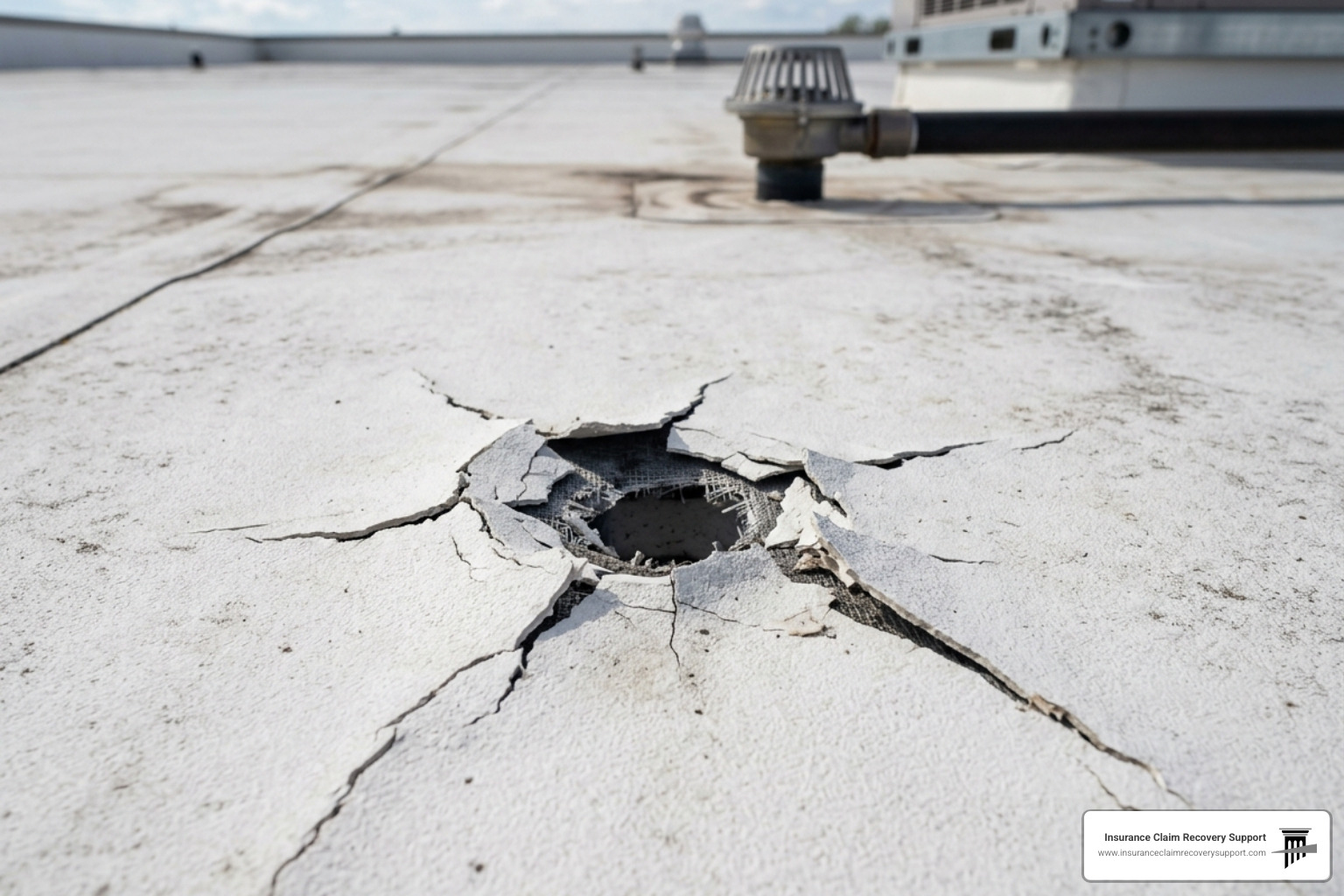
| Spider / circular cracks | Radiating crack patterns around an impact point | 🔴 High — membrane integrity compromised |
| Weakened seams | Lifting, separation, or stress along membrane seams | 🔴 High — primary leak entry point |
| Membrane shrinkage | Pulling away from edges or flashings | ⚠️ Moderate-High — accelerates with age |
| Insulation compression | Soft spots underfoot; no visible surface damage | ⚠️ Moderate — rarely affects R-value, but signals impact force |
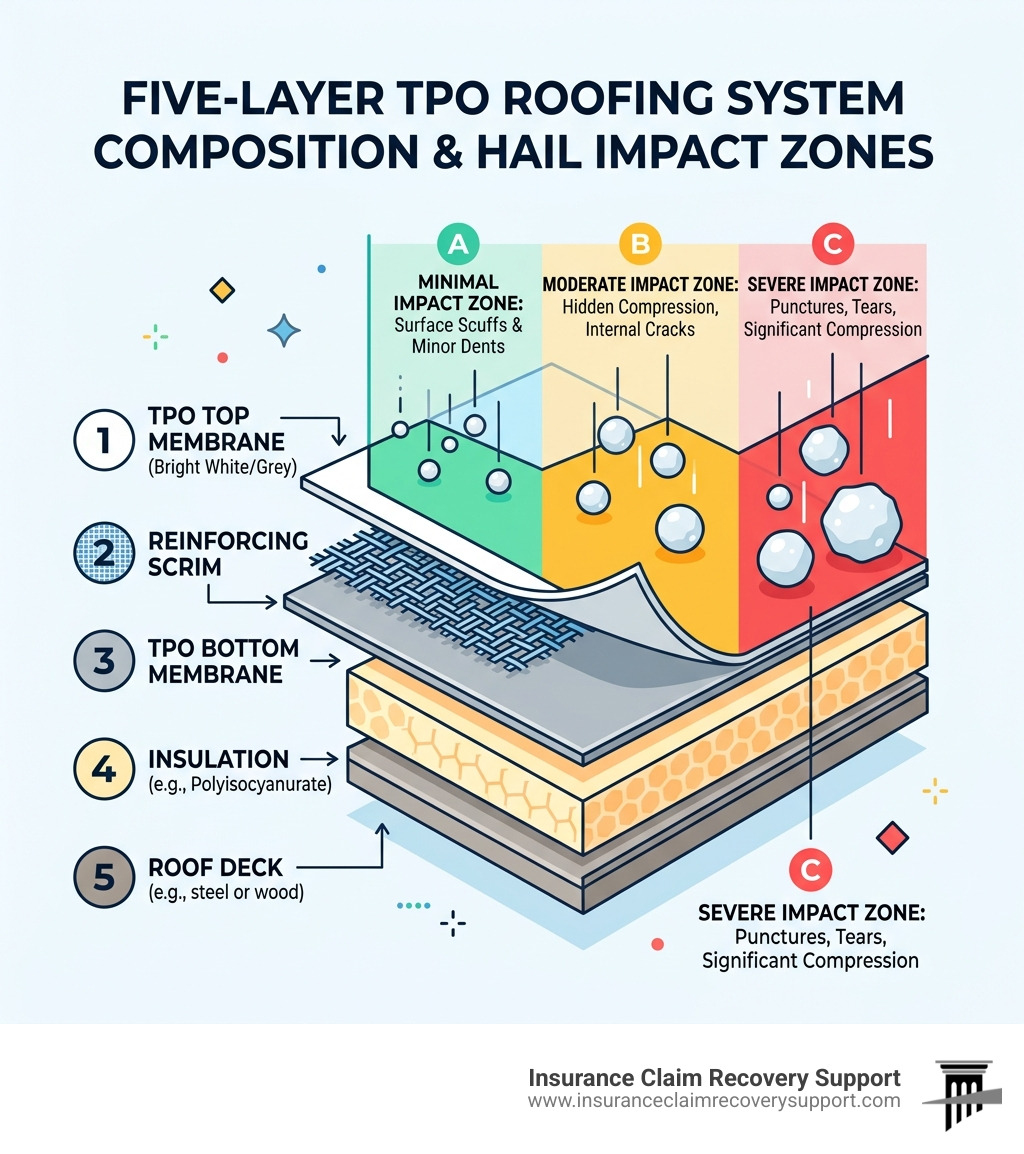
TPO (Thermoplastic Polyolefin) is one of the most widely used single-ply roofing membranes on commercial and multifamily properties today — prized for its energy efficiency, reflectivity, and relatively low installation cost. But despite its popularity, TPO is not immune to hail. Standard membranes resist hailstones up to about 1¾ inches in diameter, and once a storm pushes past that threshold, the damage can be deceptive: the surface may look fine while the underlying insulation layers and seams have already been compromised.
What makes this especially frustrating for commercial property owners and multifamily operators is that hidden damage often doesn’t show up as a leak until months — sometimes years — after the storm. By then, your insurance claim window may be closing, and the insurer’s adjuster may be looking for reasons to classify the damage as cosmetic, pre-existing, or excluded.
I’m Scott Friedson, CEO of Insurance Claim Recovery Support (ICRS) LLC and a multi-state licensed public adjuster with over 15 years of experience settling large-loss hail damage TPO claims for commercial and multifamily property owners across the country. I’ve seen how quickly a straightforward hail claim becomes a disputed, underpaid, or denied one — and this guide is built to help you get ahead of that.
Quick look at hail damage tpo:
- Hail Damage on a Flat Roof
- Roof Hail Insurance Claim
- What Does Hail Damage on a Roof Look Like
Identifying hail damage tpo: Signs, Sizes, and Vulnerabilities
When a hailstorm rips through cities like Austin, Dallas, or Houston, the immediate concern for property managers is the integrity of the building envelope. The TPO membrane is the first line of defense. Identifying hail damage tpo requires more than a quick glance from the parking lot. Because TPO is a thermoplastic, it has a certain amount of “give,” but that flexibility has its limits.
The vulnerability of your roof depends heavily on the membrane’s thickness. While 45 mil is a common entry-level thickness, many commercial properties utilize 60 mil or 80 mil systems. Generally, the thicker the membrane, the better it handles impact energy. However, as TPO ages, it loses plasticizers and becomes brittle, meaning a 10-year-old 60 mil roof might actually be more susceptible to punctures than a brand-new 45 mil roof.
Critical Hail Sizes and VSH Ratings
Not all hail is created equal. In the insurance world, we look at specific size thresholds to determine the likelihood of functional damage.
- Moderate Hail (Up to 1 inch): Think “quarter-sized.” This rarely punctures a healthy TPO membrane but can cause “bruising” where the membrane is compressed against the substrate.
- Severe Hail (1.25 to 1.75 inches): This is the “golf ball” range. At this size, standard TPO membranes are at a high risk of fracturing or puncturing, especially if the roof is over five years old.
- Very Severe Hail (VSH) (2 inches and larger): Once hail hits the “egg” or “eight-ball” size, even the best standard TPO systems are in trouble.
To combat this, manufacturers like Johns Manville have developed VSH-rated systems. These are tested for hail exceeding 2 inches falling at speeds up to 72 mph, often evaluated under ASTM International standards for impact resistance. These systems often utilize specialized cover boards, like DensDeck StormX, to absorb the impact energy that would otherwise shatter the gypsum core or puncture the membrane. If you are in a high-risk area like Fort Worth or San Antonio, knowing if your roof has a VSH rating is critical for your hail damage claim support.
Visible vs. Hidden hail damage tpo Indicators
The “sneaky” nature of TPO damage is why so many claims are underpaid. You might see a “clean” roof, but the damage is lurking beneath the surface.
- Visible Punctures: These are obvious holes where the hail has sliced through the membrane. These require immediate attention to prevent water from saturating the insulation.
- Circular Spider Cracks: Often found in older TPO, these radiating cracks indicate the plastic has lost its flexibility and “star-fractured” upon impact.
- Membrane Bruising: This looks like a dark or slightly discolored spot. It happens when the hail compresses the membrane into the insulation or cover board, weakening the reinforcement scrim inside.
- Insulation Compression: Research shows that while hail dents in polyiso insulation rarely reduce the R-value by more than 2%, they create “soft spots.” These soft spots allow the membrane to stretch and flex more than intended, eventually leading to premature failure.
| Material | Hail Resistance Threshold | Common Failure Mode |
|---|---|---|
| TPO | 1.75″ (Standard) | Punctures, Scrim Tears, Seam Stress |
| EPDM | 2.50″ | Brittle Cracking (with age), Tears |
| Modified Bitumen | 1.50″ | Granule Loss, Star Fractures |
If you suspect your roof has been hit, it is vital to check for these hail damage roof signs before the next rain.
Age and Condition Risks for hail damage tpo
Age is the ultimate enemy of TPO. When TPO is new, it is incredibly flexible. However, constant UV exposure in the Texas sun causes the material to undergo “thermal loading.” Over time, the plasticizers that keep the membrane flexible leach out.
An aged roof becomes “chalky” and brittle. When hail hits a brittle roof, it doesn’t bounce; it cracks. We often see “reinforcement scrim exposure,” where the top layer of the TPO has been eroded or knocked off by hail, leaving the internal fabric mesh exposed to the elements. This mesh acts like a wick, drawing water into the system. This is a major factor in Texas storm damage risks, especially for older multifamily complexes that haven’t had a roof refresh in a decade.
Navigating the Insurance Claim Process for TPO Roofs
Filing a claim for a commercial TPO roof is vastly different from a residential claim. The stakes are higher, the square footage is larger, and the “hidden” nature of the damage makes it a prime target for insurance company denials. Whether you are managing a retail center in Austin or an industrial warehouse in Houston, the process requires surgical precision.
Insurance companies often send out adjusters who are trained to look for “functional damage”—basically, holes that are already leaking. But as we’ve discussed, TPO damage often takes time to manifest. This is why many hail damage insurance claims are initially rejected or low-balled.
Fact vs. Myth: Common TPO Policyholder Questions
- Myth: “If it’s not leaking, there’s no damage.”
- Fact: Hail can fracture the reinforcement scrim or compress the insulation, creating a “ticking time bomb” that won’t leak until the next freeze-thaw cycle or heavy wind event.
- Myth: “Insurance covers all hail damage automatically.”
- Fact: Many modern policies now include “Cosmetic Damage Exclusions.” If the insurer decides the hail dents don’t affect the “function” of the roof (its ability to shed water), they may refuse to pay for a replacement, even if your building’s value has decreased.
- Myth: “I have to accept the insurance adjuster’s first offer.”
- Fact: You have the right to challenge an underpaid claim. Working with a public adjuster can help you navigate average insurance payouts for hail damage to ensure you receive a fair settlement.
Public Adjuster vs. Litigation: Maximizing Settlements
When an insurance company refuses to pay what is fair, many property owners think their only choice is to sue. However, litigation is often a slow and costly process. Lawsuits can drag on for years in discovery, and attorney fees (often 30-40% of the total recovery) plus expert witness costs can significantly deplete the funds available for your roof replacement.
At Insurance Claim Recovery Support (ICRS), we advocate for a more efficient path. As licensed public insurance adjusters, we represent you, the policyholder—never the insurance company. We specialize in maximizing settlements and reducing delays without the need for unnecessary lawsuits. By utilizing the policy’s appraisal provision or through expert negotiation, we can often resolve disputes in a fraction of the time it takes to litigate, ensuring more of the settlement goes toward the actual repair.
Our USP is simple: we have a 90% settlement success rate in resolving claims through negotiation and appraisal, avoiding the courtroom entirely. While an attorney focuses on legal maneuvers, we focus on the technical evidence of the hail damage tpo to get you paid and your roof fixed. For a deeper dive, check out our comprehensive guide to hail damage claims.
Immediate Actions and Documentation for TPO Repairs
If a storm just passed through your area, time is of the essence. Documentation is the “currency” of an insurance claim.
- Safety First: Never walk a flat roof alone after a storm. Use a partner and proper safety gear.
- Photo Evidence: Take photos of everything—not just the roof. Document dented HVAC fins, damaged gutters, and even the hailstones themselves next to a ruler or golf ball.
- Weather Reports: Secure a certified weather report for your specific address to prove the date of loss.
- Professional Inspection: Hire a specialist who understands TPO. This might include infrared imaging or moisture scans to find water trapped beneath the membrane.
- Temporary Tarping: You have a “duty to mitigate” further damage. If there are clear punctures, have them professionally tarped or patched immediately, and keep the receipts.
Don’t let the insurance company dictate the terms of your recovery. If you suspect your property has sustained hail storm damage insurance claims, you need an expert in your corner.
CTA: Schedule a Professional Hail Damage Claim Consultation
Our team at Insurance Claim Recovery Support is ready to help commercial and multifamily property owners in Austin, Dallas, Fort Worth, San Antonio, Houston, and throughout Texas. We ensure that your hail damage tpo claim is handled with the expertise required to secure a full and fair settlement. Don’t wait for the leak to start—contact us today.