Spot Hail Roof Damage Early — Insurance Claim Recovery Support LLC
What does hail damage on a roof look like? Hail damage appears as dents, dings, or soft spots on shingles; granule loss exposing the underlying asphalt; cracks in roofing materials; and impact marks on metal components like flashing and vents. While the look varies by material, all forms of damage compromise your roof’s integrity and can lead to costly water intrusion if ignored.
Quick Reference: Common Visual Signs of Hail Damage by Material
| Roofing Material | What to Look For |
|---|---|
| Asphalt/Composition Shingles | Black or soft “bruises,” granule loss creating dark patches, shiny exposed asphalt mat, random impact patterns |
| Metal Roofing & Components | Dents on flashing, dings on vents and pipes, scratches, small punctures in severe cases |
| Wood Shingles/Shakes | Brown or orange splits with sharp corners, impact marks along cracks, little edge deterioration |
| Tile Roofing | Chips, cracks, shattered tiles, shifted or dislodged pieces |
For commercial property owners and multifamily operators, hailstorms are a direct threat to your bottom line, leading to business interruptions and revenue loss. With hail-related property damage exceeding $1 billion annually in the U.S., understanding what to look for is key to protecting your investment. Unaddressed damage can quickly escalate from small leaks to major water intrusion, structural decay, and declining property value as repair costs multiply.
As public adjusters specializing in large-loss commercial claims, Insurance Claim Recovery Support has helped property owners identify and document hail damage across claims totaling over $250 million in settlements. Our expertise in distinguishing genuine hail impacts from normal wear helps clients avoid underpaid settlements and unnecessary litigation, recovering significantly more than initial insurance offers.
A Property Manager’s Guide: What Does Hail Damage on a Roof Look Like?
Hailstorms are a harsh reality for property owners across Texas and other states we serve like Colorado, Florida, and Oklahoma. As a property manager or commercial building owner, knowing precisely what does hail damage on a roof look like is your first line of defense against costly repairs. We’re here to equip you with the knowledge to identify these crucial signs.
For additional background on how roofing systems are evaluated for impact resistance, you can also review standards such as UL 2218 impact resistance testing, which many insurers reference when underwriting and adjusting claims.
Identifying the Telltale Signs: What Hail Damage on a Roof Looks Like on Different Materials
The appearance of hail damage varies significantly depending on your roof’s material. Let’s break down the common indicators for various roofing types.
Asphalt & Composition Shingles
Common on commercial properties, asphalt shingles show hail damage in several ways:
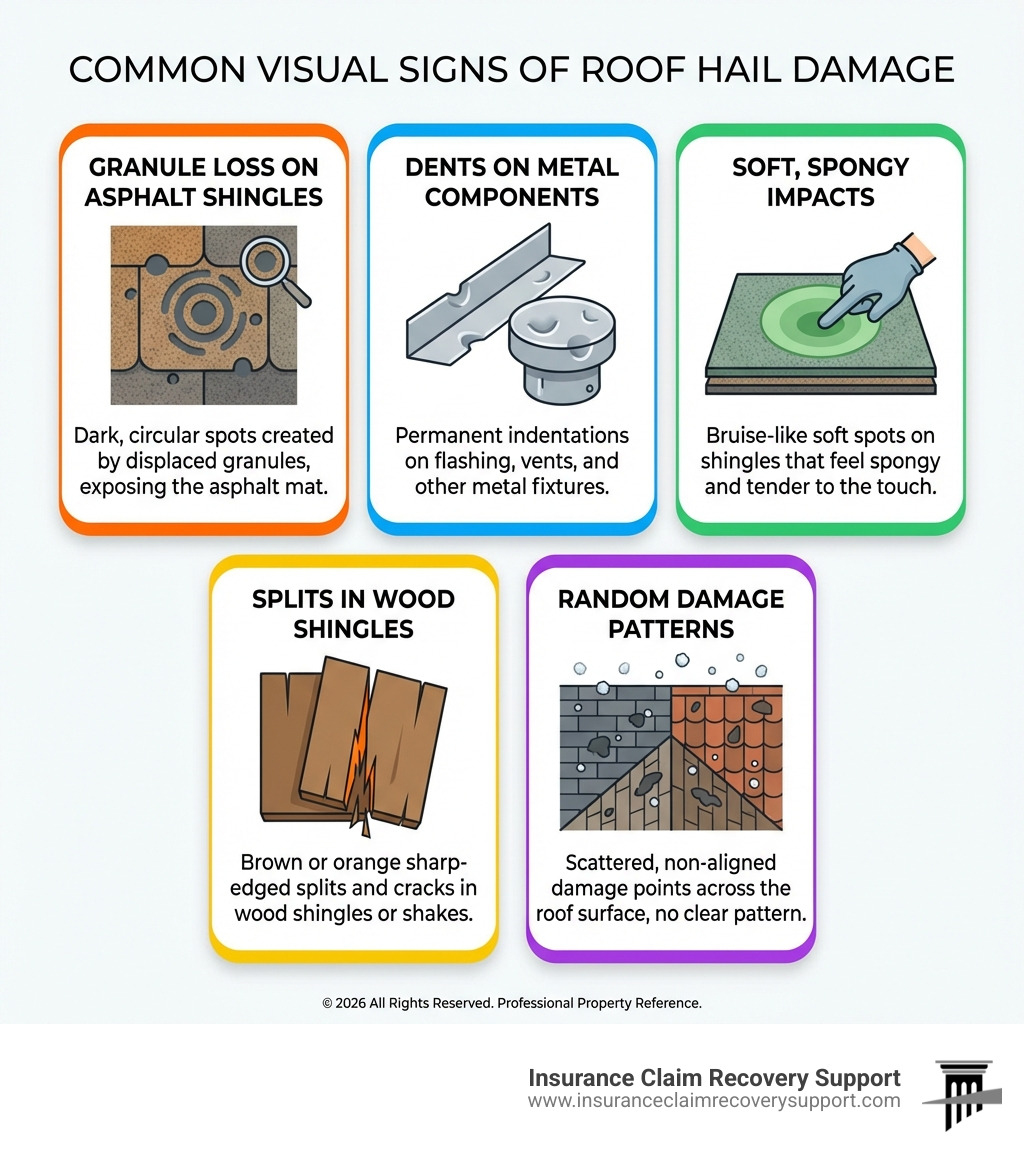
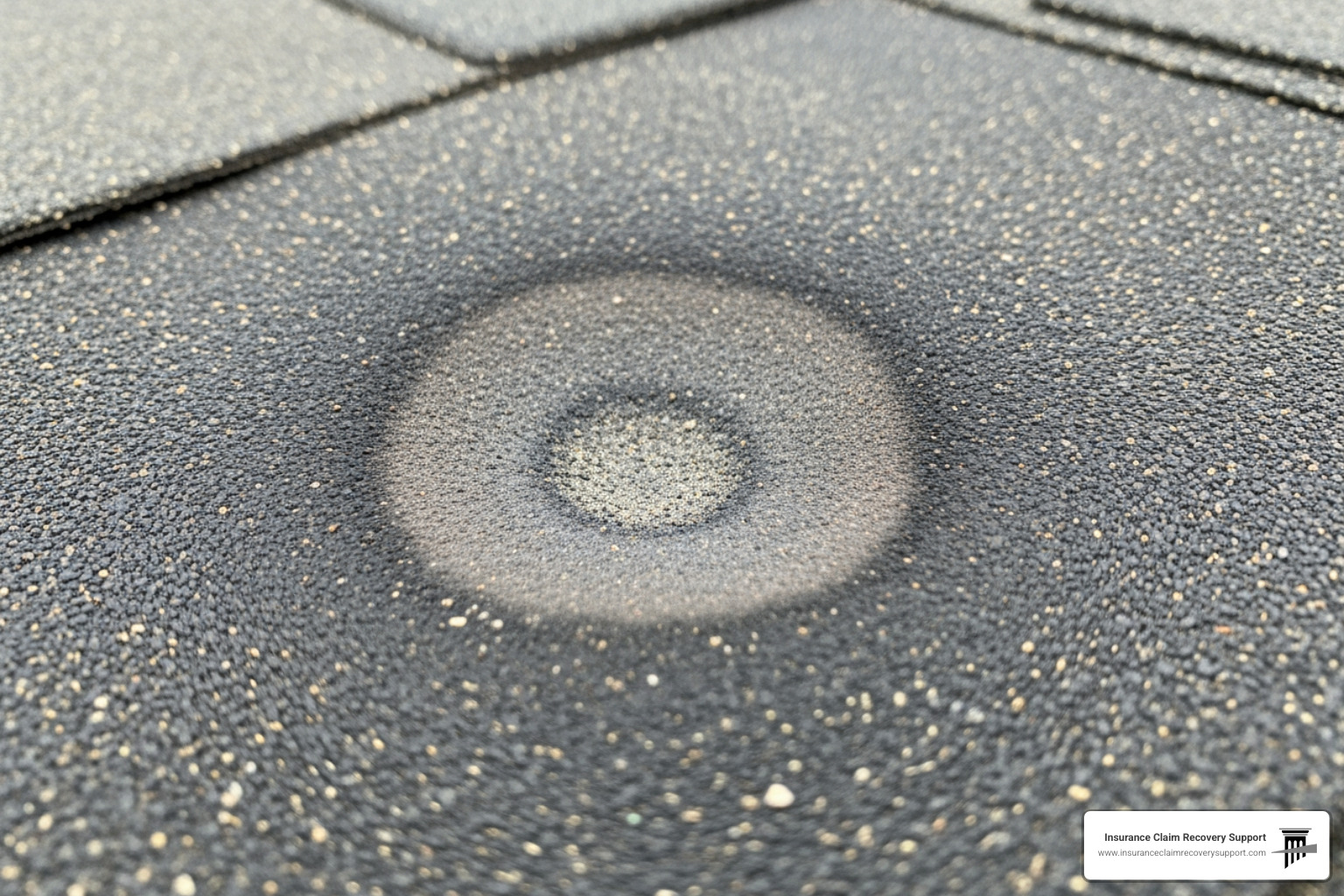
- Granule Loss: Hail impacts dislodge protective granules, leaving dark “bald spots” that expose the underlying asphalt mat to UV rays and accelerate aging.
- Soft Spots or “Bruises”: An impact can create a soft, spongy depression in the shingle, much like a bruise on an apple. These spots indicate a weakened structure prone to leaks.
- Cracks and Fractures: Severe hail can cause visible cracks in the shingle, creating direct paths for water intrusion.
- Random Pattern: Hail damage appears in a random pattern across the roof, unlike uniform wear and tear from sun or foot traffic.
Metal Roofing & Components
While durable, metal roofs and components are not immune to hail. Inspecting all metal parts is crucial.
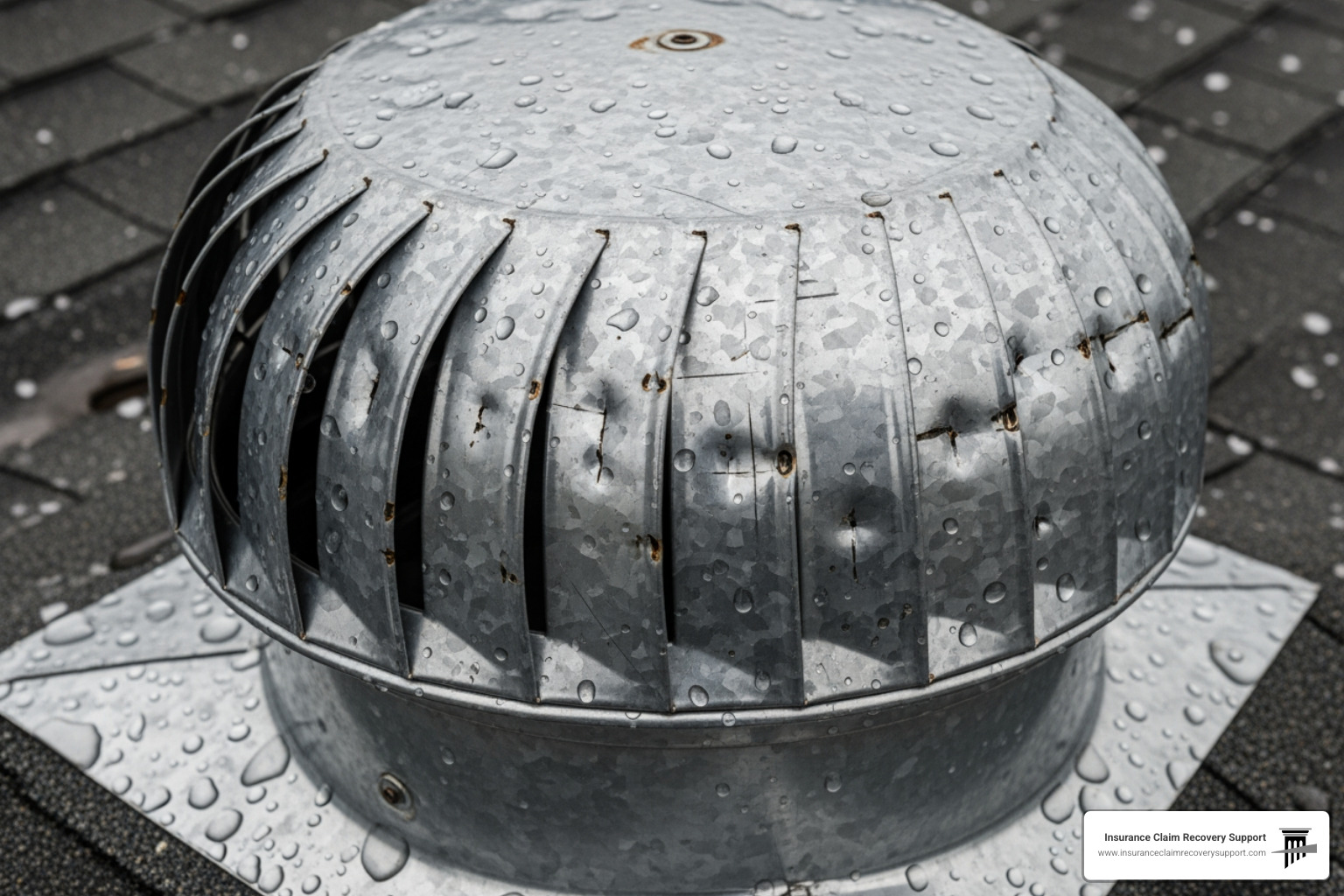
- Dents and Dings: Look for circular or irregular indentations on flashing, vents, pipes, and HVAC units. These are often the clearest collateral indicators of a hailstorm’s intensity.
- Scratches and Punctures: Hail can scratch protective coatings, and large hailstones can puncture thinner metal, creating immediate leak risks.
- Damaged Fasteners: Impacts can loosen fasteners, compromising the roof’s resistance to wind uplift.
Wood Shingles & Shakes
Hail damage on wood is distinct from natural weathering.
- Splits with Sharp Edges: Look for splits in the wood that have sharp, clean corners. Unlike weathered cracks, these splits often appear brown or orange, revealing fresh wood.
- Impact Marks: You may see dents or impact marks along the splits, confirming a direct hit from hail.
- Splintering: The force of impact can cause the wood to splinter along the grain, creating jagged cracks.
Tile Roofing
Tile roofs (clay or concrete) react to hail impacts differently than other materials.
- Chipped or Cracked Tiles: Tiles can chip along their edges or develop cracks radiating from the point of impact.
- Shattered Tiles: Large hailstones can cause tiles to shatter, leaving noticeable holes or exposed underlayment.
- Shifted or Dislodged Tiles: The force of hail can shift or dislodge tiles, making them susceptible to wind and water intrusion.
For a comprehensive review of potential hail damage on your property, we offer specialized Hail Damage Assessment services.
Key Factors That Determine Damage Severity
The severity of hail damage depends on several variables:
- Hailstone Size and Density: Hail over 1 inch in diameter can cause significant damage. Denser, harder hailstones cause more damage than softer, slushy ones.
- Wind Speed and Direction: High winds amplify the force of impact and affect which roof slopes receive the most damage.
- Roof Age and Condition: Older, brittle roofs are far more susceptible to damage from smaller hail than newer, well-maintained roofs.
- Roof Pitch and Materials: A roof’s slope and material type determine how it absorbs or deflects hail impacts.
Fact vs. Fiction: Distinguishing What Hail Damage on a Roof Looks Like From Other Issues
It is critical to distinguish true hail damage from normal wear, manufacturing defects, or mechanical damage for a successful insurance claim. Insurers often dismiss valid damage as pre-existing, leading to underpaid or denied claims.
| Characteristic | Hail Damage | Normal Wear & Tear / Defects |
|---|---|---|
| Pattern | Random, no discernible alignment. | Uniform, often in patterns related to sun exposure or installation. |
| Appearance | Bruise-like depressions (asphalt), sharp splits (wood), dents (metal). | Blistering, uniform cracking, general granule loss, flaking, algae growth. |
| Feel (Asphalt) | Soft or spongy at impact points. | Hard, brittle, or uniform texture. |
| Associated Damage | Dents on gutters, vents, and AC units. | Typically confined to the roof surface. |
The key identifier for hail is its random, impact-specific nature. A soft “bruise” on a shingle or a dent on a metal vent, especially when paired with other collateral damage, strongly indicates hail. For more information on how roofing materials are rated for impact resistance, you can refer to scientific research on hail impact ratings for roofing.
If you’re unsure if your roof damage is hail-related, our experts can help. We specialize in assessing all types of Roof Hail Damage and guiding you through the next steps.
Your Post-Storm Action Plan: What to Do When You Suspect Damage
After a hailstorm, taking immediate, systematic action is crucial for your insurance claim.
- Safety First: Never climb onto a wet or damaged roof. Leave detailed inspections to trained professionals.
- Ground-Level Inspection: From a safe distance, use binoculars to look for visible signs of damage like granule loss, dents, or missing shingles.
- Document the Storm: Record the exact date and time of the hailstorm for your claim. Public weather data from sources like the National Weather Service Storm Events Database can help corroborate the event.
- Take Photos and Videos: This is a critical step. Document everything.
- Roof Damage: Take close-up and wide shots of any suspected damage.
- Hail Size: If possible, photograph hailstones next to a ruler or coin for scale.
- Collateral Damage: Check for and photograph dents on AC units, gutters, downspouts, siding, and window frames. An accumulation of shingle granules in gutters is a strong indicator of roof damage.
- Make Temporary Repairs: If there’s a risk of water intrusion, take temporary measures like tarping the area and document these repairs.
- Get a Professional Inspection: Subtle or latent hail damage can be missed from the ground and may only cause problems months later. A professional public adjuster can conduct a thorough assessment to identify all damage and substantiate your claim.
Taking these steps sets the foundation for a successful recovery. For guidance, consider reaching out to a Hail Damage Adjuster.
Navigating Your Insurance Claim and Securing a Fair Settlement
Identifying hail damage is the first step; the next is navigating the complex insurance claim process. For large-loss commercial and multifamily claims, this can be a significant challenge.
Understanding Your Options: Public Adjuster vs. Going It Alone
Your insurance company’s adjuster works for them, with a goal of minimizing the payout. As the policyholder, the burden is on you to prove the full extent of your loss. This often leads to disputes over the scope of damage, with insurers arguing that damage is pre-existing or merely cosmetic, resulting in lowball settlement offers. This can lead to a prolonged Hail Damage Claim Dispute.
A licensed public adjuster from a firm like Insurance Claim Recovery Support works exclusively for you. We level the playing field by:
- Conducting an Independent, Expert Assessment: We identify all damage, including subtle issues the insurer’s adjuster may overlook.
- Building a Robust Claim: We use our expertise in policy language and damage documentation to build an irrefutable case for a full settlement.
- Advocating for Your Best Interests: We handle all negotiations, countering the insurer’s tactics to limit payouts.
Fact vs. Myth: Lawsuit or Public Adjuster?
| Topic | Myth: “Just Sue the Insurance Company” | Fact: Work With a Public Adjuster First |
|---|---|---|
| Cost | Lawsuits often require large retainers and hourly legal fees, plus expert witness costs. | Public adjusters are typically compensated on a contingency fee based on what they recover for you. |
| Timeline | Litigation over commercial property damage can drag on for years through findy, motions, and appeals. | A well-documented claim presented by a public adjuster is often resolved in months, not years. |
| Control of Outcome | A judge or jury ultimately decides, and outcomes can be unpredictable. | You retain more control over negotiations, documentation, and scope discussions. |
| Business Disruption | Key staff may be tied up in depositions and document production. | Your team can focus on operations while the public adjuster manages claim strategy and communication. |
| Relationship With Carrier | Adversarial from the start, which can harden positions on both sides. | Claims are negotiated based on facts, policy language, and evidence, often avoiding escalation into lawsuits. |
Public adjusters do not replace attorneys, but by thoroughly documenting your loss and resolving coverage and scope issues early, they frequently eliminate the need for property damage lawsuits or appraisal, helping owners and managers avoid unnecessary litigation.
Securing Your Full and Fair Settlement
Many policyholders believe a lawsuit is their only option after a low offer. However, litigation is a long, expensive, and uncertain process that can take years to resolve. A public adjuster offers a more efficient path.
Our primary goal is to secure a fair settlement through expert negotiation, not lawsuits. This strategy is highly effective: we achieve a 90% settlement success rate without resorting to unnecessary litigation. By presenting a thoroughly documented claim, we compel the insurance company to pay what you are rightfully owed, saving you time, legal fees, and business disruption.
For commercial properties, multifamily buildings, and HOAs in Texas and other states we serve, an inadequate settlement can have devastating consequences. Our team specializes in these large-loss claims, ensuring you receive the funds needed for a complete recovery. We maximize settlements, reduce delays, and let you focus on your business.
Hail damage is a setback, but with the right advocate, it doesn’t have to be a disaster. To learn more about protecting your investment, explore our resources on Hail and Wind Damage Insurance Claims.