When Your Insurer Stops Working for You: The Truth About Insurance Bad Faith
Insurance Bad Faith occurs when an insurance company fails to handle a claim honestly, fairly, or in a timely manner — without a reasonable basis for doing so.
Here is what that means in plain terms:
| Situation | What It Is |
|---|---|
| Insurer denies your claim with no policy basis | ✅ Potential bad faith |
| Insurer delays investigation indefinitely | ✅ Potential bad faith |
| Insurer misrepresents what your policy covers | ✅ Potential bad faith |
| Insurer disputes the dollar value of your loss | �� Likely a legitimate dispute |
| Insurer requests additional documentation once | �� Standard claims process |
| Insurer uses automated tools to systematically undervalue claims | ✅ Potential bad faith |
Every insurance policy — commercial, multifamily, hospitality, or institutional — contains what courts call an implied covenant of good faith and fair dealing. This covenant exists automatically, regardless of whether it appears in your policy language. When an insurer violates it, the conduct crosses from a simple contract dispute into something far more serious: a tort that can expose the carrier to damages well beyond your original policy limits.
For commercial property owners, apartment operators, HOAs, and institutional property managers, the stakes are not abstract. A delayed or underpaid claim on a fire-damaged office building, a hurricane-hit apartment complex, or a hail-destroyed retail center can mean the difference between full recovery and financial collapse.
⚖️ And the pattern is not rare.
In April 2026, a report from Insurance Journal revealed that a major national insurer agreed to a $15.6 million settlement over allegations that it systematically underpaid total loss claims across a five-year period. While these specific cases often involve personal lines, the systemic nature of the underpayment serves as a critical warning for commercial property owners. Around the same time, reporting from The New York Times raised pointed questions about the carrier’s conduct in California following the devastating wildfires — including concerns about non-renewals that left commercial property owners exposed precisely when coverage was most critical. Neither situation, taken on its own terms, looks like meaningful accountability. Both look like the cost of doing business.
This guide breaks down exactly what insurance bad faith is, how it shows up in large-loss commercial and multifamily claims, what state laws in Texas and Florida require of your insurer, and what you can do about it — without making the process harder than it has to be.
I’m Scott Friedson, CEO of Insurance Claim Recovery Support (ICRS) and a multi-state licensed public adjuster with more than 15 years of experience resolving insurance bad faith disputes across hundreds of large-loss commercial and multifamily property claims totaling over $250 million. In that time, I’ve seen how systemic underpayment tactics play out against property owners who are simply trying to collect what they’re owed — and in the sections ahead, I’ll show you exactly how to recognize it, document it, and fight back.
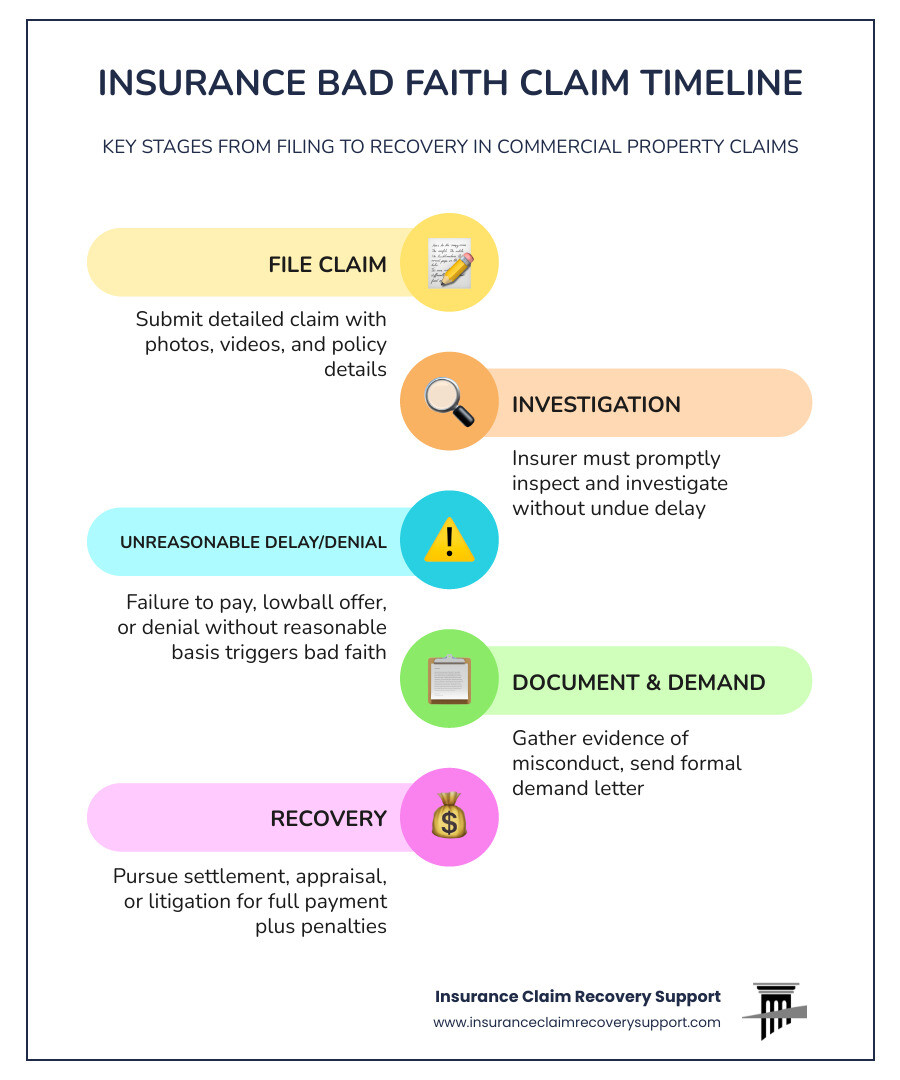
Defining Insurance Bad Faith in Commercial Property Claims
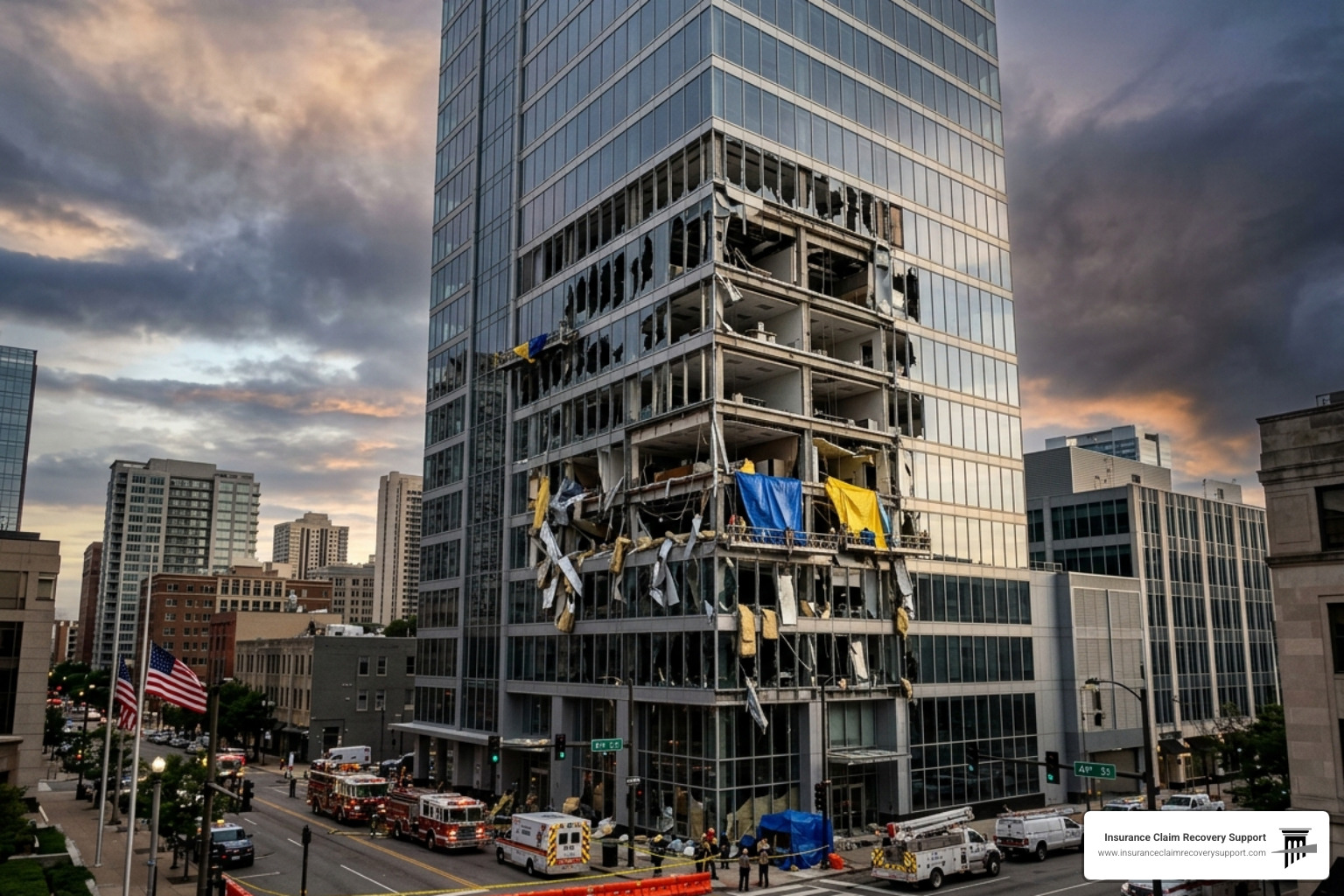
When we talk about Insurance Bad Faith in the context of commercial assets like high-rise office buildings or large multifamily complexes, we are moving beyond a simple “breach of contract.” While a breach of contract occurs when an insurer fails to pay what is owed, bad faith is a “tort” — a legal wrong that implies the insurer acted with a lack of proper cause or unreasonable intent.
As commercial building owners and HOA associations, you have a right to expect that your carrier will honor its fiduciary-like duty to protect your interests. Unfortunately, many policyholders are left wondering what you need to know about insurance claims only after they’ve been treated unfairly.
Legitimate Dispute vs. Bad Faith Conduct
It is important to distinguish between an honest disagreement and actionable misconduct.
| Legitimate Dispute | Bad Faith Conduct |
|---|---|
| Disagreeing on the cost of materials | Refusing to acknowledge proof of higher costs |
| Requesting a second inspection for clarity | Conducting a “cursory” inspection to find a reason to deny |
| A short delay due to a catastrophic event | Intentionally ignoring calls to force a low settlement |
| Denying a claim based on a clear exclusion | Misinterpreting policy language to create an exclusion |
The Legal Definition of Insurance Bad Faith
The legal threshold for Insurance Bad Faith generally requires proving that the insurer’s conduct was “unreasonable” or “without proper cause.” This includes:
- Unreasonable Denial: Denying a claim when liability is reasonably clear.
- Failure to Investigate: Refusing to look at evidence that supports the policyholder’s claim.
- Misrepresenting Policy Language: Using jargon to trick a policyholder into believing a covered loss is excluded.
According to the Insurance Research Council, nearly 38 states allow both tort and statutory claims for bad faith, emphasizing the seriousness of these violations.
First-Party vs. Third-Party Bad Faith
In the commercial world, we primarily deal with first-party bad faith. This occurs when your own insurance company fails to pay you for damage to your property (e.g., fire, hail, or hurricane damage).
Third-party bad faith involves liability. If someone sues your business and your insurer refuses to defend you or settle within policy limits—leading to an “excess judgment” against you—they may have acted in bad faith. For a deeper dive into these nuances, see our Property Damage Claim Dispute Guide.
Systemic Underpayment: The “Cost of Doing Business” Model

The recent $15.6 million settlement involving a major national carrier is a textbook example of the “cost of doing business” mentality. When a carrier systematically underpays thousands of total loss claims, a settlement of $15 million sounds large—but when the average recovery for the victim is less than $500, the “punishment” doesn’t fit the crime. If the profit generated by underpaying claims exceeds the eventual settlement cost, the insurer has a financial incentive to continue the behavior.
This systemic issue is highlighted by recent scrutiny in California, where non-renewals and valuation methods have left commercial assets vulnerable. For multifamily operators in Texas and Florida, this means your “standardized” claim process might actually be an engineered path to a lower settlement.
Translation: What Your Adjuster Says vs. What It Means
Insurers often use specific phrases to shield themselves from paying. We call these the “profit maximization” scripts.
- Adjuster Says: “This is just normal wear and tear.”
- Translation: “We see the damage, but we’re hoping you won’t hire an expert to prove it was caused by the storm.”
- Adjuster Says: “This is pre-existing damage from a previous event.”
- Translation: “We are shifting the blame to a time period you can’t prove, even if our own previous inspections said the building was fine.”
It’s a known fact that insurance companies maximize profits by shorting customers, especially after major disasters when they are overwhelmed by claims.
The Impact of Algorithmic Claims Handling
Many large carriers now use automated software like “Colossus” to determine settlement values. These systems are often calibrated to prioritize “standardized” (read: lower) payouts over the actual reality of your commercial property’s damage. This is particularly dangerous for denied fire insurance claims, where structural integrity issues are often ignored by a computer algorithm.
Warning Signs of Insurance Bad Faith in Large-Loss Claims
Recognizing the warning signs early can save your commercial investment. If you see these red flags, your insurer may be moving toward Insurance Bad Faith:
- Lowball Settlements: Offers that are 20-30% of what your own contractors estimate.
- Delayed Investigation: Taking months to send an adjuster to a storm-damaged property.
- Unusually Short Inspections: An adjuster spending 15 minutes on a 200-unit apartment complex roof.
- Excessive Documentation Demands: Asking for the same records multiple times to reset the clock.
If you are facing a denied storm damage insurance claim, these tactics are often used to wear you down.
Fact vs. Myth: Commercial Claim Realities
- Myth: Any claim denial is bad faith.
- Fact: A denial is only bad faith if it lacks a “reasonable basis.” Legitimate disputes over policy interpretation do happen.
- Myth: Insurance adjusters are independent and unbiased.
- Fact: Most staff adjusters are incentivized to meet carrier “cycle time” and “severity” goals. There are significant licensing gaps that allow inexperienced adjusters to handle complex commercial claims.
For more on navigating these hurdles, consult our denied insurance claim ultimate guide.
Coercive Tactics and Policy Misinterpretation
We’ve seen insurers threaten to cancel a policy because a policyholder dared to hire a public adjuster. Others use obscure exclusions—like “wind-driven rain”—to deny what is clearly a tornado insurance claim denial scenario. These are coercive tactics designed to exploit the policyholder’s lack of experience.
State-Specific Regulations: Texas and Florida Mandates
Texas Insurance Code 541 and 542
In Texas, policyholders are protected by two heavy-hitting statutes.
- Chapter 541: Prohibits “Unfair Competition” and “Deceptive Practices.” This is where the core of Insurance Bad Faith litigation lives.
- Chapter 542 (The Prompt Payment of Claims Act): This is your best friend. If a carrier fails to meet strict deadlines for acknowledging, investigating, and paying a claim, they must pay the claim plus 18% statutory interest and attorney fees.
Proving Insurance Bad Faith in Texas
Texas follows the “eight-corners rule” for the duty to defend, meaning the court only looks at the four corners of the policy and the four corners of the complaint. However, for property damage, proving bad faith often requires showing an “independent injury” or that the insurer knew they had no reasonable basis to deny the claim.
Whether you are in Austin, Dallas, Fort Worth, Houston, San Antonio, Lubbock, or Waco, it is often critical to ask when should a policyholder hire a public insurance adjuster to ensure these statutes are enforced and to navigate complex Texas appraisal awards.
Florida Statute 624.155 and Litigation Costs
Florida law is equally strict but follows a different path. To sue for bad faith, you must first file a Civil Remedy Notice (CRN).
- 60-Day Safe Harbor: The insurer has 60 days to “cure” the violation by paying the claim.
- 90-Day Window: Carriers are generally expected to pay or deny within 90 days. Failure to act in good faith can lead to the carrier being responsible for the policyholder’s attorney fees and even punitive damages. This is vital for those dealing with a denied hurricane damage insurance claim.
Proving a Claim and Recovering Settlements
Proving Insurance Bad Faith requires a meticulous paper trail. You cannot simply claim the insurer was “mean”; you must prove they were “unreasonable.”
The Evidence You Need:
- Communication Logs: Every email, text, and phone call (with dates/times).
- Expert Testimony: Forensic engineers who can debunk the “wear and tear” myth.
- Forensic Accounting: Vital for calculating Business Interruption losses.
Choosing between a public adjuster or plaintiff insurance attorney depends on the stage of your claim, but for claims over $250K, professional advocacy is a necessity, not an option.
Recoverable Damages in Bad Faith Suits
If you win a bad faith case, you aren’t just limited to the original claim amount. You may recover:
- Consequential Damages: Losses that resulted from the delay (e.g., lost rent).
- Statutory Penalties: Like the 18% interest in Texas.
- Punitive Damages: Awarded to punish the insurer for egregious behavior.
Frequently Asked Questions about Insurance Bad Faith
What is the difference between a legitimate denial and bad faith?
A legitimate denial is based on an honest interpretation of policy language where a “reasonable basis” for the denial exists. Insurance Bad Faith involves intentional misconduct, such as ignoring evidence or misrepresenting the policy to avoid payment.
Can I recover more than my policy limit in an Insurance Bad Faith claim?
Yes. If an insurer’s bad faith conduct causes damages that exceed the policy (such as an excess judgment in a liability case or massive consequential business losses), courts can award “extracontractual” damages that go beyond the face value of the policy.
How do I prove my insurer is acting in Insurance Bad Faith?
The key is documentation. You must show a pattern of unreasonable delays, a failure to conduct a thorough investigation, or a refusal to communicate. We recommend an expert review of your claim file to identify these patterns early.
Conclusion: Protecting Your Commercial Assets
At Insurance Claim Recovery Support (ICRS), we believe that an insurance policy is a promise—and we are here to make sure that promise is kept. We specialize in large-loss commercial, multifamily, and specialty property claims, representing policyholders in Texas, Florida, and across the U.S.
With a 90% settlement success rate without unnecessary litigation or appraisal, we focus on maximizing your settlement while reducing the delays that carriers use to squeeze your cash flow. Whether your property has been hit by fire, hail, or a hurricane, don’t let the “cost of doing business” model dictate your recovery.
Contact Insurance Claim Recovery Support for a Professional Claim Review today and ensure your commercial assets are protected by the advocates who know the industry’s playbook.